AML Induction Chemotherapy Package
Assistance
Consultation
Services
Opinion
Care Coordination
What will your treatment cost?

| Surgery Name | Cost | Room | Hospitalization |
|---|---|---|---|
| AML Induction Chemotherapy Package | USD 15000 - USD 20000 | Twin Sharing | 4 weeks |
✓ Inclusion
- ✔Haemato-oncologist consultation and daily review during the stay
- ✔Standard 7+3 induction chemotherapy drugs (cytarabine with daunorubicin or idarubicin)
- ✔About 4 weeks of hospital stay in a twin-sharing room
- ✔Central line (PICC) insertion and care
- ✔Routine blood counts, kidney and liver tests during the stay
- ✔Standard blood and platelet transfusions as per package limit
- ✔Routine antibiotics, anti-nausea and supportive medicines
- ✔Nursing care with infection-control precautions
- ✔Hospital meals as per dietitian advice
- ✔Remission bone marrow test at the end of induction (as per hospital package)
- ✔Free: airport pick-up & drop, visa invitation letter, interpreter & coordinator (Satyug Healthcare)
✗ Exclusion
- ✖Diagnostic bone marrow, flow cytometry, cytogenetic and molecular tests
- ✖Targeted drugs such as midostaurin, gilteritinib, gemtuzumab or venetoclax
- ✖High-cost antifungals and antibiotics beyond the package
- ✖ICU stay or ventilator support
- ✖Single or HEPA-filtered private room upgrade
- ✖Extra transfusions and stay beyond 4 weeks
- ✖Consolidation chemotherapy and bone marrow transplant
- ✖Hotel stay, food and local travel for attendants
- ✖Air tickets and visa fees
Know More About Procedure & Surgery
AML Induction Chemotherapy in India
Intensive first-phase chemotherapy (such as the 7+3 regimen) for acute myeloid leukaemia, given by experienced haemato-oncologists in dedicated leukaemia units at accredited Indian hospitals – at a fraction of Western and Gulf costs.
📖 What is AML Induction Chemotherapy?
Acute myeloid leukaemia (AML) is a fast-growing blood cancer that starts in the bone marrow, the soft tissue inside bones where blood is made. Abnormal young cells called blasts grow quickly and crowd out normal blood cells. This causes anaemia (low red cells), infections (low white cells) and bleeding (low platelets). Without treatment, AML can become life-threatening within weeks, so treatment should start quickly.
Induction chemotherapy is the first and most intensive phase of AML treatment. Its goal is to clear the blasts and bring the disease into complete remission (less than 5% blasts in the marrow and normal blood counts). The standard '7+3' regimen gives cytarabine for 7 days and daunorubicin or idarubicin for 3 days, sometimes with targeted drugs (such as midostaurin for FLT3-positive AML). Because blood counts fall very low for 2–3 weeks, patients stay in hospital in a protected ward. Induction is followed by consolidation chemotherapy and, for many patients, a bone marrow transplant.
🖼️ Understand It in Pictures
Normal blood vs AML

👀 Symptoms in Pictures

🩻 Scans & Tests — What Doctors See

🎬 The Treatment Journey in Pictures


📅 Recovery at a Glance
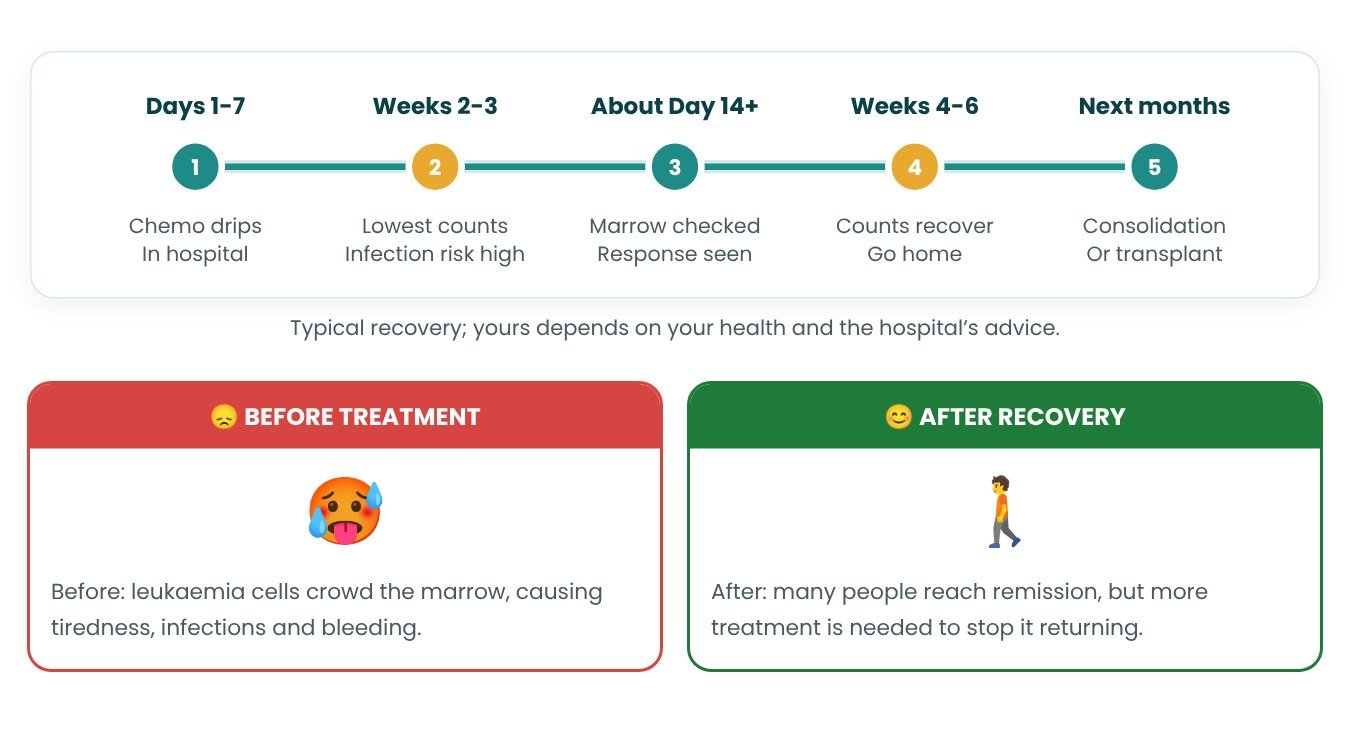
Drawings: Satyug Healthcare (simplified, not to scale). Photos: Wikimedia Commons; author and licence under each photo.
🩺 Who Needs This Treatment
⚠️ Symptoms of AML
- ➤Severe tiredness and weakness
- ➤Pale skin and breathlessness
- ➤Frequent or serious infections
- ➤Fever without clear cause
- ➤Easy bruising or bleeding gums
- ➤Small red spots on the skin
- ➤Bone or joint pain
- ➤Swollen gums or weight loss
🔬 Tests Before Treatment
| Test | Why it is done |
|---|---|
| Complete blood count & peripheral smear | Shows blasts and how low the normal blood cells are. |
| Bone marrow aspiration & biopsy | Confirms AML and measures the percentage of blasts. |
| Flow cytometry | Identifies the exact type of leukaemia cells. |
| Cytogenetics & molecular tests (FLT3, NPM1, CEBPA, etc.) | Decide the risk group and whether targeted drugs are needed. |
| Echocardiogram (2D echo) | Checks heart function before anthracycline drugs. |
| Kidney, liver tests & infection screening | Ensure the body can handle chemotherapy and detect hidden infections. |
| HLA typing (patient and siblings) | Prepares early for a possible bone marrow transplant. |
🏥 The Procedure — Step by Step

⚖️ Induction Treatment Options
| Regimen | What is given | Best for |
|---|---|---|
| 7+3 (cytarabine + daunorubicin/idarubicin) | 7 days cytarabine, 3 days anthracycline | Fit adults with most types of AML |
| 7+3 + midostaurin | Standard 7+3 with oral FLT3 inhibitor | FLT3-mutated AML |
| 7+3 + gemtuzumab ozogamicin | Antibody-drug added to induction | Favourable-risk (CBF) AML |
| CPX-351 (liposomal daunorubicin-cytarabine) | Combined liposomal drug | Secondary or therapy-related AML in older fit adults |
| Azacitidine/decitabine + venetoclax | Lower-intensity tablets and injections | Older or unfit patients |
📅 Your Day-by-Day Plan in India
| Day | What happens |
|---|---|
| Day 1 | Arrival, airport pick-up and urgent haemato-oncology consultation |
| Day 1–3 | Admission, bone marrow test, genetic tests, echo and central line |
| Day 3–10 | Induction chemotherapy (7 days) |
| Day 10–25 | Low-count phase in a protected ward with transfusions and infection care |
| Day 25–30 | Blood counts recover; remission bone marrow test; discharge after about 4 weeks |
| Week 5–6 | Stay near the hospital; plan consolidation or bone marrow transplant |
| Week 6 | If continuing at home, final review and treatment plan – Fly home ✈️ |
🌱 Recovery After Treatment
🏆 Success Rate
| Outcome | Result |
|---|---|
| Complete remission, adults under 60 | About 60–80% |
| Complete remission, fit adults over 60 | About 40–60% |
| Complete remission, children | About 85–90% |
| Treatment-related death during induction | About 3–10%, higher in older or sicker patients |
| 5-year survival (all adults under 60) | About 35–50%, depending on genetic risk |
Results depend mainly on the genetic risk group of the leukaemia, age, general fitness, infection control during low counts and whether consolidation or a bone marrow transplant follows remission.
🩹 Risks & Possible Complications
Induction chemotherapy is intensive. Most side effects are expected and managed by the team.
- •Infection and fever during low counts (febrile neutropenia) – very common, over 80%
- •Need for blood and platelet transfusions – almost all patients
- •Nausea, vomiting, mouth ulcers and diarrhoea – common
- •Hair loss – common and temporary
- •Serious fungal infection – about 5–15%
- •Bleeding due to low platelets – uncommon if platelets are supported
- •Heart damage from anthracyclines – uncommon at standard doses
- •Failure to reach remission – about 20–40%, needing a second induction
💰 Cost of AML Induction Chemotherapy in India
The cost of AML induction chemotherapy in India starts from about USD 15,000. This covers about 4 weeks in hospital in a twin-sharing room, standard 7+3 chemotherapy drugs, routine blood tests, standard transfusions and supportive medicines. Targeted drugs, ICU care, expensive antifungals and extra transfusions add to the cost.
| Option / Hospital tier | Approx. cost (USD) | Hospital stay | Notes |
|---|---|---|---|
| AML induction (7+3) – this package (twin sharing) | 15,000 | 4 weeks | Standard drugs and supportive care |
| Induction in single / HEPA room at premium centre | 18,000 – 25,000 | 4–5 weeks | Private isolation room |
| Induction with targeted drug (midostaurin / gemtuzumab) | 22,000 – 35,000 | 4–5 weeks | Depends on drug and duration |
| Consolidation (high-dose cytarabine) per cycle | 4,000 – 7,000 | 5–10 days | Usually 3–4 cycles |
| Allogeneic bone marrow transplant | 25,000 – 40,000 | 4–6 weeks | If advised after remission |

📋 What the Package Includes
- ✔7+3 induction chemotherapy drugs
- ✔About 4 weeks in twin-sharing room
- ✔Haemato-oncologist fees
- ✔Routine blood tests
- ✔Standard blood & platelet transfusions
- ✔Routine antibiotics & supportive medicines
- ✔Nursing care & meals
- ✖Bone marrow, genetic & molecular tests
- ✖Targeted drugs (midostaurin, gemtuzumab, etc.)
- ✖Expensive antifungals beyond package
- ✖ICU stay
- ✖Extra days beyond 4 weeks
- ✖Consolidation & bone marrow transplant
- ✖Hotel, food & air tickets
✈️ Your Medical Travel Process with Satyug Healthcare

| Step | Details |
|---|---|
| 1. Send reports | Complete blood count with smear, bone marrow report, flow cytometry, cytogenetic and molecular results (FLT3, NPM1, etc.) if done, echo, kidney and liver tests, and a summary of any treatment already given. |
| 2. Free opinion & quotes | Within 48-72 hours you receive opinions and cost estimates from 3-5 leading hospitals to compare. |
| 3. Choose hospital & doctor | We help you compare doctors, success rates, room options and total budget. |
| 4. Medical visa | The hospital issues a Visa Invitation Letter (VIL) to the Indian Embassy. The patient and up to 2 attendants apply for an e-Medical / Medical Attendant visa. |
| 5. Travel planning | Flight guidance, wheelchair assistance, airport pick-up, hotel or guest house near the hospital. |
| 6. Treatment in India | Your coordinator and interpreter stay with you for admission, treatment, discharge and billing. |
| 7. Return & follow-up | Fit-to-fly letter, medicines, and online follow-up with your doctor after you return home. |
🎒 Travel Checklist
- 📌Valid passport (6+ months) for the patient and attendants, plus 10 passport-size photos each
- 📌Medical visa / e-visa and the hospital’s Visa Invitation Letter
- 📌All blood and bone marrow reports, flow cytometry and genetic reports, echo and discharge summaries with prescriptions
- 📌Yellow fever vaccination certificate (mandatory for travellers from African countries)
- 📌Polio vaccination certificate where applicable
- 📌Declare cash above USD 5,000 at the airport; hospitals accept wire transfer and cards
- 📌Foreigners staying longer than permitted must register with the FRRO — our team assists
⭐ Why Choose Satyug Healthcare?
❓ Frequently Asked Questions
➤ What is the cost of AML induction chemotherapy in India?
➤ How long will I stay in India?
➤ What is the chance of remission?
➤ Is induction enough to cure AML?
➤ Why is such a long hospital stay needed?
➤ Will I lose my hair?
➤ What are the main risks?
➤ Can older patients be treated?
➤ Do I need a bone marrow transplant?
➤ Can a family member donate blood?
Medical disclaimer: This page is for general information and does not replace a consultation with a qualified specialist. Treatment plans and costs are confirmed only after the patient is examined. Sources: NCCN Clinical Practice Guidelines: Acute Myeloid Leukemia (2024); European LeukemiaNet (ELN) 2022 recommendations; NCBI StatPearls: Acute Myeloid Leukemia; RATIFY trial (Stone et al., NEJM 2017); American Cancer Society: AML treatment; Mayo Clinic: Acute myelogenous leukemia. Infographics: Satyug Healthcare.
AML induction chemotherapy in India from USD 15,000. 7+3 regimen in leukaemia units, 60-80% remission in adults under 60, 4-week stay at NABH & JCI hospitals.


![Dr. Amit Bhargava [MBBS, Diploma - Radiology Therapy, DNB - Oncology] - Doctor at Satyug Healthcare](https://satyughealthcare.com/uploads/doctors/405437761717.webp)


































































































































































































































































































































































































TOP HOSPITALS
Special High-quality Hospitals


HAPPY PATIENTS
What Our Patients Are Saying
















Our Gallery