Stroke Thrombolysis Package
Assistance
Consultation
Services
Opinion
Care Coordination
What will your treatment cost?

See the cost breakdown by option, hospital and city →
| Surgery Name | Cost | Room | Hospitalization |
|---|---|---|---|
| Stroke Thrombolysis Package | USD 4573 | ICU / Twin Sharing | 5-7 Days in Room |
✓ Inclusion
- ✔Emergency assessment by the stroke neurologist and neuro-interventionist
- ✔Emergency CT brain and CT angiography
- ✔IV thrombolysis and / or catheter-based intra-arterial thrombolysis as per package
- ✔Cath lab procedure charges and standard consumables
- ✔Neuro-interventionist and anaesthetist fees
- ✔Neuro ICU stay with monitoring
- ✔Total 5–7 days hospital stay (ICU and twin-sharing room)
- ✔Repeat brain scan after the procedure
- ✔Routine medicines, IV fluids and nursing care
- ✔In-hospital physiotherapy and speech / swallowing assessment
- ✔Discharge summary with stroke prevention plan
- ✔Free: airport pick-up & drop, visa invitation letter, interpreter & coordinator (Satyug Healthcare)
✗ Exclusion
- ✖Additional thrombectomy devices (stent retrievers, aspiration catheters) beyond package
- ✖Carotid or intracranial stents and balloon angioplasty
- ✖Extra ICU days, ventilator or decompressive craniectomy
- ✖MRI, CT perfusion and advanced tests beyond package
- ✖Treatment of complications such as brain bleeding or pneumonia
- ✖Outpatient rehabilitation after discharge
- ✖Air ambulance, medical escort and wheelchair services
- ✖Medicines after discharge
- ✖Hotel stay, food, local travel, air tickets and visa fees
Know More About Procedure & Surgery
Thrombolysis & Interventional Neuroradiology for Stroke in India
Emergency treatment of acute ischaemic stroke with clot-dissolving medicine and catheter-based clot removal (mechanical thrombectomy), and catheter-directed thrombolysis for brain vein clots – delivered by neuro-interventional teams at 24×7 stroke-ready hospitals in India.
📖 What is Interventional Stroke Thrombolysis?
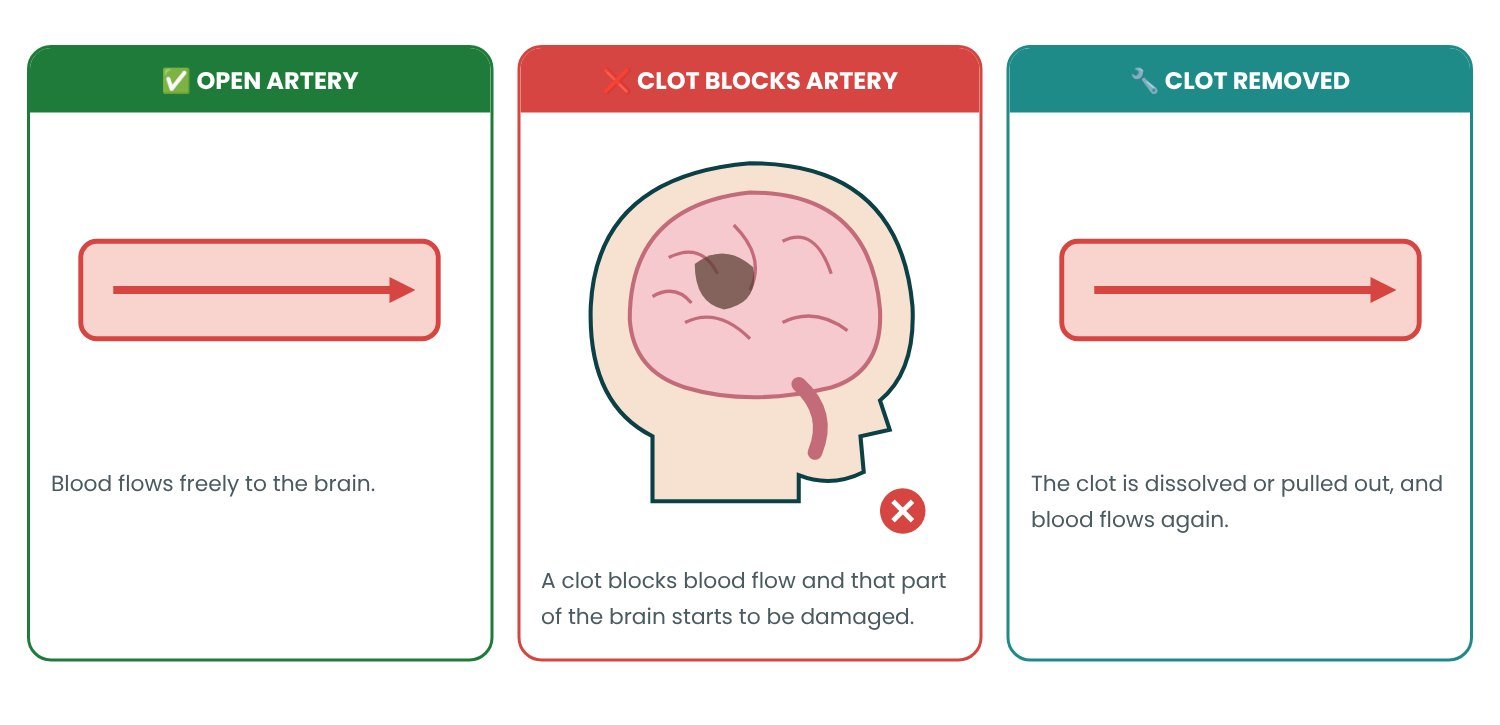
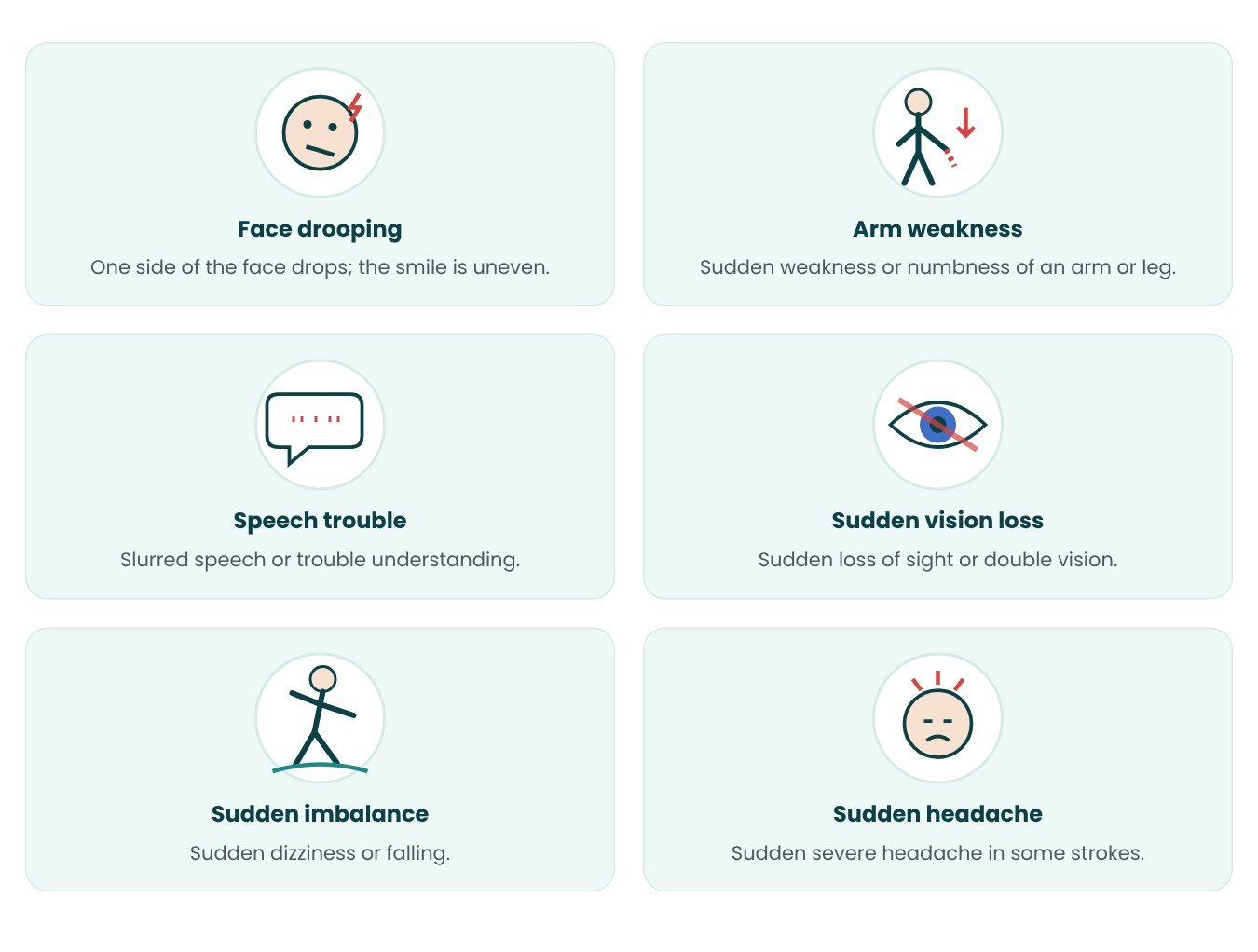
An ischaemic stroke happens when a blood clot blocks an artery that supplies the brain. Brain cells start dying within minutes – about 1.9 million nerve cells are lost every minute in a large stroke. The result can be sudden weakness of one side of the body, a drooping face, slurred speech, loss of vision or loss of balance. A clot can also form in the brain's veins (cerebral venous sinus thrombosis), causing severe headache, seizures and bleeding.
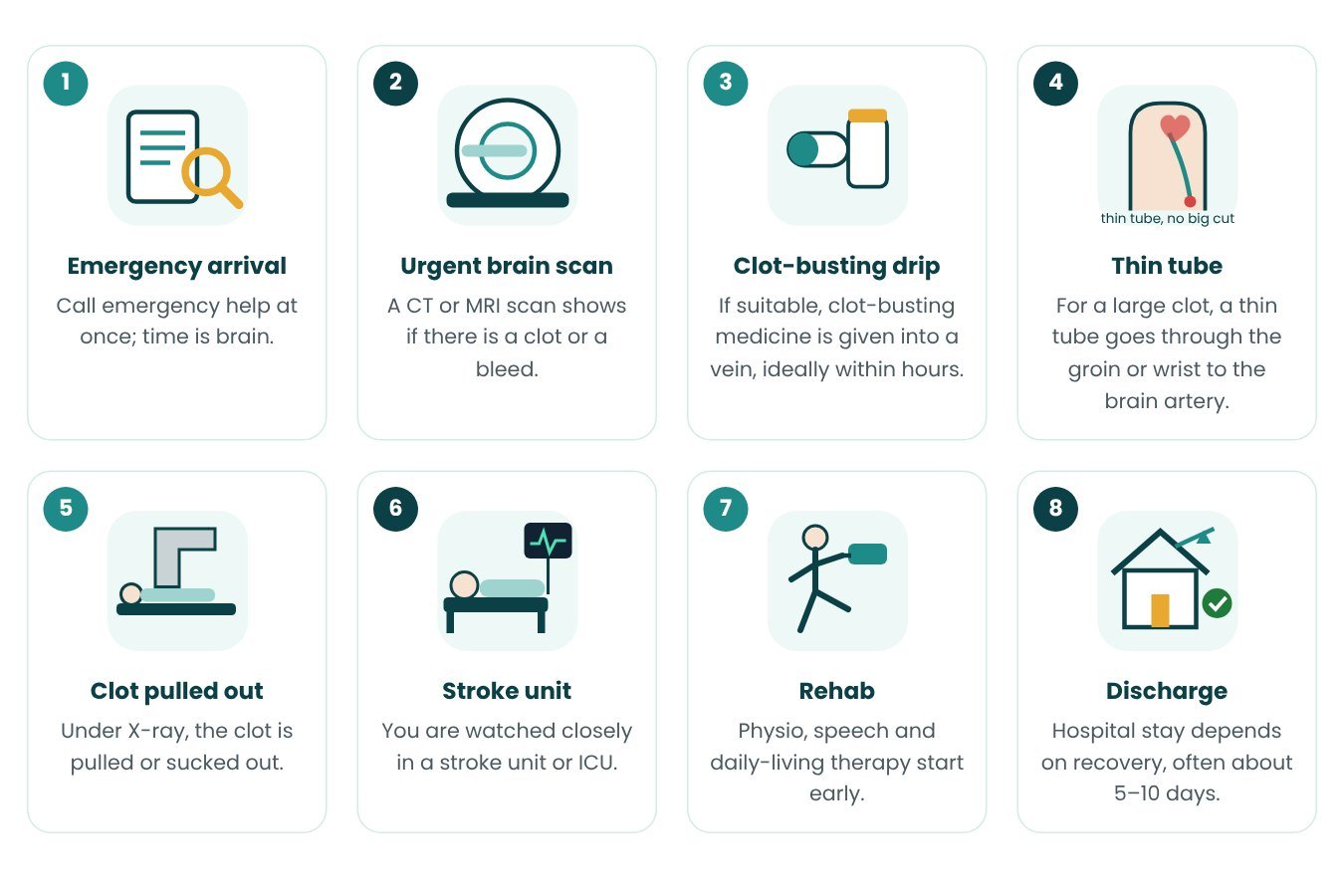
Thrombolysis means dissolving the clot with medicine (alteplase or tenecteplase) given into a vein, ideally within 4.5 hours of stroke onset. In interventional neuroradiology, a specialist passes a thin catheter from the groin or wrist up to the brain under X-ray guidance to remove large clots with a stent retriever or suction device (mechanical thrombectomy), sometimes with medicine given directly into the clot. Thrombectomy can be done up to 24 hours in carefully selected patients. Time is brain – the sooner the artery is opened, the better the recovery.
🖼️ Understand It in Pictures
Open artery vs blocked artery in stroke
👀 Symptoms in Pictures
🩻 Scans & Tests — What Doctors See


🎬 The Treatment Journey in Pictures
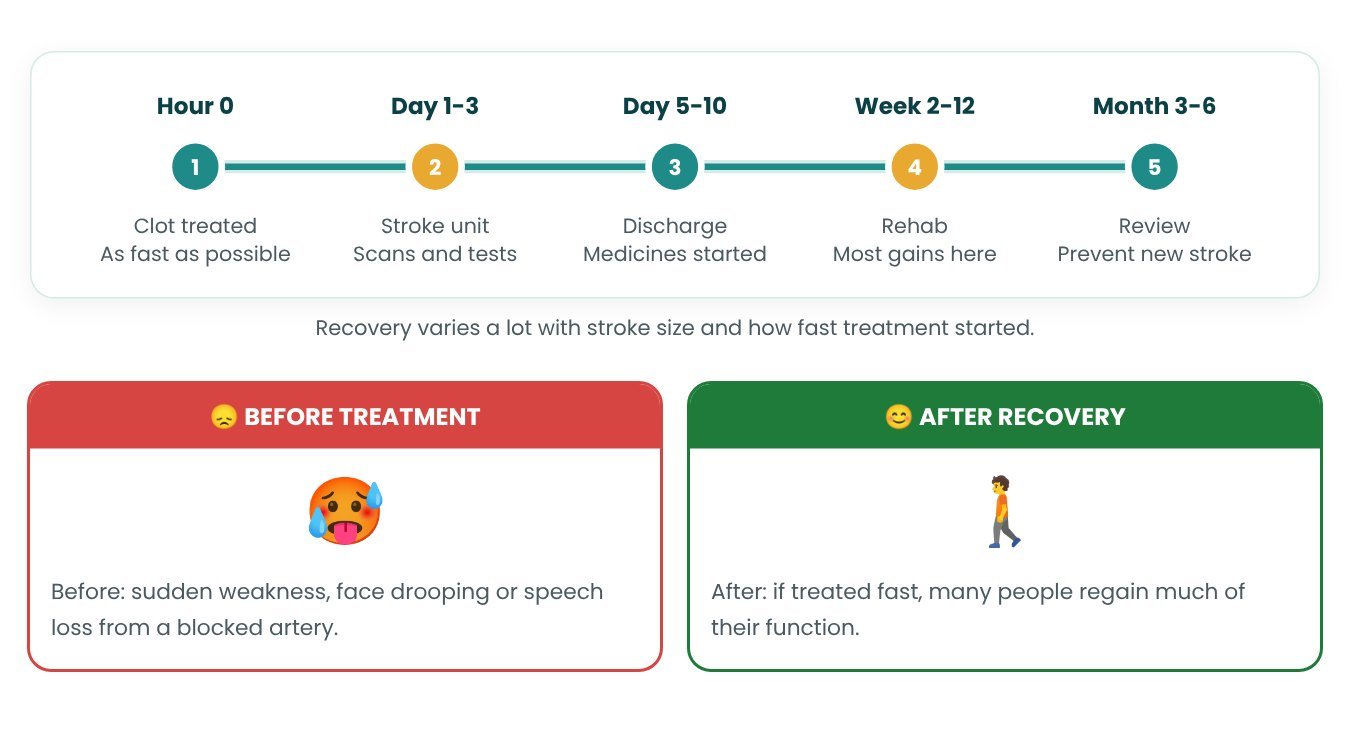
📅 Recovery at a Glance
Drawings: Satyug Healthcare (simplified, not to scale). Photos: Wikimedia Commons; author and licence under each photo.
🩺 Conditions Treated
⚠️ Warning Signs of Stroke (Act FAST)
- ➤Face drooping on one side
- ➤Arm or leg weakness or numbness
- ➤Speech slurred or confused
- ➤Sudden loss of vision
- ➤Sudden loss of balance or dizziness
- ➤Sudden severe headache
- ➤Confusion or trouble understanding
- ➤Time – call emergency services immediately
🔬 Tests Before Treatment
| Test | Why it is done |
|---|---|
| Emergency CT brain | Rules out bleeding in the brain before any clot-busting medicine. |
| CT angiography (CTA) | Shows which artery is blocked and if thrombectomy is needed. |
| CT perfusion or MRI (selected) | Shows how much brain can still be saved, especially after 6 hours. |
| Blood sugar, clotting and blood count | Low sugar can mimic stroke; clotting must be safe for thrombolysis. |
| ECG and heart monitoring | Looks for atrial fibrillation, a common cause of stroke. |
| Echocardiogram and carotid Doppler | Finds the source of the clot to prevent another stroke. |
🏥 The Procedure — Step by Step

⚖️ Treatment Options
| Treatment | What is done | Best for |
|---|---|---|
| IV thrombolysis | Clot-dissolving medicine through a vein | Ischaemic stroke within 4.5 hours, no bleeding |
| Mechanical thrombectomy | Catheter removes clot with stent retriever or aspiration | Large artery blockage, up to 24 hours in selected patients |
| Bridging therapy | IV thrombolysis followed by thrombectomy | Large artery blockage within 4.5 hours |
| Intra-arterial thrombolysis | Medicine given directly into the clot by catheter | Selected cases, residual small clots |
| Catheter-directed venous thrombolysis / thrombectomy | Clot dissolved or removed from brain veins | Cerebral venous thrombosis worsening on blood thinners |
📅 Your Day-by-Day Plan in India
| Day | What happens |
|---|---|
| Day 0 | Emergency arrival, CT scans, IV thrombolysis and / or thrombectomy |
| Day 1–2 | Neuro ICU monitoring, repeat brain scan |
| Day 3–5 | Shift to room, stroke work-up (echo, Doppler, heart monitoring), early physiotherapy and speech therapy |
| Day 5–7 | Discharge after 5–7 day hospital stay with prevention medicines |
| Day 8–18 | Outpatient rehabilitation, neurologist review and fitness-to-fly assessment |
| Day 14–21 | Fly home ✈️ (with medical escort if advised) |
🌱 Recovery After Treatment
🏆 Success Rate
| Outcome | Result |
|---|---|
| Independent at 90 days with thrombectomy (large vessel) | About 46% vs 26.5% without (HERMES) |
| Artery successfully reopened (TICI 2b–3) | About 70–90% |
| Benefit of IV thrombolysis within 3 hours | About 1 in 3 more patients recover with little or no disability (NINDS) |
| Symptomatic brain bleeding after IV thrombolysis | About 2–7% |
| Mortality at 90 days (large vessel, treated) | About 15% |
The single biggest factor is time from stroke onset to treatment. Stroke severity, age, the size of the blocked artery, blood sugar and overall health also strongly affect recovery.
🩹 Risks & Possible Complications
Stroke treatment carries real risks, but in suitable patients the benefits clearly outweigh them.
- •Bleeding in the brain – about 2–7% after IV thrombolysis, about 4–6% after thrombectomy
- •Bleeding elsewhere, such as gums, urine or the groin puncture site
- •Damage to the artery during thrombectomy – uncommon
- •Clot moving to a new area of the brain – uncommon
- •Allergic swelling (angio-oedema) with clot-busting drugs – rare
- •Contrast-related kidney injury – uncommon
- •Brain swelling after large strokes
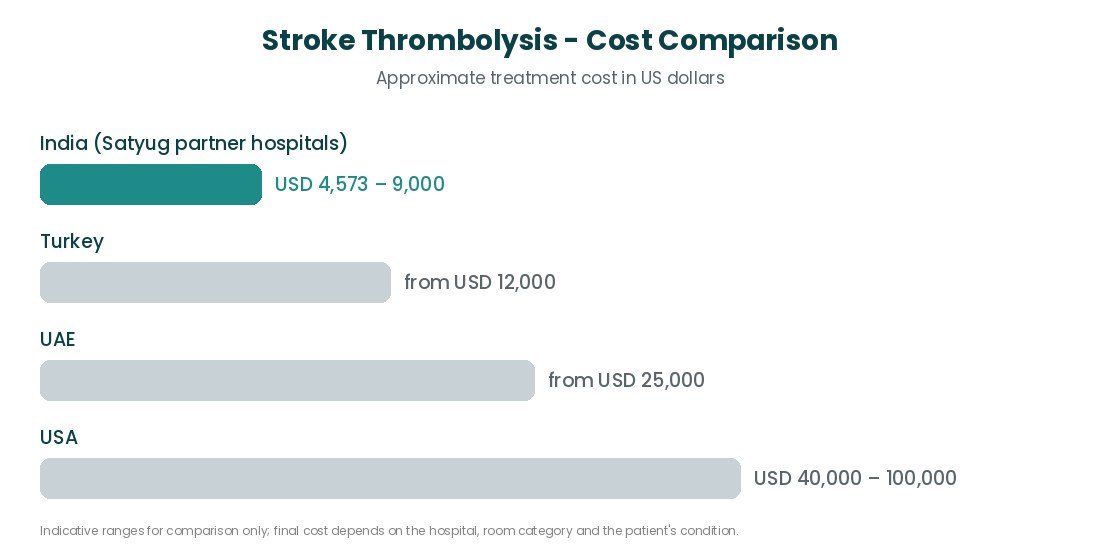
💰 Cost of Stroke Thrombolysis in India
The cost of interventional stroke thrombolysis in India starts from about USD 4,573 for this package, with ICU and twin-sharing room stay for 5–7 days. The final cost depends mainly on whether mechanical thrombectomy devices are used, the number of devices, the drug used (alteplase or tenecteplase) and the length of ICU stay.
| Option / Hospital tier | Approx. cost (USD) | Hospital stay | Notes |
|---|---|---|---|
| Interventional thrombolysis (this package) – ICU / twin sharing | From 4,573 | 5–7 days | Neuro-intervention and ICU care |
| IV thrombolysis only | 1,500 – 3,000 | 4–6 days | Drug cost forms a large part |
| Mechanical thrombectomy (stent retriever / aspiration) | 6,000 – 9,000 | 5–7 days | Device cost varies; more passes cost more |
| Thrombectomy with carotid stent (tandem lesion) | 8,000 – 11,000 | 6–8 days | Extra stent and devices |
📋 What the Package Includes
- ✔Neuro-interventionist and stroke team fees
- ✔Emergency CT and CT angiography
- ✔Cath lab procedure charges
- ✔Standard consumables
- ✔ICU stay and twin-sharing room (5–7 days total)
- ✔Routine medicines and monitoring
- ✔In-hospital physiotherapy
- ✔Discharge summary and prevention plan
- ✖Thrombectomy devices beyond package
- ✖Carotid or intracranial stents
- ✖Extra ICU days or ventilator
- ✖Decompressive surgery if needed
- ✖Outpatient rehabilitation
- ✖Air ambulance or medical escort
- ✖Hotel stay and flights
- ✖Medicines after discharge
✈️ Your Medical Travel Process with Satyug Healthcare

| Step | Details |
|---|---|
| 1. Send reports | For emergency help, call our helpline immediately with the patient's location and time of stroke onset. For planned follow-up or second opinion: CT / MRI brain and angiography images, discharge summary, ECG, echocardiogram, carotid Doppler and current medicine list. |
| 2. Free opinion & quotes | Within 48-72 hours you receive opinions and cost estimates from 3-5 leading hospitals to compare. |
| 3. Choose hospital & doctor | We help you compare doctors, success rates, room options and total budget. |
| 4. Medical visa | The hospital issues a Visa Invitation Letter (VIL) to the Indian Embassy. The patient and up to 2 attendants apply for an e-Medical / Medical Attendant visa. |
| 5. Travel planning | Flight guidance, wheelchair assistance, airport pick-up, hotel or guest house near the hospital. |
| 6. Treatment in India | Your coordinator and interpreter stay with you for admission, treatment, discharge and billing. |
| 7. Return & follow-up | Fit-to-fly letter, medicines, and online follow-up with your doctor after you return home. |
🎒 Travel Checklist
- 📌Valid passport (6+ months) for the patient and attendants, plus 10 passport-size photos each
- 📌Medical visa / e-visa and the hospital’s Visa Invitation Letter
- 📌All CT / MRI brain and angiography reports, scans on CD / link, discharge summary and prescriptions
- 📌Yellow fever vaccination certificate (mandatory for travellers from African countries)
- 📌Polio vaccination certificate where applicable
- 📌Declare cash above USD 5,000 at the airport; hospitals accept wire transfer and cards
- 📌Foreigners staying longer than permitted must register with the FRRO — our team assists
⭐ Why Choose Satyug Healthcare?
❓ Frequently Asked Questions
➤ How much does stroke thrombolysis cost in India?
➤ Can I travel to India for stroke thrombolysis?
➤ What is the time window for treatment?
➤ How long is the hospital stay?
➤ What is the success rate?
➤ What are the risks?
➤ Is the procedure painful?
➤ Will I recover fully?
➤ When can I fly home after a stroke?
➤ Can elderly patients be treated?
Medical disclaimer: This page is for general information and does not replace a consultation with a qualified specialist. Treatment plans and costs are confirmed only after the patient is examined. Sources: AHA/ASA Guidelines for the Early Management of Acute Ischemic Stroke (2019 update); ESO-ESMINT guidelines on mechanical thrombectomy (2019, 2023); HERMES meta-analysis (Goyal et al., Lancet 2016); NINDS rt-PA Stroke Study (NEJM 1995); DAWN and DEFUSE-3 trials (NEJM 2018); NCBI StatPearls: Acute Stroke and Thrombolytic Therapy; NHS; Mayo Clinic. Infographics: Satyug Healthcare.
Stroke thrombolysis and mechanical thrombectomy in India from USD 4,573 – 24×7 neuro-intervention teams, ICU care and rehab support at NABH & JCI hospitals.




TOP HOSPITALS
Special High-quality Hospitals


HAPPY PATIENTS
What Our Patients Are Saying