CyberKnife Radiosurgery Package
Assistance
Consultation
Services
Opinion
Care Coordination
What will your treatment cost?

See the cost breakdown by option, hospital and city →
| Surgery Name | Cost | Room | Hospitalization |
|---|---|---|---|
| CyberKnife Radiosurgery Package | 6600 USD | OPD | OPD Basis |
| Cyber Knife therapy Single session - approx. | 5500 USD | OPD Basis | OPD Basis |
✓ Inclusion
- ✔Consultation with radiation oncologist and neurosurgeon
- ✔Review of MRI, CT and biopsy reports
- ✔Custom thermoplastic face mask for head immobilisation
- ✔Treatment planning CT scan with MRI image fusion
- ✔Computer dose planning by medical physicists and quality assurance check
- ✔Three CyberKnife radiosurgery sessions on OPD basis (30–90 minutes each)
- ✔Doctor review after each session and at the end of treatment
- ✔Standard medicines used during sessions
- ✔Treatment summary and dose report for your home doctor
- ✔Online follow-up review of your post-treatment MRI
- ✔Free: airport pick-up & drop, visa invitation letter, interpreter & coordinator (Satyug Healthcare)
✗ Exclusion
- ✖Hotel or guest-house accommodation and food
- ✖Flights, visa fees and travel insurance
- ✖Additional MRI, PET-CT or blood tests not part of planning
- ✖Fiducial marker placement (if needed for non-brain targets)
- ✖Biopsy, open surgery or shunt surgery
- ✖Chemotherapy, immunotherapy or targeted drugs
- ✖Take-home medicines such as steroids and anti-seizure tablets
- ✖Hospital admission and ICU care for any complication
- ✖Extra sessions beyond three, or treatment of additional tumours
Know More About Procedure & Surgery
CyberKnife Radiosurgery for Brain Tumours in India
Painless robotic radiosurgery for small brain tumours, brain metastases, acoustic neuromas, meningiomas and AVMs – planned by neurosurgeons and radiation oncologists at India's leading accredited cancer centres, at a fraction of US or European cost.
📖 What is CyberKnife Radiosurgery?
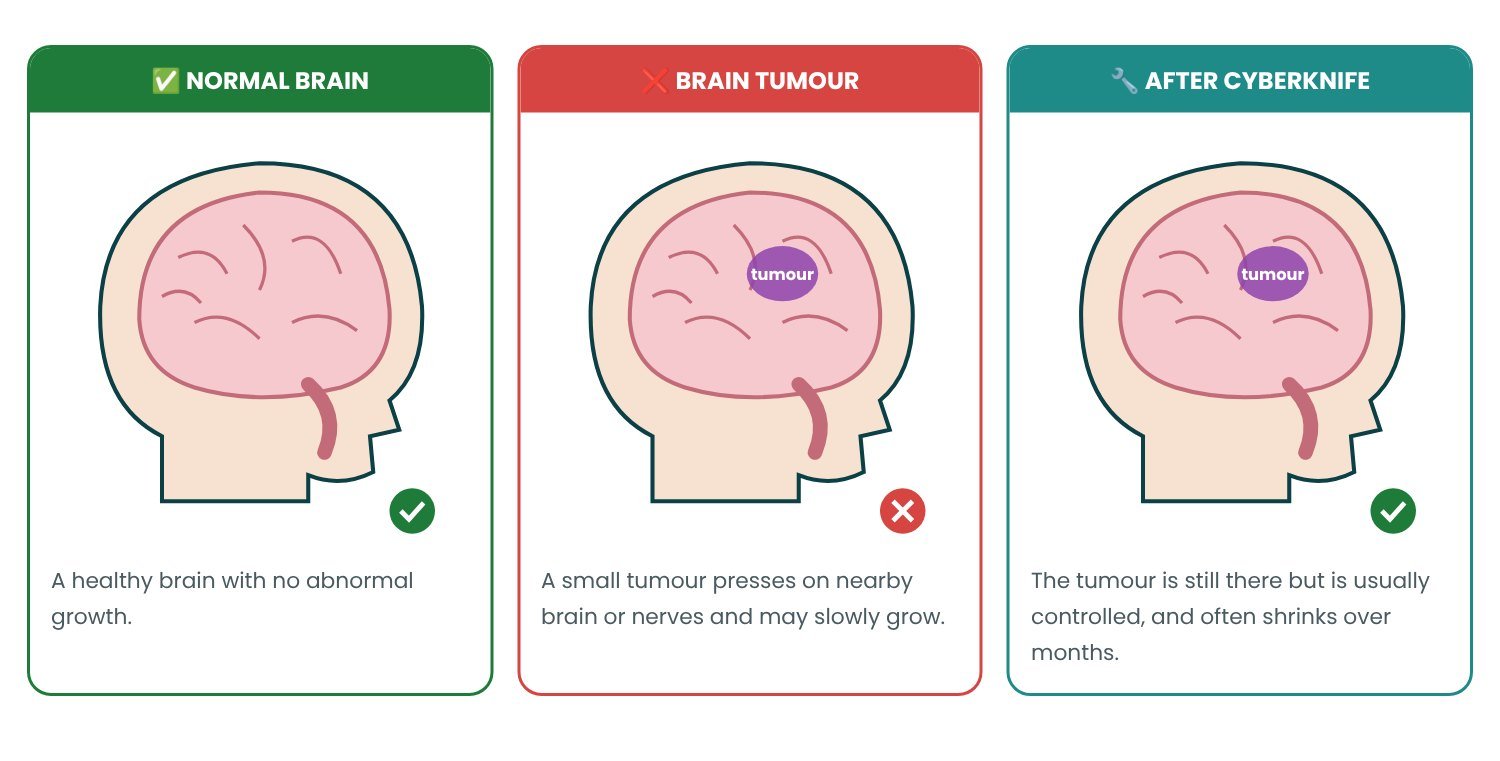
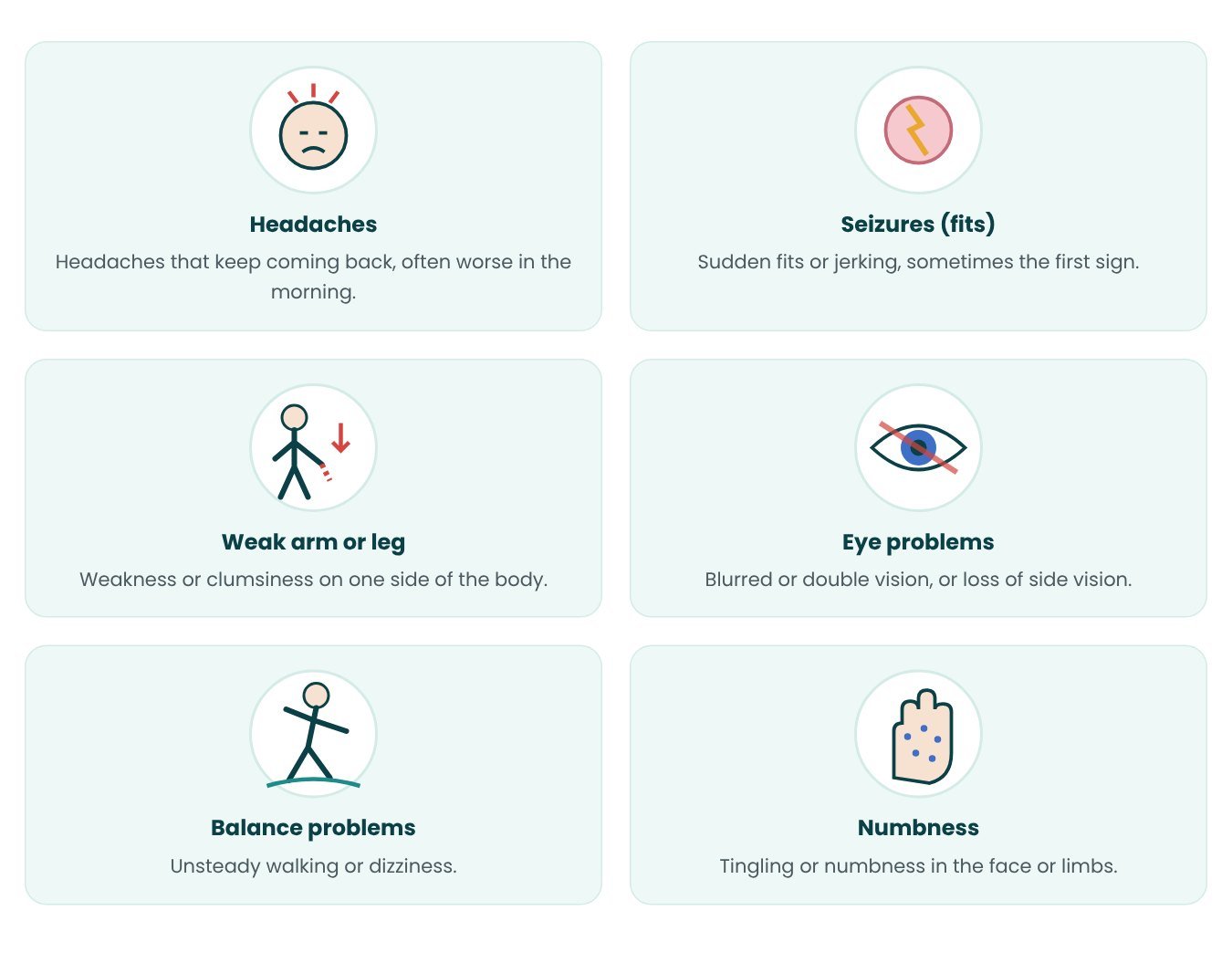
A brain tumour is an abnormal growth of cells inside the skull. Some are benign (not cancer), such as meningioma, acoustic neuroma (vestibular schwannoma) and pituitary adenoma. Others are cancer, such as tumours that spread to the brain from the lung or breast (brain metastases). Even a benign tumour can press on nerves and brain tissue and cause headache, hearing loss, weakness or fits.
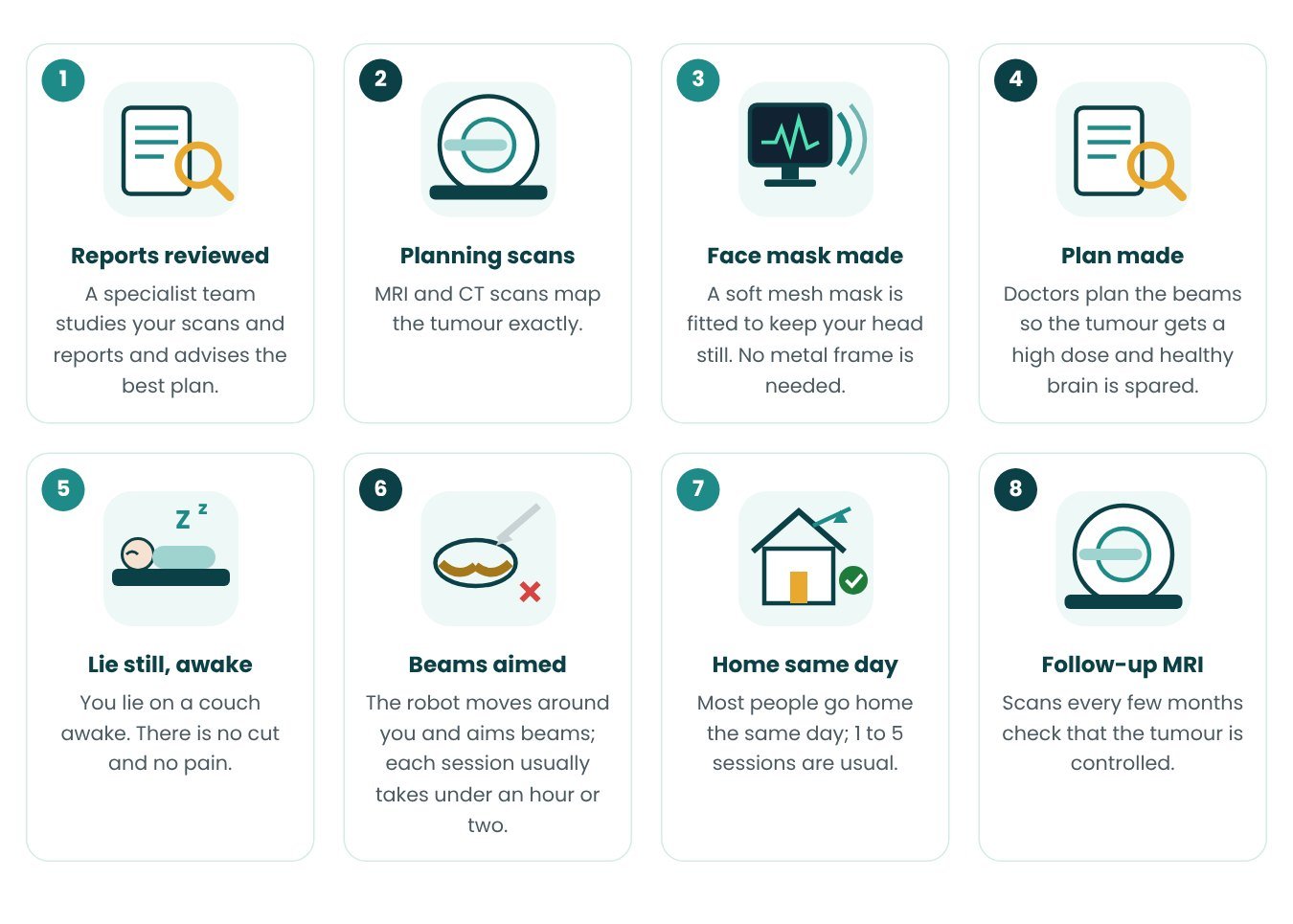
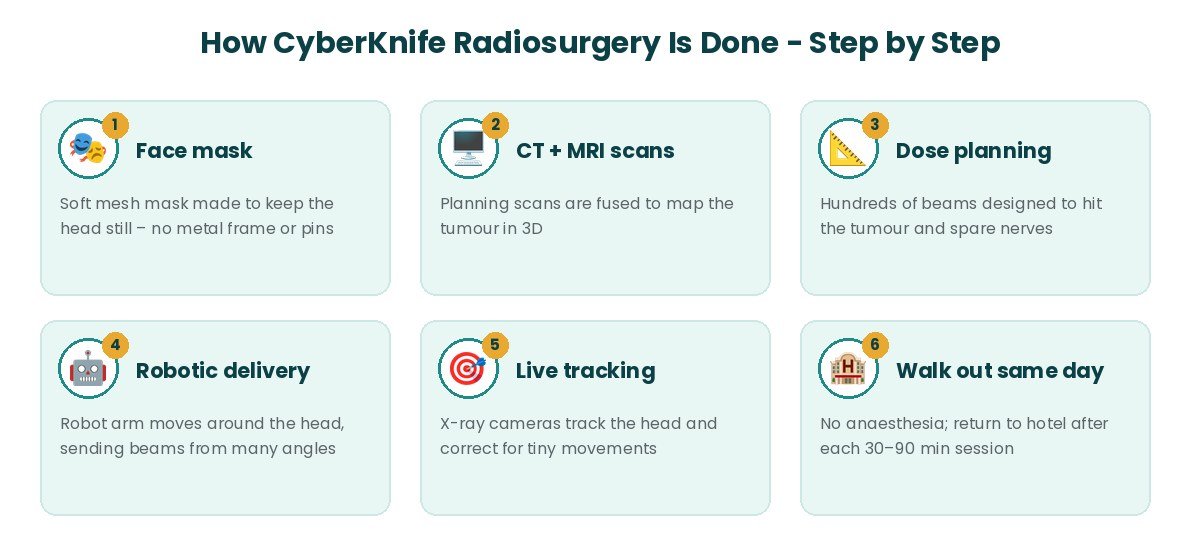
CyberKnife is a type of stereotactic radiosurgery (SRS). It is not a knife and there is no cut. A small linear accelerator on a robotic arm sends hundreds of thin, very precise radiation beams from many angles that meet at the tumour. The tumour gets a high dose, while the normal brain around it gets very little. A soft mesh face mask is used instead of a metal head frame, and the robot tracks and corrects for small head movements during treatment. Treatment is given in 1 session (radiosurgery) or 2–5 sessions (called fractionated SRS or hypofractionated SRT) on an outpatient basis. This package covers three sessions, often chosen for larger tumours or tumours near the optic nerve or brainstem.
🖼️ Understand It in Pictures
Brain tumour before and after CyberKnife
👀 Symptoms in Pictures
🩻 Scans & Tests — What Doctors See


🎬 The Treatment Journey in Pictures
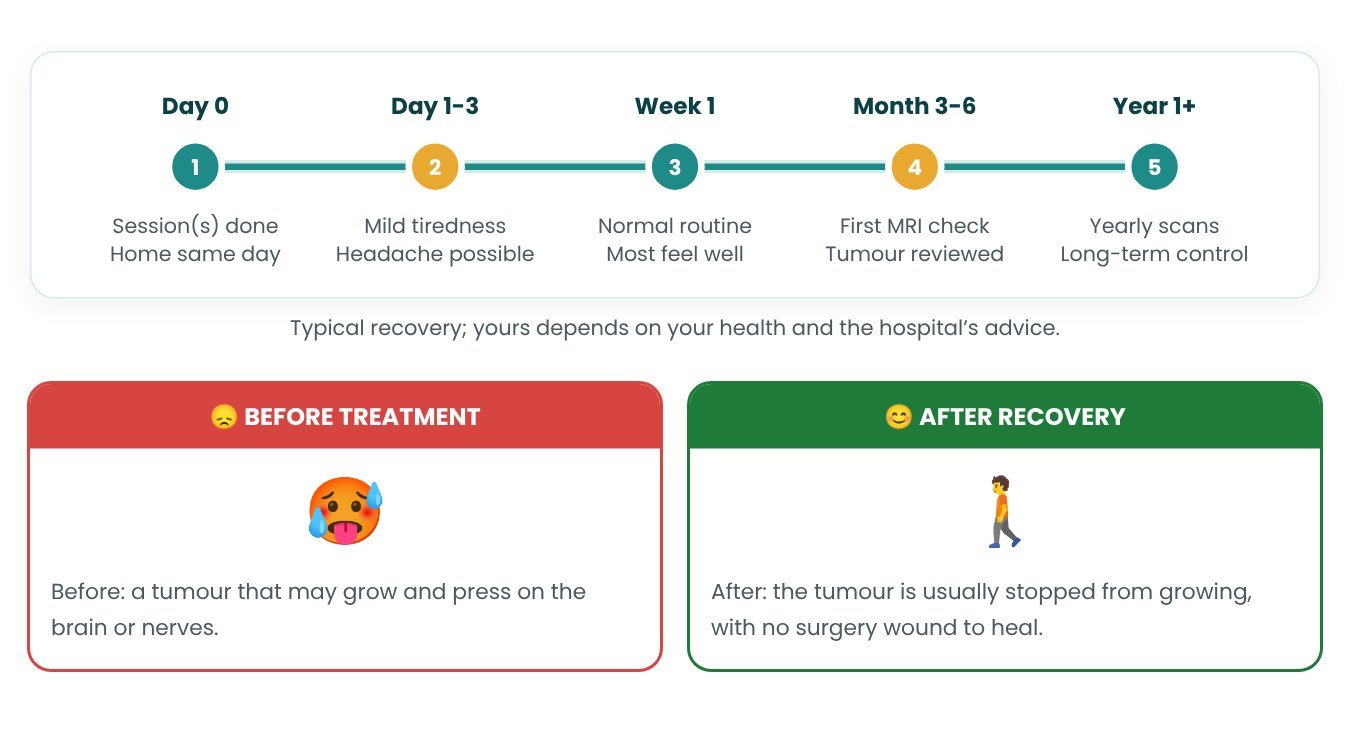
📅 Recovery at a Glance
Drawings: Satyug Healthcare (simplified, not to scale). Photos: Wikimedia Commons; author and licence under each photo.
🩺 Conditions Treated
⚠️ Signs That May Need Treatment
- ➤Headaches that are new or getting worse
- ➤Fits (seizures)
- ➤Hearing loss or ringing in one ear
- ➤Problems with balance or dizziness
- ➤Blurred or double vision, or loss of side vision
- ➤Weakness or numbness of face, arm or leg
- ➤Changes in memory, speech or behaviour
- ➤Small tumour found on MRI that is growing
🔬 Tests Before Treatment
| Test | Why it is done |
|---|---|
| Contrast MRI brain (thin slices) | Shows the exact size, shape and position of the tumour for planning. |
| Planning CT scan with face mask | Gives precise bone and position data; it is fused with the MRI by the planning computer. |
| Biopsy / histopathology report (if done) | Confirms the type of tumour, which decides the radiation dose. |
| PET-CT (for cancer patients) | Checks the cancer elsewhere in the body before planning brain treatment. |
| Hearing test, eye field test (as needed) | Records hearing for acoustic neuroma and vision for tumours near the optic nerve. |
| Blood tests (CBC, kidney function) | Make sure contrast dye and steroid medicines are safe. |
🏥 The Procedure — Step by Step
⚖️ Types & Techniques
| Option | What is done | Best for |
|---|---|---|
| Single-session SRS (CyberKnife) | One high-dose session | Small tumours (usually under 2.5–3 cm) away from the optic nerve |
| 3-session CyberKnife (this package) | Dose split into three daily sessions | Larger tumours, or tumours near the optic nerve or brainstem |
| 5-session SRT | Dose split into five sessions | Bigger or more sensitive locations; also post-surgery tumour bed |
| Gamma Knife | Cobalt-based radiosurgery, often with a head frame | Small brain targets, trigeminal neuralgia, AVMs |
| Open microsurgery | Tumour removed through a skull opening | Large tumours, pressure on brain, or when tissue diagnosis is needed |
📅 Your Day-by-Day Plan in India
| Day | What happens |
|---|---|
| Day 1 | Arrival in India, airport pick-up, hotel check-in |
| Day 2 | Consultation with radiation oncologist and neurosurgeon; mask making and planning CT/MRI |
| Day 3–5 | Treatment planning and quality checks (you rest at the hotel) |
| Day 5–7 | CyberKnife sessions 1, 2 and 3 (outpatient, 30–90 min each) |
| Day 8–9 | Final review, steroid plan and discharge summary |
| Day 10 | Fly home ✈️ |
🌱 Recovery After Treatment
🏆 Success Rate
| Outcome | Result |
|---|---|
| Acoustic neuroma – tumour control at 5–10 years | About 90–95% |
| Meningioma – tumour control at 5 years | About 85–95% |
| Brain metastasis – local control at 1 year | About 70–90% (depends on size and cancer type) |
| AVM closure at 3 years | About 70–80% (smaller AVMs do better) |
| Hearing kept (acoustic neuroma, at 5 years) | About 50–70% |
Results depend on tumour type, size and location, how much radiation the nearby nerves can safely take, and – for cancer – how well the cancer is controlled in the rest of the body.
🩹 Risks & Possible Complications
CyberKnife is non-invasive, but radiation can still cause side effects.
- •Tiredness, mild headache or nausea for a few days (common)
- •Brain swelling (oedema) causing temporary symptoms – usually helped by steroids
- •Small patch of hair loss at the beam entry area
- •Radiation necrosis (dead tissue at the treated spot): about 5–10% for metastases, more with larger targets
- •Gradual hearing loss after acoustic neuroma treatment
- •Face numbness or weakness near the treated nerve (rare, about 1–5%)
- •Fits (seizures) in patients with tumours near the brain surface (uncommon)
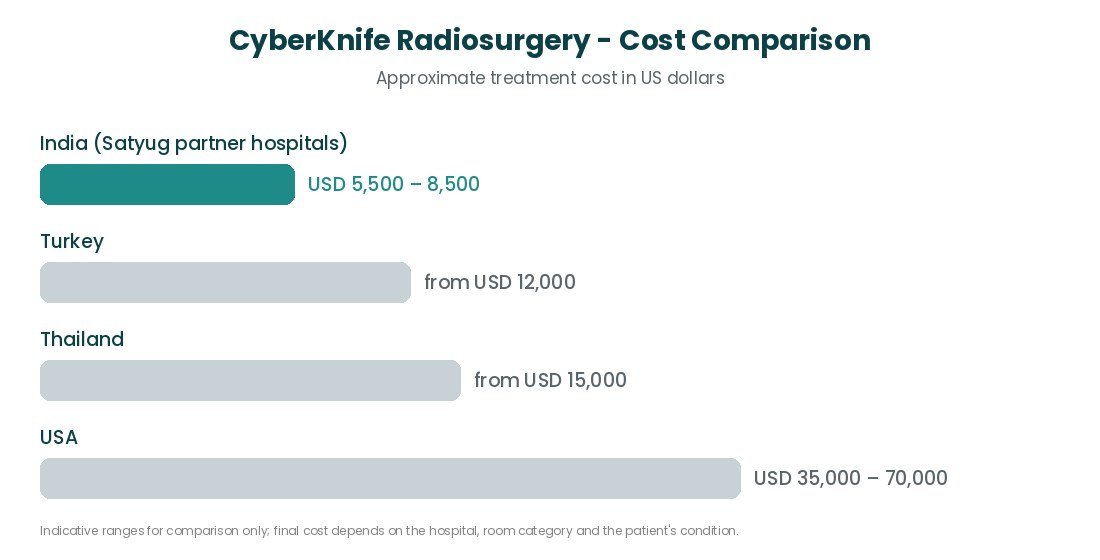
💰 Cost of CyberKnife Radiosurgery in India
The cost of CyberKnife radiosurgery for a brain tumour in India starts from about USD 6,600 for a three-session course on an outpatient (OPD) basis. A single-session treatment costs about USD 5,500. The package covers consultation, mask making, planning CT/MRI fusion, physics planning and the treatment sessions.
| Option / Hospital tier | Approx. cost (USD) | Hospital stay | Notes |
|---|---|---|---|
| CyberKnife – three sessions (this package) | 6,600 | OPD basis | Larger tumours or tumours near the optic nerve/brainstem |
| CyberKnife – single session | 5,500 | OPD basis | Small tumours, single metastasis |
| CyberKnife – five sessions | 7,000 – 8,500 | OPD basis | Larger or post-surgery targets |
| Gamma Knife (frame-based) | 5,000 – 7,000 | Day care | Small targets, AVM, trigeminal neuralgia |
📋 What the Package Includes
- ✔Radiation oncologist & neurosurgeon consultation
- ✔Thermoplastic face mask
- ✔Planning CT and MRI image fusion
- ✔Physics planning & quality check
- ✔Three CyberKnife sessions
- ✔Review after treatment & summary report
- ✔Free airport pick-up & coordinator
- ✖Hotel / guest-house stay
- ✖Fresh MRI or PET-CT beyond planning scans
- ✖Biopsy or open surgery
- ✖Chemotherapy or targeted drugs
- ✖Steroid and other take-home medicines
- ✖Admission if complications occur
- ✖Flights and visa fees
✈️ Your Medical Travel Process with Satyug Healthcare

| Step | Details |
|---|---|
| 1. Send reports | Latest contrast MRI brain (within 4–6 weeks) with report, any CT or PET-CT, biopsy/histopathology report, operation notes if surgery was done, and a summary of cancer treatment received so far. |
| 2. Free opinion & quotes | Within 48-72 hours you receive opinions and cost estimates from 3-5 leading hospitals to compare. |
| 3. Choose hospital & doctor | We help you compare doctors, success rates, room options and total budget. |
| 4. Medical visa | The hospital issues a Visa Invitation Letter (VIL) to the Indian Embassy. The patient and up to 2 attendants apply for an e-Medical / Medical Attendant visa. |
| 5. Travel planning | Flight guidance, wheelchair assistance, airport pick-up, hotel or guest house near the hospital. |
| 6. Treatment in India | Your coordinator and interpreter stay with you for admission, treatment, discharge and billing. |
| 7. Return & follow-up | Fit-to-fly letter, medicines, and online follow-up with your doctor after you return home. |
🎒 Travel Checklist
- 📌Valid passport (6+ months) for the patient and attendants, plus 10 passport-size photos each
- 📌Medical visa / e-visa and the hospital’s Visa Invitation Letter
- 📌All MRI brain and PET-CT scans (DICOM on CD / link), biopsy reports, discharge summaries and current prescriptions
- 📌Yellow fever vaccination certificate (mandatory for travellers from African countries)
- 📌Polio vaccination certificate where applicable
- 📌Declare cash above USD 5,000 at the airport; hospitals accept wire transfer and cards
- 📌Foreigners staying longer than permitted must register with the FRRO — our team assists
⭐ Why Choose Satyug Healthcare?
❓ Frequently Asked Questions
➤ How much does CyberKnife for a brain tumour cost in India?
➤ Is CyberKnife painful?
➤ How many sessions will I need?
➤ How long do I need to stay in India?
➤ Do I need to stay in hospital?
➤ Does the tumour disappear after treatment?
➤ What is the success rate?
➤ What side effects can happen?
➤ When can I go back to work?
➤ Is CyberKnife better than Gamma Knife?
➤ Can I have CyberKnife after brain surgery?
➤ Can children or elderly patients have CyberKnife?
Medical disclaimer: This page is for general information and does not replace a consultation with a qualified specialist. Treatment plans and costs are confirmed only after the patient is examined. Sources: NCBI StatPearls: Stereotactic Radiosurgery; Mayo Clinic: Stereotactic radiosurgery; Cleveland Clinic: CyberKnife; NHS: Acoustic neuroma treatment; Yamamoto et al., JLGK0901 study, Lancet Oncology 2014; International Stereotactic Radiosurgery Society (ISRS) practice guidelines; ASTRO brain metastases guideline 2022. Infographics: Satyug Healthcare.
Frequently Asked Questions
CyberKnife controls the growth of many suitable brain tumours and metastases, meaning the tumour shrinks or stops growing. Results depend on the tumour type, size and location; your radiation oncologist will explain the expected outcome for your case.
CyberKnife radiosurgery for brain tumours in India from USD 6,600 (3 sessions). No cut, no anaesthesia, OPD treatment at JCI hospitals. Free opinion in 48 h.





TOP HOSPITALS
Special High-quality Hospitals


HAPPY PATIENTS
What Our Patients Are Saying






























Our Gallery