Assistance
Consultation
Services
Opinion
Care Coordination
What will your treatment cost?
Middle Cerebral Artery (MCA) Infarct Treatment in India
Released Date: 2026-05-12
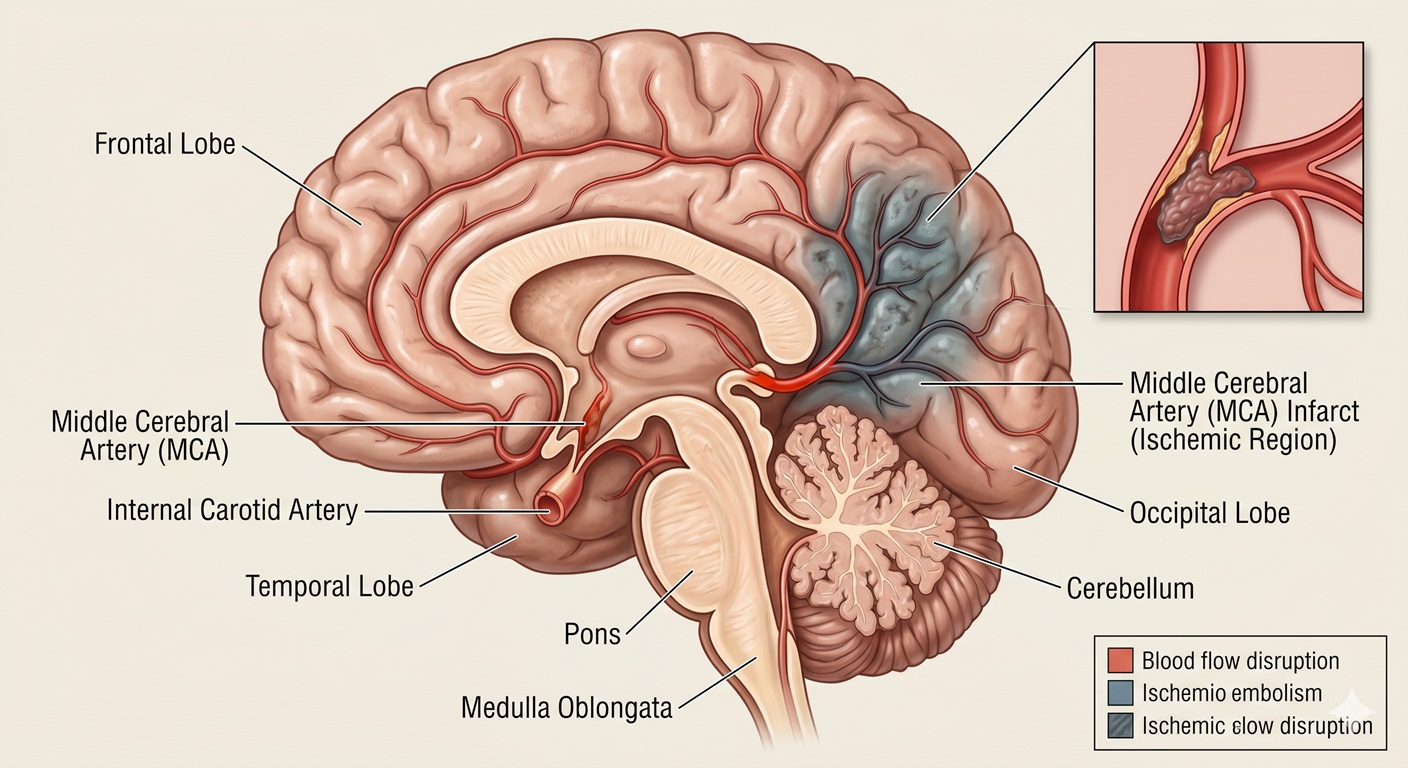
🧠 Middle Cerebral Artery (MCA) Infarct Treatment in India
Acute Stroke Care · Thrombolysis · Mechanical Thrombectomy · Neuro-ICU · Rehabilitation
A Middle Cerebral Artery (MCA) infarct is the most common and most disabling type of ischaemic stroke worldwide. The MCA is the largest of the three major arteries that supply blood to the brain, feeding critical regions that control movement, speech, sensation and higher cognitive function. When this artery becomes blocked, brain tissue begins to die within minutes — making MCA infarct one of the most time-critical medical emergencies in neurology.
India has emerged as one of the world's leading destinations for stroke care. Top Indian hospitals now offer 24x7 stroke-ready emergency units, intravenous thrombolysis, mechanical thrombectomy, neuro-ICU care and decompressive craniectomy at JCI/NABH accredited centres — at a cost 60–80% lower than the USA, UK or Europe.
🩺 What is a Middle Cerebral Artery (MCA) Infarct?
The Middle Cerebral Artery is a major branch of the internal carotid artery that supplies blood to a large portion of the cerebral cortex — including the lateral surface of the frontal, parietal and temporal lobes, and deep structures like the basal ganglia and internal capsule. An MCA infarct occurs when blood flow through this artery is suddenly interrupted, depriving brain tissue of oxygen and nutrients.
🔴 Ischaemic Stroke
~85% of cases — caused by a blood clot (thrombus or embolus) blocking the MCA
🟣 Haemorrhagic Stroke
Caused by rupture of the MCA or its branches, leading to bleeding into brain tissue
⚠️ Important: The MCA is the most commonly affected artery in acute stroke. Massive strokes can be life-threatening due to brain swelling — a condition known as malignant MCA infarction.
⚡ Causes and Risk Factors
🔴 Common Causes
- Atherosclerosis — plaque build-up in the carotid or cerebral arteries
- Cardio-embolism — clots from the heart (atrial fibrillation, mitral valve disease, recent MI)
- Small vessel disease — lacunar infarcts from chronic hypertension and diabetes
- MCA dissection — a tear in the arterial wall
- Hypercoagulable states — thrombophilia, cancer-related clotting disorders
- Vasculitis or infections — inflammation of cerebral arteries
🔶 Modifiable Risk Factors
- High blood pressure (#1 risk factor)
- Diabetes mellitus
- High cholesterol
- Smoking & tobacco use
- Obesity & sedentary lifestyle
- Heavy alcohol consumption
- Atrial fibrillation
🔷 Non-Modifiable Risk Factors
- Age above 55 years (risk doubles every decade)
- Family history of stroke
- Prior stroke or TIA
- Male sex (younger age groups)
🚨 Signs and Symptoms of an MCA Infarct
MCA infarct symptoms are sudden in onset and almost always affect one side of the body — opposite to the affected brain hemisphere. Recognising these signs early can save a life.
- 💪 Sudden weakness or paralysis on one side of the body (hemiparesis/hemiplegia) — face, arm and leg
- 😟 Facial droop — one side of the mouth drooping when smiling
- 🗣️ Speech difficulties — slurred speech (dysarthria) or aphasia
- ✋ Sensory loss — numbness on one side of the body
- 👁️ Visual disturbances — homonymous hemianopia or gaze deviation
- 🧭 Neglect — ignoring one side of the body (most common in right MCA strokes)
- 😵 Confusion or altered consciousness in larger strokes
- 🤕 Severe headache, nausea or vomiting with brain swelling or haemorrhagic transformation
⏰ Remember BE-FAST
Balance · Eye changes · Face drooping · Arm weakness · Speech difficulty · Time to call emergency
⏳ Time is brain — every minute counts
⚖️ Left MCA vs Right MCA Infarct
🔬 Diagnosis — How an MCA Infarct is Confirmed
Rapid diagnosis is essential — the therapeutic window is just hours. India's top stroke centres follow international guidelines with door-to-needle times under 60 minutes.
First imaging test — rules out haemorrhage, shows early ischaemic changes
Identifies exact occlusion site (M1, M2) & collaterals
Distinguishes infarct core from salvageable penumbra
Most sensitive test for acute infarction
Non-invasive cerebral vessel imaging
Evaluates carotid stenosis as embolic source
Detects cardiac sources of emboli (TTE/TEE)
CBC, coagulation, sugar, lipids, renal function
💊 Treatment of MCA Infarct in India
Treatment depends on time from symptom onset, severity, and whether the infarct is small, moderate or malignant. Indian stroke centres offer the complete spectrum of care.
1 💉 Intravenous Thrombolysis (IV tPA / Alteplase)
For eligible patients within 4.5 hours of symptom onset, intravenous recombinant tissue plasminogen activator (alteplase 0.9 mg/kg) is the first-line treatment. It dissolves the clot and can dramatically improve neurological recovery. Newer agents like tenecteplase (TNK) are increasingly used at advanced Indian centres.
2 🔧 Mechanical Thrombectomy (Endovascular Treatment)
For large vessel occlusions of the proximal MCA (M1) or terminal internal carotid artery, mechanical thrombectomy physically removes the clot using a stent retriever or aspiration catheter. Performed within up to 24 hours in selected patients. Major Indian centres routinely achieve TICI 2b-3 recanalisation rates above 85%.
3 🏥 Stroke Unit and Neuro-ICU Care
All MCA infarct patients are managed in dedicated stroke units or neuro-ICUs with:
- Continuous BP, oxygen, heart rhythm and neurological monitoring
- Antiplatelet (aspirin, clopidogrel) or anticoagulation therapy
- Statin therapy for plaque stabilisation
- Strict glucose, temperature and BP control
- Prevention of pneumonia, DVT, pressure sores
- Early swallow assessment before oral feeding
4 🧠 Decompressive Hemicraniectomy (DHC)
A massive MCA stroke can cause severe brain swelling — known as malignant MCA infarction. Without surgery, mortality reaches 70–80%. Decompressive hemicraniectomy removes a portion of the skull to allow the swollen brain to expand outward — a life-saving procedure that significantly reduces mortality when performed early (within 48 hours) in patients generally under 60 years of age. Major Indian neurosurgical centres routinely perform this with excellent results.
5 🛡️ Secondary Prevention
After the acute phase, the focus shifts to preventing recurrence: long-term antiplatelet/anticoagulant therapy, BP and cholesterol control, diabetes management, atrial fibrillation treatment, carotid endarterectomy or stenting for significant stenosis, and lifestyle modification.
🏃 Stroke Rehabilitation in India
Recovery from an MCA infarct is a journey, not an event. India's leading hospitals offer comprehensive multidisciplinary neurorehabilitation programmes — among the most intensive and cost-effective worldwide.
🚶 Physiotherapy
Bobath, PNF, gait training, CIMT, robotic gait trainers, functional electrical stimulation
✋ Occupational Therapy
Activities of daily living, fine motor skills, hand function and cognitive retraining
🗣️ Speech & Language Therapy
For aphasia, dysarthria and swallowing rehabilitation (dysphagia therapy)
🧠 Neuropsychology
Cognitive assessment, memory, attention, executive function, post-stroke depression
💪 Spasticity Management
Botulinum toxin injections, oral baclofen, intrathecal baclofen pumps
🤖 Advanced Technology
VR rehabilitation, Lokomat exoskeleton, rTMS and brain-computer interfaces
🌟 Why Choose India for MCA Infarct Treatment?
Stroke-Ready Hospitals
24x7 stroke teams, neurointerventional cathlabs, neuro-ICUs and round-the-clock CT, MRI & angiography.
World-Class Specialists
DM-qualified neurologists, neurointerventional radiologists and neurosurgeons trained at AIIMS, PGI & leading USA/UK centres.
60–80% Cost Saving
Comprehensive stroke treatment in India costs a fraction of the West, without compromising quality.
No Waiting Lists
Patients receive consultation and treatment within 24–48 hours of arrival.
💵 Cost Comparison — MCA Infarct Treatment
* Costs vary by stroke severity, ICU stay, rehabilitation needs and hospital. Contact Satyug Healthcare for a personalised estimate.
📈 Prognosis and Outcomes
Outcomes depend on stroke size, time to treatment, age, pre-stroke health and rehabilitation quality. Patients treated with thrombolysis or thrombectomy within the recommended window have significantly better functional outcomes (modified Rankin Scale 0–2) at 3 months. Even patients with malignant MCA infarction can survive with good quality of life if decompressive surgery is performed early. Neurorehabilitation delivers gains for many months — and sometimes years — after the stroke.
🤝 How Satyug Healthcare Helps
A stroke is a medical emergency. Travelling abroad for stroke care — or for post-stroke rehabilitation — needs careful coordination. Satyug Healthcare makes this journey smooth and stress-free.
Send CT/MRI brain images, angiography reports and discharge summary. Free written opinion from a leading neurologist or neurointerventional radiologist.
Consultations with two or more stroke specialists so you can choose who you trust most.
BLK-Max, Indraprastha Apollo, Medanta Medicity, Fortis Memorial, Amrita Hospital, Max Saket, Manipal Dwarka, Artemis Hospital.
Expedited medical visa invitation letter; for acute cases, direct admission coordination from the airport.
Airport pick-up, hotel, hospital appointments, ICU admission, rehab booking and follow-ups.
English, Arabic, Russian, French and other languages — no communication barriers.
Video consultations with your treating neurologist to monitor progress after you return home.
❓ Frequently Asked Questions
Q1. Can a person fully recover from an MCA infarct?
Recovery varies. Small/moderate strokes treated early with thrombolysis or thrombectomy often have excellent recovery. Larger strokes typically leave some degree of weakness, speech or cognitive impairment, but with intensive rehabilitation, many patients regain significant function and independence over months to years.
Q2. How soon should I travel to India for stroke treatment?
For acute stroke (within 24 hours), patients must seek the nearest stroke-ready hospital first. International travel is most relevant for: subacute evaluation/second opinion, post-stroke rehabilitation, complications, or advanced procedures like carotid stenting. Satyug Healthcare can fast-track your medical visa within days.
Q3. Is mechanical thrombectomy safer than thrombolysis?
Both are safe, evidence-based treatments. Thrombolysis is given for smaller clots or as bridging therapy. Thrombectomy is preferred for large vessel occlusions. The two are often combined for best results. India's top stroke centres offer both 24x7.
Q4. What documents do I need to share to get a medical opinion?
Please send: (1) CT/MRI brain images and reports, (2) CT/MR angiography report, (3) hospital admission & discharge summaries, (4) current medication list, (5) ECG and echocardiogram, (6) blood test results. Send via WhatsApp or email — opinion within 24–48 hours.
Q5. How long does stroke rehabilitation take in India?
Inpatient rehab typically lasts 3–6 weeks for moderate strokes, longer for severe strokes. After this, patients usually continue outpatient or home-based therapy for 6–12 months. India offers intensive programmes at a fraction of Western costs, with family accommodation options.
💙 Your Recovery Starts With One Call
Get a free written medical opinion from a leading neurologist or stroke specialist in India within 24–48 hours — at no obligation.
📞 +91-8860606766 | +91-9910655125
✉️ query@satyughealthcare.com · 💬 WhatsApp 24/7
Related Blogs
HAPPY PATIENTS
What Our Patients Are Saying




Our Gallery