Assistance
Consultation
Services
Opinion
Care Coordination
What will your treatment cost?
Paraumbilical Hernia: Causes, Symptoms, Surgery & Cost in India
Released Date: 2026-10-28
Hernia guide • General & laparoscopic surgery
A paraumbilical hernia is a bulge that pushes through the midline of the belly just above or below the belly button. It is common in adults, does not heal by itself and is fixed with a short operation - usually a mesh repair. Here is everything you need to know, in pictures.
★ At a glance
A paraumbilical hernia is one of the most common reasons adults - especially women after pregnancy - notice a lump near the navel. Because it sits so close to the belly button, it is often called an "umbilical hernia" in reports. The two are closely related; see our paraumbilical vs umbilical hernia comparison for the exact difference.
Satyug Healthcare helps patients from Africa, the Middle East and Central Asia get hernia surgery at accredited hospitals in India, at a fraction of Western prices. This guide explains the condition simply, with pictures, so you know what to expect before you travel.
● In simple words
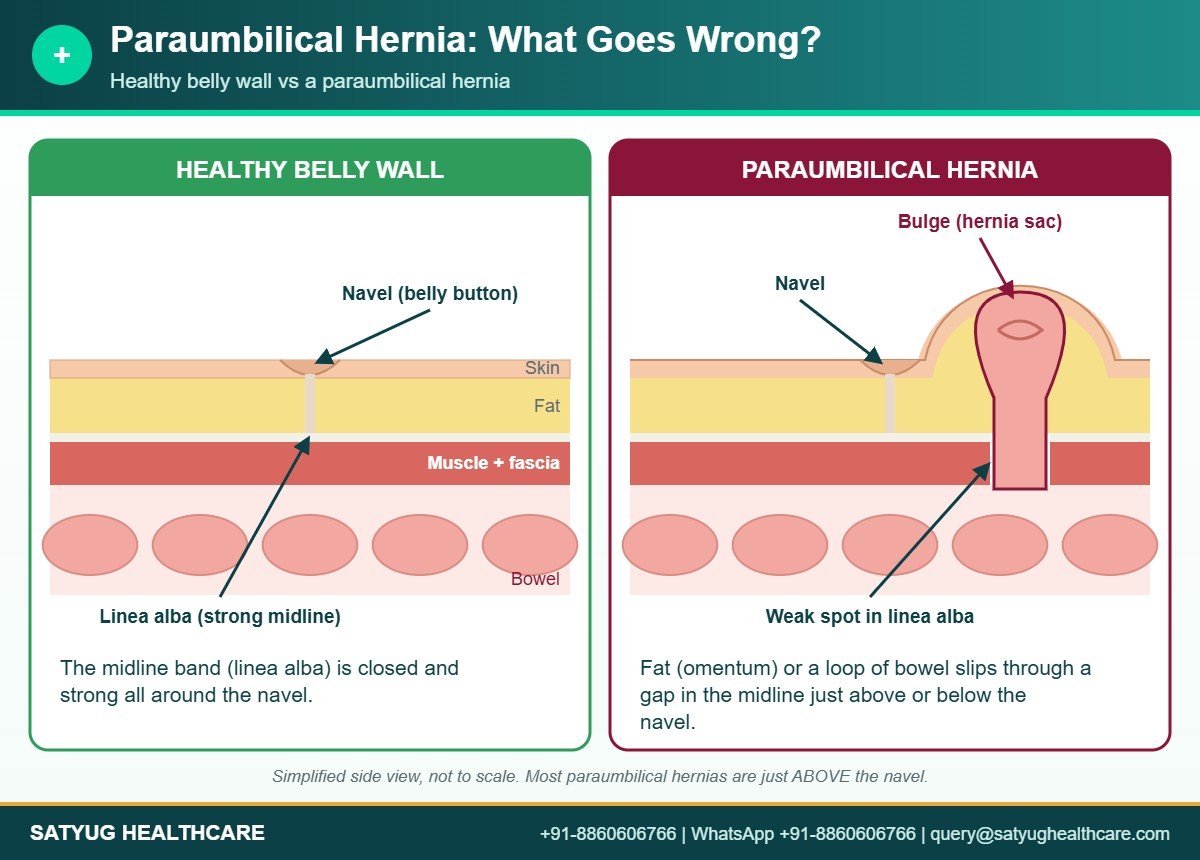
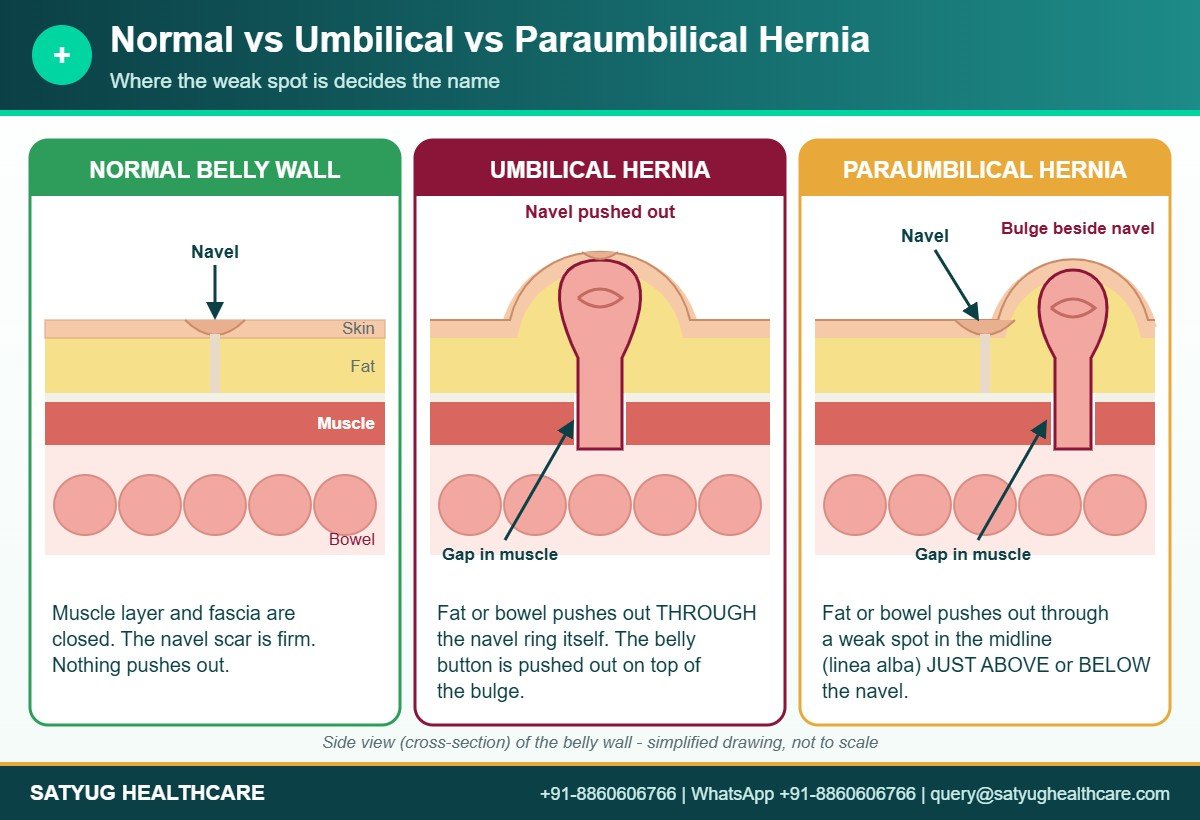
The two long muscles at the front of your belly are joined in the middle by a tough band called the linea alba. If this band becomes weak and stretched next to the navel, a small gap opens. Fat - and sometimes a loop of bowel - pushes through it and forms a soft lump under the skin. That lump is a paraumbilical hernia.
❓What Is a Paraumbilical Hernia?
A paraumbilical hernia is a protrusion through the belly wall around the umbilicus (belly button). It usually lies just above the navel and less commonly just below it, and is caused by weakness of the linea alba. The hernia sac often contains omentum (the fatty apron inside the belly) and sometimes small or large bowel. Its neck is often narrow compared with the size of the sac.
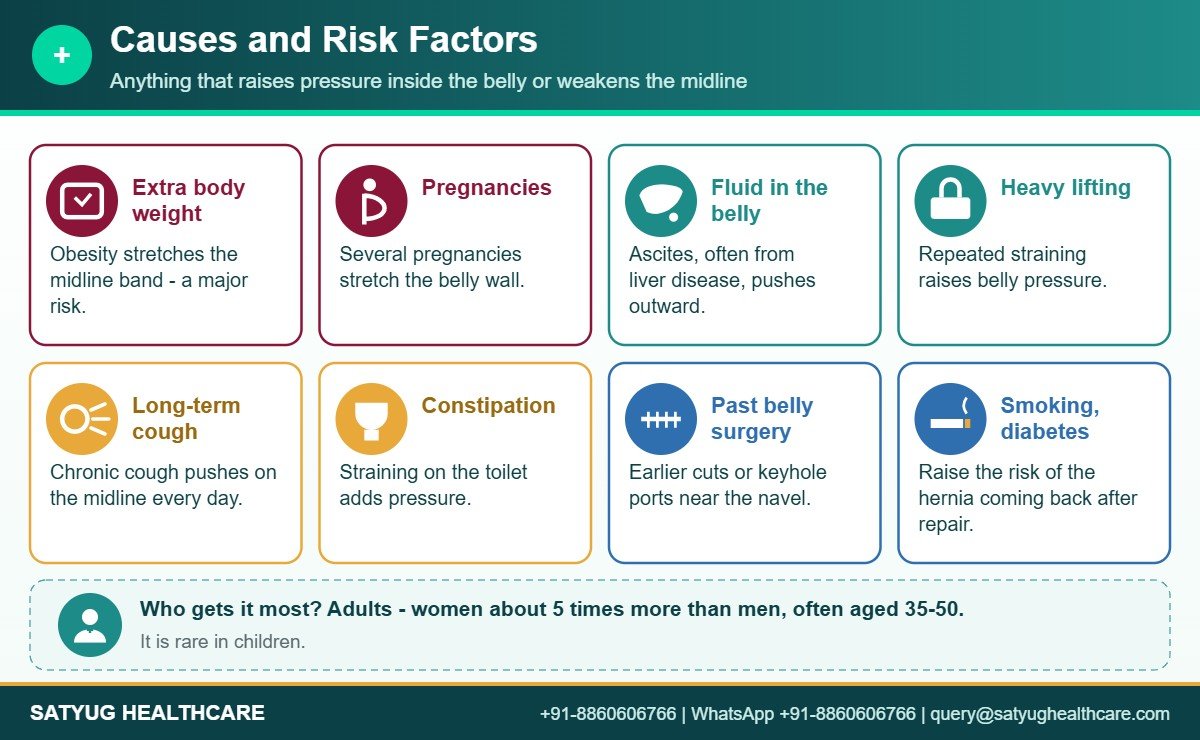
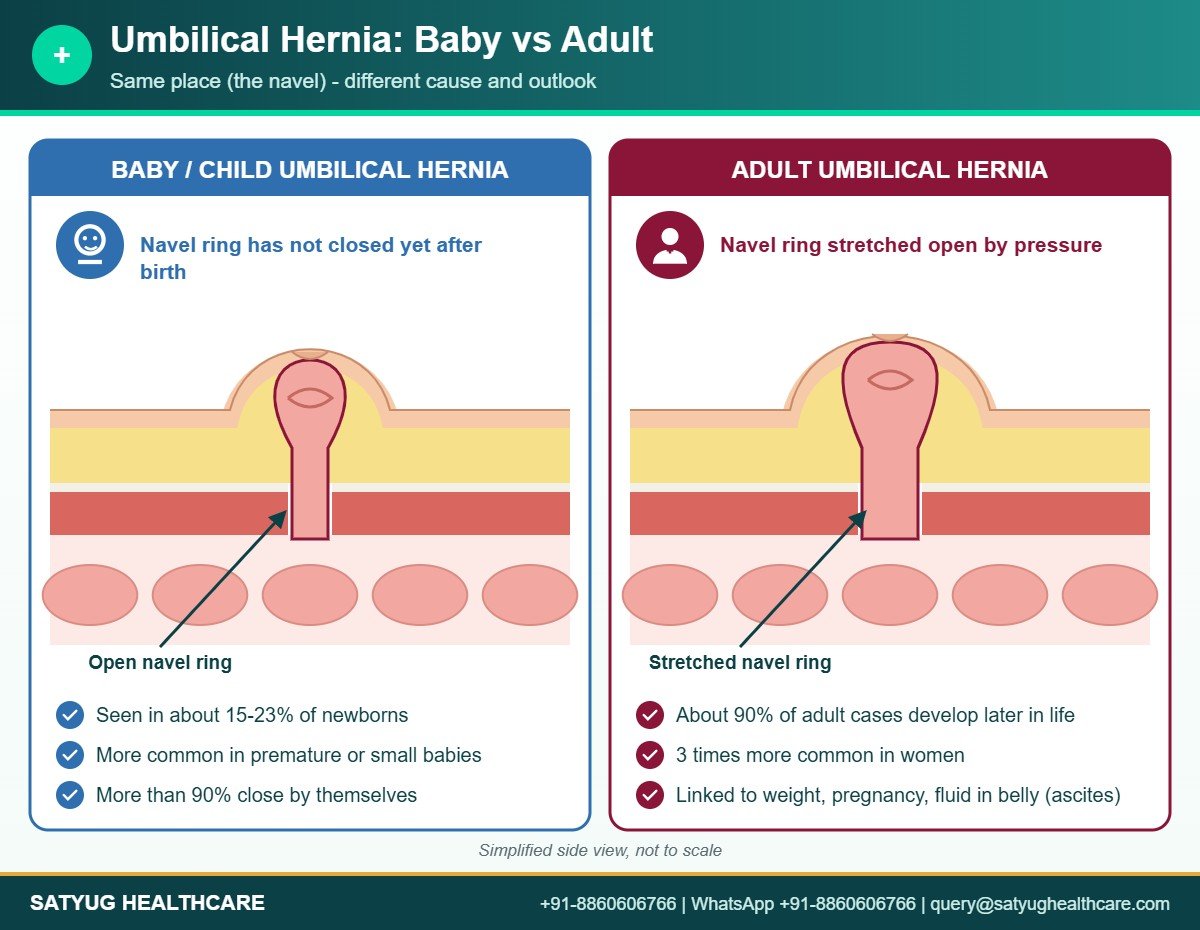
Paraumbilical hernias are rare in children and most common in adults aged about 35-50. Women are affected about five times more often than men.
▲ Picture at the top of this page: a healthy belly wall next to a paraumbilical hernia - a simplified side view of the belly wall.
☰Types of Paraumbilical Hernia
▲Supra-umbilical
Just above the navel - the most common position.
▼Infra-umbilical
Just below the navel - less common.
SBy size (EHS/AHS)
Small under 1 cm, medium 1-4 cm, large over 4 cm. The size guides the type of repair.
!By behaviour
Reducible (goes back in), incarcerated (stuck) or strangulated (blood supply cut off - an emergency).
✎ Same zone, same treatment
The European Hernia Society counts every hernia within 3 cm of the navel as an "umbilical" hernia. That is why your report may use either word - and why the treatment advice for adults is the same.
⚙Causes and Risk Factors
A paraumbilical hernia develops when pressure inside the belly stretches an already weak midline. Known risk factors include:
- Obesity and metabolic syndrome - a major risk factor; most patients are overweight women.
- Several pregnancies - the belly wall is stretched again and again.
- Fluid in the belly (ascites) - often from liver cirrhosis; up to 20% of people with cirrhotic ascites develop an umbilical-area hernia.
- Long-term raised pressure - chronic cough, constipation and straining, or heavy lifting.
- Previous surgery near the navel, including keyhole ports placed through the umbilicus.
- Connective-tissue disorders and poor nutrition.
⚠Symptoms of a Paraumbilical Hernia
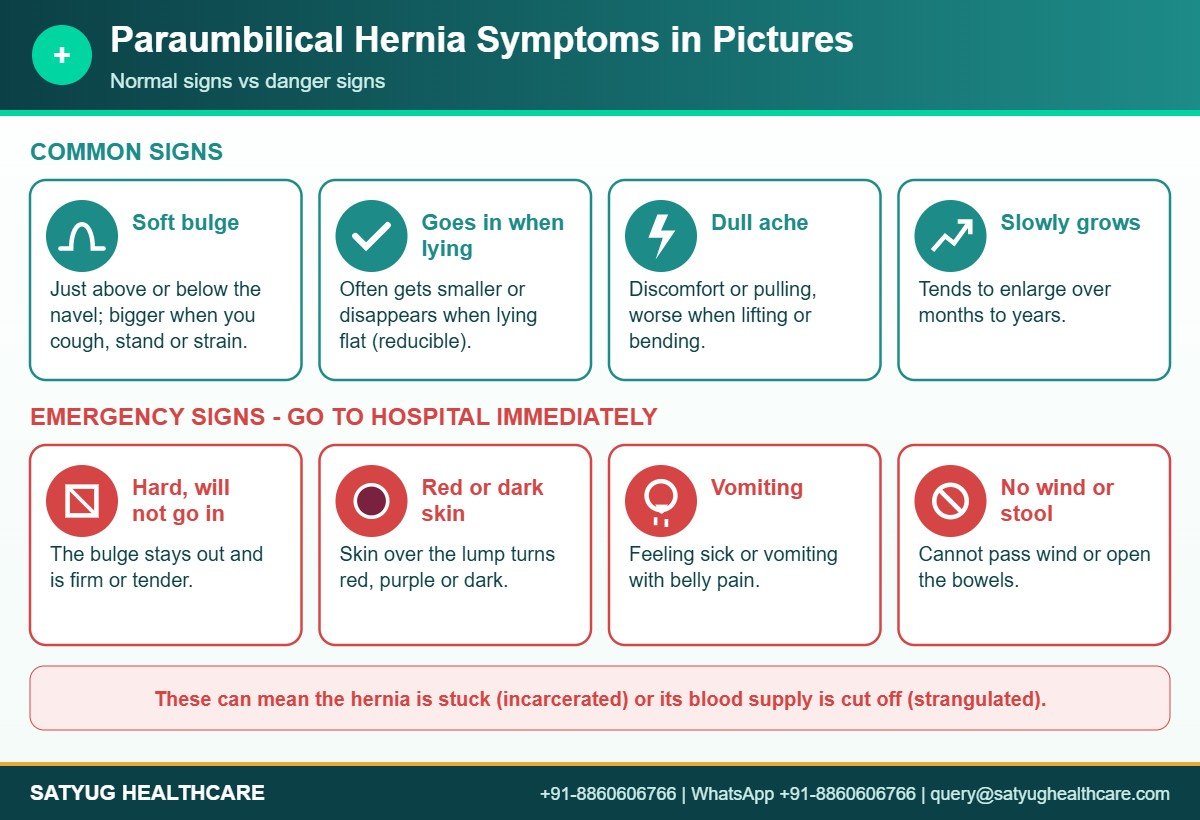
●Soft lump beside the navel
Just above or below the belly button; bigger when you cough, stand or strain.
●Goes in when lying flat
Many hernias shrink or disappear when you lie down (reducible).
●Dull ache or pulling
Discomfort that is worse with lifting, bending or long standing.
●Slow growth
These hernias tend to enlarge over months or years; many cause no symptoms at first.
⚠ Emergency - go to hospital immediately if
- The lump becomes hard, tender and will not go back in
- The skin over it turns red, purple or dark
- You have severe tummy pain, nausea or vomiting
- You cannot pass wind or open your bowels
⇄Paraumbilical vs True Umbilical Hernia: Quick Comparison
| Feature | Paraumbilical hernia | True umbilical hernia |
|---|---|---|
| Where | Midline just above or below the navel | Through the navel ring itself |
| Typical patient | Adult, often a woman aged 35-50 | Babies; also adults |
| Closes by itself? | ✖ No | ✔ Babies usually by age 4-5 / ✖ adults no |
| Neck of the sac | Often narrow - higher trapping risk | Variable |
| Adult treatment | Mesh repair (open or keyhole) | Mesh repair (open or keyhole) |
Read the full side-by-side guide: Paraumbilical hernia vs umbilical hernia.
⚲How Is a Paraumbilical Hernia Diagnosed?
Clinical examination
The surgeon examines you lying down and standing, asks you to cough, checks if the lump goes back and feels the edges of the gap to estimate its size.
Ultrasound of the abdominal wall
Confirms a small or unclear hernia and shows its contents; less reliable in severe obesity.
CT scan
Measures the gap exactly, shows the contents and any other hernias - helpful for large or recurrent hernias and keyhole planning.
MRI
Only if other scans are unclear (about 92% sensitive, 95% specific).
Fitness for surgery
Blood tests, sugar, ECG and chest X-ray when needed, plus an anaesthesia review.
⚕Treatment of Paraumbilical Hernia
A paraumbilical hernia does not heal on its own. Surgery is the only cure; the type of repair depends on the size of the gap, your weight and general health.
1Watchful waiting (selected patients only)
For a small hernia that causes no symptoms - or in someone too unwell for surgery - the surgeon may advise watching. The yearly risk of strangulation for symptom-free hernias is under 1%, but you must know the emergency signs. Hernias that hurt or grow should be repaired.
2Open stitch (suture) repair
A small curved cut is made near the navel, the sac is freed and pushed back, and the gap is closed with strong permanent stitches. It is suitable for very small gaps (about 2 cm or less). For bigger gaps, stitch-only repair has a recurrence rate of about 10-14%.
3Open preperitoneal flat mesh repair (recommended for most)
Through the same small cut, a flat mesh is placed behind the muscle layer to reinforce the gap. The 2020 EHS/AHS guideline recommends mesh to reduce recurrence and an open approach with a preperitoneal flat mesh for most of these hernias. In a randomised trial, mesh cut the return rate from 12% to 4%.
4Laparoscopic (keyhole) mesh repair - IPOM or eTEP
Through 3 small cuts away from the navel, a larger mesh is placed using a camera. It is preferred for large gaps, obesity, several defects or recurrent hernias. A meta-analysis of 16,549 patients found fewer wound infections, wound breakdowns and recurrences with laparoscopic repair, but longer operating time.
5Robotic repair
Robot-assisted keyhole repair is available at selected hospitals for complex or recurrent hernias. It allows precise suturing but usually takes longer and costs more.
6Emergency surgery
If the hernia is stuck or strangulated, it is operated on urgently. Damaged fat or bowel may need to be removed. This is why planned repair is advised once a hernia causes symptoms.
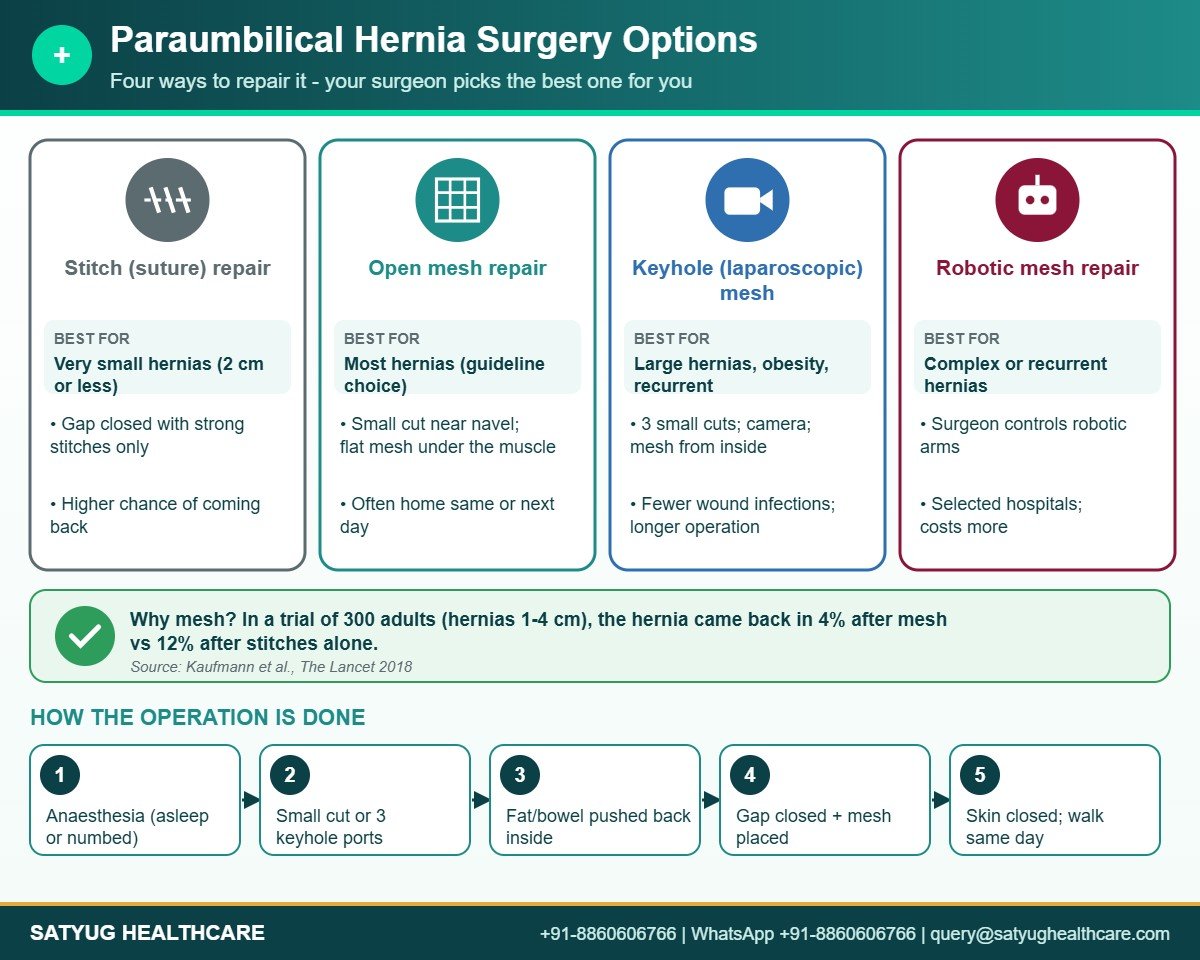
| Repair | One small cut | Mesh | Best for | Main drawback |
|---|---|---|---|---|
| Stitch (suture) | ✔ | ✖ | Very small gaps (2 cm or less) | Higher recurrence |
| Open flat mesh | ✔ | ✔ | Most hernias (guideline choice) | Slightly more wound problems than keyhole |
| Laparoscopic mesh | ✖ (3 small cuts) | ✔ | Large, recurrent, obese patients | Longer operation, general anaesthesia |
| Robotic mesh | ✖ (small ports) | ✔ | Complex / recurrent | Higher cost, selected hospitals |
⏱Recovery After Surgery
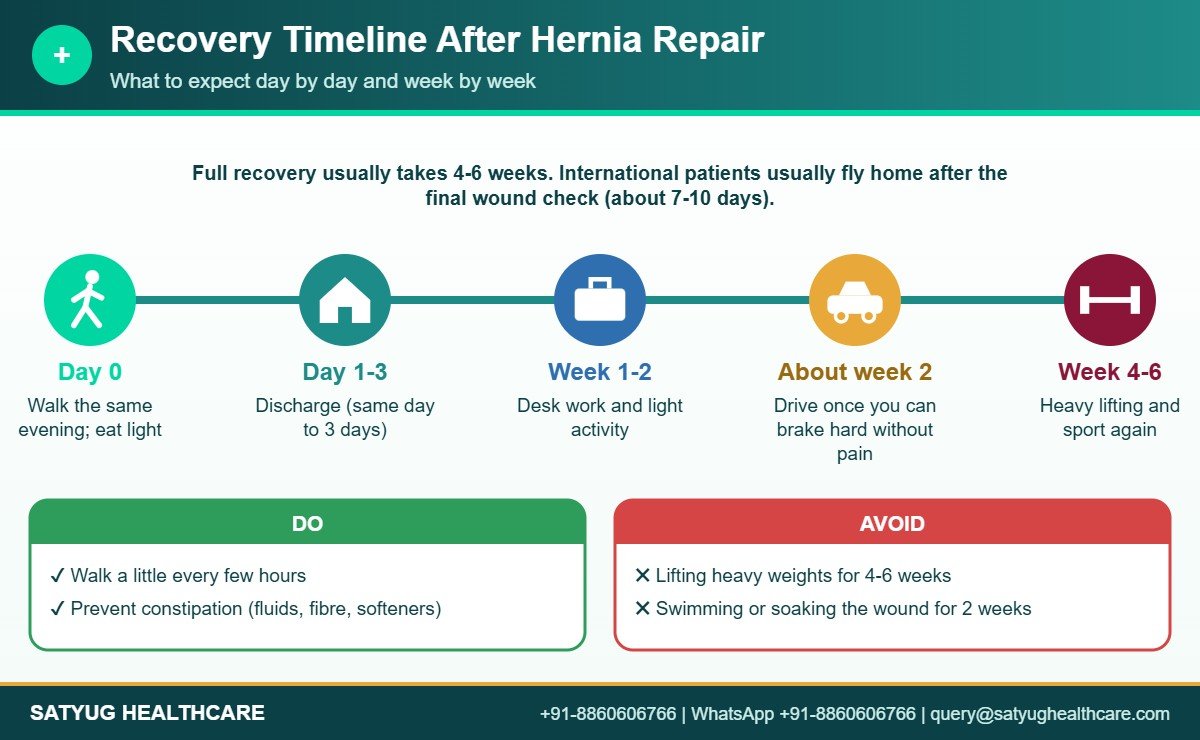
✔ DO
✔ Walk from the first evening
✔ Keep the wound clean and dry as advised
✔ Prevent constipation with fluids, fibre and softeners
✔ Return to desk work after about 1-2 weeks
✖ DON'T
✖ Do not lift heavy weights for 4-6 weeks
✖ Do not swim or soak the wound for 2 weeks
✖ Do not drive until you can brake hard without pain (about 2 weeks)
✖ Do not smoke - it slows healing and raises recurrence
✈Why Choose India for Paraumbilical Hernia Surgery?
$Big savings
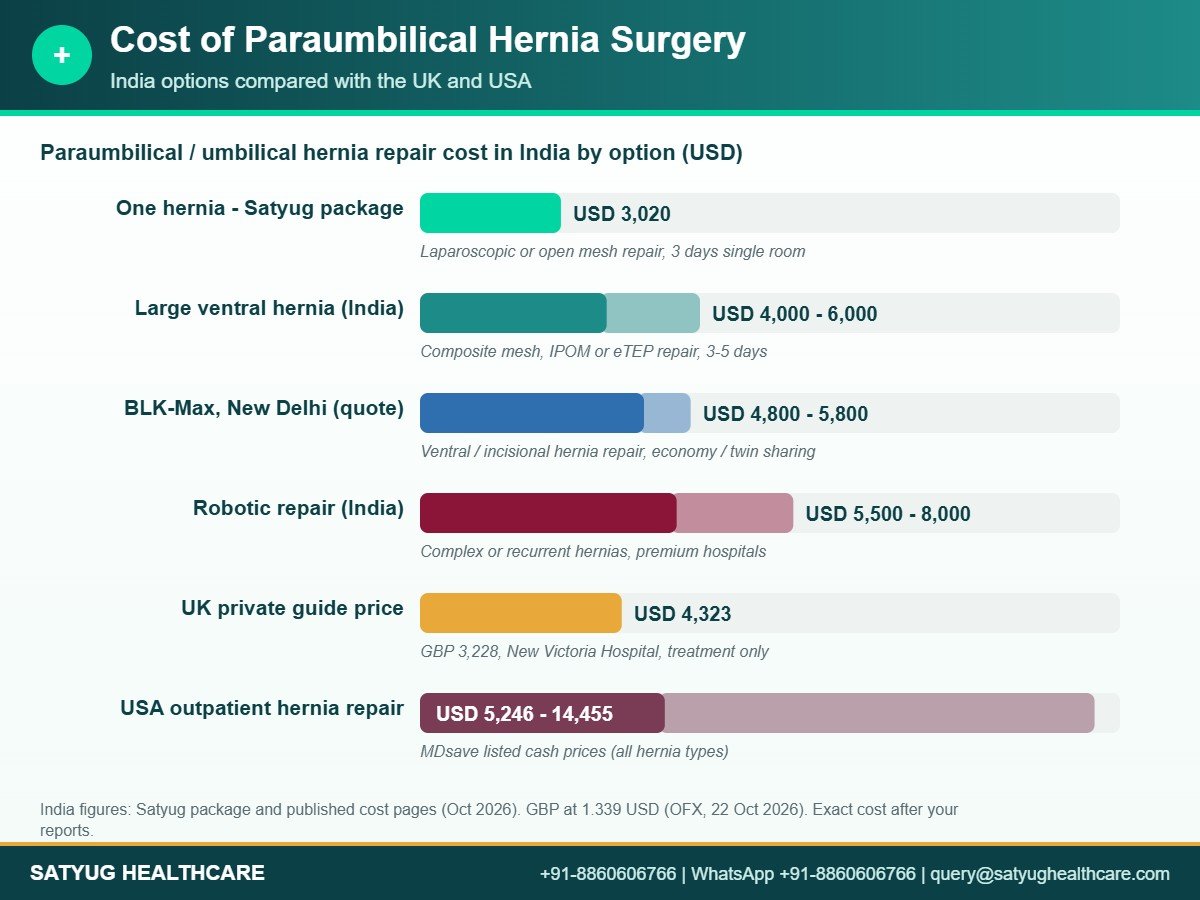
From USD 3,020 in India vs a UK private guide price of GBP 3,228 (treatment only) and US outpatient hernia repair prices of USD 5,246-14,455.
★Accredited hospitals
Surgery at NABH / JCI accredited hospitals by experienced general and laparoscopic surgeons.
⚙All techniques
Open mesh, laparoscopic IPOM / eTEP and robotic repair are available.
✉e-Medical visa
Valid 60 days from first arrival, multiple entry; up to 2 attendants.
$Paraumbilical Hernia Surgery Cost in India
The prices below come from our Hernia Surgery package and hernia surgery cost page. Costs for other countries are shown with their sources.
| Option | Approx. cost (USD) | Hospital stay | Note |
|---|---|---|---|
| Paraumbilical / umbilical repair - Satyug package | 3,020 | 3 days, single room | Laparoscopic or open mesh repair of one hernia |
| Large incisional / ventral hernia | 4,000 - 6,000 | 3-5 days | Composite mesh, IPOM or eTEP |
| BLK-Max Super Speciality Hospital, New Delhi (quote) | 4,800 - 5,800 | Economy / twin sharing | Ventral / incisional repair; evaluation USD 800-1,000 extra |
| Robotic hernia repair | 5,500 - 8,000 | 2-3 days | Complex or recurrent hernias |
| UK private guide price | about 4,323 (GBP 3,228) | - | New Victoria Hospital, treatment only |
| USA outpatient hernia repair | 5,246 - 14,455 | Day case | MDsave listed cash prices, all hernia types |
All options and hospitals➤ Hernia surgery cost in New Delhi
Delhi hospital quotes➤ BLK-Max hospital hernia cost
Hospital quote details➤ Laparoscopic hernia repair cost
Keyhole repair prices
GBP converted at 1 GBP = 1.339 USD (OFX, 22 Oct 2026). Exact cost depends on hernia size, mesh, hospital and room, and is confirmed after your reports are reviewed.
♥Prognosis
✔ Excellent results with mesh
After mesh repair, umbilical-area hernias come back in only about 0-3% of patients. Most people walk the same day, return to desk work in 1-2 weeks and recover fully in 4-6 weeks.
The risk of complications rises with the size of the gap - by about 1% for every extra millimetre - and with smoking, diabetes, liver disease and severe obesity. Repairing the hernia early, while it is small, gives the best result.
☎How Satyug Healthcare Helps
Share your reports
Photo of the lump while standing, ultrasound or CT report, and details of past surgery, diabetes, heart or lung problems and blood thinners.
Free opinions in 48-72 hours
Written opinions and estimates from accredited hospitals to compare.
Pick your surgeon and budget
We explain open vs keyhole, mesh type and room options - no extra fee for our service.
Visa and travel
Visa invitation letter, e-Medical visa guidance, airport pick-up and nearby hotel.
Hospital support
Your coordinator stays with you from admission to discharge; English, Arabic, French and Portuguese spoken.
Follow-up at home
Fit-to-fly letter, medicines and online review with your surgeon.
❓Frequently Asked Questions
Q. Is a paraumbilical hernia dangerous?
Usually not at first, but it does not go away and tends to grow. Its narrow neck can trap fat or bowel, which is an emergency. Planned repair is safer than waiting for a complication.
Q. Can a paraumbilical hernia heal without surgery?
No. It does not heal on its own - surgery is the only way to remove it and close the gap.
Q. Will I need mesh?
Most adults do. Mesh lowers the chance of the hernia coming back (4% vs 12% compared with stitches in a trial of 1-4 cm hernias). Very small gaps may be closed with stitches only.
Q. How long will I stay in India?
The Satyug package includes 3 days in hospital. Most international patients fly home after the final wound check, about 7-10 days after arrival.
Q. What does paraumbilical hernia surgery cost in India?
From USD 3,020 for one hernia with the Satyug package (3 days, single room). Large or complex hernias cost about USD 4,000-6,000 and robotic repair about USD 5,500-8,000.
Get a free medical opinion for paraumbilical hernia surgery
Send your ultrasound or CT report and a photo of the bulge. Within 48-72 hours we share opinions and written cost estimates from leading accredited hospitals in India - free of charge.
Related guides: Paraumbilical vs umbilical hernia • Umbilical hernia in adults and children • Hernia surgery package
☰ Sources (checked 28 October 2026)
- GPnotebook: Paraumbilical hernia
- Holt AC, Bamarni S, Leslie SW. Umbilical Hernia. StatPearls (NCBI Bookshelf), updated 27 Feb 2024
- Henriksen NA et al. EHS and AHS guidelines for treatment of umbilical and epigastric hernias. Br J Surg 2020;107(3):171-190
- Kaufmann R et al. Mesh versus suture repair of umbilical hernia in adults: randomised trial. Lancet 2018
- Hajibandeh S et al. Laparoscopic versus open umbilical or paraumbilical hernia repair: meta-analysis. Hernia 2017;21(6):905-916
- Liverpool University Hospitals NHS: Paraumbilical / umbilical hernia repair leaflet
- Ramsay Health Care UK: Hernia repair (paraumbilical)
- NHS: Umbilical hernia
- New Victoria Hospital (UK): hernia guide prices
- MDsave (USA): Hernia repair (outpatient) prices
- OFX: GBP to USD rate, 22 Oct 2026
Medical disclaimer: this article is general information and does not replace an examination by a qualified surgeon. Prices are indicative and are confirmed only after your reports are reviewed. Infographics: Satyug Healthcare.
✎ Written & reviewed by Vikram Kashyap, Medical Consultant, Satyug Healthcare
Related Blogs



HAPPY PATIENTS
What Our Patients Are Saying






























Our Gallery