Liver Transplant Package
Assistance
Consultation
Services
Opinion
Care Coordination
What will your treatment cost?

| Surgery Name | Cost | Room | Hospitalization |
|---|---|---|---|
| Liver Transplant Package | 22500 USD | Single | Recipient: 21 days (5 days ICU + 16 days Single Room) | Donor: 8 days (2 days ICU + 6 days Single Room) |
✓ Inclusion
- ✔Living-donor liver transplant surgery for the recipient and donor hepatectomy for the donor
- ✔Recipient hospital stay of 21 days: 5 days ICU + 16 days single room
- ✔Donor hospital stay of 8 days: 2 days ICU + 6 days single room
- ✔Surgeon, transplant team, anaesthetist and assistant fees
- ✔Operating theatre charges and standard surgical consumables
- ✔Routine in-hospital medicines including starting anti-rejection drugs during the stay
- ✔Standard post-operative blood tests and Doppler scans during the stay
- ✔Nursing care, doctor visits, physiotherapy and dietitian guidance
- ✔Hospital meals for the patient and donor as per hospital policy
- ✔Transplant coordinator support for documentation and authorisation committee
- ✔Free: airport pick-up & drop, visa invitation letter, interpreter & coordinator (Satyug Healthcare)
✗ Exclusion
- ✖Pre-transplant evaluation tests for recipient and donor (quoted separately)
- ✖Extra ICU or room days beyond the package
- ✖Blood and blood products beyond standard use, plasma exchange, IVIG or rituximab
- ✖ABO-incompatible transplant protocols
- ✖Treatment of complications, re-operations, ERCP or interventional procedures
- ✖Dialysis if needed
- ✖Medicines after discharge, including lifelong anti-rejection drugs
- ✖Hotel stay, food and local travel outside the hospital
- ✖Air tickets, visa fees and travel insurance
Know More About Procedure & Surgery
Liver Transplant Surgery in India
Living-donor and deceased-donor liver transplant for end-stage liver disease, liver failure and selected liver cancers, done by experienced transplant teams at India's busiest liver centres – at a fraction of US, UK or Gulf costs.
📖 What is a Liver Transplant?
The liver is the largest organ inside the body. It cleans the blood, makes proteins that help blood clot, stores energy and makes bile to digest fat. When the liver is badly scarred (cirrhosis) or suddenly fails, it cannot do these jobs. Fluid collects in the belly, the skin turns yellow, the patient becomes confused and may vomit blood. Medicines can slow the damage, but they cannot bring a dead liver back.
A liver transplant removes the diseased liver and replaces it with a healthy one. In India most transplants are living-donor liver transplants (LDLT): a healthy close relative gives a part of their liver (usually the right lobe, about 55–65%). Both the donor's remaining liver and the new liver in the patient grow back to almost normal size within 6–8 weeks. A deceased-donor transplant (DDLT) uses a whole liver from a brain-dead donor, but foreign patients usually cannot wait on this list, so a family donor is needed.
🩺 Conditions Treated
⚠️ Signs That a Liver Transplant May Be Needed
- ➤Yellow eyes and skin (jaundice)
- ➤Swollen belly with fluid (ascites)
- ➤Vomiting blood or black stools
- ➤Confusion or sleepiness (encephalopathy)
- ➤Easy bruising and bleeding
- ➤Severe tiredness and muscle loss
- ➤Swollen legs and feet
- ➤Repeated hospital admissions
🔬 Tests Before Treatment
| Test | Why it is done |
|---|---|
| Liver function tests, INR & MELD score | Show how badly the liver is working and how urgent the transplant is. |
| Triple-phase CT or MRI of the liver | Maps blood vessels, checks the liver size and looks for cancer. |
| Echo, ECG and stress test | Make sure the heart can handle a long operation. |
| Lung tests & chest CT | Check breathing and look for lung problems linked to liver disease. |
| Viral markers & infection screening | Hepatitis B, C, HIV, TB and other infections are checked before surgery. |
| Donor tests: blood group, liver CT volume, MRCP, fitness tests | Confirm the donor is healthy and that enough liver remains safely for them. |
| Legal & ethics committee documents | Indian law (THOTA) requires proof of relationship and approval before transplant. |
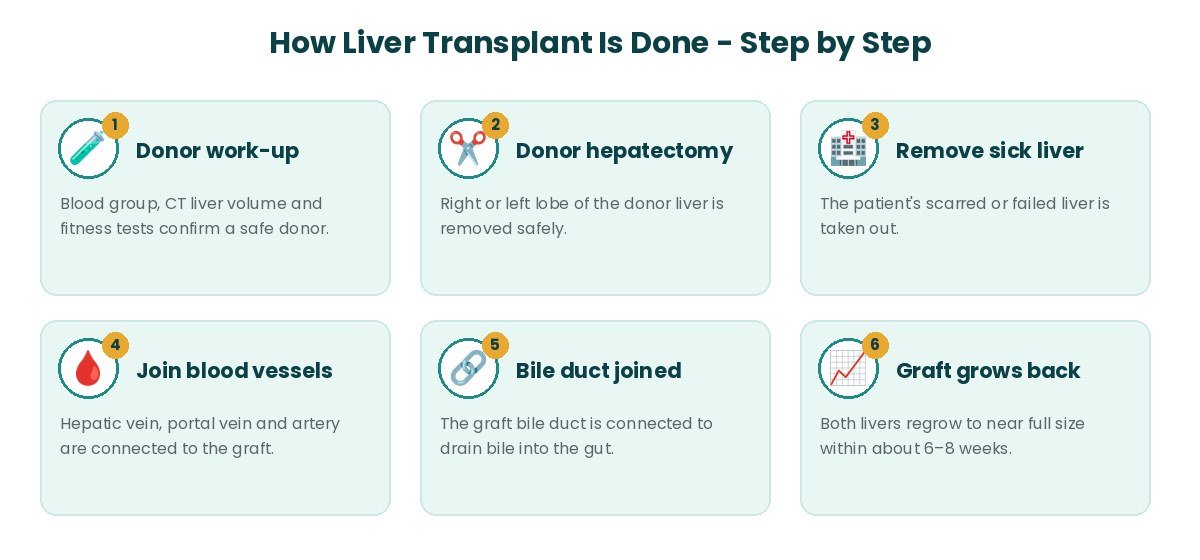
🏥 The Procedure — Step by Step
⚖️ Types of Liver Transplant
| Type | What is done | Best for |
|---|---|---|
| Living-donor (LDLT) – right lobe | A relative donates about 60% of the liver | Most adult patients from abroad |
| Living-donor – left lobe / left lateral segment | A smaller part of the donor liver is used | Children and small adults |
| Deceased-donor (DDLT) | Whole liver from a brain-dead donor | Indian residents on the state waiting list |
| ABO-incompatible LDLT | Donor of a different blood group, with special drugs and plasma exchange | Patients without a blood-group-matched donor |
| Swap (paired) transplant | Two families exchange donors to get a match | Families whose donor does not match |
📅 Your Day-by-Day Plan in India
| Day | What happens |
|---|---|
| Day 1 | Arrival in India, airport pick-up and hotel check-in near the hospital |
| Day 2–7 | Recipient and donor evaluation, scans and specialist consultations |
| Day 8–12 | Document checks and transplant authorisation committee approval |
| Day 13 | Admission and transplant surgery for donor and recipient |
| Day 13–18 | Recipient in ICU (about 5 days); donor in ICU about 2 days |
| Day 20 | Donor discharged after about 8 days in hospital |
| Day 18–34 | Recipient recovers in a single room; total about 21 days in hospital |
| Week 5–8 | Stay near the hospital for blood tests, scans and medicine adjustment |
| Week 7–8 | Final review, medicine plan and travel clearance – Fly home ✈️ |
🌱 Recovery After Treatment
🏆 Success Rate
| Outcome | Result |
|---|---|
| 1-year patient survival (good centres) | About 90% |
| 5-year patient survival | About 75–80% |
| Donor serious complication rate | About 1–2% (low), most donors fully recover |
| Donor death risk (right lobe) | About 0.1–0.5% |
| Return to normal life | Most recipients by 6–12 months |
Results depend on how sick the patient is before surgery (MELD score), the quality and size of the donor graft, the patient's age, heart and kidney health, and strict use of anti-rejection medicines after going home.
🩹 Risks & Possible Complications
A liver transplant is major surgery. Risks are higher for very sick patients and are watched closely in the ICU.
- •Infections (bacterial, viral, fungal) – common in the first 3 months because of anti-rejection drugs
- •Bile duct leak or narrowing – about 10–25%, often treated by endoscopy (ERCP)
- •Acute rejection – about 15–30%, usually controlled with steroid treatment
- •Bleeding needing re-operation – about 5–10%
- •Hepatic artery or portal vein clot – about 2–5%, may need urgent surgery or re-transplant
- •Kidney problems, diabetes and high blood pressure from long-term medicines
- •Return of the original disease (e.g. hepatitis B, fatty liver, cancer) if not controlled
💰 Cost of Liver Transplant in India
The cost of liver transplant in India starts from about USD 22,500. This package covers the transplant surgery for recipient and donor, about 21 days in hospital for the recipient (5 days ICU + 16 days single room), about 8 days for the donor (2 days ICU + 6 days single room), routine medicines and consumables, and standard post-operative care. Complex cases, longer ICU stay, ABO-incompatible transplant and extra procedures add to the cost.
| Option / Hospital tier | Approx. cost (USD) | Hospital stay | Notes |
|---|---|---|---|
| Living-donor liver transplant – this package (single room) | 22,500 | Recipient 21 days, donor 8 days | Uncomplicated adult LDLT |
| LDLT at premium JCI centres (Delhi NCR, Chennai, Hyderabad) | 30,000 – 40,000 | Recipient 3–4 weeks | Most foreign patients fall in this range |
| ABO-incompatible LDLT | 40,000 – 50,000 | 3–5 weeks | Extra drugs (rituximab) and plasma exchange |
| Paediatric liver transplant | 25,000 – 35,000 | 3–4 weeks | Left lateral segment graft from parent |
| Pre-transplant evaluation only (recipient + donor) | 1,500 – 3,000 | Outpatient | Adjusted later if the transplant goes ahead |

📋 What the Package Includes
- ✔Recipient & donor surgery fees
- ✔Recipient 21 days stay (5 ICU + 16 single room)
- ✔Donor 8 days stay (2 ICU + 6 single room)
- ✔Anaesthesia & operating theatre
- ✔Routine medicines & consumables
- ✔Standard in-hospital tests
- ✔Doctor visits & nursing care
- ✔Airport pick-up & coordinator support
- ✖Pre-transplant work-up beyond the package
- ✖Extra ICU or hospital days
- ✖Blood products beyond package limit
- ✖Treatment of complications or re-surgery
- ✖Medicines after discharge
- ✖Hotel and food outside the hospital
- ✖Air tickets & visa fees
✈️ Your Medical Travel Process with Satyug Healthcare

| Step | Details |
|---|---|
| 1. Send reports | Recent liver function tests, INR, creatinine and blood counts, triple-phase CT or MRI of the liver, endoscopy report, AFP (for cancer), viral markers, a discharge summary and the blood group of the patient and possible donors. |
| 2. Free opinion & quotes | Within 48-72 hours you receive opinions and cost estimates from 3-5 leading hospitals to compare. |
| 3. Choose hospital & doctor | We help you compare doctors, success rates, room options and total budget. |
| 4. Medical visa | The hospital issues a Visa Invitation Letter (VIL) to the Indian Embassy. The patient and up to 2 attendants apply for an e-Medical / Medical Attendant visa. |
| 5. Travel planning | Flight guidance, wheelchair assistance, airport pick-up, hotel or guest house near the hospital. |
| 6. Treatment in India | Your coordinator and interpreter stay with you for admission, treatment, discharge and billing. |
| 7. Return & follow-up | Fit-to-fly letter, medicines, and online follow-up with your doctor after you return home. |
🎒 Travel Checklist
- 📌Valid passport (6+ months) for the patient and attendants, plus 10 passport-size photos each
- 📌Medical visa / e-visa and the hospital’s Visa Invitation Letter
- 📌All liver blood tests, CT/MRI scans on CD or link, endoscopy reports, discharge summaries and current prescriptions
- 📌Yellow fever vaccination certificate (mandatory for travellers from African countries)
- 📌Polio vaccination certificate where applicable
- 📌Declare cash above USD 5,000 at the airport; hospitals accept wire transfer and cards
- 📌Foreigners staying longer than permitted must register with the FRRO — our team assists
⭐ Why Choose Satyug Healthcare?
❓ Frequently Asked Questions
➤ What is the cost of a liver transplant in India?
➤ Who can be a liver donor?
➤ How long do we need to stay in India?
➤ What is the success rate?
➤ Is the surgery safe for the donor?
➤ Is the operation painful?
➤ How long does recovery take?
➤ Will I take medicines for life?
➤ Is there a waiting list for foreign patients?
➤ Can children have a liver transplant?
➤ How many people can come with the patient?
➤ What documents are needed for transplant approval?
➤ What follow-up is needed at home?
➤ Will there be a language problem?
Medical disclaimer: This page is for general information and does not replace a consultation with a qualified specialist. Treatment plans and costs are confirmed only after the patient is examined. Sources: NCBI StatPearls: Liver Transplantation; AASLD/AST Practice Guideline: Evaluation for Liver Transplantation in Adults (2013, updated); European Liver Transplant Registry; Mayo Clinic: Liver transplant; NHS: Liver transplant; Transplantation of Human Organs and Tissues Act (India). Infographics: Satyug Healthcare.
Frequently Asked Questions
Liver transplant surgery in India starts from USD 25,000 through Satyug Healthcare — which is 60–70% less than the USA or UK. The package covers pre-transplant evaluation for recipient and one donor, surgery for both, ICU and hospital stay, OT charges, nursing, lab, radiology, and pharmacy services.
Liver transplant in India from USD 22,500. Living-donor transplant at top JCI & NABH centres, about 90% 1-year survival, no waiting list with a family donor.
























































TOP HOSPITALS
Special High-quality Hospitals


HAPPY PATIENTS
What Our Patients Are Saying



























Our Gallery