Finding a lump in the armpit can be worrying. In most cases the swelling is an axillary lymph node that has enlarged because the body is fighting an infection, and it settles on its own within a few weeks. Sometimes, however, a swollen armpit node is the first sign of a more serious condition such as breast cancer, lymphoma or cancer that has spread from another part of the body. Because the axillary lymph nodes are also the main drainage station for the breast, they play a central role in how breast cancer is staged and treated.
This guide explains, with simple pictures, the anatomy of the axillary lymph nodes, the common causes of swelling, warning signs, modern tests, treatment options, recovery, the risk of lymphoedema and the cost of treatment in India for international patients.
★ At a glance
20-40
lymph nodes in each armpit
75%
of breast lymph drains to the armpit
2-4 weeks
most infection-related nodes settle
1-3 nodes
removed in sentinel node biopsy
5-7% vs 20-30%
arm swelling risk: SLNB vs ALND
USD 3,300+
mastectomy with ALND in India
✍ In simple words
Lymph nodes are small filters of the immune system. The ones in the armpit drain the arm, chest wall and breast. They swell most often because of a minor infection. A node that is hard, painless, fixed and growing for more than 2 to 4 weeks should be checked by a doctor with an ultrasound and, if needed, a needle biopsy.
⚙What are Axillary Lymph Nodes?
Lymph nodes are bean-shaped structures, usually less than 1 cm in size, that filter lymph fluid and trap bacteria, viruses and abnormal cells. The armpit (axilla) contains roughly 20 to 40 lymph nodes embedded in fat. They receive lymph from the arm, the chest wall, the upper back and about 75 percent of the lymph drainage of the breast.

▶ Picture 1: Where the armpit nodes are, the 3 levels, and normal vs swollen node
Surgeons divide the axillary nodes into three levels based on their position relative to the pectoralis minor muscle:
ILevel I
Below and outside the pectoralis minor muscle - the lowest group and usually the first to receive drainage from the breast.
IILevel II
Directly behind the pectoralis minor muscle.
IIILevel III
Above and inside the pectoralis minor, close to the collarbone.
★ What is the sentinel lymph node?
The sentinel lymph node is the first node (or first few nodes) to which a tumour drains. If the sentinel node is free of cancer, the remaining nodes are very likely to be free as well, which is the principle behind sentinel lymph node biopsy.
⚠Causes of a Swollen Axillary Lymph Node

▶ Picture 2: Causes of an armpit lump - green usually harmless, red serious
MOST COMMON
1Infection
This is the most common cause. Infections of the hand, arm, breast or armpit skin, such as an infected cut, boil, hair follicle infection after shaving, or breast abscess, cause nearby nodes to swell and become tender. Viral illnesses like flu, glandular fever (infectious mononucleosis), HIV and cat-scratch disease can also enlarge armpit nodes. In many of the countries our patients come from, tuberculosis (TB) lymphadenitis is an important cause of painless, matted nodes.
USUALLY HARMLESS
2Reactive lymph nodes
A reactive node is a normal node that has enlarged in response to a nearby trigger. Common examples include recent vaccination in the arm (including COVID-19 and other vaccines, which can cause node swelling for several weeks), skin conditions such as eczema, and autoimmune diseases such as rheumatoid arthritis and lupus.
SERIOUS
3Breast cancer
Because the axilla drains most of the breast, it is the first place breast cancer usually spreads. A hard armpit lump may be found together with a breast lump, or occasionally on its own when the breast tumour is too small to feel (occult breast cancer). Men can also develop breast cancer, so a hard axillary lump in a man should not be ignored.
SERIOUS
4Lymphoma
Lymphoma is a cancer of the lymphatic system itself. Both Hodgkin and non-Hodgkin lymphoma can present as one or more painless, rubbery, enlarging nodes in the armpit, neck or groin. It is often accompanied by so-called B symptoms: fever, drenching night sweats and unexplained weight loss.
SERIOUS
5Metastasis from other cancers
Cancers of the arm or trunk skin, especially melanoma and squamous cell skin cancer, as well as lung cancer and some other tumours, can spread to the axillary nodes.
GOOD TO KNOW
✚Not every lump is a node
A skin cyst, boil or soft fatty lump (lipoma) in the armpit can feel like a swollen node. An ultrasound quickly tells them apart.
●Symptoms of an Abnormal Axillary Lymph Node
●A lump or swelling in the armpit, which may be soft and tender or hard and painless
⚡Pain or discomfort when moving the arm
♨Redness and warmth of the overlying skin (more typical of infection)
♨Fever, chills and feeling unwell (infection)
☾Night sweats, weight loss and tiredness (lymphoma or advanced cancer)
⚠A breast lump, nipple discharge, nipple inversion or skin dimpling (breast cancer)
⚠When Should You Worry?

▶ Picture 3: Warning signs - when to see a doctor
⚠ When to see a doctor urgently
- ⚠The lump is larger than 1.5 to 2 cm, or keeps growing
- ⚠It is hard, painless and fixed to the skin or deeper tissue
- ⚠It persists for more than 2 to 4 weeks with no infection to explain it
- ⚠Several nodes are matted together
- ⚠You also have a breast lump, skin changes or nipple changes
- ⚠You have unexplained fever, night sweats or weight loss
- ⚠You have a previous history of cancer
✔ Good news
Most tender, small nodes linked to an obvious infection settle within 2 to 4 weeks. Nodes that swell after a vaccination generally settle without treatment. Even when a test is needed, an ultrasound and a needle test give a clear answer quickly.
◉How is an Axillary Lump Diagnosed?

▶ Picture 4: The diagnosis pathway, step by step
1Clinical examination
The doctor examines both armpits, both breasts, the neck, the arm and the skin, and asks about recent infections, vaccinations and general symptoms.
2Axillary ultrasound
Ultrasound is the first and most useful imaging test. A normal node is oval with a fatty centre (hilum). Worrying features include a round shape, a thickened cortex (usually more than 3 mm), loss of the fatty hilum and abnormal blood flow.
3Mammogram and breast imaging
In women, a bilateral mammogram with breast ultrasound is done to look for a hidden breast tumour. Breast MRI is used when the mammogram and ultrasound are normal but an occult breast cancer is still suspected.
4FNAC (Fine Needle Aspiration Cytology)
A thin needle is passed into the node under ultrasound guidance to collect cells. FNAC is quick, inexpensive and good at confirming metastatic cancer or infection such as TB.
5Core needle biopsy
A slightly larger needle removes small cores of tissue. This allows full tissue diagnosis, including immunohistochemistry (ER, PR, HER2 and Ki-67) for breast cancer. If lymphoma is suspected, doctors usually prefer a core biopsy or a complete excision biopsy of the node, because lymphoma classification needs the whole node architecture.
6Sentinel lymph node biopsy (SLNB)
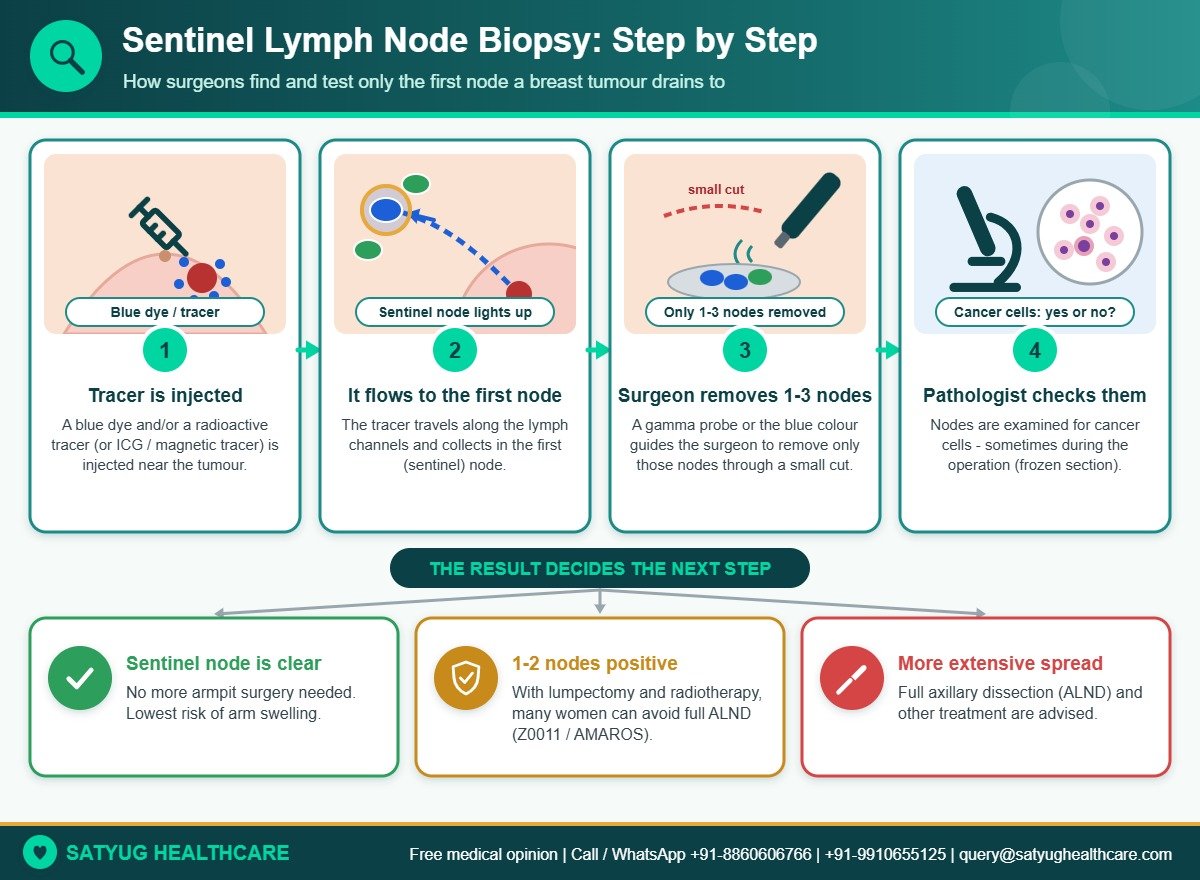
For breast cancer patients whose nodes appear normal on examination and ultrasound, SLNB is the standard staging test. A blue dye, a radioactive tracer (technetium-99m), or newer agents such as ICG fluorescence or magnetic tracers are injected near the tumour. The first nodes that take up the tracer are removed, usually 1 to 3 nodes, and checked by a pathologist, sometimes during the operation itself (frozen section).
7PET-CT scan
A whole-body PET-CT is used to stage lymphoma, to look for distant spread in locally advanced breast cancer, and to search for the primary tumour when cancer is found in a node but its source is unknown.
✚Treatment Options for Axillary Lymph Node Conditions
Treatment depends entirely on the cause. Many patients need nothing more than antibiotics or a repeat scan; others need surgery, chemotherapy or radiotherapy.

▶ Picture 5: Treatment options compared side by side
NON-SURGICAL
✔Antibiotics and treatment of infection
Bacterial infections are treated with a course of antibiotics, and an abscess may need drainage. TB lymphadenitis requires a standard course of anti-tubercular therapy, usually for at least 6 months.
WATCH AND WAIT
◉Observation
Small reactive nodes with a benign ultrasound appearance are usually monitored with a repeat examination or ultrasound in 4 to 6 weeks. Nodes that swell after vaccination generally settle without treatment.
➤ Sentinel lymph node biopsy (SLNB)
SLNB is both a staging test and a treatment step in early breast cancer and melanoma. Large trials such as NSABP B-32 and ACOSOG Z0011 have shown that many women with a negative sentinel node, or with only one or two positive sentinel nodes treated with breast-conserving surgery and radiotherapy, can safely avoid a full axillary dissection. This greatly reduces arm side effects.
▶ Picture 6: Sentinel lymph node biopsy step by step
➤ Axillary lymph node dissection (ALND)
ALND removes the Level I and II nodes (and Level III if they are involved), typically 10 to 20 or more nodes. It is recommended when there is extensive nodal disease, when nodes are clearly positive before surgery and remain positive after chemotherapy, in inflammatory breast cancer, or when SLNB is not suitable. The operation takes about 1 to 2 hours, often combined with breast surgery, and a drain is usually placed for 1 to 2 weeks.
| Feature | ★ SLNB | ALND |
|---|
| Nodes removed | Usually 1 to 3 | Typically 10 to 20 or more |
| Cut | Small cut | Larger operation, about 1 to 2 hours |
| Main use | Staging when nodes look normal | Extensive or persistent node disease |
| Hospital stay | About 1 to 2 days | About 2 to 3 days |
| Drain | - | Usually 1 to 2 weeks |
| Lymphoedema risk | ✔ About 5 to 7% | ✖ About 20 to 30% |
| Arm stiffness and swelling | ✔ Lower risk | ✖ Higher risk |
➤ Breast cancer surgery
When the axillary lump is due to breast cancer, axillary surgery is combined with either breast-conserving surgery (lumpectomy) followed by radiotherapy, or mastectomy. A modified radical mastectomy (MRM) combines removal of the breast with ALND. Many top Indian hospitals also offer oncoplastic surgery and immediate breast reconstruction.
➤ Chemotherapy, targeted therapy and radiation
- ➤Neoadjuvant chemotherapy (before surgery) can shrink positive nodes; when nodes become negative, targeted axillary dissection or SLNB may replace full ALND.
- ➤Targeted and hormone therapy such as trastuzumab and pertuzumab for HER2-positive cancer, and tamoxifen or aromatase inhibitors for hormone-positive cancer.
- ➤Radiotherapy to the breast or chest wall and regional nodes reduces the risk of recurrence.
- ➤Lymphoma is treated mainly with chemotherapy and immunotherapy (for example R-CHOP or ABVD), sometimes with radiotherapy, rather than surgery.
⏱Recovery and Lymphoedema

▶ Picture 7: Recovery timeline and how to protect your arm
Most patients go home within 1 to 2 days after SLNB and 2 to 3 days after ALND or mastectomy. Light daily activity is possible within a week, and arm exercises taught by a physiotherapist help restore shoulder movement.
Lymphoedema is long-term swelling of the arm caused by disruption of lymph drainage. The risk is about 5 to 7 percent after SLNB, compared with roughly 20 to 30 percent after ALND, and it is higher when ALND is combined with regional radiotherapy. Ways to lower the risk and manage it:
✔ Do
- ✔Do the prescribed arm and shoulder exercises regularly
- ✔Keep a healthy body weight
- ✔Protect the arm from cuts, burns and insect bites, and treat any infection early
- ✔Report early heaviness or tightness of the arm
- ✔Use complete decongestive therapy if advised: manual lymphatic drainage, compression bandaging and garments, exercise and skin care
✖ Don't
- ✖Ignore a feeling of heaviness, tightness or new swelling in the arm
- ✖Leave cuts, burns or insect bites on that arm untreated
- ✖Skip the physiotherapy exercises once the wound has healed
- ✖Let your weight climb, as extra weight raises the risk
★ Advanced option in India
Lymphatic microsurgery (lymphovenous bypass or lymph node transfer) is available for selected patients at specialised Indian centres.
$Cost of Axillary Lymph Node Treatment in India
India offers internationally accredited cancer care at a fraction of the cost in the USA, UK or Gulf countries. The figures below are approximate ranges for international patients at leading JCI and NABH accredited hospitals in Delhi NCR, Mumbai, Bengaluru, Chennai and Hyderabad, such as Fortis, Max Healthcare, Medanta, Artemis, Apollo, Manipal and HCG.
| Procedure / Test | ★ India - Approximate Cost (USD) |
|---|
| Oncology consultation with axillary and breast ultrasound | USD 80 - 200 |
| Bilateral digital mammogram | USD 40 - 100 |
| Ultrasound-guided FNAC of axillary node | USD 50 - 120 |
| Core needle biopsy with histopathology and IHC (ER, PR, HER2) | USD 200 - 450 |
| Excision biopsy of axillary lymph node | USD 700 - 1,300 |
| Whole-body PET-CT scan | USD 300 - 700 |
| Sentinel lymph node biopsy (standalone) | USD 1,400 - 2,500 |
| Axillary lymph node dissection (ALND) | USD 2,500 - 4,500 |
| Lumpectomy (breast-conserving surgery) with SLNB | USD 3,000 - 6,000 |
| Modified radical mastectomy (mastectomy with ALND) | USD 3,300 - 6,000 |
| Mastectomy with immediate breast reconstruction | USD 6,000 - 12,000 |
| Chemotherapy (per cycle, depending on drugs) | USD 400 - 1,500 |
| Radiotherapy course (3D-CRT / IMRT) | USD 3,500 - 6,000 |
| Lymphoedema therapy (complete decongestive therapy, per session) | USD 20 - 50 |
Prices are indicative for international patients (USD), based on published hospital and package prices as of October 2026; final cost depends on hospital, stage and stay.

▶ Picture 8: Mastectomy with node dissection - India vs other countries (indicative USD)
Surgical packages usually include the surgeon and anaesthesia fees, operation theatre charges, a 2 to 4 day hospital stay, routine medicines and nursing. Costs vary with the hospital, the surgeon, room category, use of a radioactive tracer or frozen section, and the final histopathology. A full course of breast cancer treatment combining surgery, chemotherapy, targeted therapy and radiotherapy typically ranges from USD 9,000 to 18,000, still far lower than in Western countries.
✔ Free written cost estimate
Satyug Healthcare provides a free, written cost estimate from several hospitals after reviewing your reports.
★Why Choose India for Axillary Lymph Node and Breast Cancer Treatment?
★Accredited hospitals
Many JCI and NABH accredited cancer centres with dedicated breast units.
⚕Experienced surgical oncologists
Specialists trained in SLNB with dual tracer, oncoplastic surgery and reconstruction.
⚙Complete cancer care under one roof
PET-CT, digital mammography, molecular pathology, tumour boards, modern linear accelerators and day-care chemotherapy.
$Affordable costs
Savings of 60 to 80 percent compared with the USA, UK and Gulf countries.
⏱Short waiting time
Diagnosis and surgery can usually be scheduled within days.
☎Easy communication
English-speaking doctors and interpreters for Arabic, French, Russian and other languages.
♥How Satyug Healthcare Helps You
Satyug Healthcare, based in New Delhi, has been helping international patients from Africa, the Middle East, Central Asia and beyond to access treatment at leading Indian hospitals since 2015. Our services are free for patients:
1Share your reports
Send your ultrasound, mammogram, biopsy or PET-CT reports by email or WhatsApp.
2Free medical opinion
We obtain opinions and treatment plans from senior surgical and medical oncologists at multiple hospitals.
3Transparent cost estimate
Compare hospitals, doctors and packages before you decide.
4Medical visa support
We issue the visa invitation letter and guide you through the e-medical visa process.
5Arrival and stay
Airport pick-up, affordable accommodation near the hospital, interpreters and local SIM card.
6During treatment
A dedicated coordinator manages appointments, admission, billing and reports.
7Return home and follow-up
Online follow-up consultations with your doctor in India and help with ongoing care.
?Frequently Asked Questions
QIs a swollen lymph node in the armpit always cancer?
No. Most swollen axillary nodes are caused by infection, skin irritation or a recent vaccination and settle within a few weeks. However, a node that is hard, painless, fixed or growing for more than 2 to 4 weeks should be checked by a doctor.
QHow long does it take for a reactive lymph node to go down?
Reactive nodes usually shrink within 2 to 6 weeks once the underlying infection or trigger has settled. Nodes after vaccination may take up to 6 to 10 weeks.
QWhat is the difference between SLNB and axillary lymph node dissection?
SLNB removes only the first 1 to 3 nodes that drain the tumour, through a small cut, with a low risk of lymphoedema. ALND removes most of the Level I and II nodes and is used when cancer has spread more widely in the axilla. It carries a higher risk of arm swelling and stiffness.
QCan I avoid full axillary dissection if my sentinel node is positive?
Often yes. Women with early breast cancer, one or two positive sentinel nodes, breast-conserving surgery and planned radiotherapy can frequently avoid ALND, based on the Z0011 and AMAROS trials. Your surgical oncologist will decide based on your individual case.
QHow long is the stay in India for axillary surgery?
For SLNB or ALND alone, plan to stay about 7 to 10 days in India including tests, surgery and the first check-up. If chemotherapy or radiotherapy follow, the total stay may be several weeks to a few months, or part of the treatment can be continued in your home country.
QWhat is the cost of sentinel lymph node biopsy in India?
A standalone SLNB costs about USD 1,400 to 2,500 at top Indian hospitals. When done together with lumpectomy, the combined package is roughly USD 3,000 to 6,000.
♥ Get a free medical opinion
Send your ultrasound, mammogram, biopsy or PET-CT reports and receive a treatment plan and written cost estimate from top Indian hospitals - free of charge.
Disclaimer: This article is for general information only and does not replace consultation with a qualified doctor. Treatment and cost depend on individual medical evaluation.