●
Overview: Congenital Diaphragmatic Hernia (CDH)
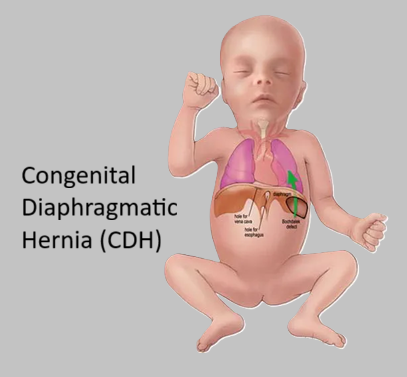
Congenital Diaphragmatic Hernia (CDH) is a rare but serious birth defect where a baby is born with a hole in the diaphragm — the muscle that separates the chest from the abdomen. This hole allows abdominal organs (such as the stomach, liver, or intestines) to move into the chest cavity, restricting lung development and causing breathing problems after birth.
CDH can occur on either side of the diaphragm but most commonly affects the left side. The severity of the condition depends on how much the lung is compressed and underdeveloped at birth.
This results in two main life-threatening issues immediately after birth:
- 1Pulmonary Hypoplasia: Underdeveloped, small lungs that cannot take in enough oxygen.
- 2Pulmonary Hypertension: High blood pressure in the arteries of the lungs, making blood flow and oxygen exchange extremely difficult.
💉
? Diaphragmatic Hernia Repair Surgery
The goal of CDH repair surgery is to move the herniated organs back into the abdomen and close the defect in the diaphragm.
Timing: The surgery is not performed immediately after birth. The baby must first be stabilized, which can take several days to a week. The surgical team prioritizes addressing the pulmonary hypertension and hypoplasia first.
Procedure:
- ✓The pediatric surgeon makes an incision (usually in the abdomen, sometimes in the chest).
- ✓The herniated abdominal organs are gently pulled down from the chest cavity into the abdomen.
The surgeon then closes the hole in the diaphragm:
- ✓Primary Repair: For smaller defects, the surgeon sutures the muscle edges directly together.
- ✓Patch Repair: For larger defects, a synthetic surgical patch is sewn into place to bridge the gap and create a new diaphragm.
Post-Surgery: The baby remains in the Neonatal Intensive Care Unit (NICU) on respiratory support as the lungs gradually adjust to the newly created space.
? Symptoms of Congenital Diaphragmatic Hernia
- ✓Symptoms are usually evident right after birth for severe cases:
- ✓Severe Respiratory Distress: Rapid, labored breathing due to the small, stiff lungs.
- ✓Cyanosis: Bluish discoloration of the skin and lips due to low oxygen levels.
- ✓Scaphoid Abdomen: The abdomen appears sunken or flat because the abdominal organs are displaced into the chest.
- ✓Absent Breath Sounds: Breath sounds are usually decreased or absent on the side of the hernia.
- ✓Heart Displacement (Dextrocardia): The heart may be shifted to the opposite side of the chest due to the mass effect of the herniated organs.
? Diagnosis Diaphragmatic Hernia
The vast majority of severe CDH cases are diagnosed before the baby is born.
- ✓Prenatal Ultrasound: Typically detected during the routine 20-week anatomy scan when a sonographer visualizes abdominal organs (like the stomach bubble or intestines) in the chest cavity.
- ✓Fetal MRI: Provides detailed imaging to assess the size of the lungs (using the Lung-to-Head Circumference Ratio - LHR) and determine if the liver has herniated into the chest, which are key indicators of severity.
- ✓Fetal Echocardiogram: Performed to rule out associated congenital heart defects, which are common with CDH.
- ✓Chest X-ray (Postnatal): Confirms the diagnosis after birth by clearly showing the presence of abdominal contents in the chest and the displacement of the heart.
? Cause of Congenital Diaphragmatic Hernia
- ✓In most cases (85%), the exact cause of CDH is unknown (isolated).
- ✓Multifactorial: It is generally believed to result from a complex interaction of genetic, environmental, and nutritional factors that disrupt diaphragm development early in the first trimester.
- ✓Genetic Syndromes: In 10% to 15% of cases, CDH is associated with a known chromosomal abnormality (e.g., Trisomy 18) or a specific genetic syndrome, often accompanied by other birth defects (e.g., heart, kidney, or limb anomalies).
- ✓Teratogens: Exposure to certain medications or chemicals during pregnancy is also sometimes implicated.
? Treatment Options for Congenital Diaphragmatic Hernia
Treatment is highly specialized and requires a multidisciplinary team.
- ✓Fetal Intervention (FETO): For the most severe cases, Fetoscopic Endoluminal Tracheal Occlusion (FETO) is sometimes offered. This involves placing a small balloon in the fetal trachea to trap lung fluid, forcing the lungs to grow before birth.
- ✓Postnatal Stabilization: Immediately after birth, care focuses on stabilizing the baby in a Level III/IV NICU:
- ✓Gentle Ventilation: Using specialized breathing machines.
- ✓Pulmonary Hypertension Management: Medications like Inhaled Nitric Oxide (iNO) to lower blood pressure in the lungs.
- ✓ECMO (Extracorporeal Membrane Oxygenation): Used as a last resort for the sickest babies; this heart-lung bypass machine temporarily takes over breathing, allowing the lungs and heart to rest.
- ✓Surgical Repair: Diaphragmatic Hernia Repair Surgery is performed once the baby is stable (see section above).
- ✓Long-Term Follow-up: Ongoing care is crucial for chronic issues like Pulmonary Hypertension, Chronic Lung Disease, and Gastroesophageal Reflux Disease (GERD).
? Risk of Diaphragmatic Hernia Repair Surgery
While necessary and generally safe, the risks associated with CDH surgery are significant, primarily due to the baby's underlying condition:
- ✓Surgical Risks: Bleeding, infection, damage to surrounding organs, and complications related to general anesthesia.
- ✓Pulmonary Complications: The most critical risk is failure to ventilate due to the underdeveloped lungs, persistent pulmonary hypertension, and lung collapse.
- ✓Recurrence: The hernia can return, particularly if a patch was used for the repair, requiring repeat surgery.
- ✓Abdominal Compartment Syndrome: Increased pressure in the abdomen after organs are returned from the chest, which can impact blood flow and breathing.
- ✓Mortality: The overall survival rate for CDH is good at specialized centers, but it remains a life-threatening condition, and the mortality risk is highest for those with severe pulmonary hypoplasia or associated anomalies.
? 15 FAQ Congenital Diaphragmatic Hernia for International Patients
- ✓Is CDH treatment available in India for newborns? Yes, India has several internationally accredited hospitals with advanced Level III/IV NICUs, pediatric surgeons, and ECMO capabilities.
- ✓How soon after birth is the surgery performed? The baby must be stabilized first. Surgery is usually performed 3 to 7 days after birth, not immediately.
- ✓Can my baby fly home immediately after surgery? No. After a complex surgery like CDH repair, the baby will require several weeks (often 3-6 weeks) of recovery and stabilization in the NICU before being cleared to fly.
- ✓What is the success rate for CDH surgery in India? Survival rates at top Indian centers are comparable to international standards (typically 70-90%), depending heavily on the severity of the lung hypoplasia.
- ✓Is the ECMO procedure available in Indian hospitals? Yes, the best pediatric surgery units and NICUs in India are equipped with ECMO machines and specialists.
- ✓Will my baby need lifelong medication? Many CDH survivors need medication for issues like chronic lung disease, pulmonary hypertension, and GERD for a period, sometimes extending into childhood.
- ✓What is the cost of CDH treatment in India? The overall cost, including the NICU stay, surgery, and ECMO (if needed), is significantly lower than in Western countries, offering high-quality, affordable care.
- ✓Do I need a medical visa for my baby and me? Yes, you will need to apply for a Medical Visa for yourself and an attendant visa for a family member, and the hospital will provide a Visa Invitation Letter.
- ✓What kind of doctor treats CDH? A multidisciplinary team, including a Neonatologist, a Pediatric Surgeon, and a Pediatric Pulmonologist, manages CDH.
- ✓Is an emergency transfer possible to India? Due to the risks of transportation, it is highly recommended to seek prenatal diagnosis and plan the delivery near the specialized Indian hospital. Emergency transfers of unstable newborns are challenging.
- ✓Will my baby have a large scar? The incision is usually small and low on the abdomen. Surgeons use techniques to minimize scarring.
- ✓What if the hernia comes back (recurs)? Recurrence (most common with patch repair) requires a second surgery, which can be successfully performed by an experienced pediatric surgeon.
- ✓Are long-term follow-up facilities available for international patients? Top hospitals offer virtual consultation and medical records transfer for long-term follow-up after the patient returns home.
- ✓Is the liver being in the chest a bad sign? Yes, if the liver is up (herniated), it severely compresses the lungs and is a key indicator of a more severe case requiring intensive management.
- ✓Does the baby need any special care during the flight back? Yes, the hospital will arrange for a specialized medical team or medical escort to manage the baby's breathing and oxygen needs during the return journey, which is often mandatory for CDH survivors.
? Satyug Healthcare: Assistance for International CDH Patients
Satyug Healthcare specializes in helping international patients access complex and life-saving pediatric surgeries like CDH repair in India. Their services are designed to simplify the stressful process of medical travel:
- ✓Expert Access and Opinion: They connect you directly with India's leading Pediatric Surgeons and Neonatologists at hospitals with Level III/IV NICU and ECMO facilities (like Manipal, Apollo, or Fortis).
- ✓Cost Transparency: They provide free, transparent, and comprehensive cost estimates for the entire process, including the NICU stay, surgery, and potential ECMO support, with no hidden charges.
- ✓Visa and Travel Logistics: They expedite the provision of the necessary Visa Invitation Letter from the hospital and arrange complimentary airport pickup and accommodation near the hospital.
- ✓Dedicated Support: A 24/7 Case Manager is assigned to handle all non-medical logistics, including interpretation services, hospital admission, and daily needs, allowing the family to focus entirely on the baby.
- ✓Pre-Travel Consultation: They facilitate virtual consultations with the surgeon and neonatologist before you travel, ensuring the medical plan is finalized.
Would you like to get a free consultation and cost estimate for CDH repair from a top pediatric surgeon in India?