Artificial Urinary Sphincter Package
Assistance
Consultation
Services
Opinion
Care Coordination
What will your treatment cost?

| Surgery Name | Cost | Room | Hospitalization |
|---|---|---|---|
| Artificial Urinary Sphincter Package | 12500 USD | 2 days | Semi Private |
✓ Inclusion
- ✔Consultation with a senior reconstructive urologist
- ✔Routine pre-operative tests: blood tests, urine culture, ECG and chest X-ray
- ✔AMS 800 artificial urinary sphincter device (single cuff, pump and reservoir)
- ✔Artificial urinary sphincter implantation surgery
- ✔Surgeon, assistant and anaesthesia fees
- ✔Operation theatre charges and routine consumables
- ✔2 days hospital stay in a semi-private room
- ✔Nursing care, routine medicines, IV antibiotics and diet in hospital
- ✔Wound check and written activation instructions before departure
- ✔Free: airport pick-up & drop, visa invitation letter, interpreter & coordinator (Satyug Healthcare)
✗ Exclusion
- ✖Urodynamic study, cystoscopy and other special tests
- ✖Treatment of urethral stricture or bladder neck narrowing
- ✖Double (tandem) cuff, transcorporal cuff or revision surgery
- ✖Extra hospital days beyond 2 days
- ✖Device activation visit at 6 weeks if done later in India
- ✖Treatment of complications or other illnesses
- ✖Medicines after discharge
- ✖Hotel stay, food, local travel and flights
- ✖Attendant's food and accommodation
Know More About Procedure & Surgery
Artificial Urinary Sphincter (AUS) Implantation in India
AMS 800 artificial urinary sphincter for moderate to severe stress urinary incontinence – most often after prostate cancer surgery – placed by experienced reconstructive urologists at accredited Indian hospitals, at a fraction of the cost in the USA, UK or the Gulf.
📖 What is an Artificial Urinary Sphincter?
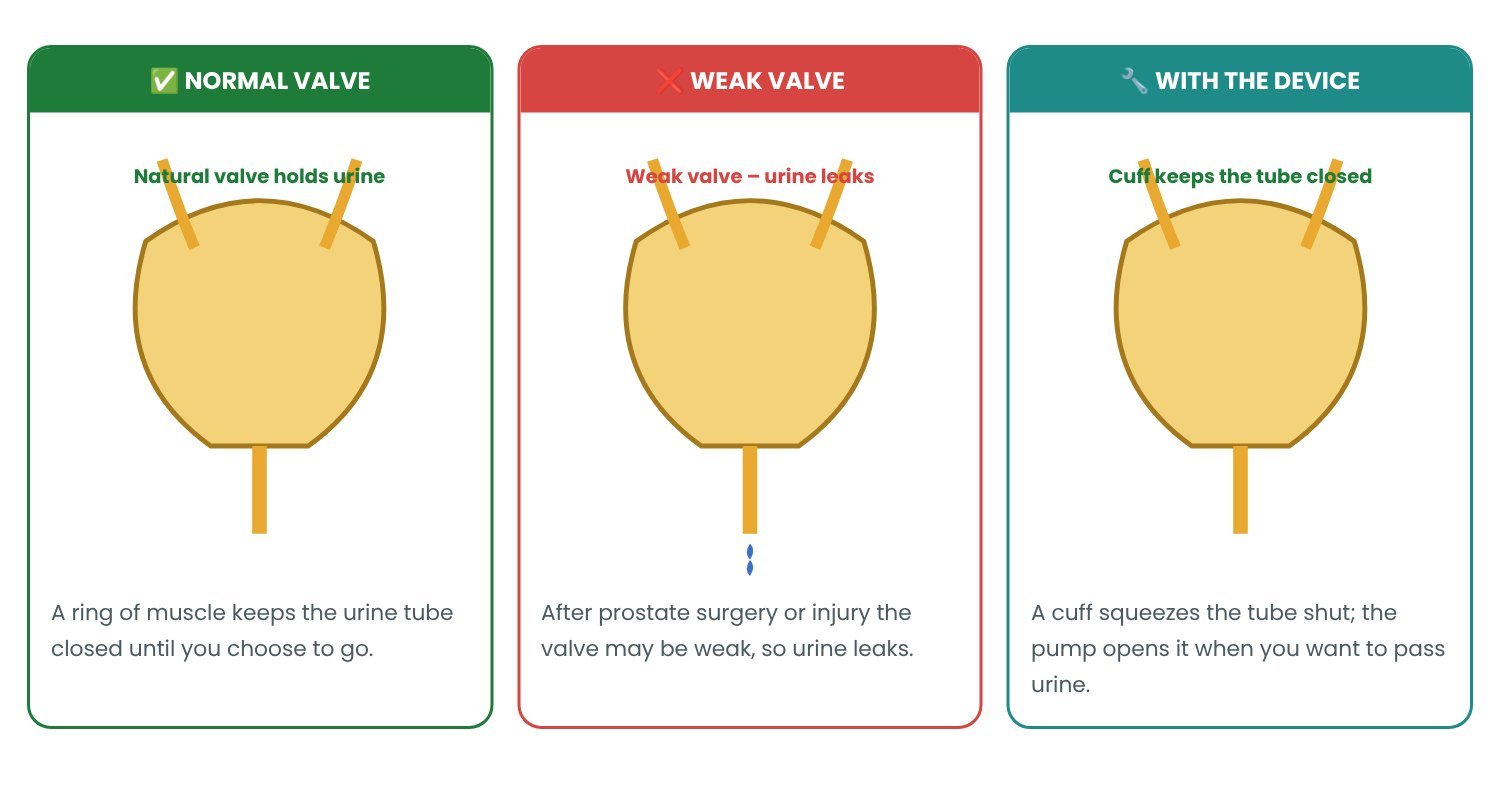
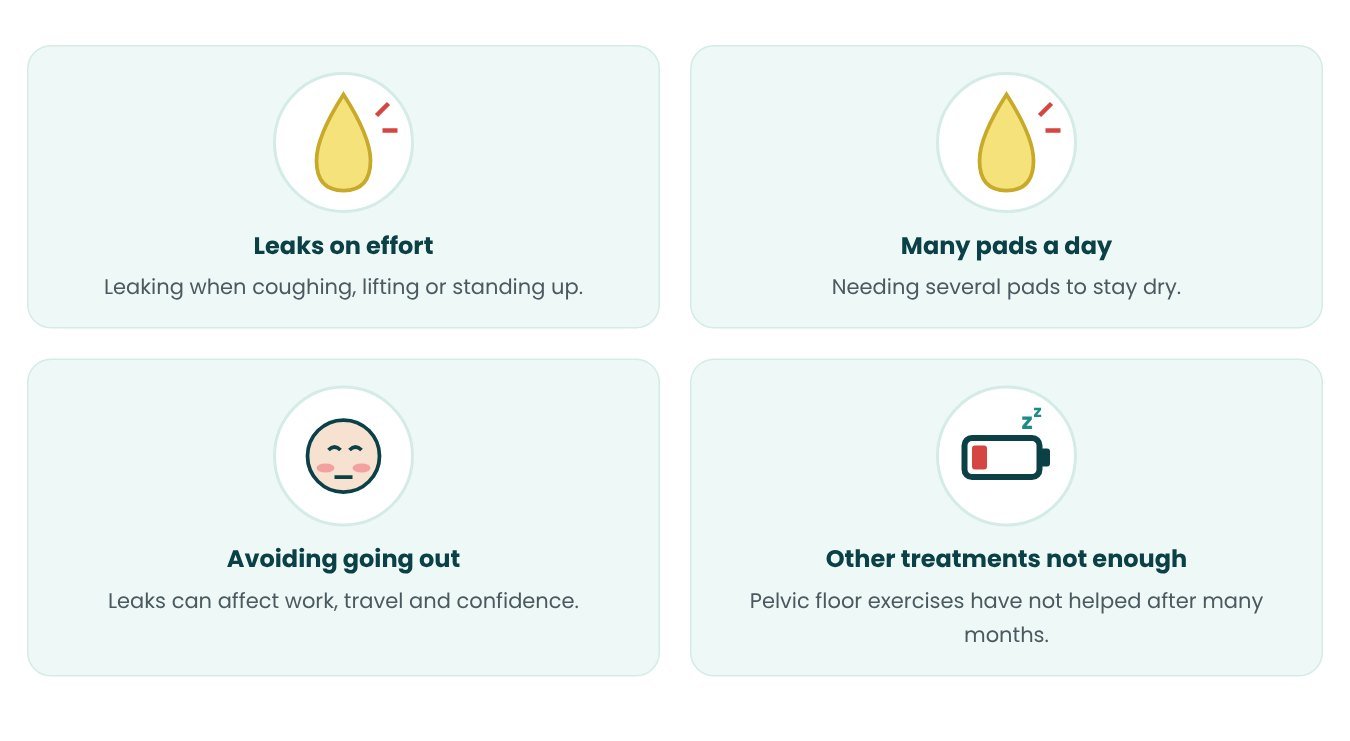
The urinary sphincter is a ring of muscle around the urethra (the tube that carries urine out) that stays closed to hold urine in the bladder. If this muscle is damaged – most commonly after radical prostatectomy for prostate cancer, prostate radiation or TURP, or after pelvic injury – urine leaks when you cough, sneeze, stand up, walk or lift. This is called stress urinary incontinence. Severe leakage can mean using many pads a day and affects work, prayer, travel and sleep.
An artificial urinary sphincter (AUS), such as the AMS 800, is a small, fluid-filled device placed fully inside the body. It has three parts: an inflatable cuff around the urethra that keeps it closed, a pump in the scrotum (or labia in women) and a balloon reservoir in the lower abdomen. When you want to pass urine, you squeeze the pump; the cuff opens, the bladder empties, and the cuff closes again automatically within a few minutes. It is regarded as the gold-standard treatment for moderate to severe male stress incontinence.
🖼️ Understand It in Pictures
Normal valve vs leaking, and after the device
👀 Symptoms in Pictures
🎬 The Treatment Journey in Pictures

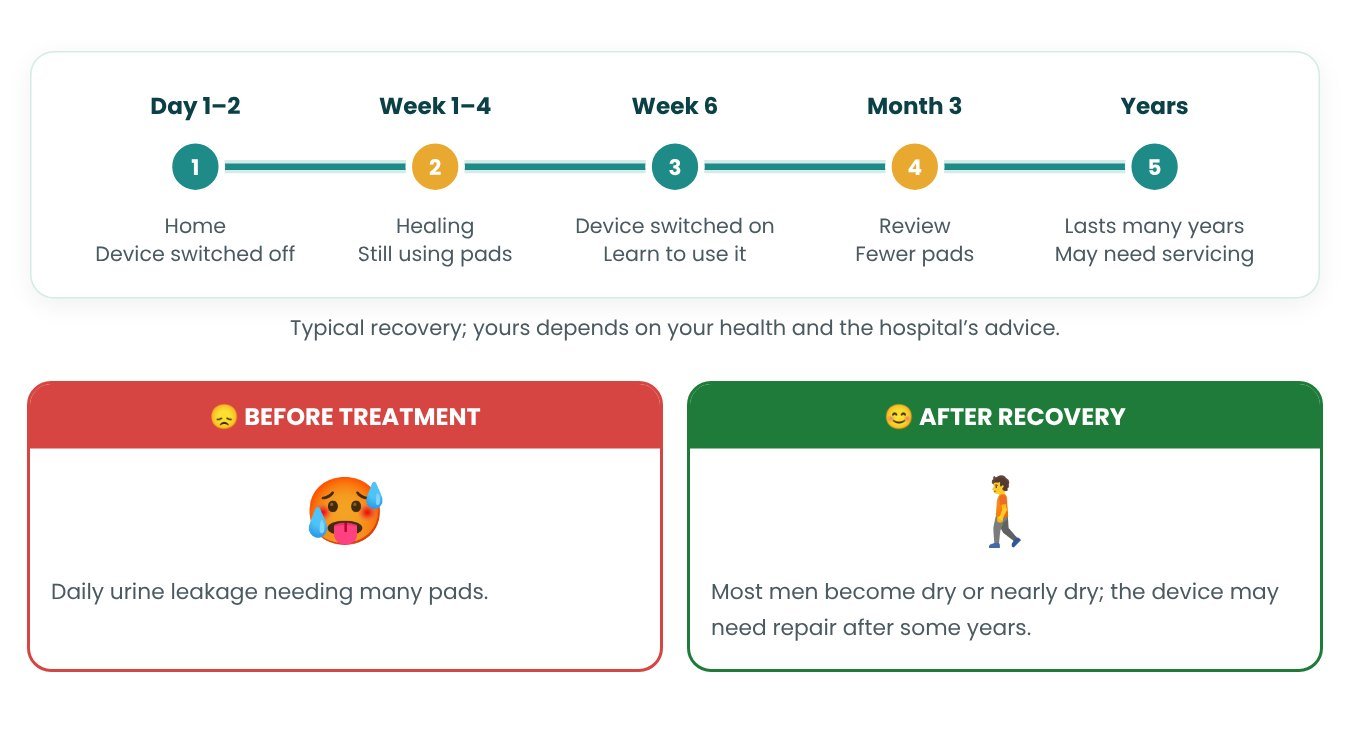
📅 Recovery at a Glance
🩺 Conditions Treated
⚠️ Signs You May Need an Artificial Sphincter
- ➤Leaking urine when coughing or sneezing
- ➤Leaking when standing up or walking
- ➤Using 3 or more pads a day
- ➤Leakage continuing a year after prostate surgery
- ➤Wet at night or during prayer
- ➤Skin rash from constant wetness
- ➤Avoiding travel or social life
- ➤Pelvic floor exercises have not helped
🔬 Tests Before Treatment
| Test | Why it is done |
|---|---|
| Urology consultation and pad test | Measures how much urine you leak in 24 hours. |
| Urodynamic study | Checks bladder pressure and capacity and confirms stress incontinence. |
| Cystoscopy | Looks inside the urethra and bladder neck for narrowing (stricture) that must be fixed first. |
| Urine culture | Any urinary infection must be treated before an implant. |
| PSA (after prostate cancer) | Confirms the cancer is controlled before surgery. |
| Blood tests, ECG and chest X-ray | Check fitness for anaesthesia. |
| Hand function check | You must be able to squeeze the pump easily. |
🏥 The Procedure — Step by Step

⚖️ Treatment Options for Male Stress Incontinence
| Option | What is done | Best for |
|---|---|---|
| Artificial urinary sphincter (AMS 800) | Inflatable cuff, pump and reservoir control urine flow | Moderate to severe leakage; after radiation |
| Tandem / double cuff AUS | Two cuffs placed for extra closure | Very severe leakage or revision cases |
| Male sling (e.g. AdVance) | Mesh tape supports and repositions the urethra | Mild to moderate leakage, no radiation |
| Pelvic floor muscle training | Supervised Kegel exercises and biofeedback | First 6–12 months after prostate surgery |
| Bulking injections | Material injected to narrow the urethra | Very mild leakage; short-lived results |
📅 Your Day-by-Day Plan in India
| Day | What happens |
|---|---|
| Day 1 | Arrival in India ✈️, airport pick-up and hotel check-in |
| Day 2 | Urology consultation, pad test, urine culture and blood tests |
| Day 3 | Cystoscopy and urodynamic study; final surgical plan |
| Day 4 | Admission and artificial urinary sphincter implantation 🏥 |
| Day 5 | Hospital stay (2 days): catheter removed, walking, discharge |
| Day 6–11 | Hotel rest; scrotal support; antibiotics; device remains OFF |
| Day 11–13 | Wound check and review; activation plan explained |
| Day 12–14 | Fly home ✈️ (activation at about 6 weeks, in India or with your local urologist) |
🌱 Recovery After Treatment
🏆 Success Rate
| Outcome | Result |
|---|---|
| Dry or 0–1 pad per day | About 60–80% |
| Significant improvement in leakage | About 85–90% |
| Patient satisfaction | About 85–90% |
| Device working at 10 years without revision | About 60–75% |
| Infection or erosion | About 3–5% (higher after radiation) |
Results are best when leakage is caused by sphincter weakness alone, the urethra has not had radiation, and the patient can operate the pump easily. Radiation, previous urethral surgery and diabetes increase the risk of erosion or infection.
🩹 Risks & Possible Complications
AUS implantation is a well-established operation; most problems can be corrected.
- •Scrotal swelling and bruising for 1–3 weeks – common
- •Urinary retention right after surgery – about 1–5%, short-term catheter
- •Infection of the device – about 1–3%, usually needs removal
- •Erosion of the cuff into the urethra – about 3–5%, higher after radiation
- •Urethral atrophy causing recurrent leakage over time – about 5–10%, cuff may be resized
- •Mechanical failure – about 20–30% over 10 years, fixed by revision surgery
- •Need for the pump to be squeezed every time you pass urine – lifelong
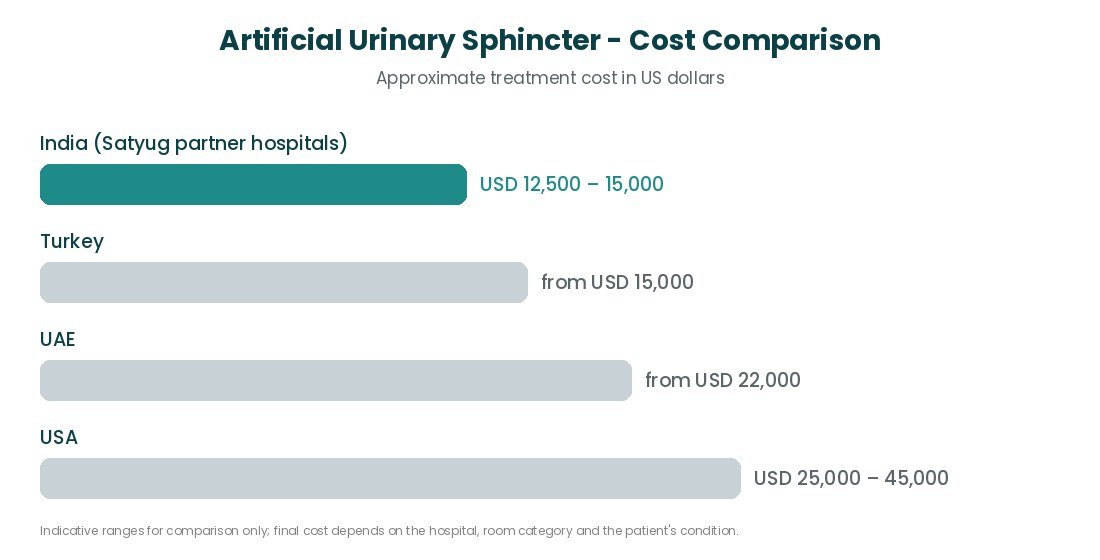
💰 Cost of Artificial Urinary Sphincter in India
The cost of artificial urinary sphincter implantation in India starts from about USD 12,500. This includes the imported AMS 800 device (the main part of the cost), surgery, anaesthesia, a 2-day stay in a semi-private room, routine medicines and antibiotics. Urodynamic studies, cystoscopy, double-cuff surgery and revision of an old device cost extra.
| Option / Hospital tier | Approx. cost (USD) | Hospital stay | Notes |
|---|---|---|---|
| AMS 800 AUS implantation (this package) | 12,500 | 2 days, semi-private room | Single cuff, standard case |
| AUS with private room / premium hospital | 13,500 – 15,000 | 2–3 days, private room | Top-tier JCI hospital |
| Tandem (double) cuff or revision AUS | 14,000 – 17,000 | 2–3 days | Very severe leakage or previous AUS |
| Male sling (alternative) | 5,000 – 7,000 | 1–2 days | For mild to moderate leakage |
📋 What the Package Includes
- ✔AMS 800 artificial urinary sphincter device
- ✔Surgeon and anaesthesia fees
- ✔2-day stay in a semi-private room
- ✔Operation theatre and consumables
- ✔Routine medicines and IV antibiotics
- ✔Nursing care and meals in hospital
- ✔Wound check before flying
- ✔Free airport pick-up, visa letter and interpreter
- ✖Urodynamic study and cystoscopy
- ✖Treatment of urethral stricture
- ✖Double cuff or revision surgery
- ✖Extra hospital days
- ✖Activation visit if done in India later
- ✖Medicines after discharge
- ✖Hotel, flights and food
- ✖Attendant's stay and meals
✈️ Your Medical Travel Process with Satyug Healthcare

| Step | Details |
|---|---|
| 1. Send reports | Details of your leakage (pads per day, 24-hour pad test if done), prostate surgery and radiation history with dates, recent PSA, urine culture, urodynamic and cystoscopy reports if available, kidney function and your full medical history and medicines. |
| 2. Free opinion & quotes | Within 48-72 hours you receive opinions and cost estimates from 3-5 leading hospitals to compare. |
| 3. Choose hospital & doctor | We help you compare doctors, success rates, room options and total budget. |
| 4. Medical visa | The hospital issues a Visa Invitation Letter (VIL) to the Indian Embassy. The patient and up to 2 attendants apply for an e-Medical / Medical Attendant visa. |
| 5. Travel planning | Flight guidance, wheelchair assistance, airport pick-up, hotel or guest house near the hospital. |
| 6. Treatment in India | Your coordinator and interpreter stay with you for admission, treatment, discharge and billing. |
| 7. Return & follow-up | Fit-to-fly letter, medicines, and online follow-up with your doctor after you return home. |
🎒 Travel Checklist
- 📌Valid passport (6+ months) for the patient and attendants, plus 10 passport-size photos each
- 📌Medical visa / e-visa and the hospital’s Visa Invitation Letter
- 📌All urology reports, PSA results, urodynamic and cystoscopy reports, surgery notes and prescriptions
- 📌Yellow fever vaccination certificate (mandatory for travellers from African countries)
- 📌Polio vaccination certificate where applicable
- 📌Declare cash above USD 5,000 at the airport; hospitals accept wire transfer and cards
- 📌Foreigners staying longer than permitted must register with the FRRO — our team assists
⭐ Why Choose Satyug Healthcare?
❓ Frequently Asked Questions
➤ How much does artificial urinary sphincter surgery cost in India?
➤ How does the AUS work?
➤ Will I be dry straight after surgery?
➤ How long will I stay in hospital and in India?
➤ Who is a good candidate?
➤ Is the surgery painful?
➤ How long does the device last?
➤ What are the main risks?
➤ Can I have an AUS after radiotherapy?
➤ Is an AUS available for women?
➤ When can I return to work?
➤ How many attendants can come with me?
➤ What precautions are needed after going home?
Medical disclaimer: This page is for general information and does not replace a consultation with a qualified specialist. Treatment plans and costs are confirmed only after the patient is examined. Sources: NCBI StatPearls: Artificial Urinary Sphincter; NCBI StatPearls: Stress Urinary Incontinence; NHS: Urinary incontinence treatment; Mayo Clinic: Male urinary incontinence; Cleveland Clinic: Artificial Urinary Sphincter; AUA/SUFU Guideline on Incontinence after Prostate Treatment (2019, amended 2024); EAU Guidelines on Urinary Incontinence in Adults; Van der Aa F et al., European Urology 2013. Infographics: Satyug Healthcare.
Artificial urinary sphincter (AMS 800) in India from USD 12,500. Gold-standard fix for leakage after prostate surgery, 2-day stay, free opinion & visa help.


































![Dr. Mithilesh Yadav [MBBS, MS, MCh - Urology] - Doctor at Satyug Healthcare](https://satyughealthcare.com/uploads/doctors/7cb73de23766d100e6ab6a857cf4d406.jpg)








































































































































































































































































































































































































TOP HOSPITALS
Special High-quality Hospitals


HAPPY PATIENTS
What Our Patients Are Saying






























Our Gallery