When a Bladder Infection Travels Up to the Kidney
⚡ Quick Facts: Pyelonephritis is a bacterial infection of the kidney itself, most often caused by bacteria travelling up from the bladder. E. coli is responsible for roughly 80% of cases. It is more common in women due to a shorter urethra, but can affect anyone, and requires prompt treatment to prevent kidney damage or sepsis.
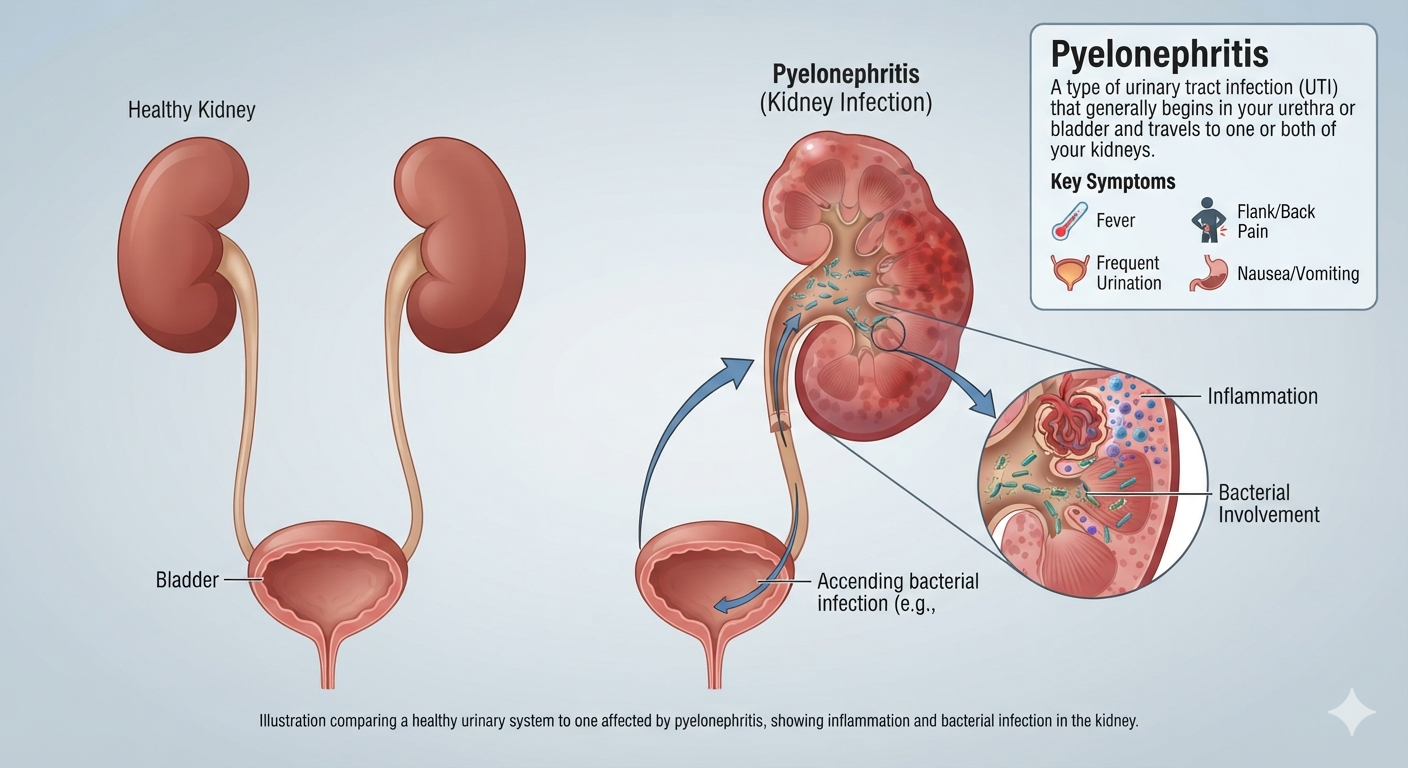
Pyelonephritis is inflammation of the kidney tissue and the renal pelvis (the funnel-shaped area where urine collects before draining to the bladder), almost always caused by a bacterial infection. It typically begins as a simple bladder infection (cystitis) that spreads upward through the ureters to one or both kidneys. It can be acute (sudden, short-lived) or chronic (recurrent, leading to long-term scarring, usually associated with an underlying structural problem like vesicoureteral reflux or obstruction).
🔴 Classic Symptoms
|
🟠 Other Possible Signs
|
| Complication | Risk Level |
|---|---|
| Sepsis / urosepsis (infection spreading to the blood) | HIGH |
| Renal / perinephric abscess | MODERATE |
| Emphysematous pyelonephritis (gas-forming infection, mainly in diabetics) | HIGH |
| Chronic pyelonephritis / kidney scarring | MODERATE |
| Acute kidney injury | MODERATE |
| 🩺 | Test | What It Shows |
|---|---|---|
| 🧪 | Urinalysis & Urine Culture | Confirms infection and identifies the exact bacteria |
| 🩸 | Blood Tests & Blood Culture | Checks for spread of infection into the bloodstream |
| 📡 | Ultrasound | Checks for obstruction, abscess, or stones |
| 🖥️ | CT Scan | Used in severe or non-responding cases to look for abscess/complications |
🔴 Seek urgent medical care if you have fever with flank pain, persistent vomiting, confusion, or symptoms not improving within 48–72 hours of starting antibiotics — these can signal a spreading or complicated infection.
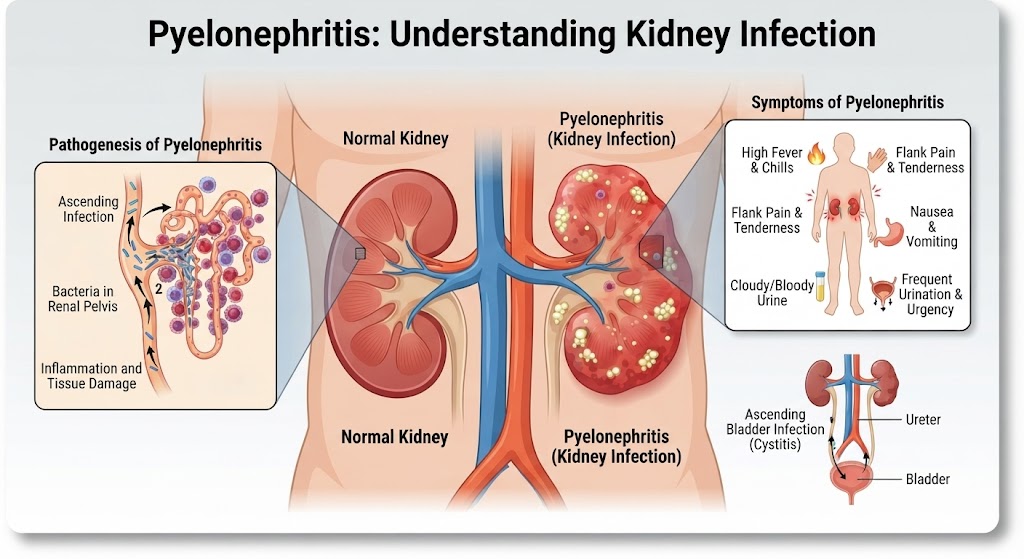
With prompt antibiotic treatment, most cases of acute pyelonephritis resolve completely within one to two weeks without lasting kidney damage. Delayed treatment, recurrent infections, or an underlying obstruction can lead to scarring and, over time, chronic kidney disease — which is why identifying and correcting any underlying cause is an important part of treatment.
Our partner urologists and nephrologists provide rapid diagnosis and treatment of kidney infections, including management of underlying stones, obstruction, or reflux, for international patients.
📞 International Patient Helpdesk: +91-8860606766 | +91-9910655125
This article is for general educational purposes and is not a substitute for professional medical advice, diagnosis, or treatment. Seek prompt medical care for suspected kidney infection.