Assistance
Consultation
Services
Opinion
Care Coordination
What will your treatment cost?
Bilateral Renal Microlithiasis: Causes, Symptoms, Diagnosis & Treatment
Released Date: 2026-08-14
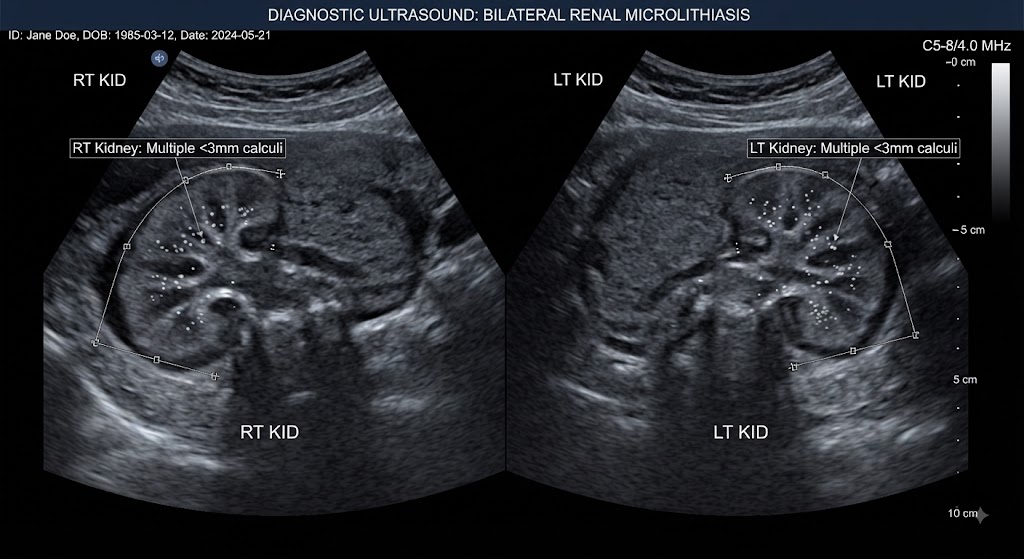
💎 Bilateral Renal Microlithiasis
Tiny Crystals in Both Kidneys — What They Mean
⚡ Quick Facts: Renal microlithiasis refers to tiny stone-forming particles — typically under 3 mm — seen as small bright (hyperechogenic) spots inside the kidneys on ultrasound. When these are found in both kidneys, it is called bilateral renal microlithiasis. Many people have no symptoms at all; it is often an incidental finding.
📖 What Is Renal Microlithiasis?
Kidney stones don't appear overnight — they usually start as microscopic crystals that clump together in the tiny collecting tubules and calyces of the kidney. When these early clusters are large enough to see on ultrasound (generally under 3 mm) but not yet a fully formed "stone," they're called microliths. They can be thought of as the earliest visible stage of kidney stone disease.
🧬 What Causes It?
- Low fluid intake / chronic mild dehydration — concentrates urine and encourages crystal formation
- High urinary calcium (hypercalciuria) — the most common metabolic driver
- High urinary oxalate (hyperoxaluria) — from diet or intestinal conditions
- Family history of kidney stones — genetic predisposition to stone formation
- Medullary sponge kidney — a structural condition where microliths cluster in dilated collecting ducts
- High-protein, high-salt, or high-oxalate diets (nuts, spinach, chocolate, tea, bran)
- Metabolic conditions such as hyperparathyroidism, gout, or renal tubular acidosis
🤒 Signs and Symptoms
Microlithiasis is frequently silent, but some people notice:
- Recurrent, vague abdominal or flank discomfort
- Burning or discomfort while urinating (dysuria)
- Blood in the urine, visible or microscopic (hematuria)
- Recurrent urinary tract infections
- No symptoms at all — found incidentally on a routine scan
🔍 How Is It Diagnosed?
| 🩺 | Test | What It Shows |
|---|---|---|
| 📡 | Ultrasound (KUB) | First-line test; detects tiny echogenic foci in both kidneys |
| 🩸 | Serum Calcium, Uric Acid, PTH | Screens for metabolic causes |
| 🧪 | 24-Hour Urine Study | Measures calcium, oxalate, citrate, uric acid, and volume |
| 🖥️ | Non-Contrast CT (CT-KUB) | Used if a symptomatic stone needs to be sized precisely |
💊 Treatment Options
Most bilateral renal microlithiasis is managed conservatively, with the goal of preventing progression into larger, symptomatic stones:
- High fluid intake — aiming for roughly 2.5–3.5 litres of urine output daily is the single most effective preventive step
- Dietary adjustment — reducing salt and animal protein, moderating oxalate-rich foods if urinary oxalate is high, while maintaining normal dietary calcium
- Treating the underlying metabolic cause — such as medication for hypercalciuria or hyperuricosuria once identified on 24-hour urine testing
- Citrate supplementation — for some patients, to reduce crystal formation
- Regular monitoring — periodic ultrasound to track whether microliths are stable, resolving, or enlarging
- Intervention (e.g., lithotripsy, ureteroscopy) — only if microliths progress into a larger, obstructing, or persistently symptomatic stone
🚨 When to See a Doctor
🔴 Seek urgent care for severe flank pain, fever with pain (possible infection), or visible blood in the urine. 🟡 Book a routine urology consult if microlithiasis is found incidentally, especially with a personal or family history of stones.
📈 Prognosis
Outlook is generally excellent. With adequate hydration and correction of any underlying metabolic imbalance, many microliths remain stable or even resolve, and progression to larger, symptomatic stones can often be prevented. Without any preventive measures, a proportion of microliths (studies suggest a meaningful minority) will grow into clinically significant stones over time.
Our partner urologists offer complete metabolic work-up and personalised prevention plans for renal microlithiasis and kidney stone disease, along with advanced stone treatment when needed.
📞 International Patient Helpdesk: +91-8860606766 | +91-9910655125
This article is for general educational purposes and is not a substitute for professional medical advice, diagnosis, or treatment. Always consult a qualified urologist about kidney stone findings on your scan.
Related Blogs



HAPPY PATIENTS
What Our Patients Are Saying






























Our Gallery