India performs more hand transplants than any other country in the world. Here is exactly how a donor hand is matched and allocated, what surgery and recovery actually involve, what it costs, and ten real, verified cases from Indian hospitals.
Losing a hand to trauma, a burn, an electrical accident, or a workplace injury does not just take away a limb — it takes away the ability to eat unaided, write, work, and touch another person. A prosthetic can restore some function, but it cannot restore sensation. A hand transplant can.
Since 2015, India has quietly become the global leader in this procedure. Indian surgical teams have performed more upper-extremity (hand and forearm) transplants than centers in the United States or Europe, spread across nine hospitals from Kerala to Delhi. This guide walks through the entire journey — from who qualifies, to how a donor hand is found and legally allocated, to what daily life looks like five years after surgery.
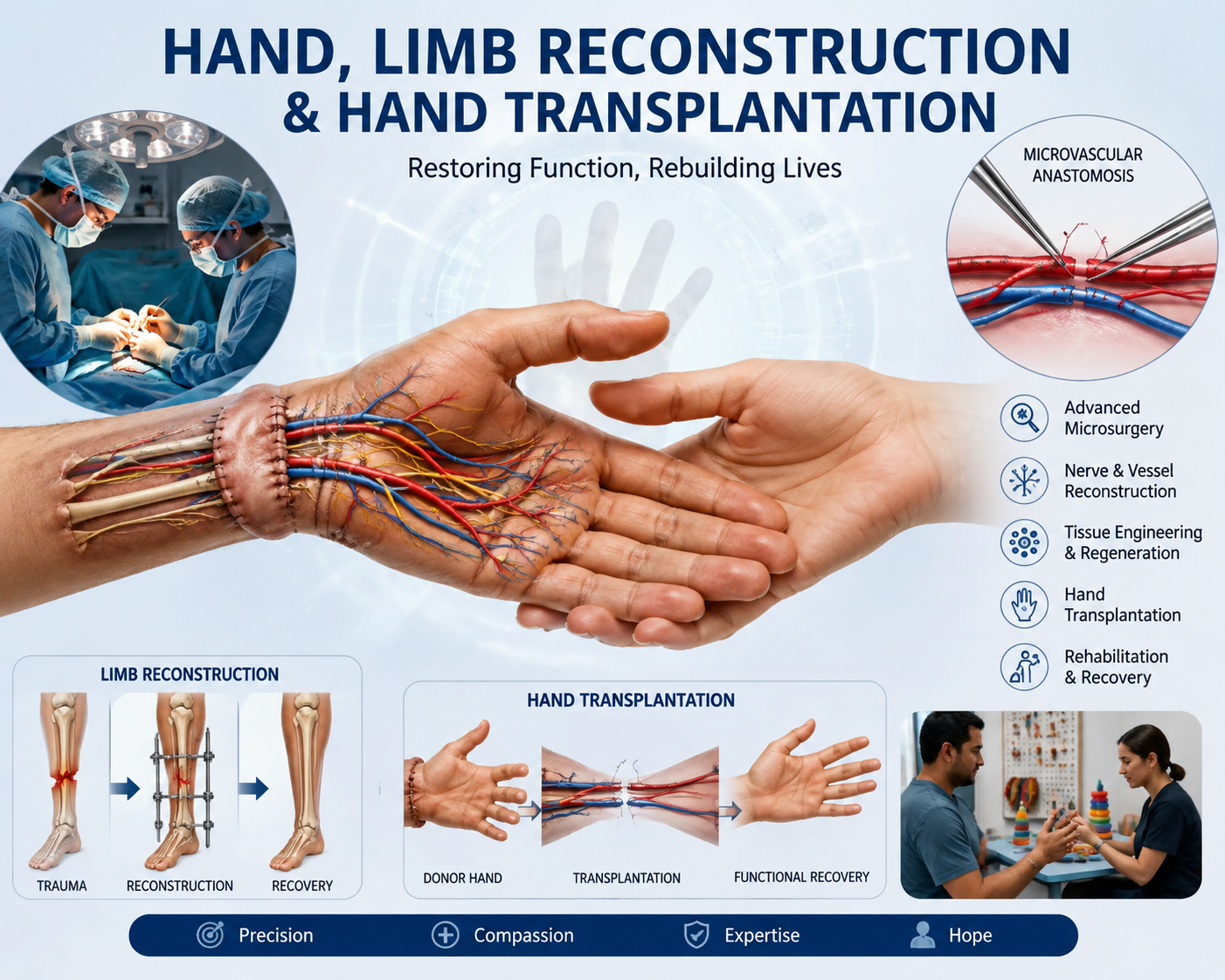
A hand transplant is medically classified as Vascularized Composite Allotransplantation (VCA) — a category distinct from solid-organ transplants like a kidney or liver. Where a kidney transplant reconnects one tissue type, a hand transplant must reconnect all of them at once inside a single limb:
Because skin is included, VCA is also more visibly immune-reactive than a solid organ — rejection often shows up as a rash or discoloration that can be seen and biopsied early, which is actually an advantage over transplants where rejection is silent until organ function drops.
Transplants can be unilateral (one hand) or bilateral (both hands), and at different levels — wrist, forearm, or, in rare complex cases, above the elbow.
Candidacy is decided by a hospital's transplant board, not by the patient alone. Common qualifying situations in India include:
Beyond the physical wound, evaluators look for two things: whether the person's body can tolerate lifelong immunosuppressive medication, and whether they are psychologically prepared for a multi-year rehabilitation process and the reality of living with a donor's hand. Candidates for whom a prosthetic has already failed, or who have lost their dominant hand or both hands, are generally considered stronger candidates.
A hand donor is a brain-dead individual whose family has given separate, specific consent for limb donation — this is not bundled automatically with consent for organs like the heart or kidneys, because donating a visible body part carries different emotional weight for families. Several of the verified Indian cases below involved families who initially hesitated specifically because the hands are visible, before consenting.
Matching a donor hand to a recipient considers:
Before a patient is even placed on a waiting list, a multidisciplinary hospital board evaluates them. This typically includes:
| Specialist | What they assess |
|---|---|
| Hand / micro-surgeon | Surgical feasibility, stump condition, bone and vessel quality |
| Immunologist | Tissue typing, rejection risk, drug tolerance |
| Psychiatrist / psychologist | Mental readiness for a visible transplant and lifelong therapy |
| Physiotherapist | Rehabilitation potential and commitment |
| Nephrologist (if relevant) | Only for patients with an existing organ transplant, to check drug interactions |
Unlike registering for a driving license or a general database, a patient cannot register directly on any public organ registry for a hand transplant. Registration only happens after a hospital's board has completed the full evaluation above and formally lists the patient.
Until recently, India had no dedicated national registry entry for hand transplants. That changed when NOTTO (National Organ and Tissue Transplant Organization), under the Union Health Ministry, began registering hand-transplant patients under the "bone" category of its tissue transplant system. Dr. Subramania Iyer — who led India's first hand transplant in 2015 — publicly welcomed the move, noting that a registry and pan-India allocation "will give boost to the donation as well as the proper utilisation of donated hands."
In practice, allocation works in two layers:
Real example: Because compatible donor-recipient pairs are rare, donor hands are frequently flown across states — from Thane to Faridabad, from Surat to Faridabad, and by chartered flight from Chennai to Mumbai in cases documented below. This cross-state logistics chain is exactly what the new NOTTO registry is designed to make faster and more transparent.
Because hand transplantation demands microsurgical expertise and 24/7 post-operative monitoring, only a handful of hospitals are authorized and equipped for it. Notable programs include Amrita Hospitals (Kochi and Faridabad-NCR), Gleneagles Hospitals (Mumbai and Chennai), Stanley Medical College and Hospital (Chennai — India's first government-hospital program), Sir Ganga Ram Hospital (Delhi — first in North India), IPGMER-SSKM Hospital (Kolkata), KEM Hospital (Mumbai — first public hospital in the city), and JIPMER (Puducherry).
Two surgical teams operate in parallel — one preparing and harvesting the donor limb, the other preparing the recipient's stump — so the transplant can proceed the moment both are ready. The reattachment then follows a fixed microsurgical sequence:
Duration depends on whether the transplant is unilateral or bilateral, and how high up the arm the connection is made. Real durations from Indian cases range from 12 to 24 hours:
| Case | Hospital | Duration |
|---|---|---|
| Raju (bilateral) | Sir Ganga Ram, Delhi | 12 hours |
| Narayanaswamy (bilateral) | Stanley Medical, Chennai | 13 hours |
| Basavanna Gowda (bilateral) | Amrita, Kochi | 14 hours |
| Manu (bilateral) | Amrita, Kochi | 16 hours |
| Nidhi Nayak (bilateral) | Amrita, Kochi | 16 hours |
| Monika More (bilateral) | Global Hospital, Mumbai | 16 hours |
| Gautam Tayal (unilateral, kidney recipient) | Amrita, Faridabad | 17 hours |
| Kishore (unilateral) | Amrita, Kochi | 18 hours |
Surgery restores the plumbing and structure; rehabilitation is what actually restores function. Occupational and physical therapy typically starts within 48 hours of surgery and continues 5–7 days a week in the early months.
Recovery generally follows this order:
Functional and sensory improvement can continue for up to five years after surgery.
Every hand transplant recipient takes immunosuppressive medication — typically a combination from the same drug classes used in kidney and liver transplants (a calcineurin inhibitor such as tacrolimus, an antiproliferative agent, and a corticosteroid) — for the rest of their life. This is non-negotiable: stopping the medication leads to rejection.
A notable precedent: Gautam Tayal, transplanted at Amrita Hospital, Faridabad in December 2023, had already been on immunosuppression for a decade following a kidney transplant. His case showed that a hand transplant can be layered onto an existing organ-transplant drug regimen without destabilizing the earlier transplant — a first for India and only the world's second such case.
Published outcomes data (largely from global VCA registries, consistent with what Indian centers report) show:
Real outcomes from Indian cases put numbers into context: Manu, India's first double hand transplant recipient, went on to work as a transplant coordinator. Narayanaswamy was appointed a ward supervisor at a government hospital by the Tamil Nadu Chief Minister after his recovery. Basavanna Gowda described his transplant as "a new lease of life" after a decade of disability.
This cost gap is one of the most distinctive features of India's hand transplant program: government hospitals performing hand transplants provide free immunosuppressive medication for life, dramatically lowering the total cost of care compared to private centers in India and to VCA programs abroad.
India has already treated at least one high-profile international hand transplant patient: Abdul Rahim, a captain in the Afghan security forces who lost both hands defusing landmines, traveled to Kochi and waited four months for a donor match before a 15-hour bilateral transplant at Amrita Institute of Medical Sciences in April 2015.
The following ten cases are drawn from hospital press releases and mainstream news coverage, cross-checked against multiple sources.
Manu, then 30, lost both hands after being pushed from a moving train while defending a woman passenger from harassment. In a 16-hour surgery involving over 20 surgeons, he received both forearms from a brain-dead donor. He regained finger movement, wrote a thank-you note to his donor's family, and later became a transplant coordinator himself.
Abdul Rahim, a 30-year-old captain in the Afghan security forces, lost both hands while defusing landmines. He traveled to Kochi and waited four months for a compatible donor before a 15-hour transplant led by Dr. Subramania Iyer. He regained considerable function after roughly 9–10 months of intensive physiotherapy.
Narayanaswamy, 29, lost both hands to electrocution in 2015. A 70-member team led by Dr. V. Ramadevi performed a 13-hour transplant, with the donor's family overcoming initial hesitation rooted in cultural attitudes toward visible organ donation. A year later he could move his hands voluntarily and was appointed ward supervisor at a government hospital.
Monika, 24, lost both hands in 2014 after falling into a platform gap at Ghatkopar railway station. Donor hands were flown by chartered flight from Chennai to Mumbai for her 16-hour transplant led by Dr. Nilesh Satbhai. She was walking with arm support within three days of surgery.
Basavanna Gowda, 34, lost both hands below the elbow in a high-tension electrical accident at a Bellary rice mill in 2011. A decade later, he received a 14-hour bilateral transplant — Amrita's ninth — from a donor who died on holiday in India. He called it "a new lease of life."
Nidhi Nayak, 23, from Madhya Pradesh, suffered severe burns and bilateral amputation from an electric shock at home in June 2022. She received Amrita's 15th hand transplant, a 16-hour procedure, and was discharged after roughly six weeks of rehabilitation.
Gautam Tayal, 64, lost his left hand in a factory accident and had received a kidney transplant a decade earlier. His 17-hour surgery — joining two bones, two arteries, 25 tendons, and five nerves — used a donor hand flown in from Thane. It is only the world's second recorded case of a hand transplant in a prior organ-transplant recipient.
Devansh Gupta, 19, lost both upper limbs and part of his right leg in a train accident three years earlier. He received a double hand transplant using donor limbs flown from Surat; his surgical team projected 6–18 months for functional recovery plus a full year of physiotherapy.
Raju, 45, a painter from Nangloi, lost both arms after being run over by a train in 2020. He received donor hands from a retired school vice-principal in a 12-hour surgery led by Dr. Mahesh Mangal, and was discharged after about six weeks.
It is a surgical procedure — formally called Vascularized Composite Allotransplantation (VCA) — that replaces an amputated hand with one from a deceased donor, reconnecting bone, blood vessels, tendons, nerves, and skin.
People who have lost one or both hands to trauma, burns, electrocution, blast injury, or sepsis, and who pass a full medical and psychological evaluation confirming they can tolerate lifelong immunosuppression and intensive rehabilitation.
Published outcomes report graft/patient survival above 90%, with roughly 90% of recipients regaining protective touch sensation and about 82% regaining fine touch discrimination.
Between 12 and 24 hours, depending on whether it is unilateral or bilateral and how high up the arm the reconnection is made. See the duration table above for real Indian cases.
It is intended to be permanent, but it requires lifelong immunosuppressive medication and monitoring to prevent rejection; chronic rejection can, in rare cases, still lead to graft failure years later.
Yes, in most cases. Sensation returns gradually as nerves regenerate at roughly 1mm per day, starting with pressure and progressing to temperature, texture, and eventually fine touch in many patients.
Nerves regrow at approximately 1 millimeter per day, so the distance from the surgical site to the fingertips determines the timeline — often many months to a few years for full sensory return.
Most recipients regain functional movement — grip, basic dexterity, and daily-task capability — though fine motor control continues to improve for up to five years and varies by patient.
Intensive therapy typically runs 5–7 days a week in the first months, tapering over time, with continued functional gains possible for up to five years after surgery.
Yes. Immunosuppression must be continued for as long as the transplanted hand is retained; stopping it leads to rejection.
Acute and chronic rejection, infection, blood clots, and side effects from lifelong immunosuppressive drugs (including increased risk of diabetes, high blood pressure, and infection susceptibility).
Roughly ₹15–30 lakh at private hospitals, plus about ₹15,000/month in ongoing medication. Government hospitals such as Stanley Medical, KEM, JIPMER, and SSKM provide immunosuppressive drugs free of cost, substantially lowering total lifetime cost.
Yes — India has performed more hand transplants than any other country, across nine authorized hospitals including Amrita Hospitals, Gleneagles Hospitals, Sir Ganga Ram Hospital, Stanley Medical College, KEM Hospital, SSKM Hospital, and JIPMER.
A prosthetic is a mechanical or bionic device attached externally; it restores some function but not biological sensation. A transplant is living tissue from a donor, capable of restoring genuine touch sensation over time, but requiring lifelong immunosuppression that a prosthetic does not.
Through a Medical e-Visa (or embassy visa for longer stays), supported by a hospital invitation letter, medical records, and a referral from a home-country physician. Up to two attendants can accompany the patient on a Medical Attendant Visa, and FRRO registration is required within 14 days of arrival.
India's hand transplant program has grown from a single landmark case in 2015 to the largest volume of any country in the world, spread across both private and government hospitals. The launch of a dedicated NOTTO registry in September 2024 marks the next phase — moving from hospital-by-hospital coordination to a transparent, pan-India allocation system. As techniques for minimizing lifelong immunosuppression and speeding nerve regeneration continue to advance, and as government-hospital programs make the procedure more accessible, hand transplantation is likely to become a mainstream reconstructive option for eligible amputees across the country, rather than the rare, headline-making event it was a decade ago.