Understanding a Common Ultrasound Report Finding
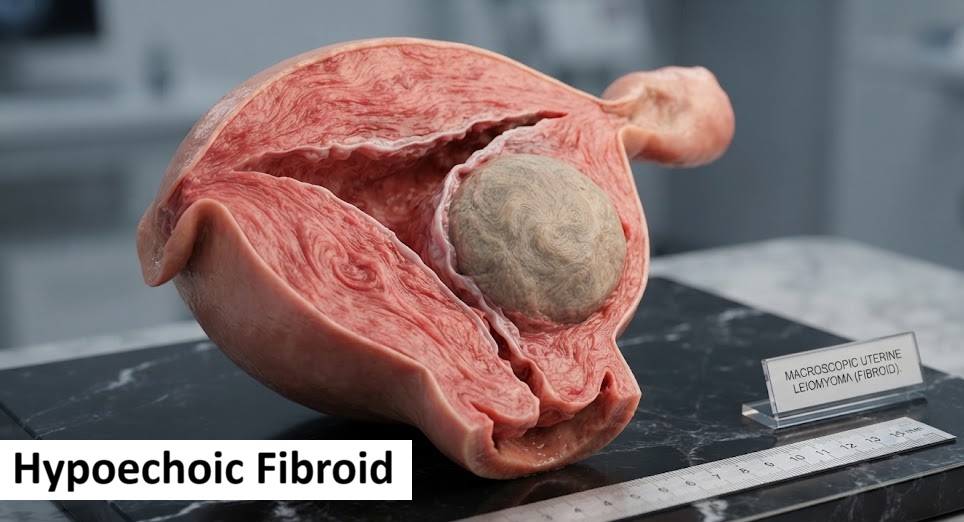
⚡ Quick Facts: A "hypoechoic fibroid" is simply a uterine fibroid (leiomyoma) that appears darker than the surrounding uterine muscle on ultrasound. Fibroids are extremely common — studies suggest up to 70–80% of women will develop at least one by age 50, though many never cause symptoms.
On ultrasound, tissues are described by how bright or dark they appear (their "echogenicity") compared to the surrounding tissue. Fibroids are benign, solid growths of smooth muscle and fibrous tissue in or around the uterus, and they typically appear as hypoechoic (darker) or heterogeneous, solid masses because they are denser than the surrounding normal myometrium. Some fibroids are hyperechoic (brighter) if they have calcified or degenerated. "Hypoechoic" is a description of appearance, not a separate diagnosis — it simply confirms the mass is fibroid tissue rather than a fluid-filled cyst.
| Type | Location |
|---|---|
| Submucosal | Just under the inner uterine lining; most likely to cause heavy bleeding and infertility |
| Intramural | Within the uterine muscle wall — the most common type |
| Subserosal | Outer surface of the uterus; may press on the bladder or bowel |
| Pedunculated | Attached by a stalk, inside or outside the uterus |
Many fibroids, including hypoechoic ones, cause no symptoms and are found incidentally. When symptoms occur, they may include:
| 🩺 | Test | What It Shows |
|---|---|---|
| 📡 | Transvaginal/Pelvic Ultrasound | First-line test; confirms fibroid size, number, and location |
| 🧲 | MRI | Maps fibroids precisely before surgery or embolization |
| 🔬 | Hysteroscopy | Directly visualizes and can remove submucosal fibroids |
| 🩸 | Blood Tests | Checks for anemia from heavy bleeding |
🔴 See a gynecologist if you have heavy periods soaking through pads/tampons hourly, severe pelvic pain, signs of anemia (fatigue, dizziness, pale skin), or you're trying to conceive and have a known fibroid.
Fibroids are benign and almost never turn cancerous. Many shrink naturally after menopause as estrogen levels fall. With the range of treatments available today — from medication to minimally invasive procedures — most women achieve good symptom control while preserving fertility if desired.
Our partner gynecologists offer complete fibroid evaluation and the full range of treatment options — from myomectomy to uterine artery embolization — for international patients.
📞 International Patient Helpdesk: +91-8860606766 | +91-9910655125
This article is for general educational purposes and is not a substitute for professional medical advice, diagnosis, or treatment. Always consult a qualified gynecologist about fibroid findings on your scan.