Bidirectional Glenn Surgery Package
Assistance
Consultation
Services
Opinion
Care Coordination
What will your treatment cost?

See the cost breakdown by option, hospital and city →
| Surgery Name | Cost | Room | Hospitalization |
|---|---|---|---|
| Bidirectional Glenn Surgery Package | USD 5500 - USD 6000 | Semi-Private | Stay in hospital: 8-10 Days | Stay in India: 3-4 weeks |
✓ Inclusion
- ✔Consultation with a paediatric cardiologist and paediatric cardiac surgeon
- ✔Pre-operative echocardiography, blood tests, chest X-ray and ECG
- ✔Bidirectional Glenn procedure with or without cardiopulmonary bypass
- ✔Ligation or takedown of an earlier BT shunt or PA band
- ✔Surgeon, assistant, perfusionist and cardiac anaesthetist fees
- ✔Operation theatre, heart-lung machine and standard consumables
- ✔Paediatric cardiac ICU care within the package stay
- ✔8–10 days total hospital stay in a semi-private room
- ✔Standard medicines, feeds and nursing care
- ✔Post-operative echocardiograms and X-rays
- ✔Free: airport pick-up & drop, visa invitation letter, interpreter & coordinator (Satyug Healthcare)
✗ Exclusion
- ✖Cardiac catheterisation, CT or MRI angiography
- ✖Additional procedures such as valve repair, PA reconstruction or septectomy unless quoted
- ✖Hospital or ICU days beyond 10 days
- ✖Treatment of chylothorax, prolonged effusions or other complications
- ✖Blood and blood products beyond routine use
- ✖Room upgrade to single or deluxe room
- ✖Medicines after discharge and follow-up echo visits
- ✖Air ambulance or medical escort
- ✖Flights, visa fees, hotel, food and local travel
Know More About Procedure & Surgery
Bidirectional Glenn Procedure in India
Heart surgery for babies and children born with single-ventricle defects such as tricuspid atresia and hypoplastic left heart, done by experienced paediatric cardiac surgeons at accredited children's heart centres in India – at a fraction of the cost abroad.
📖 What is the Bidirectional Glenn Procedure?
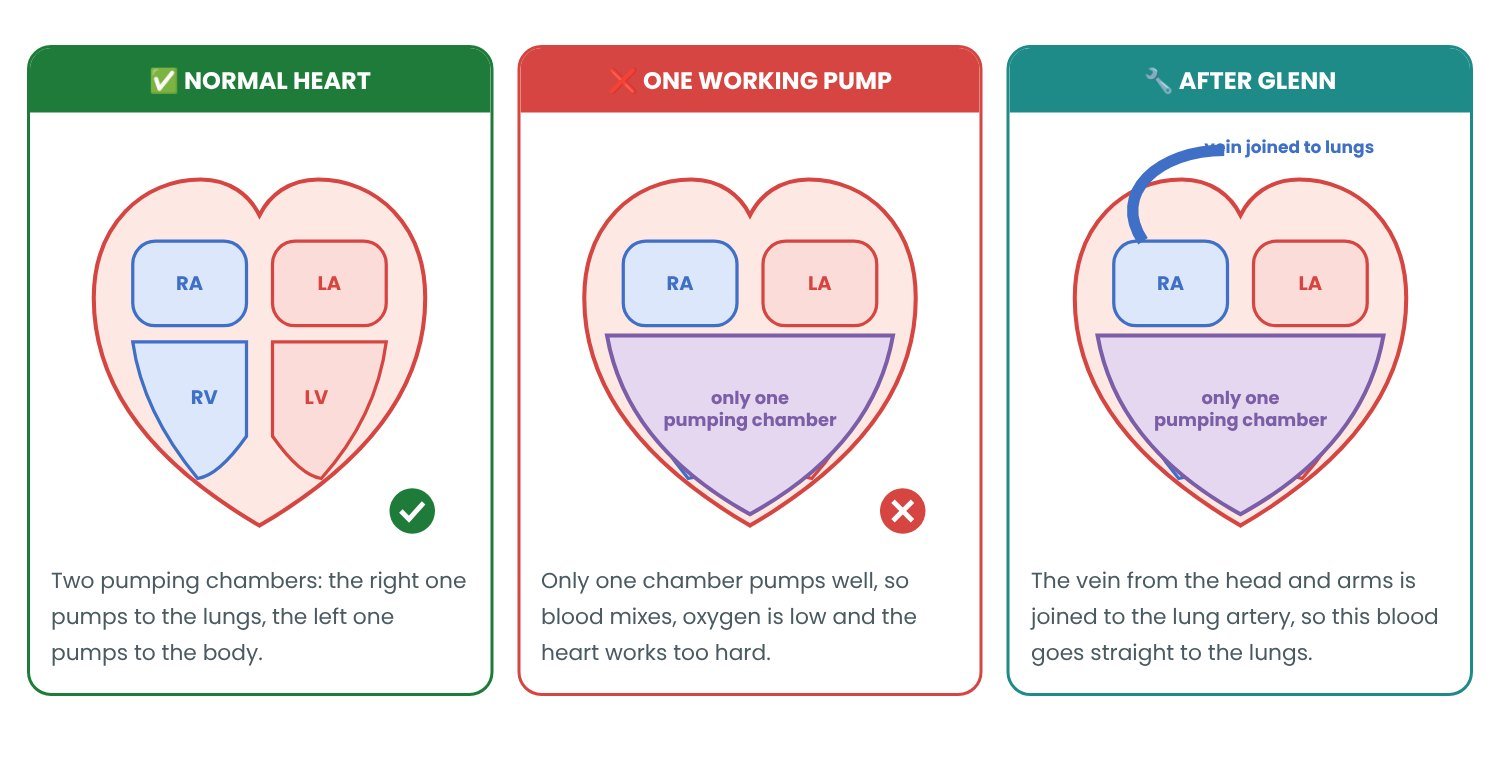
A normal heart has two pumping chambers (ventricles): the right one pumps blood to the lungs and the left one pumps blood to the body. Some babies are born with only one working ventricle – for example in tricuspid atresia, hypoplastic left heart syndrome, double inlet left ventricle or unbalanced AV canal. With one pump doing both jobs, oxygen-poor and oxygen-rich blood mix, so the child is blue (cyanotic), tires easily and may not grow well.
The bidirectional Glenn procedure (also called bidirectional cavopulmonary shunt, BDG) is usually the second of three planned operations. The surgeon disconnects the superior vena cava – the large vein bringing blood from the head and arms – from the heart and joins it directly to the pulmonary artery. This blood now flows to the lungs without needing a pump, which improves oxygen levels and reduces the workload on the single ventricle. The third stage, the Fontan operation, is usually done at 2–5 years of age.
🖼️ Understand It in Pictures
Normal heart vs single-ventricle heart
👀 Symptoms in Pictures

📷 What It Looks Like (real photos)

🩻 Scans & Tests — What Doctors See


🎬 The Treatment Journey in Pictures


📅 Recovery at a Glance

Drawings: Satyug Healthcare (simplified, not to scale). Photos: Wikimedia Commons; author and licence under each photo.
🩺 Conditions Treated
⚠️ Signs That May Need a Glenn Procedure
- ➤Blue lips, tongue or nails (cyanosis)
- ➤Oxygen saturation falling below about 75–80%
- ➤Fast breathing or breathlessness
- ➤Tiring and sweating during feeds
- ➤Poor weight gain
- ➤Outgrowing an earlier BT shunt or PA band
- ➤Frequent chest infections
- ➤Clubbing of fingers in older children
🔬 Tests Before Treatment
| Test | Why it is done |
|---|---|
| Echocardiography | Shows heart anatomy, valve leakage and pump function of the single ventricle. |
| Cardiac catheterisation | Measures lung artery pressures and size – low pressures are needed for a Glenn. |
| CT or MRI angiography | Shows the pulmonary arteries, veins and any extra vessels in detail. |
| Pulse oximetry and blood gas | Measures oxygen levels before surgery. |
| Blood tests and chest X-ray | Check blood count (haemoglobin), kidneys, clotting and lungs. |
| ECG | Records the heart rhythm before surgery. |
🏥 The Procedure — Step by Step

⚖️ Types & Techniques
| Technique | What is done | Best for |
|---|---|---|
| Bidirectional Glenn (BDG) | SVC joined to the right pulmonary artery, flow to both lungs | Most single-ventricle children at 3–6 months |
| Bilateral bidirectional Glenn | Two SVCs each joined to their own pulmonary artery | Children with a left and a right SVC |
| Hemi-Fontan | Upper heart and SVC joined to the PA with a patch | Some centres, prepares for lateral tunnel Fontan |
| Glenn with additional repair | Plus valve repair, PA reconstruction or atrial septectomy | Leaky valves or narrow pulmonary arteries |
| Fontan completion (next stage) | IVC blood also redirected to the lungs | Age 2–5 years after a Glenn |
📅 Your Day-by-Day Plan in India
| Day | What happens |
|---|---|
| Day 1 | Arrival in India ✈️, airport pick-up and hotel check-in |
| Day 2–3 | Paediatric cardiologist review, echo, blood tests; catheter study or CT if needed; admission |
| Day 4 | Bidirectional Glenn surgery 🫀 |
| Day 5–7 | Paediatric cardiac ICU: breathing tube removed, drains, heart medicines |
| Day 8–12 | Ward stay: feeding, walking or play, drain removal, echo; discharge after 8–10 days in hospital |
| Day 13–24 | Stay near the hospital, OPD visits, wound and weight checks |
| Day 25–27 | Final echo and cardiology review, medicine plan and fitness-to-fly letter |
| Day 28 | Fly home ✈️ |
🌱 Recovery After Treatment
🏆 Success Rate
| Outcome | Result |
|---|---|
| Early survival after Glenn | About 95–98% |
| Oxygen saturation after surgery | About 80–85% |
| Progress to Fontan completion | Most children (about 85–90%) |
| Pleural effusion / chylothorax | About 10–20%, mostly treated without surgery |
| Hospital stay in this package | 8–10 days |
Results depend on lung artery pressure, the pumping strength of the single ventricle, leaky valves, the size of the pulmonary arteries, the child's nutrition and the experience of the paediatric cardiac team.
🩹 Risks & Possible Complications
The Glenn is a major heart operation but is one of the safer stages of single-ventricle repair.
- •Fluid around the lungs (pleural effusion) or chylothorax – about 10–20%
- •Temporary irritability, headache or face swelling (SVC syndrome) – common early, settles
- •Low oxygen levels needing more treatment or a catheter procedure – uncommon
- •Heart rhythm problems – about 5%
- •Bleeding, infection or wound problems – about 1–3%
- •Long-term: abnormal lung blood vessels (AV malformations) lowering oxygen – corrected by Fontan
- •Risk of death – about 2–5%, higher with weak heart function or high lung pressures
💰 Cost of Bidirectional Glenn Surgery in India
The cost of bidirectional Glenn surgery in India starts from about USD 5,500. This covers the paediatric cardiac surgeon and anaesthetist fees, operation theatre, heart-lung machine where needed, routine consumables, ICU care and an 8–10 day hospital stay in a semi-private room. Pre-operative catheter study, CT, extra repairs and longer ICU stays add to the cost.
| Option / Hospital tier | Approx. cost (USD) | Hospital stay | Notes |
|---|---|---|---|
| Bidirectional Glenn (this package) | 5,500 | 8–10 days, semi-private room | Standard Glenn with ICU care |
| Glenn with valve repair or PA plasty | 6,500 – 8,500 | 10–14 days | Additional repair at the same operation |
| Cardiac catheterisation before Glenn | 800 – 1,500 | 1 day | Measures lung pressures |
| Fontan completion (future stage) | 6,500 – 9,000 | 10–14 days | Usually at 2–5 years of age |

📋 What the Package Includes
- ✔Paediatric cardiac surgeon fees
- ✔Cardiac anaesthesia and bypass
- ✔Operation theatre and consumables
- ✔ICU care within the package
- ✔8–10 days hospital stay, semi-private room
- ✔Routine medicines and nursing
- ✔Post-operative echo and X-rays
- ✔Free airport pick-up, visa letter & interpreter
- ✖Cardiac catheterisation or CT/MRI
- ✖Extra repairs not quoted
- ✖Extra ICU or hospital days
- ✖Treatment of chylothorax or complications
- ✖Blood products beyond routine
- ✖Medicines after discharge
- ✖Air ambulance or medical escort
- ✖Flights, hotel and food
✈️ Your Medical Travel Process with Satyug Healthcare

| Step | Details |
|---|---|
| 1. Send reports | Recent echocardiography report and video clips, details and reports of previous heart surgery (BT shunt, PA band, Norwood), any cardiac catheterisation or CT reports, the child's age, weight and oxygen saturation, and current medicines. |
| 2. Free opinion & quotes | Within 48-72 hours you receive opinions and cost estimates from 3-5 leading hospitals to compare. |
| 3. Choose hospital & doctor | We help you compare doctors, success rates, room options and total budget. |
| 4. Medical visa | The hospital issues a Visa Invitation Letter (VIL) to the Indian Embassy. The patient and up to 2 attendants apply for an e-Medical / Medical Attendant visa. |
| 5. Travel planning | Flight guidance, wheelchair assistance, airport pick-up, hotel or guest house near the hospital. |
| 6. Treatment in India | Your coordinator and interpreter stay with you for admission, treatment, discharge and billing. |
| 7. Return & follow-up | Fit-to-fly letter, medicines, and online follow-up with your doctor after you return home. |
🎒 Travel Checklist
- 📌Valid passport (6+ months) for the patient and attendants, plus 10 passport-size photos each
- 📌Medical visa / e-visa and the hospital’s Visa Invitation Letter
- 📌All echo reports and clips, catheterisation and CT reports, previous surgery discharge summaries and current prescriptions
- 📌Yellow fever vaccination certificate (mandatory for travellers from African countries)
- 📌Polio vaccination certificate where applicable
- 📌Declare cash above USD 5,000 at the airport; hospitals accept wire transfer and cards
- 📌Foreigners staying longer than permitted must register with the FRRO — our team assists
⭐ Why Choose Satyug Healthcare?
❓ Frequently Asked Questions
➤ How much does the Glenn procedure cost in India?
➤ At what age is the Glenn done?
➤ How long is the hospital stay?
➤ What is the success rate?
➤ Will my child need more surgery?
➤ Will my child still be blue after the Glenn?
Medical disclaimer: This page is for general information and does not replace a consultation with a qualified specialist. Treatment plans and costs are confirmed only after the patient is examined. Sources: NCBI StatPearls: Glenn Procedure / Bidirectional Cavopulmonary Shunt; NCBI StatPearls: Tricuspid Atresia; NCBI StatPearls: Hypoplastic Left Heart Syndrome; AHA Scientific Statement: Evaluation and Management of the Child and Adult With Fontan Circulation (2019); Pediatric Heart Network Single Ventricle Reconstruction Trial; Cleveland Clinic; Mayo Clinic; NHS. Infographics: Satyug Healthcare.
Bidirectional Glenn surgery in India from USD 5,500. Expert paediatric heart surgeons for single-ventricle defects, 8–10 day stay, free opinion & visa help.




TOP HOSPITALS
Special High-quality Hospitals


HAPPY PATIENTS
What Our Patients Are Saying




















Our Gallery