Understanding the Triad and Total Surgical Correction
⚡ Quick Facts: Prune Belly Syndrome (PBS), also called Eagle-Barrett Syndrome, is a rare congenital condition defined by a triad: deficient abdominal wall muscles, undescended testicles (in boys), and urinary tract abnormalities. It occurs in roughly 1 in 27,000–30,000 live births, and about 95% of affected babies are male.
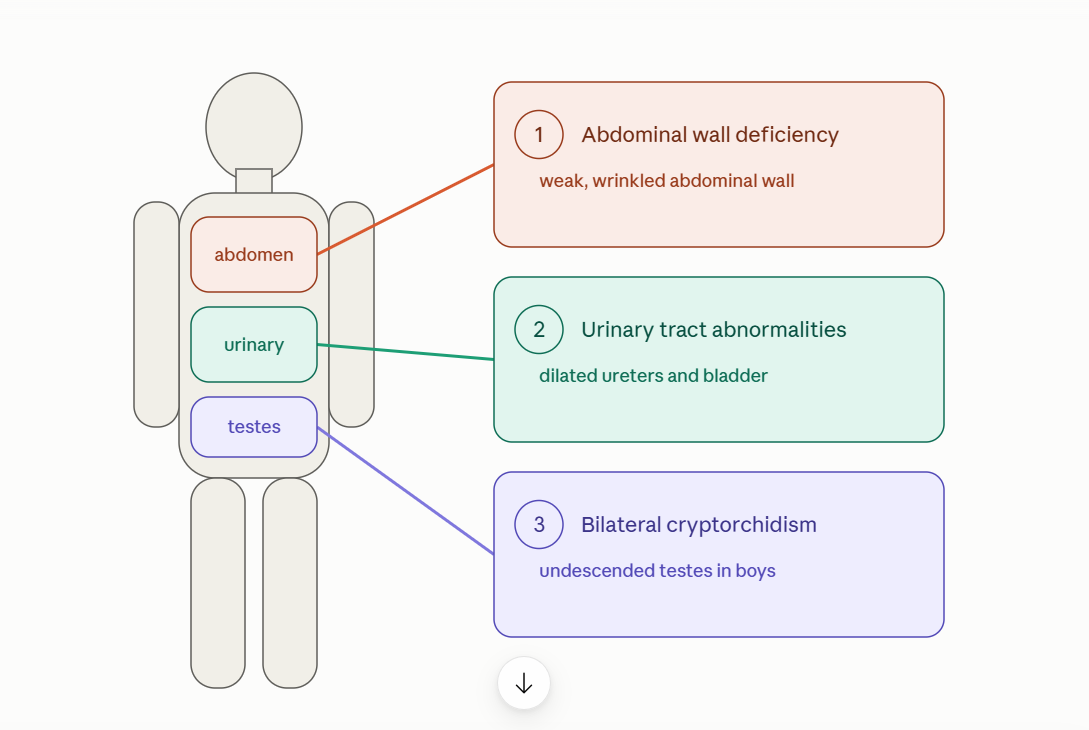
The name comes from the wrinkled, "prune-like" appearance of the abdomen caused by poorly developed or absent abdominal wall muscles. This is one part of a classic triad:
| Component | What It Involves |
|---|---|
| 1. Abdominal wall deficiency | Weak or absent abdominal muscles, giving a wrinkled, sagging belly |
| 2. Urinary tract abnormalities | Dilated, tortuous ureters; enlarged bladder; variable kidney involvement |
| 3. Bilateral cryptorchidism (in males) | Undescended testicles, present in nearly all affected boys |
Severity varies widely — from mild abdominal wall laxity with normal kidneys, to severe cases with significant kidney dysplasia and, in the most extreme forms, complications incompatible with life. Most children fall in a moderate category where the abdominal wall and urinary tract can be reconstructed with good long-term function.
The exact cause is not fully understood. The leading theory suggests an early fetal urinary tract obstruction or a developmental defect in the mesoderm (the tissue layer that forms muscle and the urinary tract) that leads to over-distension of the bladder, which in turn prevents normal abdominal wall muscle development. It occurs sporadically in most cases, with no strong pattern of inheritance identified.
| 🩺 | Test | What It Shows |
|---|---|---|
| 🤰 | Prenatal Ultrasound | Often the first clue — enlarged bladder, dilated urinary tract, low amniotic fluid |
| 👶 | Physical Examination at Birth | Confirms the characteristic wrinkled abdomen and undescended testes |
| 📡 | Postnatal Renal Ultrasound | Maps kidney and urinary tract anatomy in detail |
| 💧 | VCUG (Voiding Cystourethrogram) | Checks bladder emptying and reflux |
| 🩸 | Kidney Function Tests | Assesses the degree of any kidney involvement |
Management of Prune Belly Syndrome is individualized to each child's severity, but for children who are surgical candidates, "total correction" typically combines three reconstructive goals, often as a coordinated or staged single-stage repair:
Timing matters: correction of urinary malformations and abdominoplasty are generally completed by around 4 years of age, often combined into one coordinated surgical plan to minimize the number of anesthesia exposures for the child.
🔴 Prune Belly Syndrome is usually identified at birth or on a prenatal scan — once suspected or confirmed, early referral to a pediatric urology team is important to plan monitoring of kidney function and the timing of reconstructive surgery.
Outlook depends heavily on the degree of kidney involvement at birth, which is the single biggest factor in long-term prognosis. Children with mild-to-moderate disease and reasonably preserved kidney function generally do very well after coordinated surgical correction, achieving good cosmetic and functional results and normal or near-normal life expectancy. Children with severe kidney dysplasia at birth face a higher risk of progressing to kidney failure and may eventually need dialysis or transplant. With modern staged surgical management, overall survival and quality of life for children with Prune Belly Syndrome have improved substantially over recent decades.
Our partner pediatric urologists offer complete evaluation and staged or single-stage total surgical correction of Prune Belly Syndrome — orchidopexy, urinary tract reconstruction, and abdominoplasty — for international families.
📞 International Patient Helpdesk: +91-8860606766 | +91-9910655125
This article is for general educational purposes and is not a substitute for professional medical advice, diagnosis, or treatment. Always consult a qualified pediatric urologist for guidance specific to your child.