A Congenital Cause of Bowel Blockage in Newborns
⚡ Quick Facts: Colonic aganglionosis, better known as Hirschsprung's disease (HD), is a congenital condition in which nerve cells (ganglion cells) are missing from part of the large intestine, preventing that segment from relaxing to let stool pass. It affects roughly 1 in 5,000 live births and is more common in boys.
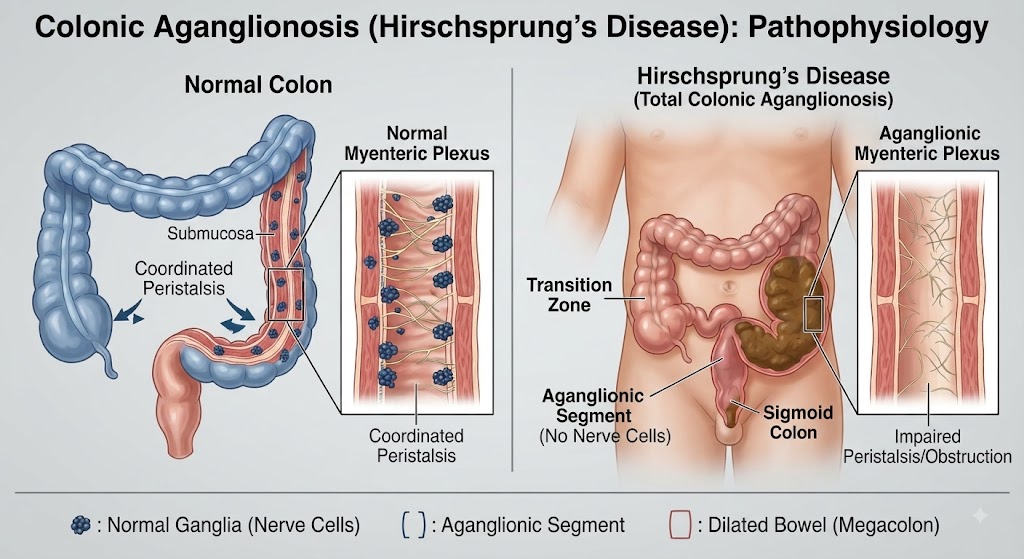
During normal development, nerve cells migrate down the length of the developing intestine to form the enteric nervous system, which coordinates the rhythmic squeezing (peristalsis) that moves stool along. In Hirschsprung's disease, this migration stops early, leaving the final segment of bowel — always including the rectum and extending variable distances upward — without ganglion cells. That segment stays tightly contracted and cannot relax, creating a functional blockage. Stool backs up behind it, causing the healthy bowel above to stretch and dilate.
In about 75% of cases, only the rectum and sigmoid colon are affected ("short-segment" disease). In roughly 14% of cases, the entire colon lacks ganglion cells — total colonic aganglionosis — a more extensive and complex form to treat.
Hirschsprung's disease results from an interruption in the normal migration of neural crest cells during early fetal development. It has a genetic component — mutations in the RET gene are the most commonly identified cause, and up to 60% of affected infants have an associated genetic syndrome or other congenital anomaly, including a notable association with Down syndrome. It can run in families, though many cases occur with no family history.
👶 In Newborns
|
🧒 In Older Infants/Children (milder forms)
|
| 🩺 | Test | What It Shows |
|---|---|---|
| 🔬 | Rectal Suction Biopsy | Gold-standard test — confirms absence of ganglion cells |
| 🩻 | Contrast (Barium) Enema | Shows the narrowed segment and dilated bowel above it |
| 📊 | Anorectal Manometry | Tests the reflex relaxation of the anal sphincter |
| 🧬 | Genetic Testing | Considered for family counselling, especially with a family history |
Surgery is required in almost all cases — there is no effective medical cure. The standard treatment is a "pull-through" procedure, which removes the segment of bowel lacking ganglion cells and connects the healthy, normally innervated bowel down to the anus.
🚨 Hirschsprung-Associated Enterocolitis (HAEC) is the most serious complication — a potentially life-threatening bowel infection that can occur before or after surgery, presenting with fever, foul diarrhea, and a distended abdomen. It requires immediate medical attention.
🔴 Seek urgent evaluation for a newborn who hasn't passed stool within 48 hours of birth, or an infant/child with severe abdominal distension, bilious vomiting, or fever with explosive diarrhea.
Most children who undergo pull-through surgery for short-segment disease go on to have normal or near-normal bowel function and growth, though some experience constipation or occasional soiling that improves with time and bowel management. Outcomes for total colonic aganglionosis are more variable and often require longer-term specialist follow-up, but the large majority of children ultimately achieve good quality of life with modern surgical techniques.
Our partner pediatric surgeons offer complete diagnosis and pull-through surgery for Hirschsprung's disease, including complex and total colonic aganglionosis cases, for international families.
📞 International Patient Helpdesk: +91-8860606766 | +91-9910655125
This article is for general educational purposes and is not a substitute for professional medical advice, diagnosis, or treatment. Always consult a qualified pediatric surgeon or gastroenterologist for a newborn or child with bowel symptoms.