Intraventricular Tumour Surgery Package
Assistance
Consultation
Services
Opinion
Care Coordination
What will your treatment cost?

| Surgery Name | Cost | Room | Hospitalization |
|---|---|---|---|
| Intraventricular Tumour Surgery Package | $5244 | Single | Patient - 7 days stay in a single room. |
✓ Inclusion
- ✔Consultation with a senior neurosurgeon
- ✔Pre-operative tests: CBC, kidney and liver function, clotting profile, blood sugar, viral markers, ECG and chest X-ray
- ✔Anaesthesia check-up and general anaesthesia
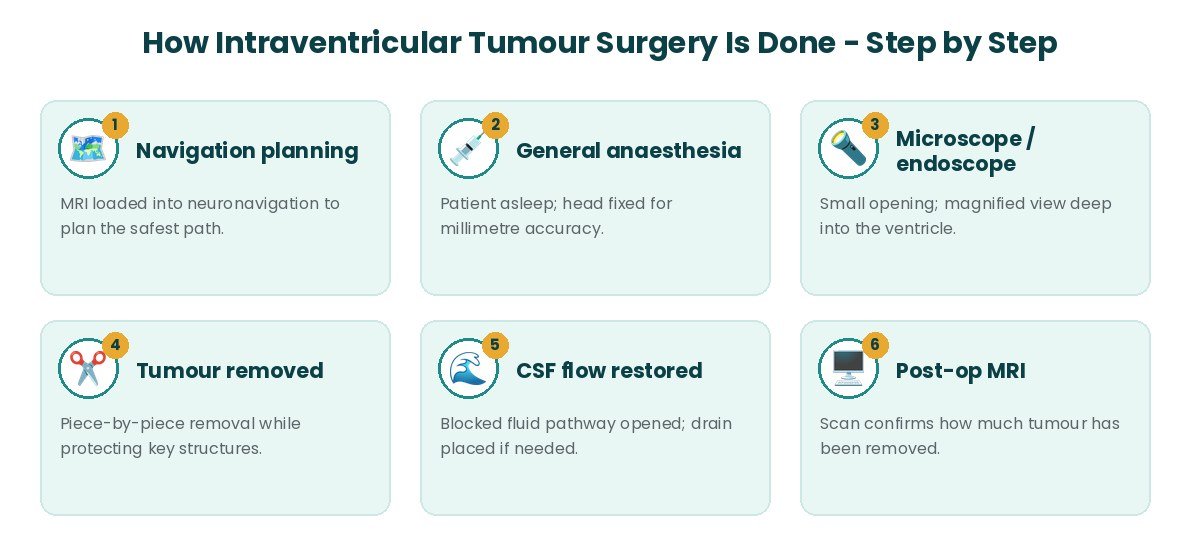
- ✔Microsurgical or endoscopic removal of the intraventricular tumour with neuronavigation
- ✔Operation theatre charges and standard neurosurgical consumables
- ✔1–2 days in neuro-ICU
- ✔Single room for the rest of the 7-day stay
- ✔Post-operative CT or MRI brain
- ✔Histopathology examination of the tumour
- ✔Nursing care, routine medicines, physiotherapy and patient's meals
- ✔One follow-up consultation after discharge
- ✔Free: airport pick-up & drop, visa invitation letter, interpreter & coordinator (Satyug Healthcare)
✗ Exclusion
- ✖VP shunt, Ommaya reservoir or other implants
- ✖External ventricular drain beyond standard use
- ✖Extra ICU or hospital days beyond the package
- ✖Radiotherapy, Gamma Knife or chemotherapy
- ✖Special tests (immunohistochemistry, molecular markers)
- ✖Treatment of complications
- ✖Medicines after discharge
- ✖Hotel, food, local travel and flights
- ✖Visa fees and personal expenses
Know More About Procedure & Surgery
Intraventricular Tumour Surgery in India
Removal of tumours inside the brain's fluid spaces – such as colloid cysts, central neurocytomas, ependymomas and meningiomas – with microsurgery or neuroendoscopy by experienced neurosurgeons at accredited Indian hospitals, at a fraction of Western costs.
📖 What is an Intraventricular Tumour?
Deep inside the brain are four connected fluid-filled spaces called ventricles. They make and carry cerebrospinal fluid (CSF), the clear fluid that cushions the brain and spinal cord. An intraventricular tumour is a growth that starts in or grows into these spaces. Many are benign (not cancer) and slow-growing, but because they can block the flow of CSF, fluid builds up and raises pressure in the head. This is called hydrocephalus and causes headaches, vomiting, vision problems and drowsiness.
Common types include colloid cyst, central neurocytoma, intraventricular meningioma, ependymoma, subependymoma, choroid plexus papilloma and SEGA (in tuberous sclerosis). Surgery aims to remove the tumour safely and restore normal CSF flow. Surgeons use an operating microscope (through a small opening in the skull) or a neuroendoscope (a thin camera through a small burr hole), guided by neuronavigation – a GPS-like system for the brain.
🖼️ Understand It in Pictures
Normal ventricles vs tumour in a ventricle

👀 Symptoms in Pictures

🩻 Scans & Tests — What Doctors See


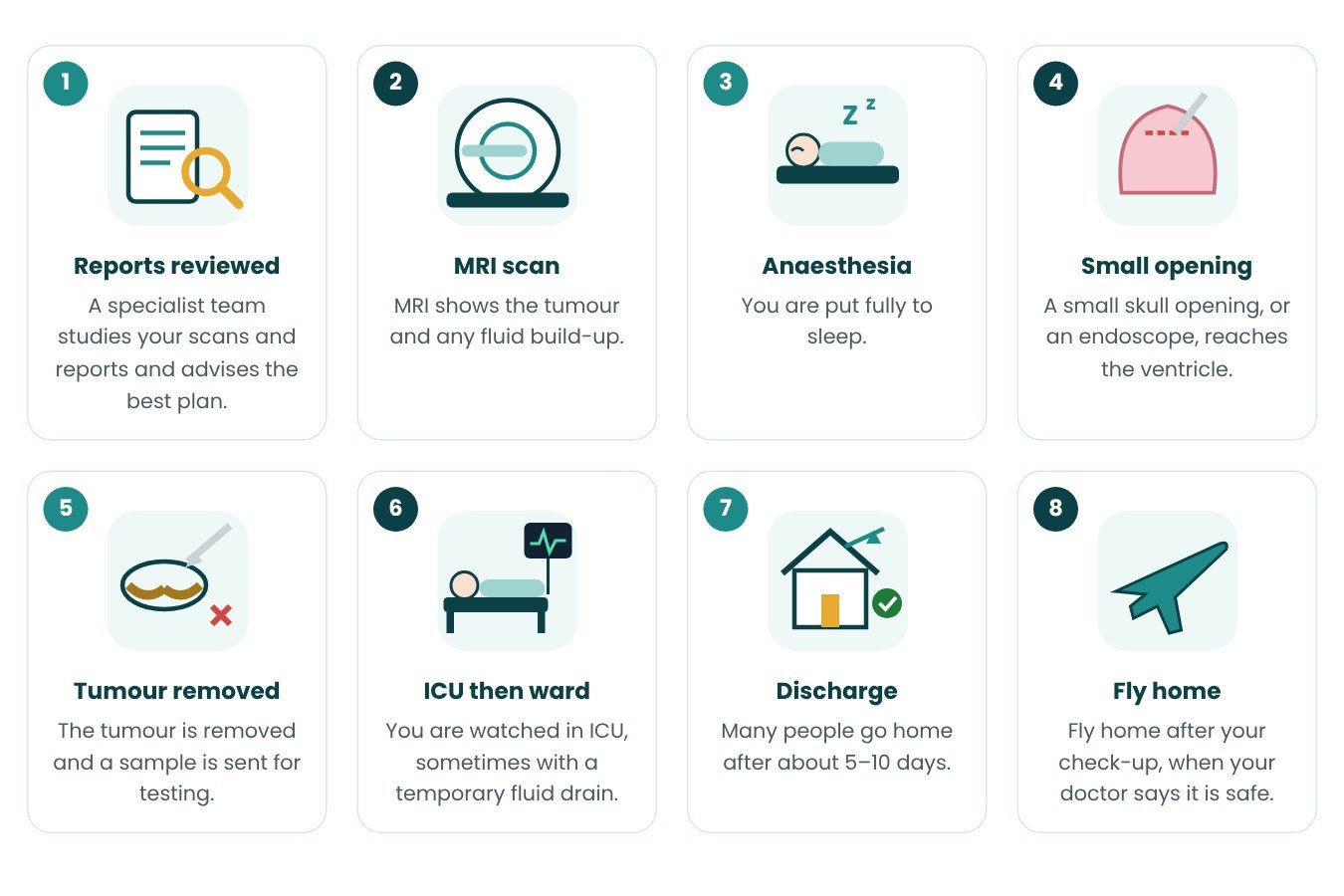
🎬 The Treatment Journey in Pictures
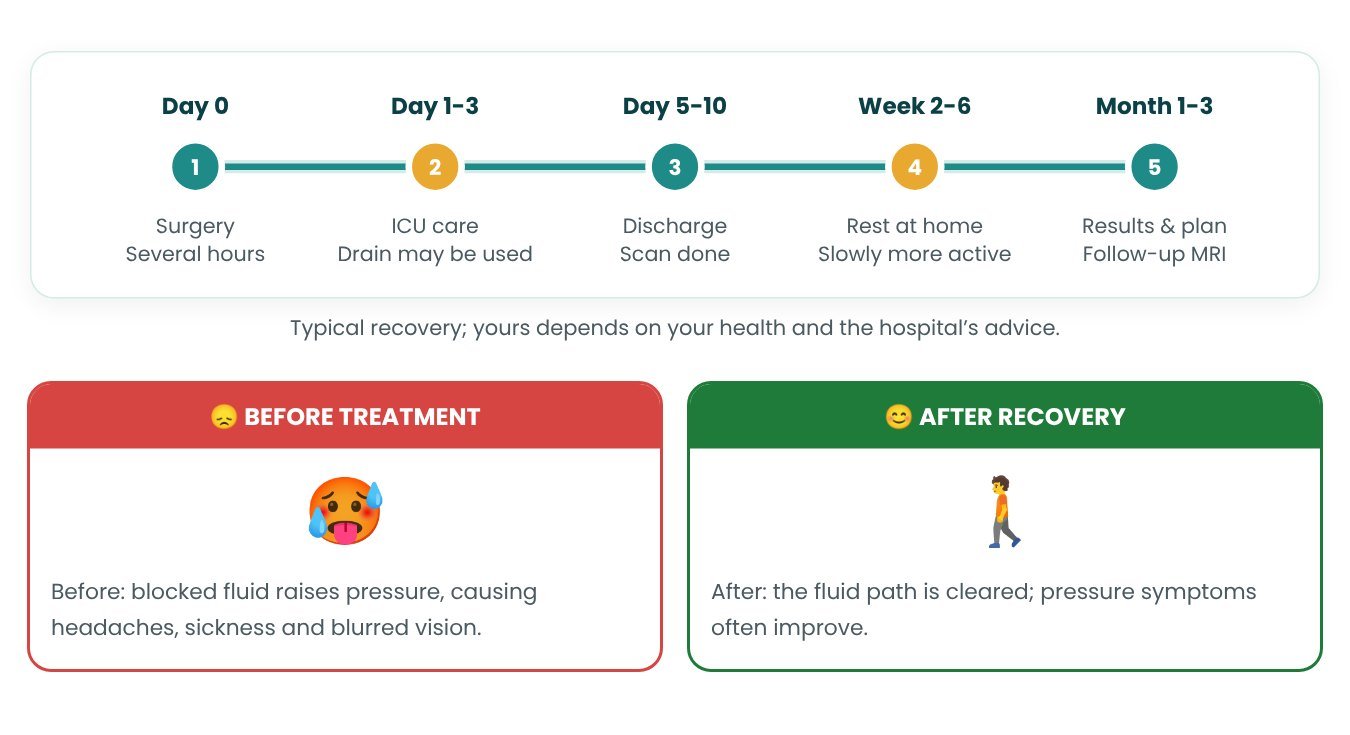
📅 Recovery at a Glance
Drawings: Satyug Healthcare (simplified, not to scale). Photos: Wikimedia Commons; author and licence under each photo.
🩺 Tumours Treated
⚠️ Symptoms That May Need Treatment
- ➤Headache, worse in the morning or on lying down
- ➤Nausea and vomiting
- ➤Blurred or double vision
- ➤Memory problems or confusion
- ➤Unsteady walking or balance problems
- ➤Drowsiness or reduced alertness
- ➤Seizures (fits)
- ➤Large or fast-growing head in babies
🔬 Tests Before Treatment
| Test | Why it is done |
|---|---|
| MRI brain with contrast | Shows the tumour, its exact location and how it relates to the ventricles |
| CT scan of the brain | Quick check for hydrocephalus, bleeding or calcium in the tumour |
| MR spectroscopy / perfusion (if needed) | Helps predict tumour type before surgery |
| MRI of the whole spine (for ependymoma) | Checks whether tumour cells have spread in the CSF |
| Eye (fundus) examination | Looks for swelling of the optic nerve from raised pressure |
| Blood tests, ECG, chest X-ray | Fitness for general anaesthesia |
🏥 The Procedure — Step by Step
⚖️ Types & Techniques
| Technique | What is done | Best for |
|---|---|---|
| Endoscopic resection | Thin camera through a burr hole into the ventricle | Colloid cysts and small tumours with hydrocephalus |
| Transcallosal microsurgery | Approach between the brain halves through the corpus callosum | Third ventricle and front of lateral ventricle tumours |
| Transcortical microsurgery | Small corridor through the brain surface into the ventricle | Large lateral ventricle tumours, meningiomas |
| Suboccipital (posterior fossa) approach | Opening at the back of the skull | Fourth ventricle tumours such as ependymoma |
| Endoscopic biopsy + ETV / radiosurgery | Tissue sample and fluid bypass, then Gamma Knife or radiotherapy | Deep tumours unsafe to remove fully |
📅 Your Day-by-Day Plan in India
| Day | What happens |
|---|---|
| Day 1 | Arrival in India, airport pick-up, hotel check-in ✈️ |
| Day 2 | Neurosurgery consultation, MRI review and pre-operative tests |
| Day 3 | Admission and surgery |
| Day 4–5 | Neuro-ICU monitoring, then shift to single room |
| Day 6–9 | Post-op MRI, walking and physiotherapy; discharge on hospital day 7 |
| Day 10–14 | Rest near hospital, stitch removal and histopathology report |
| Day 15–21 | Final review, plan for radiotherapy if needed; fly home ✈️ |
🌱 Recovery After Treatment
🏆 Success Rate
| Outcome | Result |
|---|---|
| Complete removal (colloid cyst, neurocytoma) | About 80–95% in experienced centres |
| Relief of hydrocephalus | About 85–90%; a shunt is needed in about 5–20% |
| Long-term control of benign tumours after full removal | Over 85–90% |
| Surgical mortality | About 1–3% |
| Lasting new neurological deficit | About 5–10% |
Results depend on the tumour type, its size and exact location, whether it can be fully removed and your health before surgery. Benign tumours that are completely removed usually do not need further treatment.
🩹 Risks & Possible Complications
Deep brain surgery carries real risks, which your neurosurgeon will discuss in detail:
- •Short-term memory problems, especially after third-ventricle surgery (often temporary)
- •Persistent hydrocephalus needing a shunt (about 5–20%)
- •Seizures (about 5–10%)
- •Bleeding inside the ventricle
- •Infection or meningitis (about 1–3%)
- •Weakness, speech or vision problems depending on location
- •Tumour regrowth, mainly if removal was partial
💰 Cost of Intraventricular Tumour Surgery in India
The cost of intraventricular tumour surgery in India starts from about USD 5,244. This covers the neurosurgery, anaesthesia, neuronavigation, 1–2 days in neuro-ICU and a 7-day stay in a single room in total.
| Option / Hospital tier | Approx. cost (USD) | Hospital stay | Notes |
|---|---|---|---|
| Intraventricular tumour surgery – this package | from 5,244 | 7 days, single room | Microsurgical or endoscopic removal |
| Endoscopic colloid cyst removal | 4,500 – 6,000 | 4–6 days | Small cysts with hydrocephalus |
| Large / complex tumour with EVD or shunt | 7,000 – 9,500 | 10–14 days | Longer ICU stay and shunt hardware |
| Adjuvant radiotherapy (IMRT) if needed | 3,500 – 5,500 | Outpatient, 5–6 weeks | For ependymoma or atypical tumours |

📋 What the Package Includes
- ✔Neurosurgeon and anaesthetist fees
- ✔Operation theatre with neuronavigation
- ✔1–2 days in neuro-ICU
- ✔7 days' total stay in a single room
- ✔Routine medicines and consumables
- ✔Post-operative CT/MRI scan
- ✔Histopathology (biopsy) report
- ✔Physiotherapy during stay
- ✖Shunt or special implants
- ✖Extra ICU or hospital days
- ✖Radiotherapy or chemotherapy
- ✖Pre-travel MRI
- ✖Treatment of complications
- ✖Medicines after discharge
- ✖Hotel, food and flights
✈️ Your Medical Travel Process with Satyug Healthcare

| Step | Details |
|---|---|
| 1. Send reports | MRI brain with contrast (images and report, ideally on CD or link), any CT scans, a summary of symptoms, eye check report if done, and details of previous surgery or shunt. |
| 2. Free opinion & quotes | Within 48-72 hours you receive opinions and cost estimates from 3-5 leading hospitals to compare. |
| 3. Choose hospital & doctor | We help you compare doctors, success rates, room options and total budget. |
| 4. Medical visa | The hospital issues a Visa Invitation Letter (VIL) to the Indian Embassy. The patient and up to 2 attendants apply for an e-Medical / Medical Attendant visa. |
| 5. Travel planning | Flight guidance, wheelchair assistance, airport pick-up, hotel or guest house near the hospital. |
| 6. Treatment in India | Your coordinator and interpreter stay with you for admission, treatment, discharge and billing. |
| 7. Return & follow-up | Fit-to-fly letter, medicines, and online follow-up with your doctor after you return home. |
🎒 Travel Checklist
- 📌Valid passport (6+ months) for the patient and attendants, plus 10 passport-size photos each
- 📌Medical visa / e-visa and the hospital’s Visa Invitation Letter
- 📌All brain MRI and CT reports, scans on CD / link and prescriptions
- 📌Yellow fever vaccination certificate (mandatory for travellers from African countries)
- 📌Polio vaccination certificate where applicable
- 📌Declare cash above USD 5,000 at the airport; hospitals accept wire transfer and cards
- 📌Foreigners staying longer than permitted must register with the FRRO — our team assists
⭐ Why Choose Satyug Healthcare?
❓ Frequently Asked Questions
➤ What is the cost of intraventricular tumour surgery in India?
➤ Are ventricular tumours cancer?
➤ How long will I be in hospital?
➤ How long should I stay in India?
➤ Is endoscopic surgery possible?
➤ Will I need a shunt?
➤ What are the main risks?
➤ Will I need radiotherapy?
➤ Is the surgery painful?
➤ Can children be treated?
➤ When can I return to work?
➤ When can I fly home?
➤ Can family come with me?
Medical disclaimer: This page is for general information and does not replace a consultation with a qualified specialist. Treatment plans and costs are confirmed only after the patient is examined. Sources: NCBI StatPearls: Intraventricular Tumors, Colloid Cyst, Ependymoma, Central Neurocytoma; American Association of Neurological Surgeons; Mayo Clinic: Brain tumor; NHS; WHO Classification of CNS Tumours 2021; published endoscopic colloid cyst series (J Neurosurg). Infographics: Satyug Healthcare.
Frequently Asked Questions
In total, there are four ventricles; right and left lateral ventricles, third ventricle and fourth ventricle.
- Lateral Ventricles. The left and right lateral ventricles are located within their respective hemispheres of the cerebrum.
- Third Ventricle.
Fourth Ventricle.
Intraventricular brain tumour surgery in India from USD 5,244. Endoscopic & microsurgical removal, neuronavigation, 7-day stay, top neurosurgeons, visa help.












































































































































































































































TOP HOSPITALS
Special High-quality Hospitals




HAPPY PATIENTS
What Our Patients Are Saying


























Our Gallery