Brainstem Tumour Surgery Package
Assistance
Consultation
Services
Opinion
Care Coordination
What will your treatment cost?

See the cost breakdown by option, hospital and city →
| Surgery Name | Cost | Room | Hospitalization |
|---|---|---|---|
| Brainstem Tumour Surgery Package | $5449 | Single | Patient - 7 days stay in a single room. |
✓ Inclusion
- ✔Brainstem tumour surgery (suboccipital craniotomy and microsurgical resection) or stereotactic biopsy as planned
- ✔Neurosurgeon, assistant and anaesthetist fees
- ✔Operation theatre, microscope and neuronavigation charges
- ✔Intraoperative neuromonitoring where advised
- ✔ICU stay after surgery within the package days
- ✔Total 7 days hospital stay in a single room
- ✔Routine medicines, antibiotics and steroids during stay
- ✔Standard histopathology of tumour tissue
- ✔Post-operative CT or MRI brain
- ✔Nursing care, physiotherapy and patient meals
- ✔Free: airport pick-up & drop, visa invitation letter, interpreter & coordinator (Satyug Healthcare)
✗ Exclusion
- ✖Airfare, visa fees and travel insurance
- ✖Pre-surgery MRI and tests unless listed
- ✖Radiotherapy, proton therapy and chemotherapy
- ✖Molecular and genetic tumour tests (IHC/NGS)
- ✖Extra ICU days, ventilator support or tracheostomy
- ✖VP shunt or ETV if needed separately
- ✖Treatment of complications
- ✖Medicines and rehabilitation after discharge
- ✖Hotel, food and expenses of attendants
Know More About Procedure & Surgery
Brainstem Tumour (Glioma) Surgery in India
Diagnosis, biopsy and surgical removal of suitable brainstem gliomas in children and adults, planned by a tumour board of neurosurgeons, radiation oncologists and neuro-oncologists at accredited Indian hospitals, at a fraction of Western cost.
📖 What is a Brainstem Tumour or Glioma?
The brainstem connects the brain to the spinal cord. It is small but controls breathing, heartbeat, swallowing, eye movements, facial movement and the nerve pathways to the arms and legs. A glioma is a tumour that grows from the support cells of the brain (glial cells). Brainstem gliomas make up about 10–15% of brain tumours in children and are rare in adults. They range from slow-growing, low-grade tumours to fast-growing, high-grade tumours.
Treatment depends on the exact type and location. Focal and exophytic tumours (growing outward from the brainstem) can often be safely removed fully or partly with microsurgery. Diffuse tumours such as diffuse intrinsic pontine glioma (DIPG, now called diffuse midline glioma H3 K27-altered) cannot be cut out safely; a small biopsy may be taken for diagnosis and the main treatment is radiotherapy. Surgery is also used to relieve fluid build-up in the brain (hydrocephalus).
🖼️ Understand It in Pictures
Normal brain stem vs brain stem tumour

👀 Symptoms in Pictures

🩻 Scans & Tests — What Doctors See


🎬 The Treatment Journey in Pictures

📅 Recovery at a Glance

Drawings: Satyug Healthcare (simplified, not to scale). Photos: Wikimedia Commons; author and licence under each photo.
🩺 Conditions Treated
⚠️ Symptoms That Need Urgent Evaluation
- ➤Double vision or a squint that appears suddenly
- ➤Weakness of the face on one side
- ➤Difficulty swallowing or choking
- ➤Slurred speech
- ➤Unsteady walking or poor balance
- ➤Weakness or numbness in arms or legs
- ➤Morning headaches with vomiting
- ➤Change in behaviour or school performance in children
🔬 Tests Before Treatment
| Test | Why it is done |
|---|---|
| MRI brain with contrast | Shows tumour size, type of growth and relation to the brainstem. |
| MR spectroscopy and perfusion | Helps tell low-grade from high-grade tumours. |
| DTI tractography | Maps nerve pathways so the surgeon can avoid them. |
| MRI of whole spine | Checks whether tumour has spread along the spinal cord. |
| Neurological and eye examination | Records nerve function and checks for pressure behind the eyes. |
| Histopathology and molecular tests | Confirms tumour type and grade (e.g. H3 K27M, BRAF, IDH) to guide treatment. |
| Blood tests, ECG and anaesthesia check | Ensure fitness for surgery. |
🏥 The Procedure — Step by Step
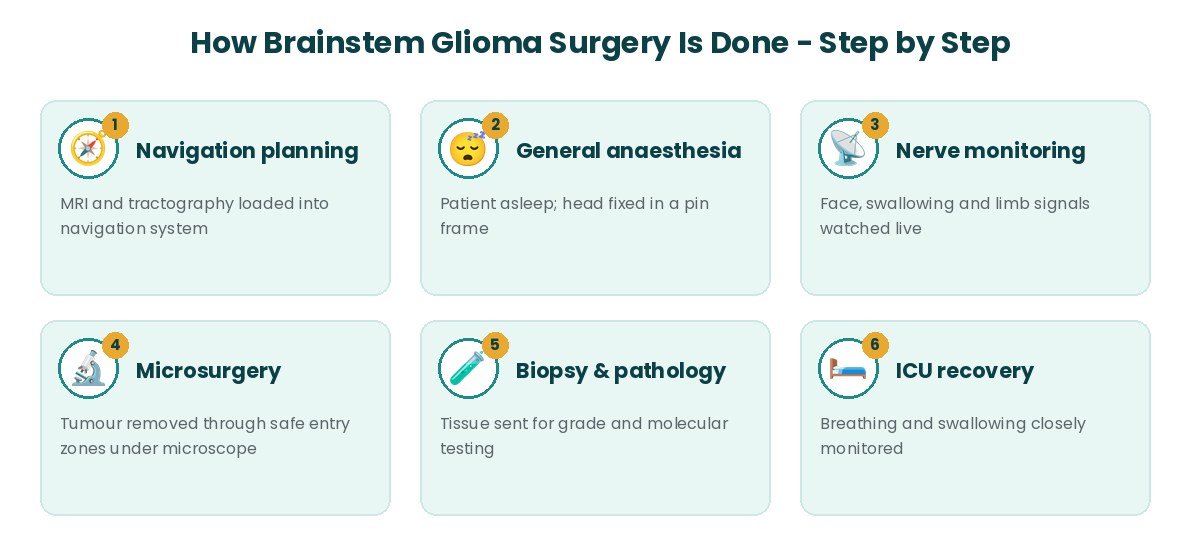
⚖️ Treatment Options
| Treatment | What is done | Best for |
|---|---|---|
| Microsurgical resection | Open surgery to remove as much tumour as safely possible | Focal, exophytic and cervicomedullary tumours |
| Stereotactic biopsy | Needle sample through a small hole for diagnosis | Diffuse tumours or uncertain diagnosis |
| ETV or VP shunt | Relieves blocked brain fluid | Hydrocephalus, tectal gliomas |
| Radiotherapy (IMRT / VMAT) | About 30 sessions over 6 weeks | DIPG, high-grade or residual tumour |
| Chemotherapy / targeted therapy | Drugs chosen by tumour type and genes | Low-grade tumours in children, selected high-grade tumours |
📅 Your Day-by-Day Plan in India
| Day | What happens |
|---|---|
| Day 1 | Arrival in India, airport pick-up and hotel check-in |
| Day 2–3 | Neurosurgeon consultation, MRI, tumour board review and fitness tests |
| Day 4 | Admission and surgery or biopsy |
| Day 5–6 | ICU monitoring of breathing and swallowing |
| Day 7–10 | Ward care, physiotherapy and swallowing assessment |
| Day 10 | Discharge after 7 days in hospital |
| Day 11–20 | Hotel recovery, stitch removal and pathology report discussion |
| Day 21–60 | Radiotherapy (about 6 weeks) if advised, otherwise review and plan |
| After review | Fly home ✈️ with MRI follow-up plan |
🌱 Recovery After Treatment
🏆 Success Rate
| Outcome | Result |
|---|---|
| 5-year survival – focal low-grade glioma | Over 80–90% |
| Gross total removal in exophytic tumours | Achieved in many cases (about 50–70%) |
| Diagnostic yield of stereotactic biopsy | About 95% |
| Median survival – DIPG with radiotherapy | About 9–12 months |
| Symptom improvement after radiotherapy in DIPG | About 70–80% (temporary) |
Outcome depends mostly on tumour type, grade and molecular profile, whether it is focal or diffuse, how much can be safely removed, the patient's age and neurological condition before treatment.
🩹 Risks & Possible Complications
The brainstem is a delicate area, so risks are higher than in most brain surgery:
- •New or worse double vision, facial weakness or swallowing difficulty (often temporary, about 10–30% after resection)
- •Weakness or numbness of arms or legs
- •Breathing problems needing longer ventilator support or tracheostomy (uncommon)
- •Brain fluid leak (CSF leak) or hydrocephalus
- •Infection (about 1–3%)
- •Bleeding in the tumour bed
- •Tumour regrowth needing further treatment
💰 Cost of Brainstem Glioma Surgery in India
The cost of brainstem tumour surgery in India starts from about USD 5,449 with 7 days in a single room. This usually covers the surgery or biopsy, neuronavigation, anaesthesia and inpatient care. Radiotherapy, chemotherapy, molecular tests and extra ICU days are charged separately.
| Option / Hospital tier | Approx. cost (USD) | Hospital stay | Notes |
|---|---|---|---|
| Brainstem tumour surgery – this package | 5,449 | 7 days | Single room, craniotomy or biopsy |
| Stereotactic biopsy only | 3,000 – 4,500 | 3–4 days | For diffuse tumours |
| Complex resection with longer ICU | 7,000 – 10,000 | 10–14 days | Large or high-risk tumours |
| Radiotherapy (IMRT/VMAT, ~30 sessions) | 3,500 – 6,000 | Outpatient | About 6 weeks |
| Proton therapy (selected children) | 18,000 – 30,000 | Outpatient | Apollo Proton Cancer Centre, Chennai |

📋 What the Package Includes
- ✔Brainstem tumour surgery or biopsy
- ✔Neurosurgeon and anaesthesia fees
- ✔Neuronavigation and monitoring
- ✔7 days in a single room (incl. ICU as per package)
- ✔Routine medicines and consumables
- ✔Basic histopathology
- ✔Post-operative MRI/CT
- ✔Nursing care and meals
- ✖Flights and visa fees
- ✖Hotel stay
- ✖Radiotherapy and chemotherapy
- ✖Molecular / genetic tumour tests
- ✖Extra ICU days or ventilator
- ✖Shunt or tracheostomy if needed
- ✖Rehabilitation after discharge
- ✖Attendant food and stay
✈️ Your Medical Travel Process with Satyug Healthcare

| Step | Details |
|---|---|
| 1. Send reports | Latest MRI brain with contrast (images on CD or online link, not only the report), any MRI spine, previous biopsy or surgery reports and slides, a short note of current symptoms (vision, swallowing, walking), age and weight. |
| 2. Free opinion & quotes | Within 48-72 hours you receive opinions and cost estimates from 3-5 leading hospitals to compare. |
| 3. Choose hospital & doctor | We help you compare doctors, success rates, room options and total budget. |
| 4. Medical visa | The hospital issues a Visa Invitation Letter (VIL) to the Indian Embassy. The patient and up to 2 attendants apply for an e-Medical / Medical Attendant visa. |
| 5. Travel planning | Flight guidance, wheelchair assistance, airport pick-up, hotel or guest house near the hospital. |
| 6. Treatment in India | Your coordinator and interpreter stay with you for admission, treatment, discharge and billing. |
| 7. Return & follow-up | Fit-to-fly letter, medicines, and online follow-up with your doctor after you return home. |
🎒 Travel Checklist
- 📌Valid passport (6+ months) for the patient and attendants, plus 10 passport-size photos each
- 📌Medical visa / e-visa and the hospital’s Visa Invitation Letter
- 📌All MRI brain/spine scans on CD / link, pathology reports and prescriptions
- 📌Yellow fever vaccination certificate (mandatory for travellers from African countries)
- 📌Polio vaccination certificate where applicable
- 📌Declare cash above USD 5,000 at the airport; hospitals accept wire transfer and cards
- 📌Foreigners staying longer than permitted must register with the FRRO — our team assists
⭐ Why Choose Satyug Healthcare?
❓ Frequently Asked Questions
➤ How much does brainstem tumour surgery cost in India?
➤ Can all brainstem gliomas be removed?
➤ How long is the hospital stay?
➤ How long do I need to stay in India?
➤ What is the success rate?
➤ Is the surgery risky?
➤ Is a biopsy needed for DIPG?
➤ Is proton therapy available in India?
➤ Can children be treated?
Medical disclaimer: This page is for general information and does not replace a consultation with a qualified specialist. Treatment plans and costs are confirmed only after the patient is examined. Sources: NCBI StatPearls: Brainstem Glioma and Diffuse Intrinsic Pontine Glioma; WHO Classification of CNS Tumours 5th edition (2021); National Cancer Institute PDQ: Childhood Brain Stem Glioma Treatment; Cancer Research UK: brain tumours; Children's Oncology Group outcome data. Infographics: Satyug Healthcare.
Frequently Asked Questions
Some brainstem tumours can be removed, especially well-defined (focal) low-grade tumours, by experienced neurosurgeons using navigation and nerve monitoring. Diffuse tumours such as DIPG cannot be removed safely because they are spread through vital tissue; they are treated mainly with radiotherapy.
Brainstem tumour and glioma surgery in India from USD 5,449: biopsy or safe removal with navigation & nerve monitoring, plus radiotherapy. Free opinion.




TOP HOSPITALS
Special High-quality Hospitals


HAPPY PATIENTS
What Our Patients Are Saying













Our Gallery