Spine Instrumentation with Decompression (1 Level) Package
Assistance
Consultation
Services
Opinion
Care Coordination
What will your treatment cost?

See the cost breakdown by option, hospital and city →
| Surgery Name | Cost | Room | Hospitalization |
|---|---|---|---|
| Spine Instrumentation with Decompression (1 Level) Package | USD 5200 | Twin Sharing | 4-6 Days in Room |
✓ Inclusion
- ✔Spine surgeon consultation
- ✔Pre-operative tests: blood work, ECG, chest X-ray
- ✔Single-level decompression with pedicle screw instrumentation and fusion
- ✔Standard titanium pedicle screws, rods and interbody cage
- ✔Operation theatre, anaesthesia and surgical consumables
- ✔4–6 days hospital stay in a twin-sharing room
- ✔Routine medicines, IV fluids and pain management during stay
- ✔Post-operative X-ray
- ✔In-hospital physiotherapy and lumbar brace (if advised)
- ✔One follow-up consultation and stitch removal
- ✔Free: airport pick-up & drop, visa invitation letter, interpreter & coordinator (Satyug Healthcare)
✗ Exclusion
- ✖MRI, CT or other imaging before surgery
- ✖Imported or premium implants and bone substitutes
- ✖MIS, navigation, robotic or neuromonitoring charges if not in package
- ✖Additional spinal levels
- ✖ICU stay or treatment of complications
- ✖Blood products
- ✖Stay beyond package days or room upgrade
- ✖Medicines after discharge and outpatient physiotherapy
- ✖Hotel accommodation, food, flights and visa fees
Know More About Procedure & Surgery
Spine Instrumentation with Decompression (1 Level) in India
Surgery that frees trapped nerves and stabilises one unstable spinal segment with screws, rods and a cage, for slipped vertebrae, severe stenosis and recurrent disc problems. Performed by experienced spine surgeons at accredited Indian hospitals at a fraction of Western costs.
📖 What is Spine Instrumentation with Decompression?
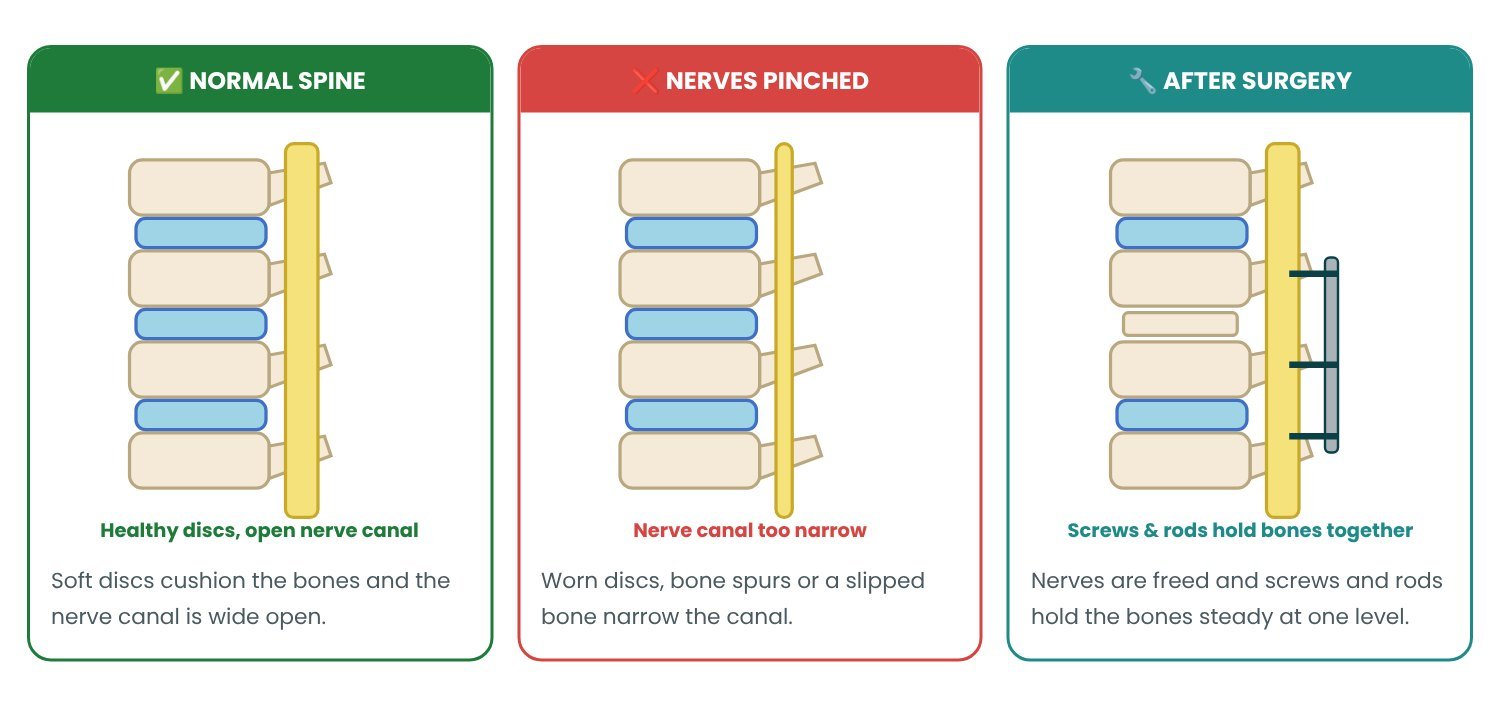
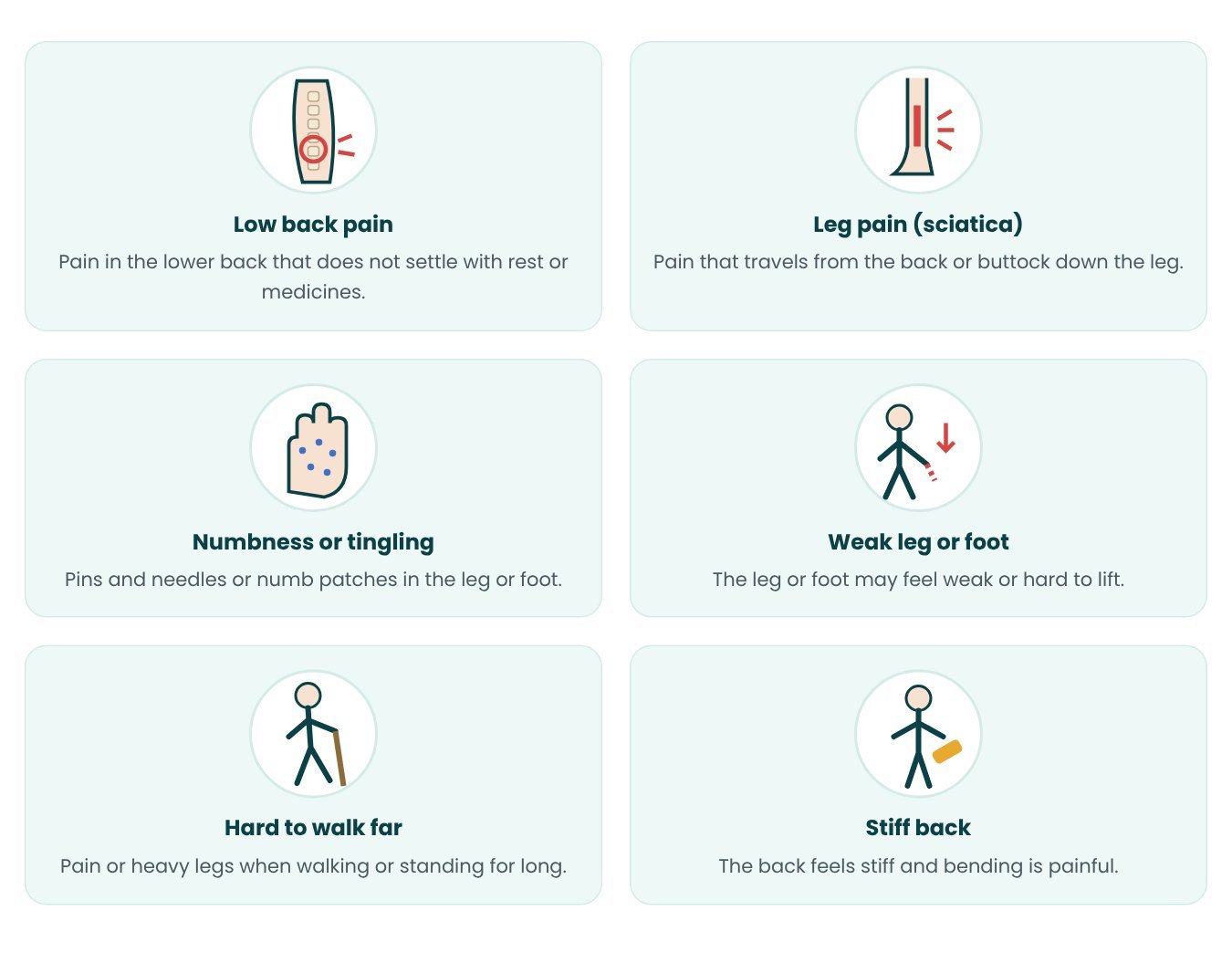
The spine is made of bones (vertebrae) separated by cushion-like discs, with nerves running through a central canal. With age, wear or injury, the canal can narrow (spinal stenosis), a disc can press on a nerve, or one vertebra can slip forward on another (spondylolisthesis). This causes back pain and leg pain, numbness or weakness (sciatica), and difficulty walking.
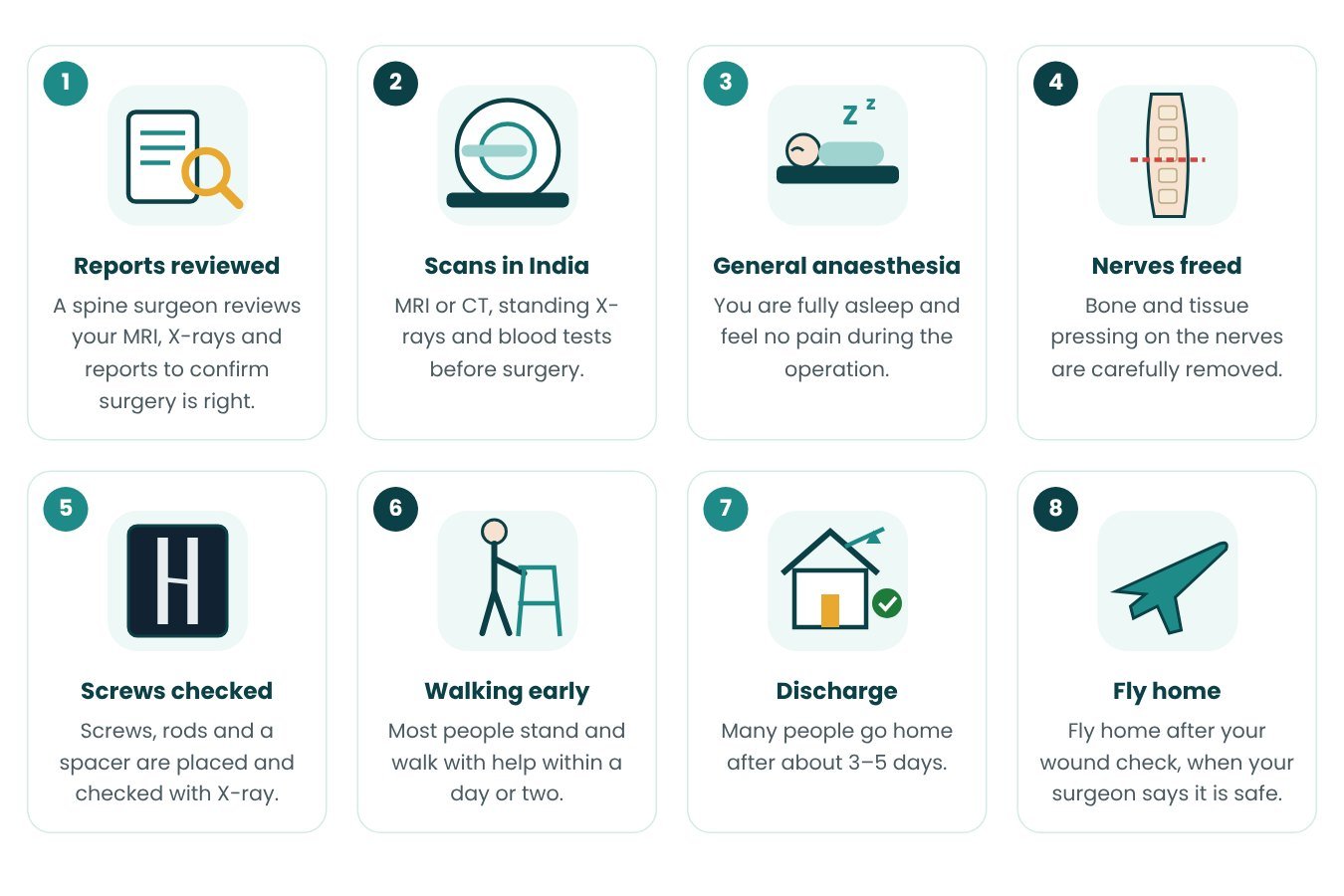
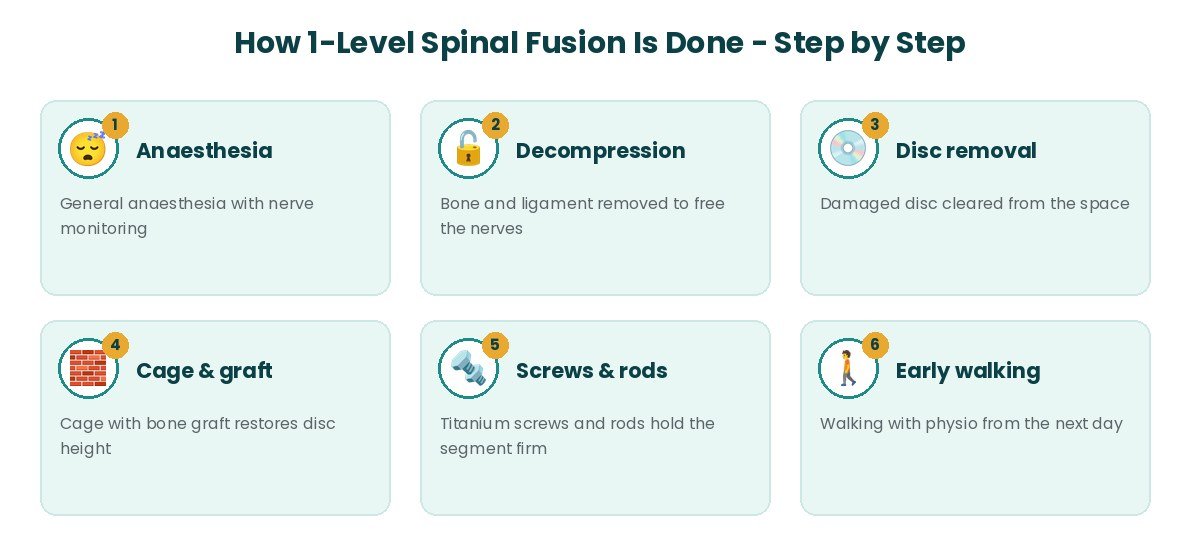
In this operation, the surgeon first decompresses the nerves by removing the bone, ligament or disc pressing on them (laminectomy, discectomy). Then the segment is stabilised (instrumentation) with titanium pedicle screws and rods, usually with a cage and bone graft between the vertebrae so they grow together (fusion). One-level means one spinal segment, for example L4–L5. Common names are TLIF, PLIF and posterior lumbar fusion.
🖼️ Understand It in Pictures
Normal vs narrowed nerve canal
👀 Symptoms in Pictures
🩻 Scans & Tests — What Doctors See


🎬 The Treatment Journey in Pictures

📅 Recovery at a Glance
Drawings: Satyug Healthcare (simplified, not to scale). Photos: Wikimedia Commons; author and licence under each photo.
🩺 Conditions Treated
⚠️ Symptoms That May Need Surgery
- ➤Leg pain or sciatica not improving
- ➤Pain or heaviness in legs on walking
- ➤Numbness or tingling in legs or feet
- ➤Weakness or foot drop
- ➤Chronic low back pain with instability
- ➤Reduced walking distance
- ➤Pain worse on standing, better on bending forward
- ➤Bladder or bowel problems (emergency)
🔬 Tests Before Treatment
| Test | Why it is done |
|---|---|
| MRI of the spine | Shows nerve compression, disc herniation and stenosis. |
| Standing and flexion-extension X-rays | Show slipping and instability between vertebrae. |
| CT scan | Shows bone detail and helps plan screw placement. |
| Nerve conduction / EMG (if needed) | Confirms nerve damage and rules out other causes. |
| Bone density (DEXA) in older patients | Checks bone strength for screws. |
| Blood tests, ECG & chest X-ray | Fitness for anaesthesia. |
🏥 The Procedure — Step by Step
⚖️ Types & Techniques
| Technique | What is done | Best for |
|---|---|---|
| Open TLIF / PLIF | Decompression, cage and screws through a midline cut | Most spondylolisthesis and stenosis cases |
| MIS-TLIF | Same operation through small cuts with tubes | Less muscle damage, faster recovery |
| Posterolateral fusion | Screws and rods with bone graft at the side, no cage | Selected degenerative cases |
| Navigation / robotic-assisted fusion | Computer or robot guides screw placement | Complex anatomy; selected centres |
📅 Your Day-by-Day Plan in India
| Day | What happens |
|---|---|
| Day 1 | Arrival in India, airport pick-up and hotel check-in |
| Day 2 | Spine surgeon consultation, MRI/X-ray review and tests |
| Day 3 | Admission and spine surgery |
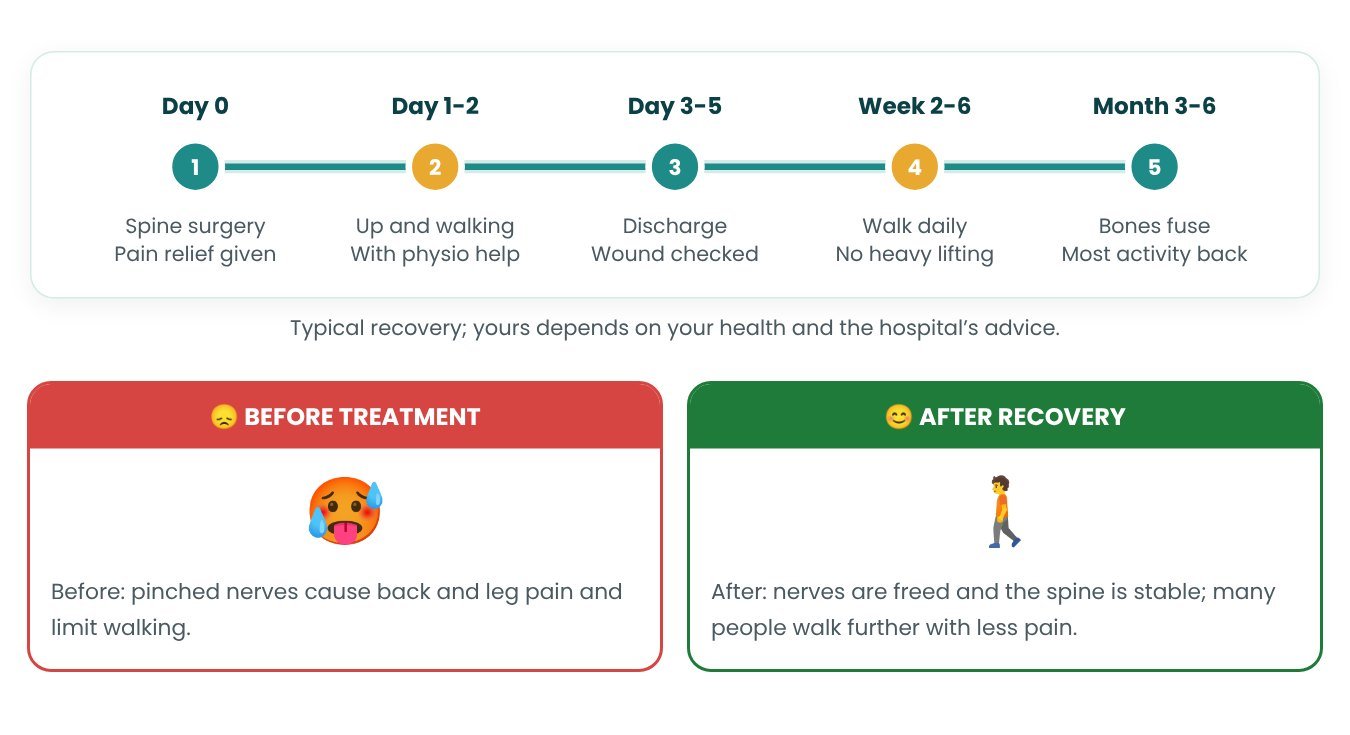
| Day 4–5 | Walking with physiotherapist, drain removed |
| Day 6–8 | Post-operative X-ray and discharge (4–6 days in hospital) |
| Day 9–15 | Hotel stay, daily walks and physiotherapy |
| Day 16–17 | Wound check, stitch removal and review |
| Day 18 | Fit-to-fly – Fly home ✈️ |
🌱 Recovery After Treatment
🏆 Success Rate
| Outcome | Result |
|---|---|
| Leg pain relief | About 80–90% |
| Patient satisfaction | About 75–85% |
| Fusion rate at 1 year | About 90–95% |
| Reoperation within 5 years | About 5–15% |
| Serious complications | About 2–5% |
Results are best when symptoms match the MRI findings, especially for leg pain from a single unstable level. Smoking, diabetes, obesity and osteoporosis slow fusion and reduce benefit.
🩹 Risks & Possible Complications
Most patients recover well; possible complications include:
- •Wound pain and stiffness – common, temporary
- •Wound infection – about 1–4%
- •Dural tear (CSF leak) – about 2–5%, usually repaired during surgery
- •Screw misplacement or loosening – about 1–3%
- •Non-union (fusion does not heal) – about 5–10%
- •Adjacent segment disease over years – about 2–4% per year
- •Nerve injury or weakness – under 1%
💰 Cost of 1-Level Spinal Fusion in India
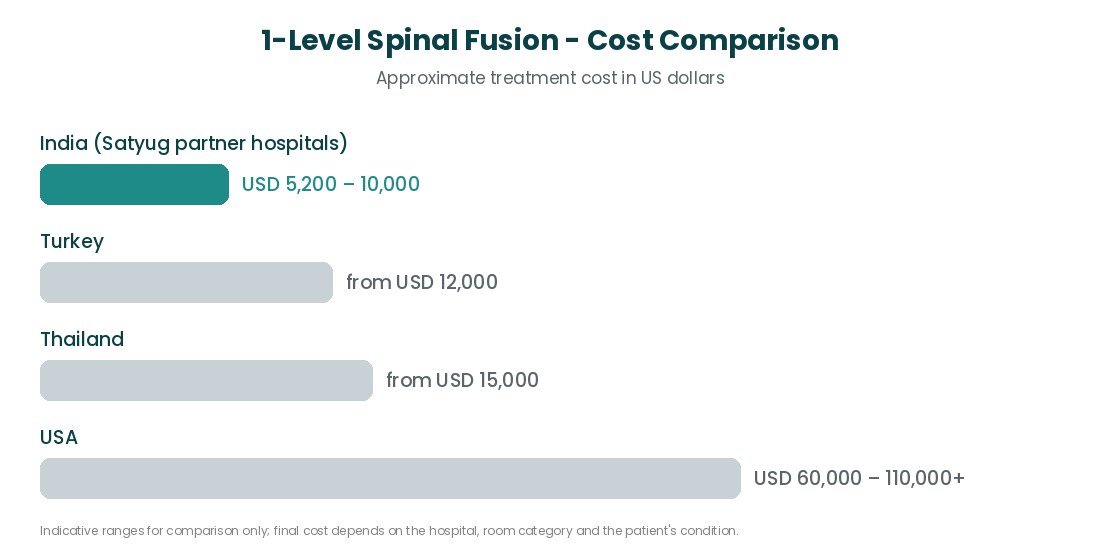
The cost of spine instrumentation with decompression (1 level) in India starts from about USD 5,200. This includes surgery, surgeon and anaesthesia fees, standard titanium screws, rods and cage, and 4–6 days in a twin-sharing room. Costs rise with MIS or navigation, imported implants, extra levels or ICU care.
| Option / Hospital tier | Approx. cost (USD) | Hospital stay | Notes |
|---|---|---|---|
| 1-level fusion with decompression (this package) | 5,200 | 4–6 days, twin sharing | Standard implants included |
| MIS-TLIF (1 level) | 6,500 – 8,000 | 3–4 days | Minimally invasive approach |
| Navigation / robotic-assisted (1 level) | 8,000 – 10,000 | 3–5 days | Selected centres |
| 2-level fusion | 7,000 – 9,000 | 5–7 days | Extra implants |
| Decompression only (no screws) | 2,800 – 3,800 | 2–3 days | When the spine is stable |
📋 What the Package Includes
- ✔Spine surgeon and anaesthesia fees
- ✔Operation theatre charges
- ✔Standard screws, rods and cage
- ✔4–6 days in a twin-sharing room
- ✔Routine medicines and consumables
- ✔Post-operative X-ray
- ✔Physiotherapy during stay
- ✔Lumbar brace if needed
- ✖MRI or CT scans before surgery
- ✖Imported or premium implants
- ✖MIS, navigation or robotic charges
- ✖Extra levels
- ✖ICU stay for complications
- ✖Hotel stay and flights
✈️ Your Medical Travel Process with Satyug Healthcare

| Step | Details |
|---|---|
| 1. Send reports | Recent MRI of the spine (images on CD and report), standing and flexion-extension X-rays, any CT scan, description of symptoms (back vs leg pain, walking distance), previous spine surgery notes and current medicines. |
| 2. Free opinion & quotes | Within 48-72 hours you receive opinions and cost estimates from 3-5 leading hospitals to compare. |
| 3. Choose hospital & doctor | We help you compare doctors, success rates, room options and total budget. |
| 4. Medical visa | The hospital issues a Visa Invitation Letter (VIL) to the Indian Embassy. The patient and up to 2 attendants apply for an e-Medical / Medical Attendant visa. |
| 5. Travel planning | Flight guidance, wheelchair assistance, airport pick-up, hotel or guest house near the hospital. |
| 6. Treatment in India | Your coordinator and interpreter stay with you for admission, treatment, discharge and billing. |
| 7. Return & follow-up | Fit-to-fly letter, medicines, and online follow-up with your doctor after you return home. |
🎒 Travel Checklist
- 📌Valid passport (6+ months) for the patient and attendants, plus 10 passport-size photos each
- 📌Medical visa / e-visa and the hospital’s Visa Invitation Letter
- 📌All spine MRI/X-ray/CT images on CD / link and prescriptions
- 📌Yellow fever vaccination certificate (mandatory for travellers from African countries)
- 📌Polio vaccination certificate where applicable
- 📌Declare cash above USD 5,000 at the airport; hospitals accept wire transfer and cards
- 📌Foreigners staying longer than permitted must register with the FRRO — our team assists
⭐ Why Choose Satyug Healthcare?
❓ Frequently Asked Questions
➤ How much does 1-level spinal fusion with decompression cost in India?
➤ How long is the hospital stay?
➤ How long should I stay in India?
➤ Will I be able to walk after surgery?
➤ Is the surgery painful?
➤ What is the success rate?
➤ Are the screws permanent?
➤ Will my spine become stiff?
➤ What is MIS-TLIF?
➤ What are the risks?
➤ When can I return to work?
➤ Can elderly patients have this surgery?
➤ What follow-up is needed at home?
➤ Is an interpreter available?
Medical disclaimer: This page is for general information and does not replace a consultation with a qualified specialist. Treatment plans and costs are confirmed only after the patient is examined. Sources: NCBI StatPearls: Transforaminal Lumbar Interbody Fusion; NCBI StatPearls: Lumbar Spinal Stenosis; NCBI StatPearls: Spondylolisthesis; Ghogawala et al. NEJM 2016 (SLIP trial); NASS clinical guidelines; AAOS OrthoInfo; Mayo Clinic; NHS. Infographics: Satyug Healthcare.
1-level spinal fusion with decompression in India from USD 5,200. Screws, rods & cage, senior spine surgeons, 4–6 day stay, free opinion & visa support.





TOP HOSPITALS
Special High-quality Hospitals


HAPPY PATIENTS
What Our Patients Are Saying