
Cranioplasty Package
Assistance
Consultation
Services
Opinion
Care Coordination
What will your treatment cost?

See the cost breakdown by option, hospital and city →
| Surgery Name | Cost | Room | Hospitalization |
|---|---|---|---|
| Cranioplasty Package | USD 6000 - USD 7000 | Semi Private | 4-5 days |
✓ Inclusion
- ✔Neurosurgeon, assistant surgeon and anaesthetist fees
- ✔Operation theatre charges
- ✔Titanium mesh implant with fixation plates and screws
- ✔1 day ICU/HDU observation
- ✔4–5 days total hospital stay in a semi-private room
- ✔Routine medicines, antibiotics and IV fluids during stay
- ✔Standard pre-operative blood tests, ECG and chest X-ray
- ✔Post-operative CT scan of the head
- ✔Nursing care, physiotherapy and meals for the patient
- ✔Free: airport pick-up & drop, visa invitation letter, interpreter & coordinator (Satyug Healthcare)
✗ Exclusion
- ✖3D-printed custom titanium or PEEK implant (extra cost)
- ✖MRI or special tests before admission
- ✖Extra ICU or hospital days
- ✖Shunt surgery or treatment of complications
- ✖Medicines after discharge
- ✖Rehabilitation and speech/occupational therapy
- ✖Upgrade to private room
- ✖Hotel/guest-house stay and attendant meals
- ✖Flights, visa fees and travel insurance
Know More About Procedure & Surgery
Cranioplasty with Titanium Mesh in India
Repair of a skull bone defect after decompressive craniectomy, head injury or tumour surgery, using a titanium mesh, the patient's own bone or a 3D-printed custom implant, by experienced neurosurgeons at accredited Indian hospitals – at a fraction of Western costs.
📖 What is Cranioplasty?
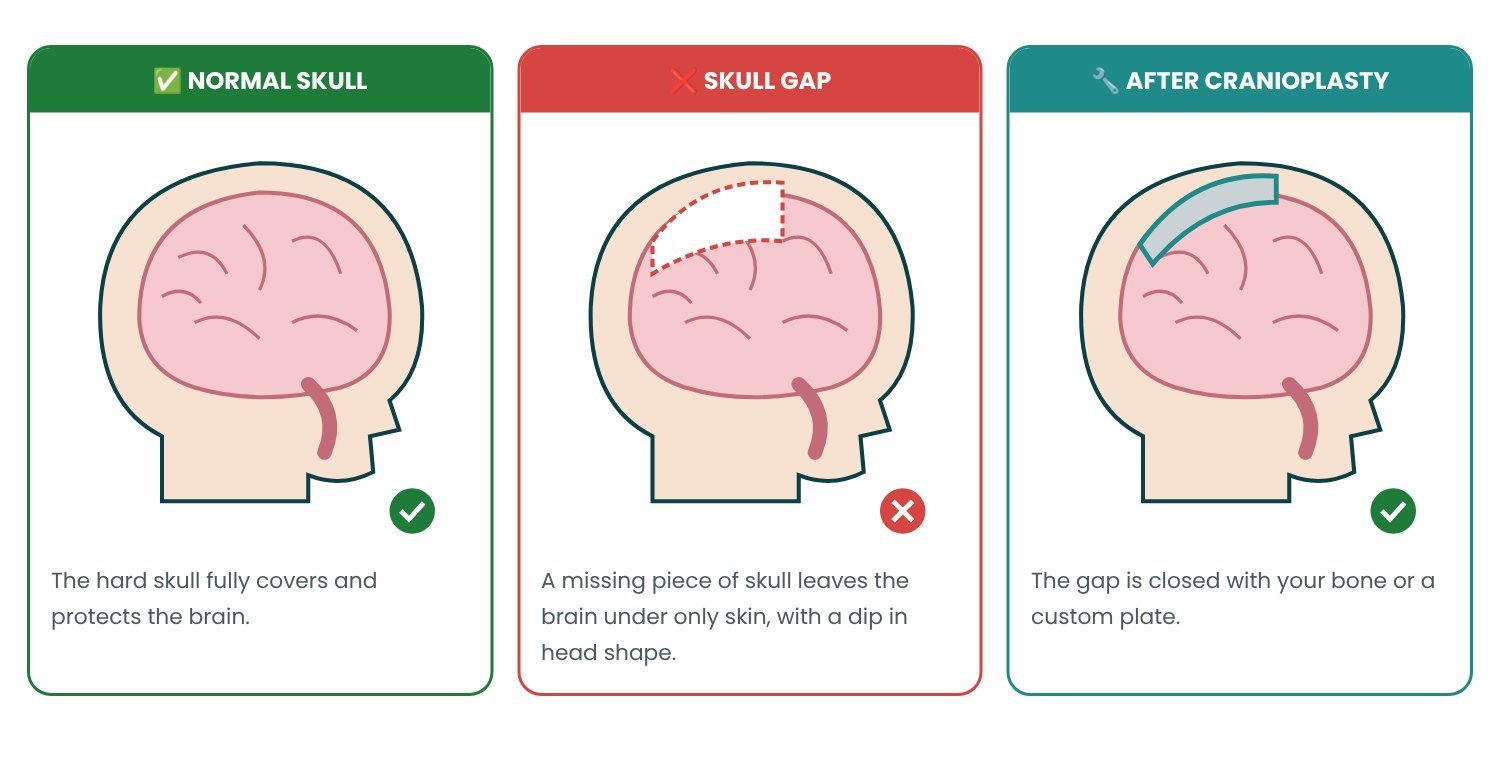
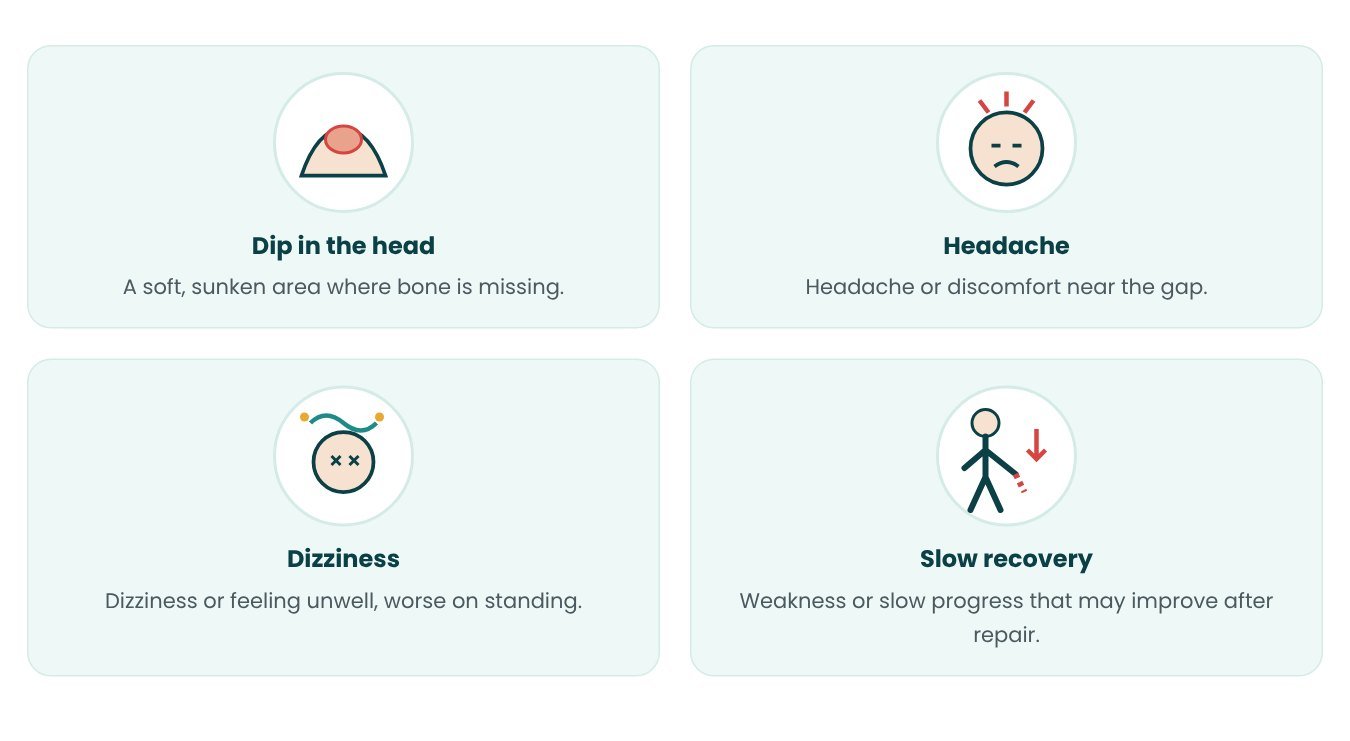
Sometimes a part of the skull bone must be removed to save a patient's life – for example after a severe head injury, a stroke with brain swelling, or bleeding in the brain. This operation is called a decompressive craniectomy. It gives the swollen brain room. After the patient recovers, a soft area or dent remains on the head where the bone is missing. The brain under it is protected only by skin, and patients may have headaches, dizziness, weakness or a 'sinking skin flap' feeling.
Cranioplasty is the operation that closes this skull defect. The surgeon puts back the patient's own stored bone, or uses an implant such as titanium mesh, a 3D-printed custom titanium or PEEK plate, or bone cement (PMMA). It protects the brain, restores the shape of the head, and often improves brain function, because normal pressure and blood flow return. It is usually done 6 weeks to 6 months after craniectomy, once the brain swelling has settled and there is no infection.
🖼️ Understand It in Pictures
Skull gap vs repaired skull
👀 Symptoms in Pictures
🩻 Scans & Tests — What Doctors See

🎬 The Treatment Journey in Pictures
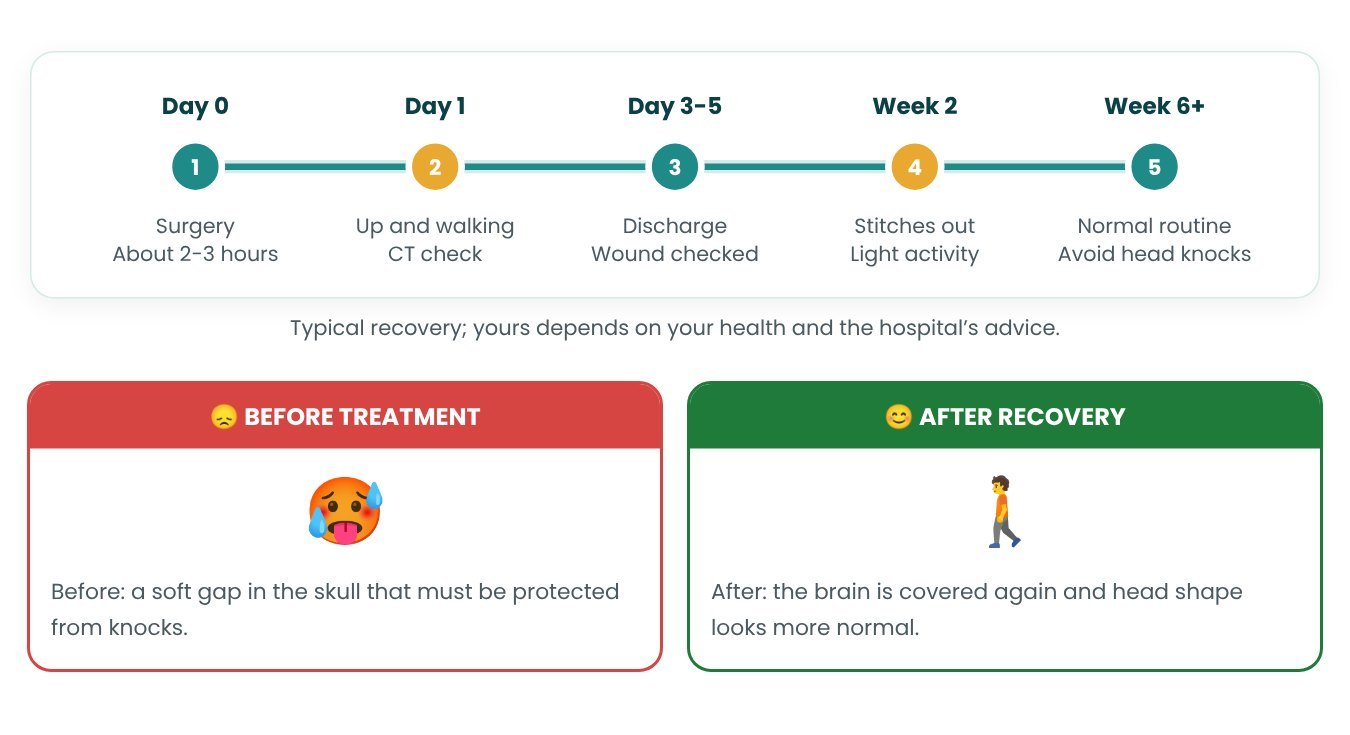
📅 Recovery at a Glance
Drawings: Satyug Healthcare (simplified, not to scale). Photos: Wikimedia Commons; author and licence under each photo.
🩺 Conditions Treated
⚠️ Signs That Cranioplasty May Be Needed
- ➤A soft or sunken area on the head
- ➤Headache or dizziness, worse on standing
- ➤Weakness or numbness that worsens over time
- ➤Slower thinking, poor memory or concentration
- ➤Mood changes or tiredness
- ➤Fear of injury to the unprotected brain
- ➤Need to wear a protective helmet
- ➤Visible head deformity affecting confidence
🔬 Tests Before Treatment
| Test | Why it is done |
|---|---|
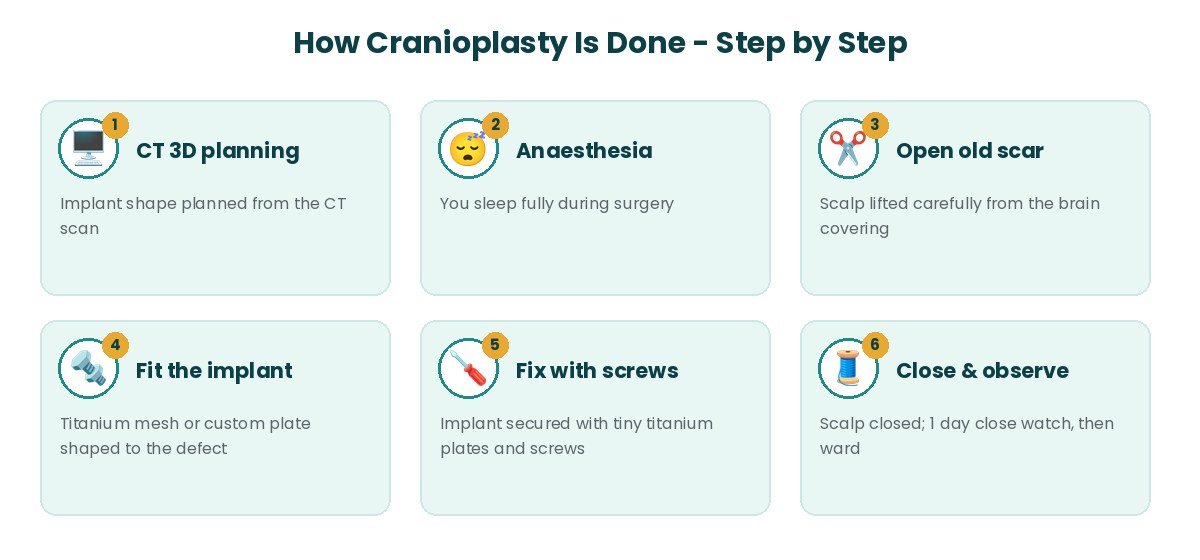
| CT scan of the head with 3D reconstruction | Shows the size and shape of the defect and is used to plan or 3D-print the implant. |
| MRI brain (if needed) | Checks the brain and any fluid collections. |
| Blood tests (CBC, CRP, ESR, clotting) | Rule out infection and check bleeding risk. |
| Neurological examination | Records current strength, speech and thinking before surgery. |
| Scalp & wound check | Ensures healthy skin to cover the implant. |
| ECG, chest X-ray, anaesthesia check | Fitness for general anaesthesia. |
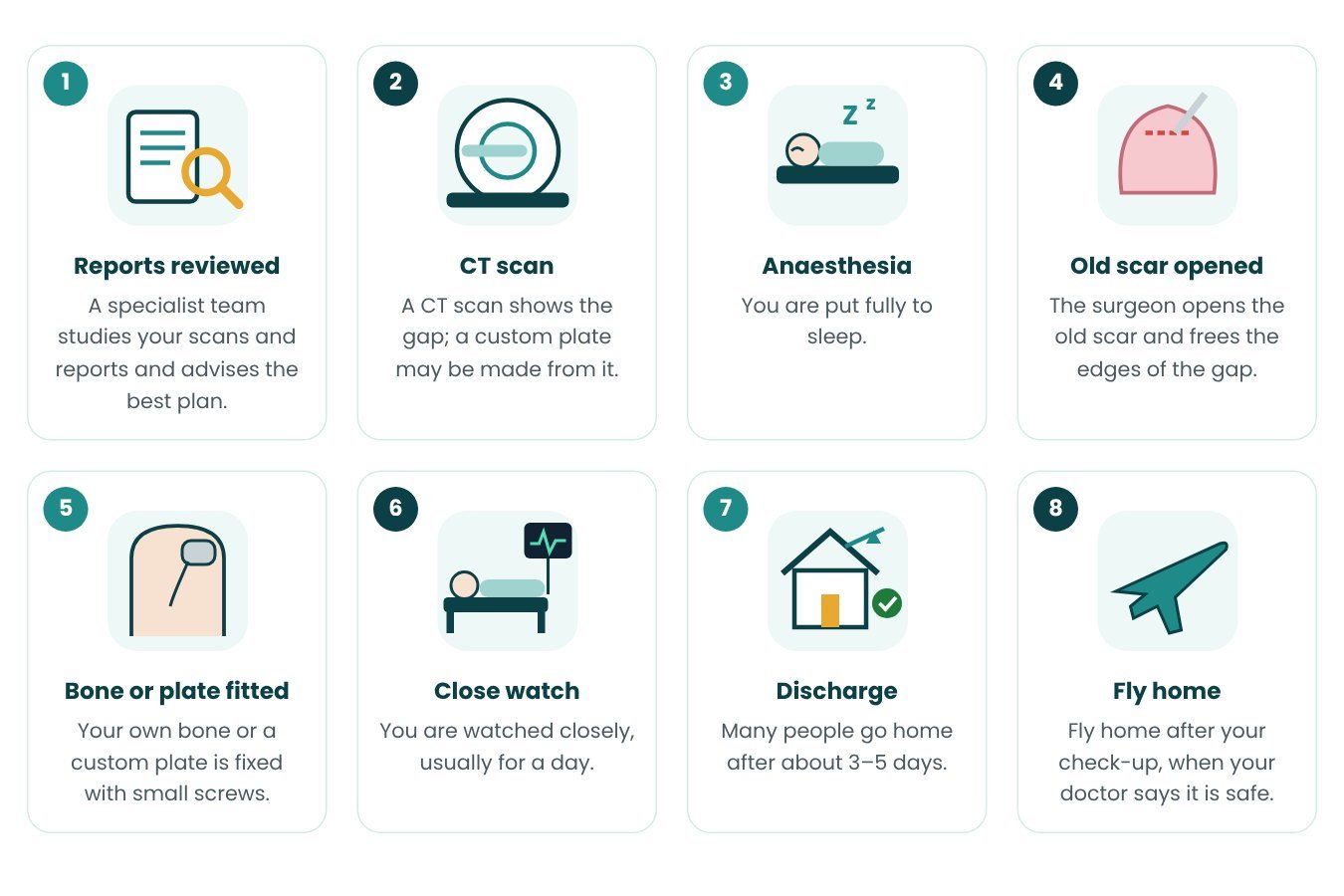
🏥 The Procedure — Step by Step
⚖️ Implant Types
| Implant | What it is | Best for |
|---|---|---|
| Own bone flap (autologous) | Patient's stored bone put back | When bone was stored safely; risk of bone thinning (resorption) |
| Titanium mesh (this package) | Strong metal mesh shaped to the defect | Most adult defects; low infection, good strength |
| 3D-printed custom titanium / PEEK | Implant made from your CT scan to fit exactly | Large or forehead defects where shape matters most |
| Bone cement (PMMA) | Acrylic cement moulded during surgery | Small to medium defects, lower cost |
| Hydroxyapatite / bioceramic | Bone-like material that bonds with skull | Children and selected small defects |
📅 Your Day-by-Day Plan in India
| Day | What happens |
|---|---|
| Day 1 | Arrive in India, airport pick-up, hotel check-in. |
| Day 2 | Meet the neurosurgeon, CT scan with 3D planning, blood tests. |
| Day 3 | Admission and pre-surgery preparation. |
| Day 4 | Cranioplasty surgery; ICU/HDU observation. |
| Day 5–7 | Ward recovery (4–5 days total), drain removal, walking, discharge. |
| Day 8–11 | Rest at hotel, wound care. |
| Day 12–13 | Stitch removal, follow-up CT if needed. |
| Day 14 | Fly home ✈️ |
🌱 Recovery After Treatment
🏆 Success Rate
| Outcome | Result |
|---|---|
| Successful skull repair | About 90% or more |
| Infection needing implant removal | About 5–10% |
| Improvement in headaches/neurological function | Reported in many patients (about 50–70% in studies) |
| Bone resorption with own bone flap | Up to about 20–30% |
Results depend on defect size, scalp quality, past infection, timing of surgery and implant choice. Children and patients with large defects may need custom implants.
🩹 Risks & Possible Complications
- •Infection of the wound or implant: about 5–10%
- •Fluid collection under the scalp: about 5–10%, often settles
- •Seizures: about 5%
- •Bleeding under the implant: about 2–5%
- •Implant exposure or wound breakdown: about 2–5%
- •Implant removal or re-operation: about 5–10%
- •Hydrocephalus (fluid build-up) needing a shunt: uncommon
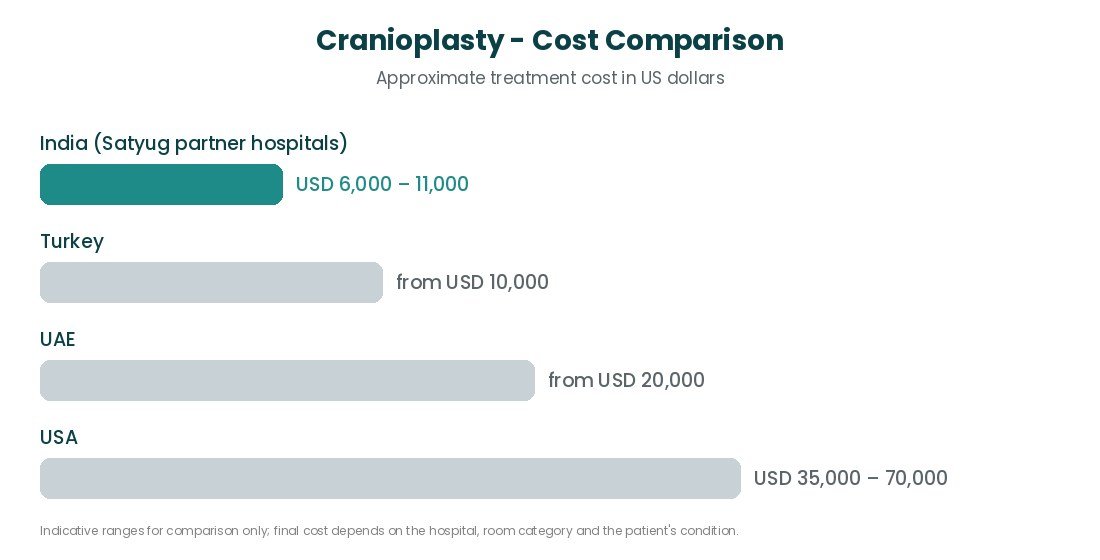
💰 Cost of Cranioplasty in India
The cost of cranioplasty with titanium mesh in India starts from about USD 6,000. This includes the neurosurgery, titanium mesh implant, anaesthesia, 4–5 days in a semi-private room, and routine medicines and tests. A 3D-printed custom implant or PEEK plate costs more.
| Option / Hospital tier | Approx. cost (USD) | Hospital stay | Notes |
|---|---|---|---|
| Cranioplasty with titanium mesh – semi-private (this package) | 6,000 | 4–5 days | Mesh shaped during surgery |
| Cranioplasty with own bone flap | 4,000 – 5,000 | 4–5 days | If bone was stored safely |
| 3D-printed custom titanium implant | 8,000 – 11,000 | 4–5 days | Exact fit, best cosmetic result |
| Custom PEEK implant | 10,000 – 14,000 | 4–5 days | Light, no CT artefact |
📋 What the Package Includes
- ✔Neurosurgeon & anaesthesia fees
- ✔Titanium mesh implant & screws
- ✔Operation theatre charges
- ✔1 day ICU/HDU observation
- ✔4–5 days semi-private room
- ✔Routine medicines & consumables
- ✔Post-operative CT scan
- ✔Meals for patient
- ✖3D custom implant upgrade
- ✖Extra ICU or hospital days
- ✖Pre-admission MRI or tests
- ✖Treatment of infection or complications
- ✖Medicines after discharge
- ✖Hotel stay
- ✖Flights & visa fees
- ✖Rehabilitation therapy
✈️ Your Medical Travel Process with Satyug Healthcare

| Step | Details |
|---|---|
| 1. Send reports | Latest CT scan of the head (with images, ideally 3D), previous craniectomy operation notes, discharge summaries and current neurological status |
| 2. Free opinion & quotes | Within 48-72 hours you receive opinions and cost estimates from 3-5 leading hospitals to compare. |
| 3. Choose hospital & doctor | We help you compare doctors, success rates, room options and total budget. |
| 4. Medical visa | The hospital issues a Visa Invitation Letter (VIL) to the Indian Embassy. The patient and up to 2 attendants apply for an e-Medical / Medical Attendant visa. |
| 5. Travel planning | Flight guidance, wheelchair assistance, airport pick-up, hotel or guest house near the hospital. |
| 6. Treatment in India | Your coordinator and interpreter stay with you for admission, treatment, discharge and billing. |
| 7. Return & follow-up | Fit-to-fly letter, medicines, and online follow-up with your doctor after you return home. |
🎒 Travel Checklist
- 📌Valid passport (6+ months) for the patient and attendants, plus 10 passport-size photos each
- 📌Medical visa / e-visa and the hospital’s Visa Invitation Letter
- 📌All CT/MRI brain scans on CD / link, operation notes, discharge summaries and prescriptions
- 📌Yellow fever vaccination certificate (mandatory for travellers from African countries)
- 📌Polio vaccination certificate where applicable
- 📌Declare cash above USD 5,000 at the airport; hospitals accept wire transfer and cards
- 📌Foreigners staying longer than permitted must register with the FRRO — our team assists
⭐ Why Choose Satyug Healthcare?
❓ Frequently Asked Questions
➤ What is the cost of cranioplasty in India?
➤ How long do I need to stay in India?
➤ When should cranioplasty be done after craniectomy?
➤ Which implant is best – titanium mesh, own bone or PEEK?
➤ Will titanium set off airport metal detectors?
➤ Can I have an MRI with a titanium implant?
➤ Will cranioplasty improve my symptoms?
➤ Is the surgery painful?
➤ What are the main risks?
➤ Can children have cranioplasty?
➤ When can I return to work?
➤ Can attendants come with me?
➤ What follow-up is needed at home?
➤ Will an interpreter be available?
Medical disclaimer: This page is for general information and does not replace a consultation with a qualified specialist. Treatment plans and costs are confirmed only after the patient is examined. Sources: NCBI StatPearls: Cranioplasty; Journal of Neurosurgery systematic reviews on cranioplasty complications and timing; Brain Trauma Foundation guidance; American Association of Neurological Surgeons (AANS): Traumatic brain injury; Mayfield Clinic: Cranioplasty. Infographics: Satyug Healthcare.
Cranioplasty with titanium mesh in India from USD 6,000. Skull defect repair after craniectomy, 3D custom implants available, free opinion & visa help.


TOP HOSPITALS
Special High-quality Hospitals


HAPPY PATIENTS
What Our Patients Are Saying














Our Gallery



Get a Free Quote
Tell us what you need and share your medical reports. Our medical team prepares your treatment plan and cost estimate.
- Free medical opinion on your reports
- Your quote within 24–48 hours
- Help with visa invitation letter, travel and airport pickup
- Coordinators available on WhatsApp
Prefer to talk? Call +91-8860606766 or WhatsApp us.
Thank you! Your request is received.
Reference . Our medical team will send your free quote within 24–48 hours by e-mail or WhatsApp.
Chat on WhatsApp now