Brain AVM Embolization / Surgery Package (per Session)
Assistance
Consultation
Services
Opinion
Care Coordination
What will your treatment cost?

See the cost breakdown by option, hospital and city →
| Surgery Name | Cost | Room | Hospitalization |
|---|---|---|---|
| Brain AVM Embolization / Surgery Package (per Session) | 8500 | Economy / Twin Sharing (Single room on request) | 5 Days per Embolization Session (incl. 1 Day ICU); Total Stay in India 3-4 Weeks |
✓ Inclusion
- ✔Embolization session — interventional neuroradiologist, anaesthetist & cath-lab charges
- ✔Standard catheters and consumables as per the hospital package
- ✔ICU monitoring after the procedure
- ✔About 5 days hospital stay (economy / twin sharing)
- ✔Nursing care, routine medicines during stay
- ✔Basic investigations during the package days
- ✔Consultations by the primary team
- ✔Meals for the patient
- ✔Discharge summary & fit-to-fly letter
- ✔Free: airport pick-up & drop, visa invitation letter, interpreter & coordinator (Satyug Healthcare)
✗ Exclusion
- ✖Evaluation and diagnostic DSA (USD 500–2,000)
- ✖Extra embolic material (Onyx / glue / coils) beyond the package
- ✖Additional embolization sessions
- ✖Microsurgery (craniotomy) or Gamma Knife if added — quoted separately
- ✖Stay beyond the package days and extra ICU days
- ✖Treatment of complications
- ✖Blood and blood products
- ✖Flights, visa fees, hotel / guest house after discharge
- ✖Single / deluxe room upgrade (extra charge)
- ✖Personal expenses
Know More About Procedure & Surgery
Brain AVM Embolization & Surgery in India
Arteriovenous malformation of the brain or spine • Ruptured AVM with bleeding • Seizures or headache from an AVM — treated by embolization, microsurgery, Gamma Knife or a combination, by senior neurosurgeons and interventional neuroradiologists at NABH & JCI accredited hospitals.
🧠 What is Brain AVM Treatment?
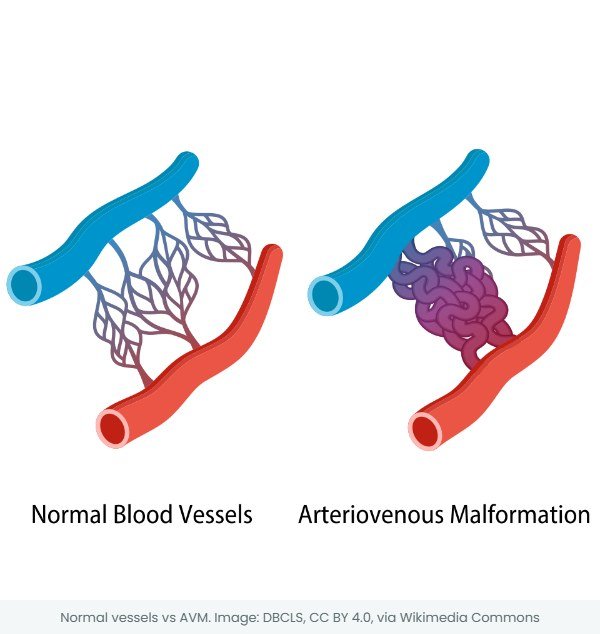
A brain arteriovenous malformation (AVM) is a tangle of abnormal blood vessels in which arteries connect directly to veins, without the normal network of tiny capillaries in between. Blood rushes through this tangle (the nidus) at high pressure, which can make the thin-walled vessels burst and bleed into the brain, cause seizures, headaches or, less often, weakness from “steal” of blood from nearby brain. Most AVMs are present from birth and are often found in people aged 20–40.
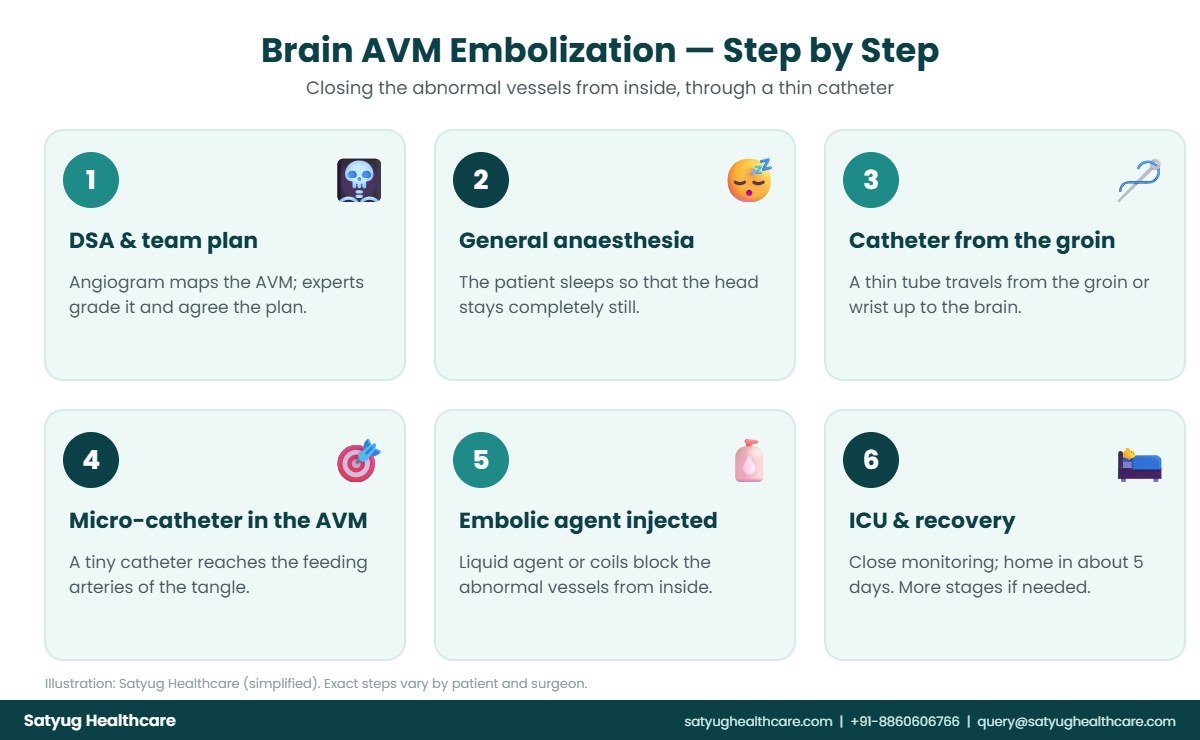
Treatment aims to remove or permanently close the AVM so that it can no longer bleed. This can be done by embolization (blocking the abnormal vessels from inside with a special glue or liquid agent through a catheter), microsurgical resection (removing the AVM through an opening in the skull), stereotactic radiosurgery such as Gamma Knife (focused radiation that makes the AVM close over 2–3 years), or a combination. The best plan depends on the AVM’s size, location and drainage — usually graded with the Spetzler-Martin scale (grades I–V).
🩺 Conditions Treated
⚠️ Symptoms That May Need Surgery
- ➤Sudden severe headache, vomiting or loss of consciousness (bleeding) — an emergency
- ➤New seizures (fits), especially in a young adult
- ➤Weakness, numbness, speech or vision problems
- ➤Headache in one part of the head that keeps coming back
- ➤A whooshing sound in the ear in time with the pulse (fistula)
- ➤Progressive weakness of the legs or bladder problems (spinal AVM)
- ➤In babies: heart failure, large head or prominent scalp veins
- ➤An AVM found by chance on an MRI or CT scan
🔬 Tests Before Surgery
| Test | Why it is done |
|---|---|
| Digital Subtraction Angiography (DSA) | The gold-standard test — a catheter study that maps the feeding arteries, nidus and draining veins; needed to plan any treatment |
| MRI Brain with MR Angiography | Shows the exact location of the AVM in relation to important brain areas, and any old or new bleeding |
| CT Scan / CT Angiography | Quick test for acute bleeding; CTA gives a first view of the vessels |
| Functional MRI / Tractography (selected cases) | Maps speech, movement and vision areas near the AVM before surgery |
| EEG | When the AVM causes seizures |
| Blood Tests, ECG, Kidney Function | Pre-anaesthesia fitness and kidney check before contrast dye; clotting profile and blood group |

🏥 The Procedure — Step by Step
⚖️ Treatment Options for Brain AVM
| Treatment | How it works | Best for |
|---|---|---|
| Endovascular embolization | Catheter through the groin; AVM blocked from inside with liquid embolic agent or coils | Before surgery or radiosurgery to make them safer; some small AVMs and most dural fistulas can be cured alone |
| Microsurgical resection (craniotomy) | AVM removed through a skull opening under the microscope | Low-grade (Spetzler-Martin I–II, some III) AVMs, especially after bleeding — gives immediate cure |
| Stereotactic radiosurgery (Gamma Knife / CyberKnife) | Highly focused radiation in one sitting; vessels close over 2–3 years | Small AVMs (usually under 3 cm) in deep or critical areas |
| Multimodal treatment | Embolization followed by surgery or radiosurgery, sometimes in stages | Larger or complex AVMs |
| Observation & medical management | Blood pressure control, seizure medicines, regular scans | Some unruptured, high-grade AVMs where treatment risk is higher than the bleeding risk |
📅 Your Day-by-Day Plan in India
| Day | What happens |
|---|---|
| Day 1 | Arrival in New Delhi — airport pick-up, hotel check-in, coordinator meeting |
| Day 2–4 | Neurosurgeon and neuro-interventionist consultation, MRI, blood tests; diagnostic DSA |
| Day 5 | Team review of the DSA and final treatment plan with written cost estimate |
| Day 6–10 | Admission and embolization (or surgery / Gamma Knife as planned); ICU monitoring; ward stay |
| Day 11–20 | Rest near the hospital, follow-up check; second-stage embolization if planned |
| Day 21–28 | Final review, follow-up imaging plan and fit-to-fly letter; fly home ✈️ — online follow-up; staged cases may need a return visit |
🌱 Recovery After Surgery
🏆 Success Rate
| Outcome | Result |
|---|---|
| Bleeding after treatment — microsurgery | 0.18 per 100 patient-years (JAMA 2011 meta-analysis, 13,698 patients) |
| Bleeding after treatment — radiosurgery or embolization | About 1.7 per 100 patient-years, mostly before complete closure |
| Case fatality after any AVM treatment | 0.68 per 100 patient-years |
| Untreated AVM annual bleeding risk | About 3% (2.2% unruptured, 4.5% ruptured) — Gross & Du 2013 |
| ARUBA trial (unruptured AVMs, 33 months) | Stroke or death 10.1% with medical management vs 30.7% with early intervention |
Low-grade AVMs that can be completely removed or closed have an excellent outlook. Large or deep AVMs need careful, often staged treatment, and the team will discuss the expected benefit and risk for your specific AVM before you travel.
🩺 Risks & Possible Complications
AVM treatment is complex and carries real risks, which differ by technique. Your team will explain these for your case:
- •Bleeding in the brain during or after embolization or surgery
- •Stroke (weakness, speech or vision problems) from blocking normal vessels — may be temporary or permanent
- •Headache, seizures or brain swelling after treatment
- •Incomplete closure needing further embolization, surgery or radiosurgery
- •After radiosurgery: delayed swelling or radiation changes in a minority of patients, and continued bleeding risk until closure
- •Catheter-related: groin bruising or haematoma, contrast reaction, rare kidney problems
💰 Cost of Brain AVM Treatment in India
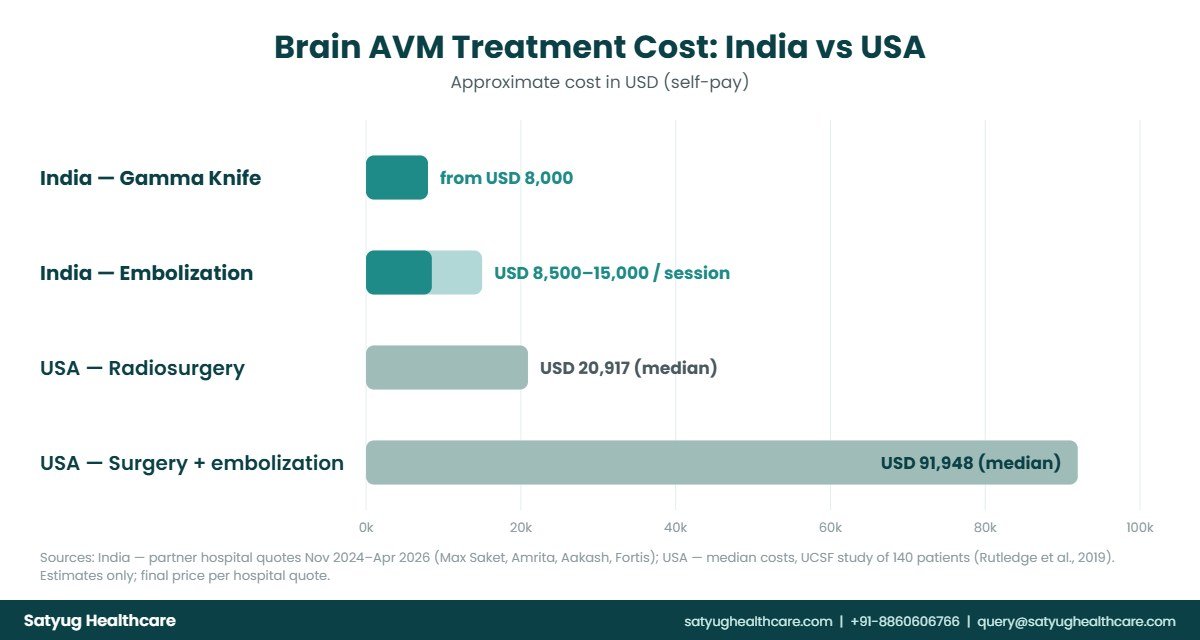
The cost of brain AVM treatment in India depends on the type and number of sessions. Embolization starts from about USD 8,500 per session (economy room), with a diagnostic DSA of about USD 1,000–2,000 and evaluation of USD 500–1,000. Gamma Knife for a small AVM starts from about USD 8,000. Below are recent cost estimates our partner hospitals in Delhi NCR shared with Satyug Healthcare (November 2024 – April 2026):
| Hospital | Specialist | Evaluation | Surgery Cost | Hospital Stay |
|---|---|---|---|---|
| Max Super Speciality Hospital, Saket, New Delhi | Dr. Anurag Gupta – Head of Unit, Neurosurgery | USD 500–700 + DSA ≈ USD 1,000 | Embolization: USD 8,500–10,000 (depends on extent and material) | 5 days economy; India 3–4 weeks |
| Amrita Hospital, Faridabad | Dr. Anandh Balasubramaniam – Prof. & HOD Neurosurgery | USD 800 | DSA + embolisation: USD 11,500–12,500 (2024) | 5–7 days; India 3–4 weeks |
| Amrita Hospital, Faridabad | Interventional radiology team | USD 800–1,000 | DSA + procedure: USD 13,000 (2026) | 5 days ward + 1 day ICU |
| Aakash Healthcare, Dwarka, New Delhi | Dr. Amit Srivastava – Director, Neurosurgery | USD 500–700 + DSA ≈ USD 2,000 | Embolization: USD 12,000–15,000 per sitting | 5 days per sitting |
| Fortis Memorial Research Institute, Gurugram | Neurosurgery team | As per tests | Gamma Knife radiosurgery for a small AVM: about USD 8,000 | 1 day |
📋 What the Package Includes
- ✔Embolization session — interventional neuroradiologist, anaesthetist & cath-lab charges
- ✔Standard catheters and consumables as per the hospital package
- ✔ICU monitoring after the procedure
- ✔About 5 days hospital stay (economy / twin sharing)
- ✔Nursing care, routine medicines during stay
- ✔Basic investigations during the package days
- ✔Consultations by the primary team
- ✔Meals for the patient
- ✔Discharge summary & fit-to-fly letter
- ✔Free: airport pick-up & drop, visa invitation letter, interpreter & coordinator (Satyug Healthcare)
- ✖Evaluation and diagnostic DSA (USD 500–2,000)
- ✖Extra embolic material (Onyx / glue / coils) beyond the package
- ✖Additional embolization sessions
- ✖Microsurgery (craniotomy) or Gamma Knife if added — quoted separately
- ✖Stay beyond the package days and extra ICU days
- ✖Treatment of complications
- ✖Blood and blood products
- ✖Flights, visa fees, hotel / guest house after discharge
- ✖Single / deluxe room upgrade (extra charge)
- ✖Personal expenses
✈️ Your Medical Travel Process with Satyug Healthcare
| Step | Details |
|---|---|
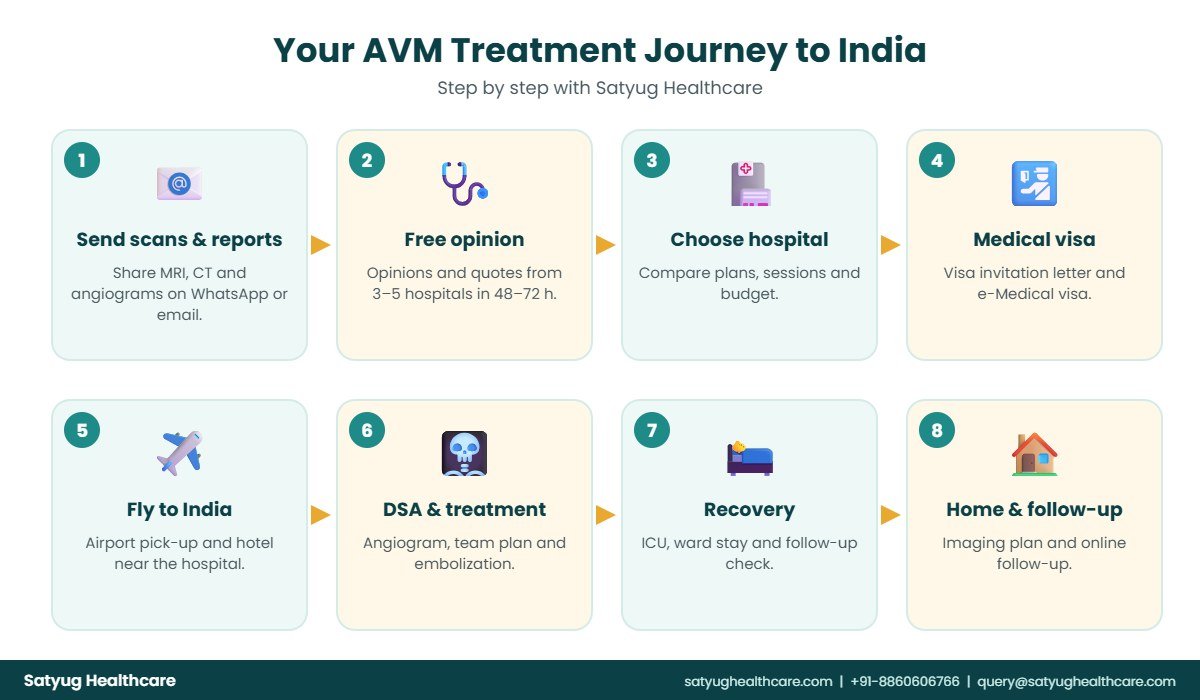
| 1. Send reports | Share MRI / CT, any DSA or CT angiography (CD or link), discharge summaries of any bleed, age and weight on WhatsApp or email. |
| 2. Free opinion & quotes | Within 48–72 hours you receive opinions from neurosurgeons and neuro-interventionists at 3–5 leading hospitals. |
| 3. Choose hospital & team | We help you compare the proposed plan (embolization, surgery, Gamma Knife), number of sessions and total budget. |
| 4. Medical visa | The hospital issues a Visa Invitation Letter (VIL). Patient and up to 2 attendants apply for an e-Medical / Medical Attendant visa. |
| 5. Travel planning | Flight guidance, wheelchair assistance, airport pick-up, hotel or guest house near the hospital. |
| 6. Treatment in India | Your coordinator and interpreter stay with you for DSA, treatment, discharge and billing. |
| 7. Return & follow-up | Fit-to-fly letter, imaging schedule, medicines and online follow-up; planning of any second stage. |
🎒 Travel Checklist
- 📌Valid passport (6+ months) for the patient and attendants, plus 10 passport-size photos each
- 📌Medical visa / e-Medical visa and the hospital’s Visa Invitation Letter (VIL)
- 📌All MRI / CT images on CD or a download link, plus printed reports and current medicine list
- 📌Yellow fever vaccination certificate (mandatory for travellers from African countries)
- 📌Polio vaccination certificate where applicable
- 📌Declare cash above USD 5,000 at the airport; hospitals accept wire transfer and cards
- 📌Foreigners staying longer than permitted must register with the FRRO — our team assists
⭐ Why Choose Satyug Healthcare?
❓ Frequently Asked Questions
➤ How much does brain AVM embolization cost in India?
➤ Can an AVM be cured?
➤ How many embolization sessions will I need?
➤ What is a DSA and why is it needed?
➤ Is embolization done through the head?
➤ How long will I stay in hospital and in India?
➤ Should every AVM be treated?
➤ What is Gamma Knife for AVM?
➤ What are the main risks?
➤ Can AVMs come back after treatment?
➤ When can I fly after embolization?
➤ Is AVM treatment available for children?
➤ What should I send for a free opinion?
Medical disclaimer: This page is for general information and does not replace a consultation with a qualified specialist. Treatment plans and costs are confirmed only after the patient is examined. Sources: Mohr JP et al., ARUBA trial, Lancet 2014 (via Congress of Neurological Surgeons summary); van Beijnum J et al., Treatment of brain arteriovenous malformations: a systematic review and meta-analysis, JAMA 2011;306(18):2011-2019; Gross BA, Du R, Natural history of cerebral arteriovenous malformations: a meta-analysis, J Neurosurg 2013; Rutledge C et al., UCSF cost determinants study, 2019 (US costs); NINDS — Arteriovenous Malformations; NHS — Brain AVM; AANS — Arteriovenous Malformations; partner hospital estimates (Nov 2024 – Apr 2026). Images: AVM illustration — DataBase Center for Life Science (DBCLS), CC BY 4.0; AVM angiogram — Royonx, CC BY-SA 3.0; both via Wikimedia Commons. Infographics: Satyug Healthcare.
✍️ Written & reviewed by Vikram Kashyap, Medical Consultant, Satyug Healthcare — last reviewed October 2026
Frequently Asked Questions
Embolization costs about USD 8,500–15,000 per session at leading hospitals in Delhi NCR, plus about USD 500–1,000 for evaluation and USD 1,000–2,000 for the diagnostic DSA. Gamma Knife for a small AVM starts from about USD 8,000.
Brain AVM embolization, surgery & Gamma Knife in India from USD 8,500 at top NABH/JCI hospitals. Expert neuro-intervention teams, free opinion & visa help.




TOP HOSPITALS
Special High-quality Hospitals


HAPPY PATIENTS
What Our Patients Are Saying