Voice Box Cancer · Laser Surgery · Radiation Therapy · Voice Preservation · Head & Neck Oncology
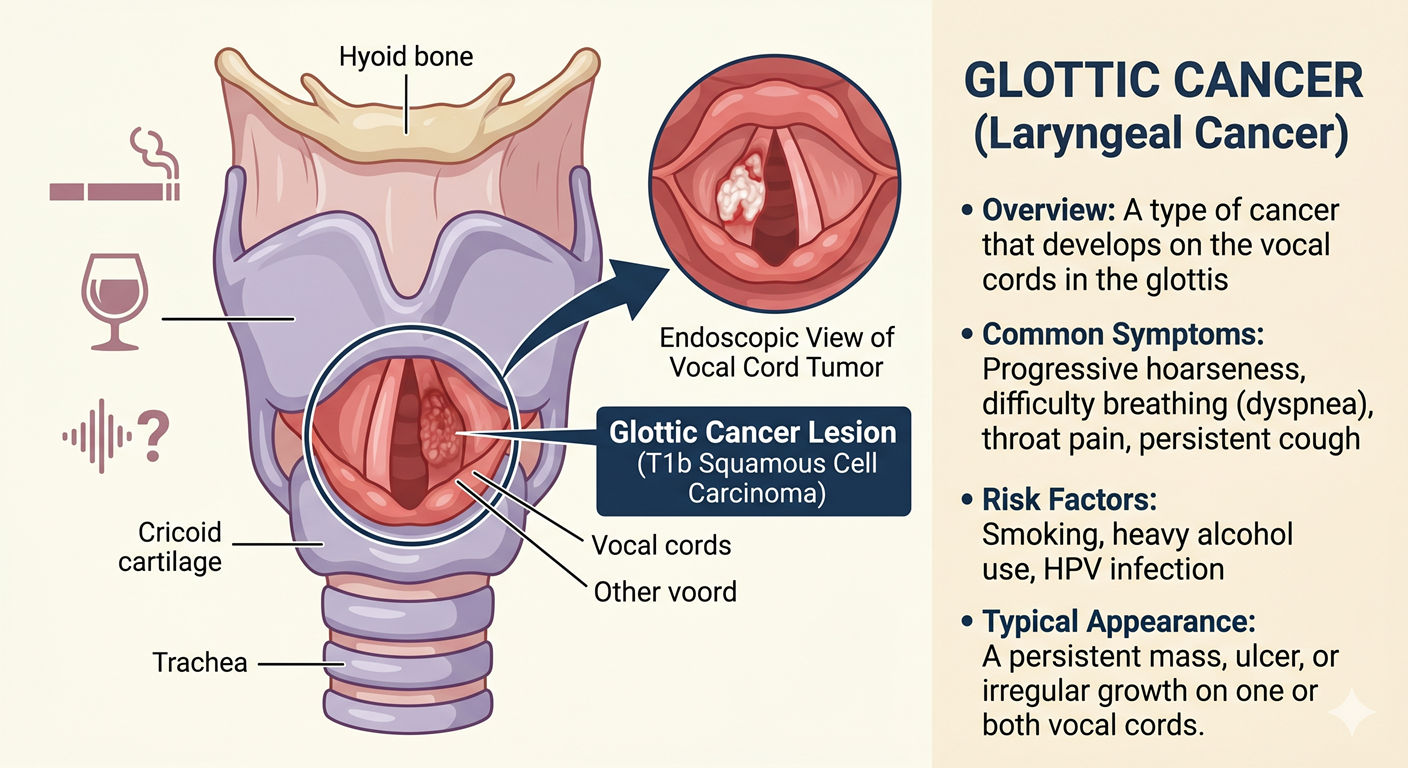
Glottic cancer is a type of laryngeal (voice box) cancer that develops on the vocal cords. It is the most common form of laryngeal cancer — and fortunately, one of the most curable. Because even a tiny tumour on the vocal cords causes early voice changes (hoarseness), most glottic cancers are detected at an early stage when cure rates exceed 90% with treatment options that preserve voice and quality of life.
India has emerged as one of the world's leading destinations for head and neck cancer care. Top Indian hospitals offer transoral CO₂ laser microsurgery, transoral robotic surgery (TORS), advanced IMRT/VMAT radiation therapy, partial and total laryngectomy with voice rehabilitation at JCI/NABH accredited centres — at a cost 60–80% lower than the USA, UK or Europe.
The larynx (voice box) sits at the top of the windpipe and is divided into three regions: supraglottis (above the vocal cords), glottis (the vocal cords themselves), and subglottis (below the vocal cords). Glottic cancer arises in the glottis — the vocal cord region — and is responsible for around 60–70% of all laryngeal cancers.
Approximately 90% of glottic cancers are squamous cell carcinomas, originating from the thin lining of the vocal cords. Less common types include verrucous carcinoma, sarcomas, and minor salivary gland tumours.
Stages 0–II — limited to vocal cords with normal mobility. Excellent cure rates (85–95%) with voice-preserving treatment
Stages III–IV — fixed vocal cord, extension beyond glottis or lymph node involvement. Requires combined treatment approach
💡 Good News: Because the glottis has minimal lymphatic drainage and the vocal cords cause early hoarseness, most glottic cancers are diagnosed at an early stage — making them one of the most curable head and neck cancers.
Glottic cancer is strongly linked to lifestyle exposures, particularly tobacco and alcohol — the two greatest risk factors that often act synergistically.
The hallmark symptom is persistent hoarseness. Any voice change lasting more than 2–3 weeks in a person with risk factors should prompt urgent ENT evaluation.
Don't ignore persistent hoarseness, especially if you smoke or drink alcohol. Early evaluation can be life-saving.
🎙️ Your voice is the early warning system — listen to it
Staging is based on tumour size and extent (T), lymph node involvement (N) and distant spread (M). Treatment and prognosis depend heavily on stage.
Diagnosis combines clinical examination, endoscopic visualisation, imaging and tissue biopsy. India's top head and neck cancer centres complete the workup typically within 5–7 days.
Office-based fibreoptic exam — visualises vocal cords and assesses mobility
Specialised exam of vocal cord vibration to detect subtle mucosal changes
Under anaesthesia — confirms diagnosis with tissue sample (gold standard)
Assesses tumour extent, cartilage invasion and lymph node involvement
Superior soft tissue detail — for cartilage and pre-epiglottic space invasion
Detects distant metastases and synchronous second primary cancers
Chest X-ray or CT to rule out lung metastases or second primary lung cancer
CBC, liver/renal function, thyroid function, nutritional assessment
Treatment depends on cancer stage, vocal cord function, patient health and patient preference. Early-stage disease has excellent voice-preservation options; advanced disease requires multimodal therapy. Indian head and neck cancer centres offer the complete spectrum.
Gold-standard treatment for early glottic cancers (Stage 0–II). Performed through the mouth using a CO₂ laser under the operating microscope, with no external incisions. Cure rates of 85–95% with excellent voice preservation. Outpatient or short-stay procedure — patients usually return to normal activities within a week.
Equally effective alternative to laser surgery for early disease. A standard course delivers 60–70 Gy over 6 weeks. Modern intensity-modulated radiation therapy (IMRT) and volumetric arc therapy (VMAT) at Indian centres minimise damage to surrounding tissue. Useful voice is preserved in 80–95% of patients. Often the preferred choice when the tumour involves both vocal cords (T1b) or the anterior commissure.
Open or robotic-assisted surgery to remove the cancerous part of the larynx while preserving voice. Types include:
Reserved for advanced disease (T4 or recurrent cancer) when organ-preservation protocols are unlikely to succeed. Complete removal of the larynx with creation of a permanent stoma (breathing hole) in the neck. Voice rehabilitation options after total laryngectomy include: tracheo-oesophageal prosthesis (TEP), electrolarynx, or oesophageal speech. Most patients regain functional voice within weeks.
For locally advanced disease (Stage III–IVA), concurrent chemoradiation with cisplatin is the standard organ-preservation approach — offering cure rates similar to total laryngectomy while preserving the voice box. Induction chemotherapy (TPF regimen: docetaxel, cisplatin, 5-FU) may be used in selected patients. Cetuximab, a targeted EGFR inhibitor, is an alternative for patients who cannot tolerate cisplatin.
For recurrent or metastatic disease, immune checkpoint inhibitors like pembrolizumab and nivolumab have transformed outcomes. PD-L1 testing guides treatment selection. India's top cancer centres offer the latest international protocols and access to clinical trials.
Quality of life after treatment depends heavily on functional rehabilitation. India's leading hospitals offer comprehensive multidisciplinary care to restore voice, swallowing and breathing.
Voice therapy after laser surgery or radiation; speech training after laryngectomy
Tracheo-oesophageal puncture with prosthesis — best functional voice after total laryngectomy
Hand-held electronic device that produces voice; alternative when TEP not suitable
Dysphagia rehabilitation; safe swallowing techniques; nutritional support
Tracheostoma management, humidification (HME), cleaning and emergency care training
Counselling for body image, identity and social adjustment after laryngectomy
Multidisciplinary tumour boards with ENT surgeons, surgical/medical/radiation oncologists, speech therapists and dietitians.
Surgeons trained at Tata Memorial, AIIMS & leading USA/UK head and neck centres, performing hundreds of laryngeal cases yearly.
Full diagnostic workup, surgery, radiation, chemotherapy and rehabilitation at a fraction of Western costs.
CO₂ laser microsurgery, Da Vinci robotic surgery (TORS), IMRT, VMAT, TomoTherapy and proton beam therapy at select centres.
* Costs vary by stage, surgical complexity, length of stay and hospital. Contact Satyug Healthcare for a personalised estimate.
Glottic cancer has one of the best outcomes of all head and neck cancers, primarily because most are detected early. 5-year survival exceeds 90% for Stage I and 75–85% for Stage II. Even locally advanced disease, with combined chemoradiation, can achieve cure rates of 50–60%. Beyond survival, modern voice-preservation strategies mean the majority of patients retain functional voice and good quality of life. Quitting smoking and alcohol after diagnosis significantly improves cure rates and reduces second cancer risk.
A cancer diagnosis is overwhelming. Satyug Healthcare specialises in making the international treatment journey smooth, transparent and stress-free for you and your family.
Send biopsy report, CT/MRI/PET images and discharge summary. Free written opinion from a leading head and neck oncologist or radiation oncologist.
Tumour board consultations with surgical, medical and radiation oncologists so you choose the optimal treatment plan.
BLK-Max, Indraprastha Apollo, Medanta Medicity, Fortis Memorial, Rajiv Gandhi Cancer Institute, Tata Memorial, Amrita Hospital, HCG Cancer Centres.
Medical visa invitation letter and full visa support — fast-track processing for urgent cases.
Airport pick-up, hotel/long-stay apartment, hospital admissions, surgery scheduling, radiation appointments, follow-up.
English, Arabic, Russian, French and other languages — no communication barriers during treatment.
Video consultations with your treating oncologist for surveillance scans, voice therapy guidance and recurrence monitoring.
Q1. Will I lose my voice if I have glottic cancer?
Not in most cases. For early-stage cancer, laser surgery or radiation preserves the voice in 80–95% of patients. Even in advanced cases requiring total laryngectomy, modern voice rehabilitation (TEP, electrolarynx, oesophageal speech) restores functional speech within weeks.
Q2. Is laser surgery or radiation better for early glottic cancer?
Both achieve similar cure rates (around 90%). Laser surgery has a shorter treatment time (often a single day), while radiation takes 6 weeks. Voice quality is generally similar. Your surgeon will recommend the best option based on tumour location, your overall health and preference.
Q3. How long is treatment in India?
For Stage I treated with laser surgery: 1–2 weeks total stay. For radiation therapy: 7–8 weeks. For advanced cancer with chemoradiation: 8–10 weeks. Total laryngectomy with rehabilitation: 4–6 weeks. Satyug Healthcare arranges long-stay apartments at affordable rates for the entire treatment period.
Q4. Can glottic cancer come back after treatment?
Yes, recurrence is possible — usually within the first 2–3 years. Most centres recommend lifelong follow-up with regular laryngoscopy and scans. Continuing to smoke or drink significantly increases recurrence risk. Quitting both improves long-term cure rates dramatically.
Q5. What documents do I need to share for a medical opinion?
Please send: (1) biopsy and histopathology report, (2) CT/MRI/PET-CT images and reports, (3) flexible laryngoscopy report (and video if available), (4) recent blood tests, (5) hospital discharge summary if previously treated, (6) list of current medications. Send via WhatsApp or email — written opinion within 24–48 hours.
Get a free written medical opinion from a leading head and neck cancer specialist in India within 24–48 hours — at no obligation.
📞 +91-8860606766 | +91-9910655125
✉️ query@satyughealthcare.com · 💬 WhatsApp 24/7