Assistance
Consultation
Services
Opinion
Care Coordination
What will your treatment cost?
Maple Syrup Urine Disease (MSUD): Causes, Symptoms, Diagnosis & Treatment
Released Date: 2026-09-14
🍁 Maple Syrup Urine Disease (MSUD)
A Rare Inherited Disorder of Amino Acid Metabolism
⚡ Quick Facts: Maple Syrup Urine Disease (MSUD) is a rare, inherited (genetic) metabolic disorder in which the body cannot properly break down three amino acids — leucine, isoleucine, and valine — found in dietary protein. These amino acids and their by-products build up in the blood and urine, giving affected infants’ urine, sweat, and earwax a distinctive sweet, "maple syrup" smell. MSUD affects an estimated 1 in 185,000 births worldwide, though it is far more common in certain communities, such as Old Order Mennonite populations (about 1 in 380 births), due to shared ancestry.
📖 What Is MSUD?
Maple Syrup Urine Disease is one of a group of conditions called "inborn errors of metabolism" — disorders present from birth in which the body is missing or short of an enzyme needed to process specific nutrients. In MSUD, the missing or malfunctioning enzyme is the branched-chain alpha-ketoacid dehydrogenase (BCKDH) complex, which is normally responsible for breaking down leucine, isoleucine, and valine (collectively called branched-chain amino acids, or BCAAs).
Without enough working enzyme, these amino acids and their toxic breakdown products accumulate in the blood and cerebrospinal fluid. Leucine build-up in particular is harmful to the brain, and if untreated, MSUD can lead to serious neurological damage. The good news is that with early detection and consistent lifelong management, most children with MSUD can grow, learn, and live full lives.
🧬 What Causes It?
MSUD is caused by inherited mutations in one of several genes — most commonly BCKDHA, BCKDHB, or DBT (and, less commonly, DLD) — each of which provides instructions for building one part of the BCKDH enzyme complex. It follows an autosomal recessive inheritance pattern, meaning a child must inherit one altered gene copy from each parent to be affected. Parents who each carry a single altered copy are usually healthy carriers with no symptoms; when both parents are carriers, each pregnancy carries a 25% chance of the child having MSUD. It is not caused by anything a parent did during pregnancy, and it cannot be "caught" from anyone else.
🤒 Signs and Symptoms
The severity and timing of symptoms depend on how much residual enzyme activity a person has, so MSUD is generally grouped into a few forms.
🍼 Classic MSUD (Neonatal-Onset, Most Common and Most Severe)
- Poor feeding and sucking within the first days of life
- Lethargy, irritability, or a high-pitched cry
- A sweet, maple syrup-like odor in urine, sweat, or earwax
- Vomiting
- Alternating muscle floppiness (hypotonia) and stiffness (hypertonia)
- Unusual movements, sometimes described as "bicycling" of the limbs
- Seizures, and, if untreated, progression to coma
🧒 Intermediate, Intermittent & Thiamine-Responsive Forms (Milder)
- Intermediate MSUD: slower growth, feeding difficulties, and developmental delay appearing anywhere from infancy to early childhood, without the dramatic newborn crisis
- Intermittent MSUD: children appear normal between episodes, but develop the characteristic odor, vomiting, unsteadiness, or lethargy during infections, fasting, or physical stress
- Thiamine (vitamin B1)-responsive MSUD: a rare subtype in which symptoms partially or fully improve with high-dose thiamine supplementation alongside dietary treatment

🔍 How Is It Diagnosed?
| Test | What It Shows |
|---|---|
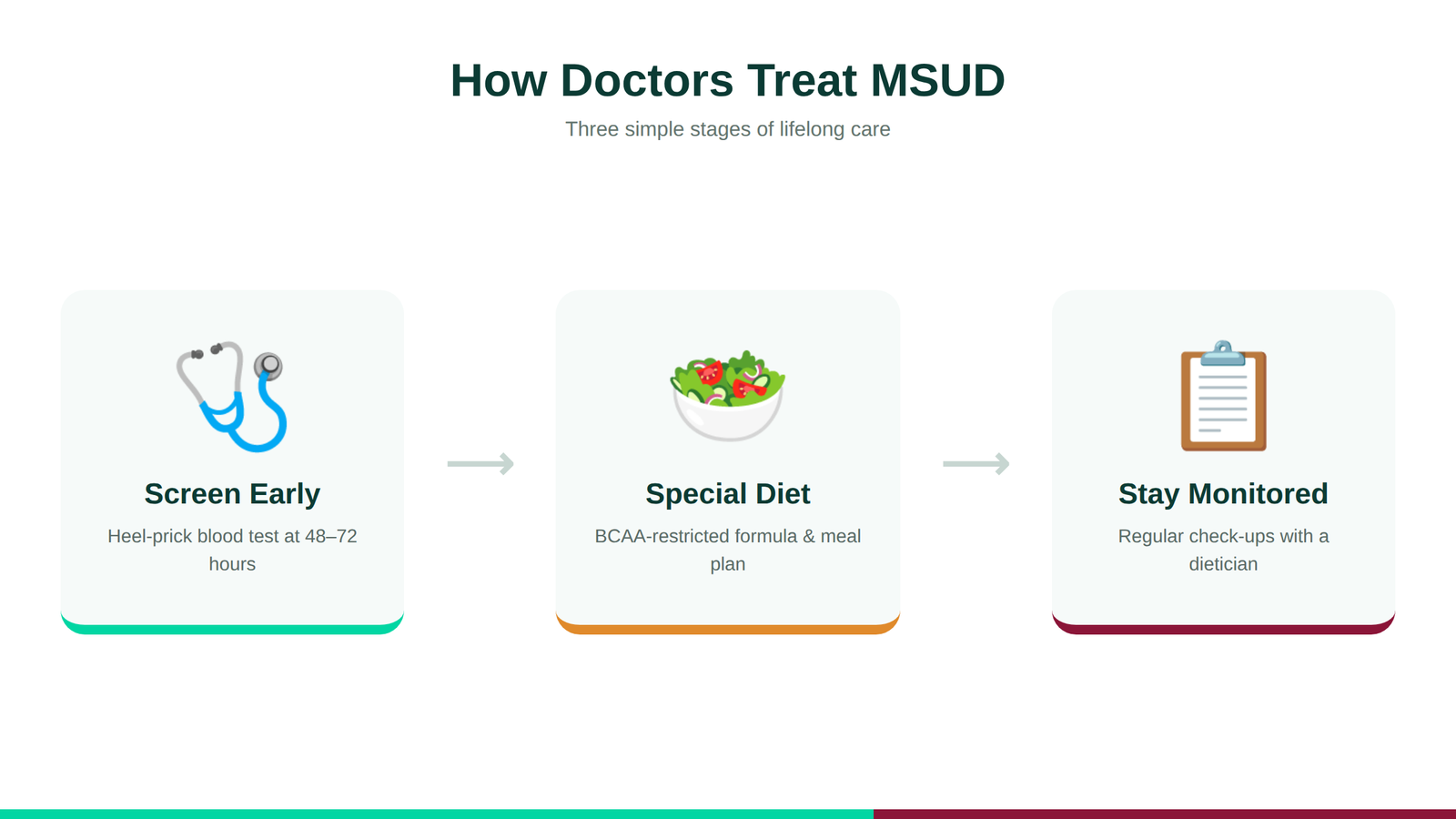
| Newborn Screening (Tandem Mass Spectrometry) | A heel-prick blood test done in the first days of life; can flag elevated branched-chain amino acids before symptoms even begin |
| Plasma Amino Acid Analysis | Confirms the diagnosis by measuring elevated leucine, isoleucine, and valine; presence of alloisoleucine is a hallmark finding |
| Urine Organic Acid Testing | Detects branched-chain ketoacids in the urine, which cause the characteristic maple syrup odor |
| Genetic (Molecular) Testing | Identifies the specific mutation(s) in BCKDHA, BCKDHB, DBT, or DLD genes; guides prognosis and genetic counseling |
| Prenatal Testing | Chorionic villus sampling or amniocentesis can be offered in future pregnancies once a family’s mutations are known |
💊 Treatment: Lifelong Dietary & Metabolic Management
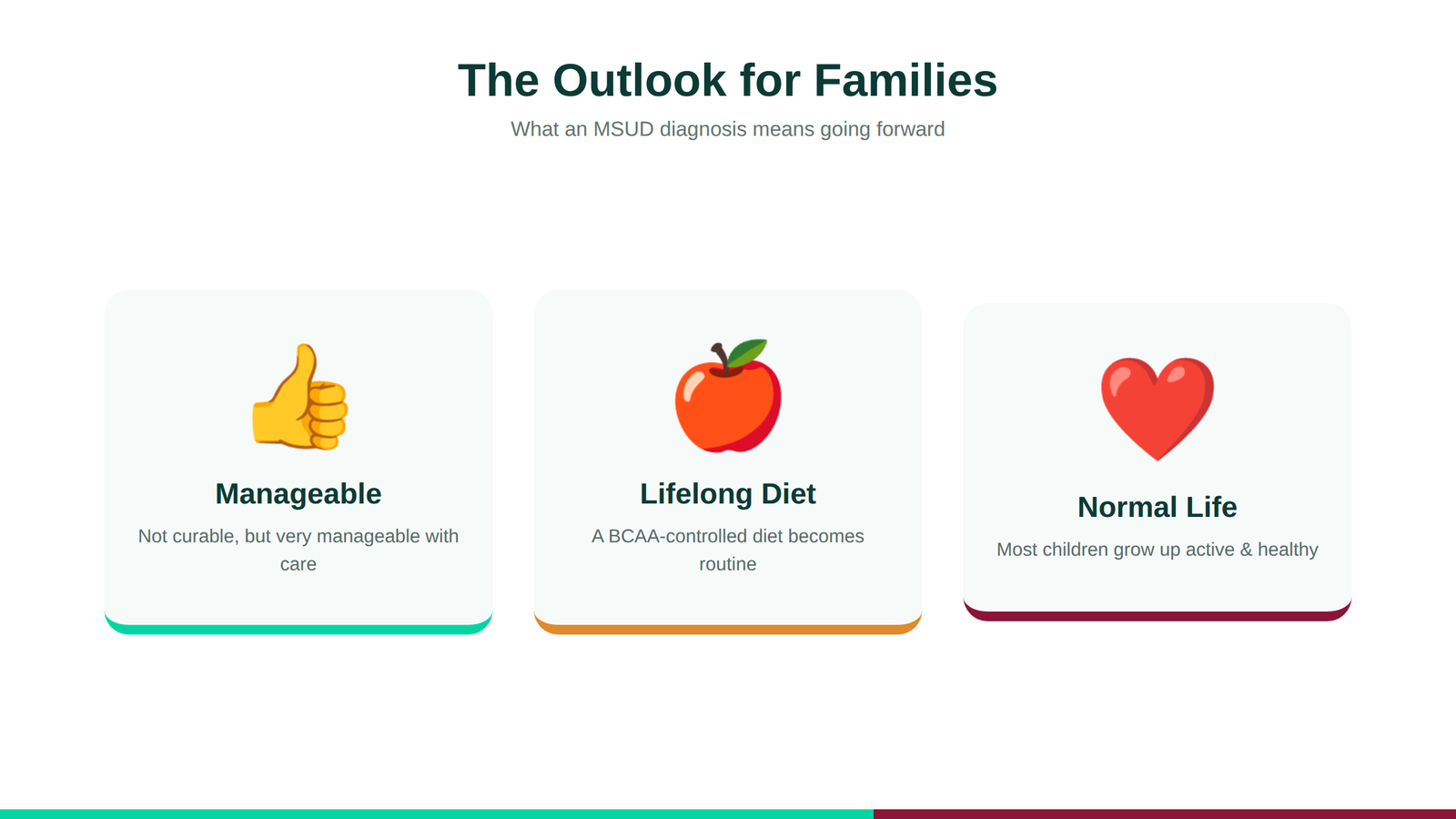
There is no one-time cure for MSUD, but it is a manageable condition. Treatment is lifelong and centers on keeping blood levels of leucine, isoleucine, and valine within a safe range while still supporting normal growth and brain development.
🥗 Dietary Therapy (First-Line, Lifelong)
- A specialized, BCAA-restricted diet that limits natural protein intake
- Medical formula or supplements that provide all essential nutrients and calories without leucine, isoleucine, and valine
- Regular blood monitoring of amino acid levels, with the diet adjusted as the child grows or as levels fluctuate
- Close coordination with a metabolic dietitian, since needs change with age, growth spurts, illness, and activity
🚑 Acute Metabolic Crisis Management
- Illness, fasting, surgery, or physical stress can push the body into a catabolic state, causing a dangerous spike in leucine — this is a medical emergency
- Management includes temporarily stopping natural protein intake and giving high-calorie glucose/fat-based nutrition to stop the body from breaking down muscle, with close hospital monitoring
- Severe crises may require dialysis or hemofiltration to rapidly clear excess amino acids from the blood
- A trial of high-dose thiamine may be given, as a subset of patients are thiamine-responsive
🏥 Liver Transplantation (an Option for Select Severe or Recurrent Cases)
For a smaller group of patients — typically those with classic MSUD who experience frequent, severe metabolic crises despite strict dietary control — liver transplantation can be considered. Because the BCKDH enzyme is also produced in the liver, a transplanted liver can restore enough enzyme activity to allow a much more liberal diet and greatly reduce the risk of future crises. It does not reverse any neurological damage that occurred before the transplant, so it is a specialist decision made case-by-case — most people with MSUD are managed successfully with dietary therapy alone and never require transplant.
🚨 Metabolic crisis is the most serious complication — a rapid rise in leucine during illness or stress can cause brain swelling, seizures, and, without prompt treatment, life-threatening neurological injury. This is why families are taught to recognize early warning signs and seek care quickly.
🚨 When to See a Doctor
🔴 Seek urgent medical attention if a baby or child with MSUD (or a family history of it) shows poor feeding, unusual sleepiness or irritability, vomiting, a change in muscle tone, unusual body odor, or any new neurological symptom — especially during a fever, infection, or after a period of not eating well. Early intervention during a crisis makes a significant difference to outcomes.
📈 Prognosis
Outcomes for MSUD have improved enormously since the introduction of newborn screening. Children diagnosed early and kept on consistent dietary treatment can generally expect normal or near-normal growth and cognitive development, though lifelong vigilance is needed since metabolic crises remain a risk during illness or stress throughout life. Without newborn screening and treatment, classic MSUD can cause severe, irreversible brain injury within days to weeks — which is why early diagnosis and a well-coordinated care team make such a critical difference.
Satyug Healthcare connects international families with NABH/JCI-accredited hospitals in India that offer specialized pediatric metabolic disease teams, geneticists, dietitians, and — for the small number of patients who need it — experienced liver transplant programs, all coordinated to support families managing MSUD from diagnosis through long-term care.
📞 International Patient Helpdesk: +91-8860606766 | +91-9910655125
This article is for general educational purposes and is not a substitute for professional medical advice, diagnosis, or treatment. Always consult a qualified pediatric metabolic specialist or geneticist for diagnosis and management of Maple Syrup Urine Disease.
Related Blogs


HAPPY PATIENTS
What Our Patients Are Saying






























Our Gallery