Assistance
Consultation
Services
Opinion
Care Coordination
What will your treatment cost?
Parkinson's Disease: Causes, Symptoms, Stages, Treatment and Cost in India
Released Date: 2026-10-08
Parkinson's disease is one of the most common neurological disorders worldwide, affecting millions of people, mostly over the age of 60, although around one in ten patients develop symptoms before 50. It slowly affects movement, causing tremor, stiffness, slowness and balance problems, and can also affect sleep, mood, memory and bowel function. In many countries across Africa, the Middle East and Central Asia, access to movement disorder specialists and advanced therapies like deep brain stimulation (DBS) is limited. The encouraging news is that Parkinson's is very treatable: with the right medicines, therapy and, when needed, surgery, most people can stay active and independent for many years. India offers experienced movement disorder neurologists and DBS programmes at affordable costs.
What is Parkinson's Disease?
Parkinson's disease is a progressive neurodegenerative disorder in which nerve cells in a part of the brain called the substantia nigra gradually die. These cells produce dopamine, a chemical messenger that helps control smooth, coordinated movement. When dopamine levels fall, the typical motor symptoms appear. Clumps of a protein called alpha-synuclein (Lewy bodies) are found in affected brain cells.
Stages of Parkinson's disease (Hoehn and Yahr)
- Stage 1 - mild symptoms on one side of the body; daily life largely unaffected.
- Stage 2 - symptoms on both sides; stiffness and slowness more noticeable, but balance is preserved.
- Stage 3 - balance problems and falls begin; the person is still independent.
- Stage 4 - severe symptoms; can stand and walk but needs help with daily activities.
- Stage 5 - wheelchair-bound or bedridden without assistance.
Doctors also distinguish Parkinson's disease from atypical parkinsonism (such as multiple system atrophy and progressive supranuclear palsy) and drug-induced parkinsonism, which respond differently to treatment.
🖼️ Understand It in Pictures
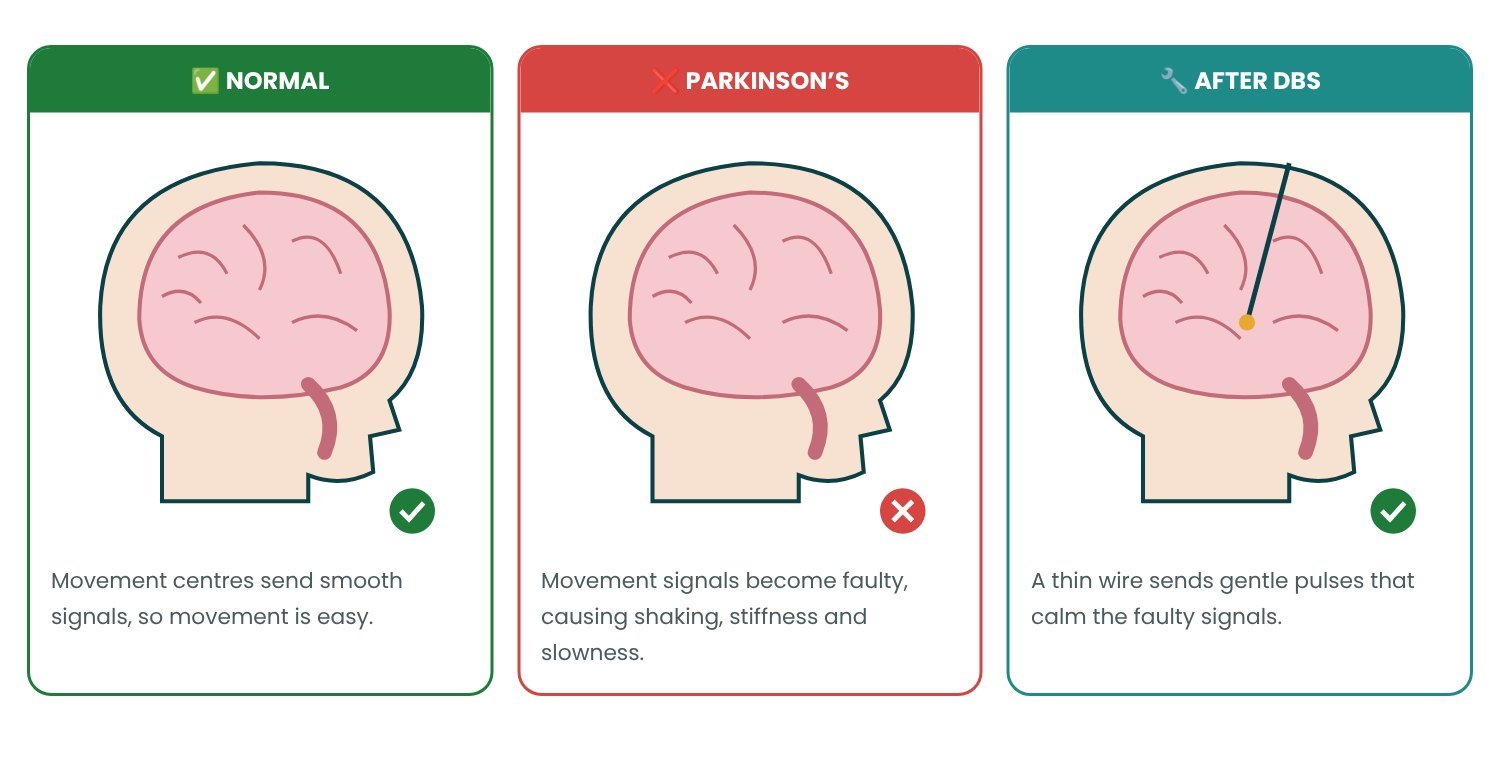
Parkinson’s brain before and after DBS
👀 Symptoms in Pictures

🩻 Scans & Tests — What Doctors See

🎬 The Treatment Journey in Pictures


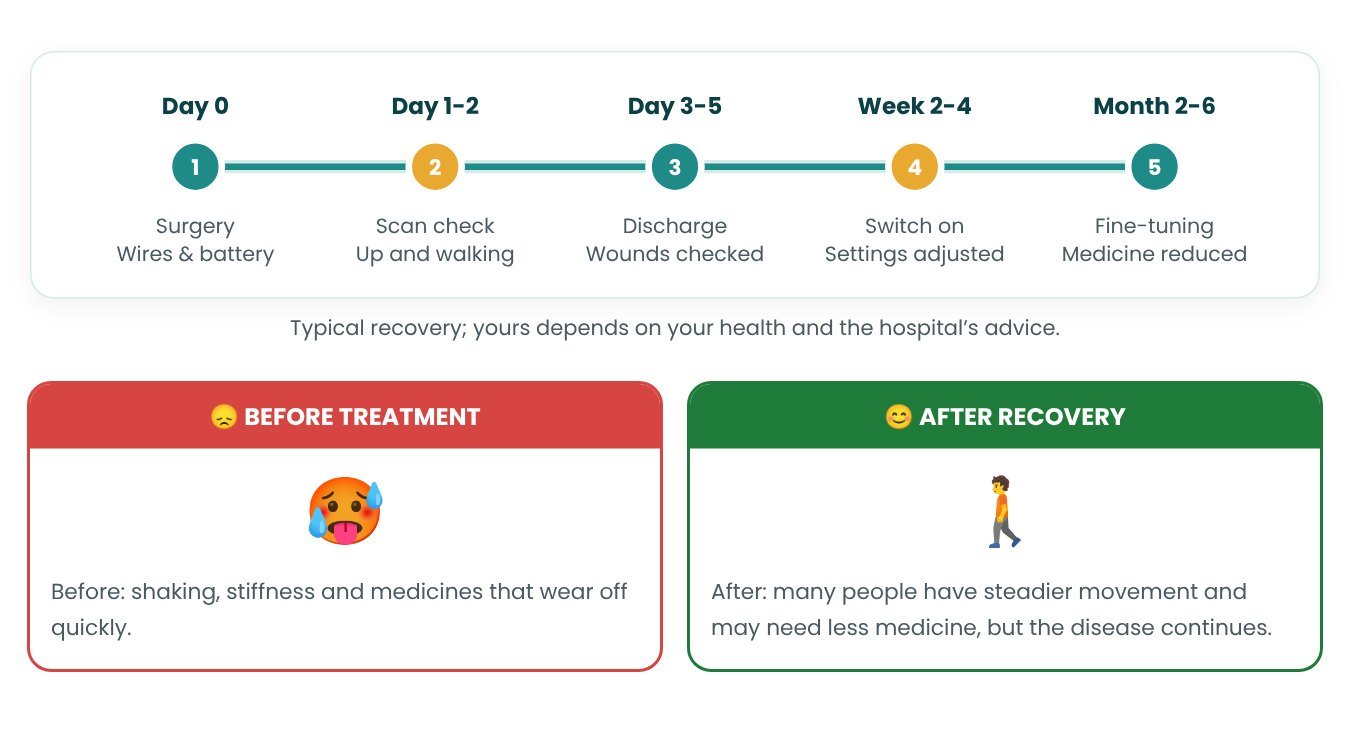
📅 Recovery at a Glance
Drawings: Satyug Healthcare (simplified, not to scale). Photos: Wikimedia Commons; author and licence under each photo.
Causes and Risk Factors
The exact cause is unknown in most people. It is thought to result from a combination of genetic and environmental factors:
- Age - the biggest risk factor; risk rises sharply after 60.
- Male sex - men are affected somewhat more often than women.
- Genetics - about 10-15% of patients have a family history; genes such as LRRK2, GBA, SNCA and PRKN are linked to Parkinson's. Some LRRK2 variants are notably common in North African Arab and Ashkenazi Jewish populations.
- Environmental exposures - long-term exposure to certain pesticides and herbicides, and rural living with well-water use, have been associated with higher risk.
- Head injuries, especially repeated injuries.
- Medicines - some anti-sickness and antipsychotic drugs can cause parkinsonism that improves when stopped.
Symptoms of Parkinson's Disease
Motor symptoms
- Tremor - usually a resting tremor of one hand ("pill-rolling"), which reduces with movement.
- Bradykinesia - slowness of movement; small handwriting; reduced facial expression.
- Rigidity - muscle stiffness, aching shoulders or neck.
- Postural instability - poor balance and falls in later stages.
- Shuffling walk, reduced arm swing and "freezing" when starting to walk or turning.
Non-motor symptoms
- Loss of sense of smell, often years before diagnosis.
- Constipation, urinary urgency and low blood pressure on standing.
- Acting out dreams during sleep (REM sleep behaviour disorder), insomnia and daytime sleepiness.
- Depression, anxiety, apathy and, later, memory or thinking problems.
- Soft voice and swallowing difficulties.
Warning signs needing urgent care
- Sudden severe stiffness, high fever and confusion, especially after stopping medicines abruptly - this can be a dangerous condition and needs emergency care.
- Repeated falls, choking or chest infections.
- Hallucinations or sudden confusion.
Diagnosis
There is no single blood test for Parkinson's disease. Diagnosis is made by a neurologist, ideally a movement disorder specialist, based on:
- Clinical examination using established criteria (slowness plus tremor or rigidity) and assessment scales such as the MDS-UPDRS.
- Response to levodopa - a clear improvement supports the diagnosis.
- MRI brain - mainly to exclude stroke, tumour, hydrocephalus or features of atypical parkinsonism.
- DaT scan (dopamine transporter SPECT) or PET scans in uncertain cases.
- Genetic testing for young-onset or familial cases.
- Blood tests to rule out thyroid disease, Wilson's disease (in younger patients) and other causes.
Treatment Options for Parkinson's Disease
Medicines
- Levodopa (with carbidopa or benserazide) - the most effective medicine for motor symptoms.
- Dopamine agonists such as pramipexole, ropinirole and rotigotine patch.
- MAO-B inhibitors (rasagiline, safinamide) and COMT inhibitors (entacapone, opicapone) to prolong levodopa's effect.
- Amantadine for dyskinesias (involuntary movements).
- Medicines for non-motor symptoms such as constipation, depression, sleep and memory problems.
After several years, many patients develop motor fluctuations ("wearing off" and "on-off" periods) and dyskinesias. This is when advanced therapies are considered.
Advanced therapies
- Deep Brain Stimulation (DBS) - thin electrodes are placed in specific brain targets (subthalamic nucleus or globus pallidus) and connected to a pacemaker-like device under the collarbone skin. DBS can reduce tremor, stiffness, slowness and dyskinesias, smooth out fluctuations and often allow a reduction in medicines. Modern rechargeable and directional systems are available in India.
- Apomorphine infusion and levodopa intestinal gel via a pump for patients unsuitable for DBS.
- MR-guided focused ultrasound - an incision-free option for selected patients with tremor, available at a limited number of centres.
Rehabilitation
Physiotherapy, regular exercise (walking, cycling, dance, tai chi), occupational therapy and speech therapy (for voice and swallowing) are proven to help and should be part of every treatment plan.
Who is a good candidate for DBS?
Patients with idiopathic Parkinson's disease, usually for at least four years, who still respond well to levodopa but have troublesome fluctuations, dyskinesias or medicine-resistant tremor, and who do not have significant dementia or uncontrolled psychiatric illness. A detailed levodopa challenge test, MRI and neuropsychology assessment are done before surgery.
What to expect during DBS surgery
DBS is usually done in two stages, often on the same day or a few days apart. In the first stage, a lightweight frame or frameless navigation system is used with MRI and CT images to plan the exact target. The electrodes are placed through two small openings in the skull. Many centres perform this part with the patient awake so that the team can test improvement in tremor and stiffness and check for side effects in real time, while others use general anaesthesia with high-precision imaging. Microelectrode recording may be used to confirm the target. In the second stage, under general anaesthesia, the extension wires and the battery (pulse generator) are placed under the skin of the chest. The system is switched on and programmed a few days to weeks later.
Latest advances
Newer DBS systems offer directional leads, which steer current towards the target and away from areas that cause side effects, and sensing (adaptive) technology, which records brain signals to help fine-tune stimulation. Smaller rechargeable batteries can last many years. Wearable sensors and remote programming are also making long-distance follow-up easier for international patients.
Cost of Parkinson's Disease Treatment in India
The table below shows approximate starting costs at JCI/NABH-accredited hospitals in Delhi/NCR.
| Treatment | Approximate Cost (USD, starting from) | Hospital Stay |
|---|---|---|
| Movement disorder evaluation (consultation, MRI, tests) | $400 - $800 | Outpatient |
| DaT scan / PET scan | $400 - $700 | Outpatient |
| Deep Brain Stimulation (non-rechargeable device) | $18,000 - $25,000 | 5 - 7 days |
| Deep Brain Stimulation (rechargeable / directional device) | $25,000 - $35,000 | 5 - 7 days |
| DBS programming and rehabilitation (2-3 weeks) | $800 - $1,500 | Outpatient |
The device brand and model make up the largest part of DBS cost; final cost depends on the patient's condition, the hospital and the system chosen. Contact Satyug Healthcare at +91-8860606766 / +91-9910655125 (WhatsApp) for a free medical opinion and cost estimate.
Recovery and Living with Parkinson's Disease
After DBS, most patients leave hospital within a week. The stimulator is switched on and programmed over the following days to weeks, and medicines are adjusted. Patients usually stay in India for about 2 to 3 weeks. Follow-up programming can often be coordinated remotely or with a local neurologist, and battery replacement is needed every few years for non-rechargeable devices.
- Take medicines at the same times every day and never stop them suddenly.
- Exercise daily; it is one of the best ways to slow functional decline.
- Make the home safe to prevent falls - remove loose rugs, add grab rails and good lighting.
- Eat a high-fibre diet with plenty of fluids for constipation; take levodopa away from high-protein meals if advised.
- Seek help for low mood, anxiety and sleep problems - they are treatable.
There is no proven way to prevent Parkinson's disease, but regular physical activity, avoiding pesticide exposure and protecting against head injury are sensible measures.
Why Choose India for Parkinson's Treatment?
- Dedicated movement disorder clinics and experienced functional neurosurgeons performing DBS.
- Access to the latest DBS systems from leading international manufacturers.
- Costs far lower than in the USA, UK or Europe, with short waiting times.
- Multidisciplinary rehabilitation and support with translators for international patients.
Step-by-Step Process to Travel to India for Treatment
- Share your reports - send your latest reports, scans/CD, angiography or echo films and passport copy to Satyug Healthcare on WhatsApp (+91-8860606766 / +91-9910655125) or email.
- Free medical opinion & cost estimate - within 24-72 hours we share opinions and written cost estimates from 2-3 JCI/NABH-accredited hospitals and specialists.
- Choose hospital & doctor - compare doctor experience, hospital, room category and total cost; we help you decide with no extra charge.
- Visa Invitation Letter (VIL) - the hospital issues a VIL for the patient and up to two attendants; we arrange it within 24-48 hours.
- Apply for Indian e-Medical Visa - apply online for the e-Medical Visa (patient) and e-Medical Attendant Visa (family) using the VIL; most approvals come in 3-5 working days.
- Book flights & accommodation - we suggest flights and arrange a guest house, service apartment or hotel near the hospital to suit your budget.
- Free airport pickup - our representative receives you at the airport and takes you to your hotel or directly to the hospital.
- Hospital admission & treatment - a dedicated coordinator and language interpreter stay with you for registration, tests, doctor consultations, the procedure and billing.
- Discharge & follow-up - you receive the discharge summary, prescriptions and fitness-to-fly certificate; follow-up checks are done before you fly.
- Return home & tele-follow-up - we arrange airport drop and stay connected for online follow-up consultations with your doctor in India.
Frequently Asked Questions
Is Parkinson's disease curable?
Not yet. However, medicines, exercise and DBS can control symptoms very effectively, and many people live with good quality of life for many years.
Does DBS cure Parkinson's disease?
No. DBS controls symptoms but does not stop the underlying disease. It works best on symptoms that respond to levodopa and on tremor; it does not improve memory problems or all balance issues.
Is DBS surgery safe?
DBS is a well-established procedure performed for decades. As with any brain surgery, there are risks such as bleeding, infection or hardware problems, but serious complications are uncommon in experienced centres.
How long do I need to stay in India for DBS?
About 2 to 3 weeks, including pre-surgery assessment, surgery, initial programming and medicine adjustment.
Is Parkinson's disease hereditary?
Most cases are not directly inherited. About 10-15% of patients have a family history, and certain gene changes increase risk, especially in young-onset cases.
Can young people get Parkinson's disease?
Yes. Young-onset Parkinson's starts before age 50. It is often more slowly progressive and genetic testing may be advised.
What is the life expectancy with Parkinson's disease?
With good treatment, life expectancy is close to normal for many people, especially when diagnosed later in life. Complications such as falls and pneumonia are the main concerns in advanced stages.
Disclaimer: This article is for general information only and is not a substitute for a consultation with a qualified doctor.
Related Blogs


HAPPY PATIENTS
What Our Patients Are Saying












Our Gallery