Robotic Bilateral Knee Replacement Package
Assistance
Consultation
Services
Opinion
Care Coordination
What will your treatment cost?

See the cost breakdown by option, hospital and city →
| Surgery Name | Cost | Room | Hospitalization |
|---|---|---|---|
| Robotic Bilateral Knee Replacement Package | USD 7500 | Twin Sharing | 4-5 Days in Ward |
✓ Inclusion
- ✔Consultation with senior joint replacement surgeon
- ✔Pre-operative blood tests, ECG, chest X-ray and anaesthesia review during admission
- ✔CT scan / 3D mapping for robotic planning
- ✔Robotic-arm assisted total knee replacement of both knees in one operation
- ✔Standard cemented knee implants for both knees
- ✔Operation theatre, robotic system and anaesthesia charges
- ✔4–5 days hospital stay in a twin-sharing ward room
- ✔Routine medicines, blood thinners, consumables and nursing care
- ✔Daily in-hospital physiotherapy
- ✔Post-operative X-rays of both knees
- ✔Discharge summary and home exercise plan
- ✔Free: airport pick-up & drop, visa invitation letter, interpreter & coordinator (Satyug Healthcare)
✗ Exclusion
- ✖Airfare, visa fees and travel insurance
- ✖Hotel or guest house stay after discharge
- ✖Premium, high-flex, oxinium or special implants
- ✖Single-room or deluxe room upgrade
- ✖Blood and blood products if needed
- ✖Stay beyond 5 days or ICU care
- ✖Outpatient physiotherapy after discharge
- ✖Walker, stick, knee brace and medicines after discharge
- ✖Treatment of complications or unrelated illnesses
- ✖Personal expenses and attendant food
Know More About Procedure & Surgery
Robotic Bilateral Knee Replacement in India
Robotic-arm assisted total replacement of both knees for severe arthritis pain, stiffness and deformity, done by experienced joint replacement surgeons at NABH and JCI accredited hospitals in India – at a fraction of US, UK or Gulf prices.
📖 What is Robotic Knee Replacement?
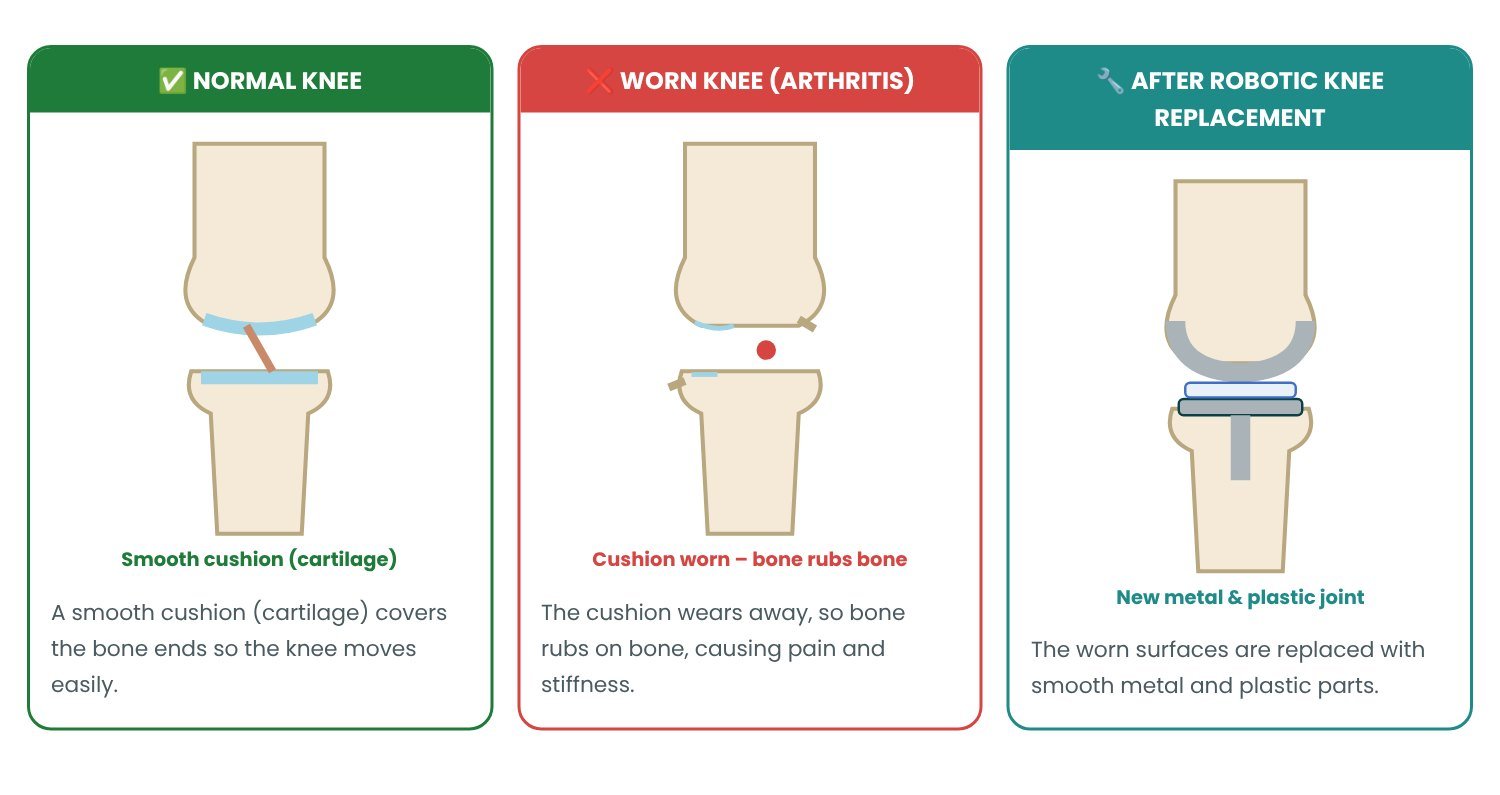
The knee joint is where the thigh bone (femur) meets the shin bone (tibia). The ends of these bones are covered with smooth cartilage. In osteoarthritis, rheumatoid arthritis or after old injuries, this cartilage wears away, so bone rubs on bone. This causes pain, swelling, stiffness and bowing of the legs (bow legs or knock knees). When both knees are badly affected, walking, climbing stairs and praying or sitting on the floor become very difficult.
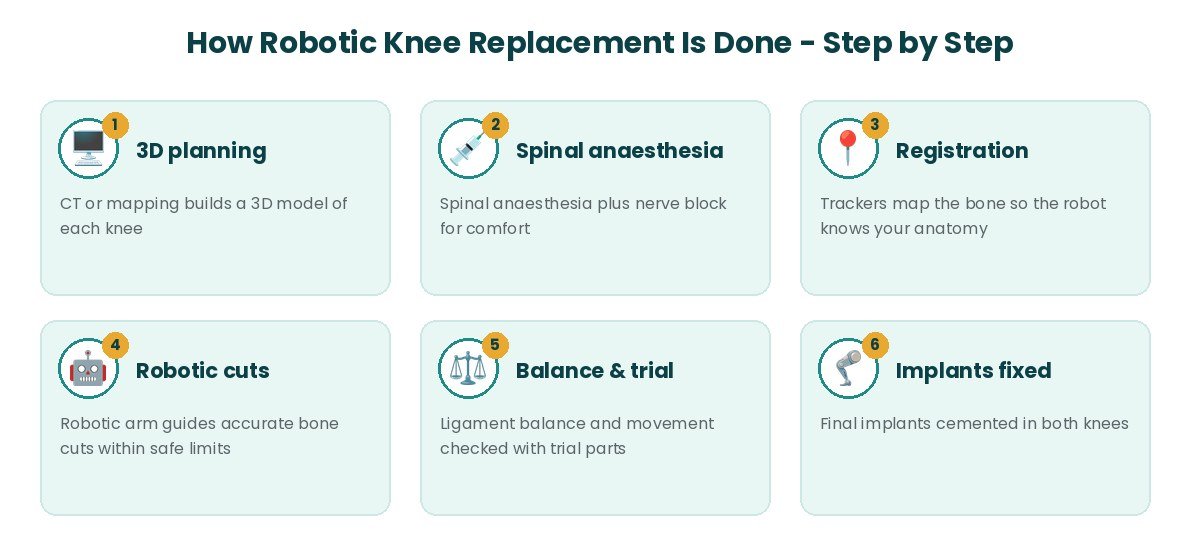
In a total knee replacement, the worn surfaces are removed and replaced with metal and medical-grade plastic parts. In robotic-arm assisted surgery, a CT scan or 3D mapping of your knee is used to plan the exact size and position of the implant. During surgery, the robotic arm guides the surgeon's cuts within a safe zone, so bone cuts and implant alignment are highly accurate and soft tissues are better protected. The surgeon is in control at all times. In this package, both knees are replaced in the same operation (simultaneous bilateral).
🖼️ Understand It in Pictures
Normal vs worn knee
👀 Symptoms in Pictures

🩻 Scans & Tests — What Doctors See

🎬 The Treatment Journey in Pictures
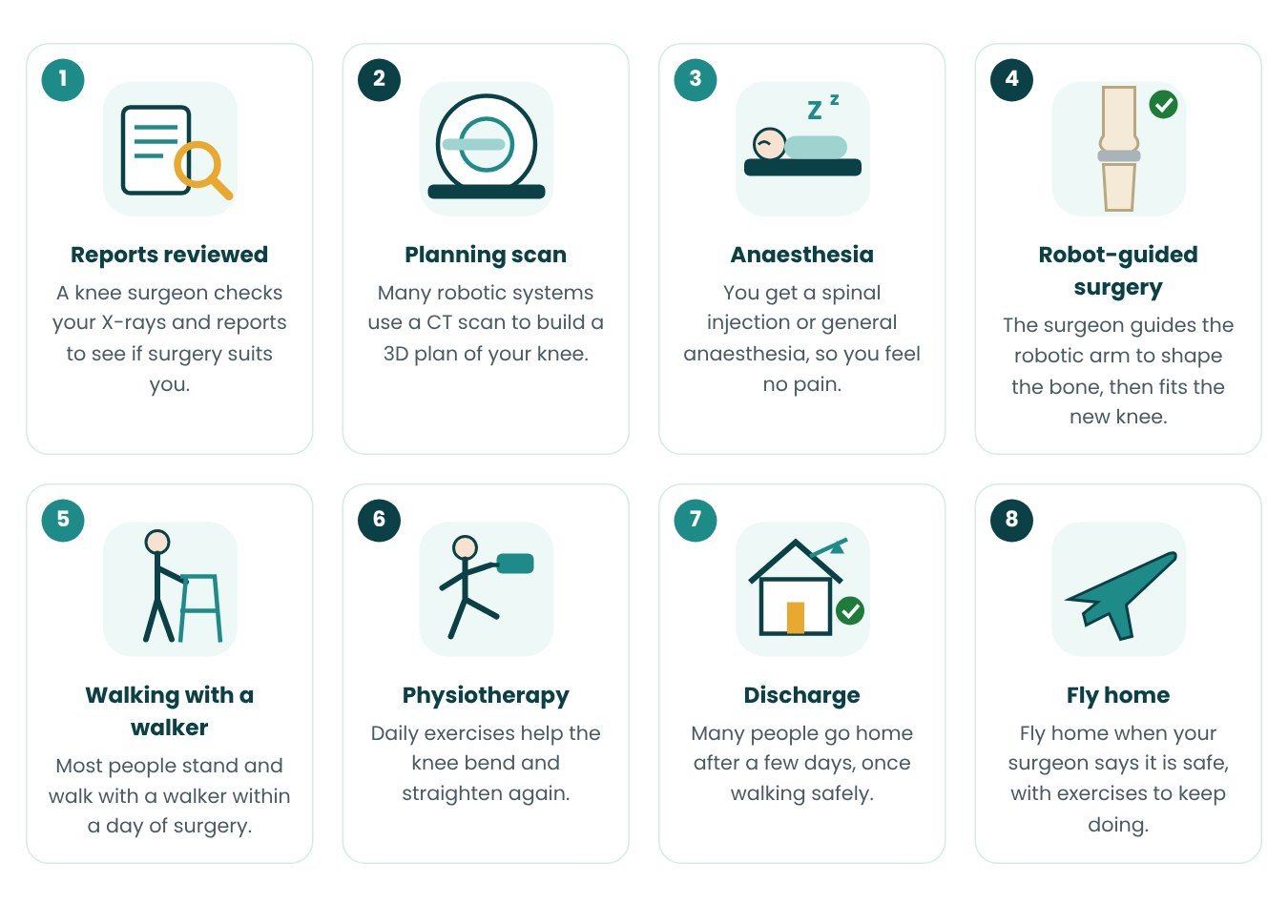

📅 Recovery at a Glance

Drawings: Satyug Healthcare (simplified, not to scale). Photos: Wikimedia Commons; author and licence under each photo.
🩺 Conditions Treated
⚠️ Symptoms That May Need Knee Replacement
- ➤Knee pain that limits walking to a few hundred metres
- ➤Pain at night or at rest
- ➤Difficulty climbing stairs or getting up from a chair
- ➤Unable to sit on the floor, kneel or pray comfortably
- ➤Visible bowing or knock-knee deformity
- ➤Stiffness and swelling of the knees
- ➤Needing a stick or support to walk
- ➤Little relief from medicines, injections or physiotherapy
🔬 Tests Before Treatment
| Test | Why it is done |
|---|---|
| Standing X-rays of both knees and full-leg (hip-to-ankle) view | Shows arthritis severity and leg alignment |
| CT scan of the leg (for some robotic systems) | Creates a 3D model for robotic planning |
| Blood tests (CBC, sugar, HbA1c, kidney, liver, clotting, blood group) | Checks fitness and prepares blood if needed |
| ECG, echocardiography and chest X-ray | Heart and lung fitness – important for bilateral surgery |
| Urine culture and dental check | Rules out hidden infection before implant surgery |
| Doppler of leg veins if needed | Checks for clots or varicose veins |
🏥 The Procedure — Step by Step
⚖️ Types & Techniques
| Technique | What is done | Best for |
|---|---|---|
| Robotic bilateral TKR (same day) | Both knees replaced in one operation with robotic guidance | Fit patients with arthritis in both knees – this package |
| Staged bilateral TKR | One knee, then the other after 1–2 weeks or months | Older patients or those with heart or lung problems |
| Conventional TKR | Manual instruments and cutting guides | Most patients – good long-term results, lower cost |
| Robotic partial (UKA) knee replacement | Only the worn part of the knee is replaced | Arthritis limited to one compartment |
| Computer navigation TKR | Computer guidance without a robotic arm | Accurate alignment at moderate cost |
📅 Your Day-by-Day Plan in India
| Day | What happens |
|---|---|
| Day 1 | Arrival in India, airport pick-up and hotel check-in |
| Day 2 | Orthopaedic consultation, X-rays, CT for robotic planning and pre-operative tests |
| Day 3 | Hospital admission and robotic bilateral knee replacement |
| Day 4–7 | Walking with walker, daily physiotherapy and discharge (4–5 day hospital stay) |
| Day 8–14 | Physiotherapy at hotel or clinic; wound checks |
| Day 15–17 | Stitch or staple removal and progress review |
| Day 18–21 | Final physiotherapy, fit-to-fly clearance and fly home ✈️ |
🌱 Recovery After Treatment
🏆 Success Rate
| Outcome | Result |
|---|---|
| Implants still working at 15–20 years | About 90–95% |
| Patients satisfied with the result | About 85–90% |
| Major pain relief | About 90% |
| Walking without support | 4–6 weeks for most patients |
| Deep infection | About 1% |
Results depend on weight, muscle strength, other health problems such as diabetes, and above all on regular physiotherapy for the first 3 months after surgery.
🩹 Risks & Possible Complications
Knee replacement is one of the most successful operations in medicine, but replacing both knees together is a bigger operation.
- •Knee stiffness needing extra physiotherapy or manipulation (about 2–5%)
- •Need for blood transfusion (more common with both knees, about 10–20%)
- •Blood clots in the leg veins (DVT) or lungs (prevented with blood thinners and early walking; symptomatic clots about 1–2%)
- •Wound healing problems (about 1–2%)
- •Deep infection of the implant (about 1%)
- •Heart, lung or confusion problems in older patients (uncommon, higher than single-knee surgery)
- •Implant loosening or wear needing revision (about 5–10% over 15–20 years)
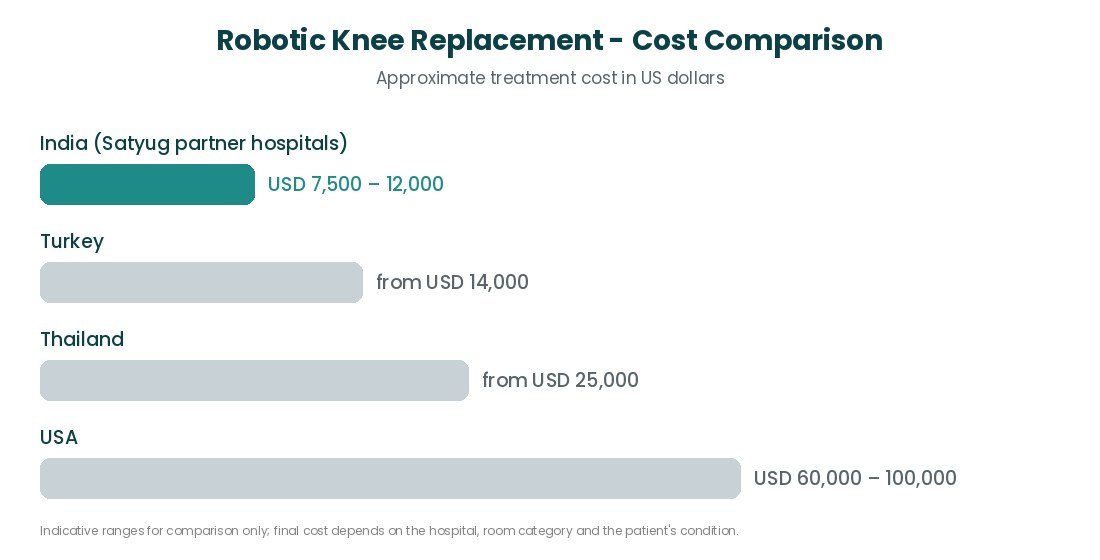
💰 Cost of Robotic Knee Replacement in India
The cost of robotic bilateral knee replacement in India starts from about USD 7,500 for both knees. This package includes surgery on both knees with robotic assistance, standard implants, surgeon and anaesthesia fees, routine medicines, physiotherapy in hospital and a 4–5 day stay in a twin-sharing ward room. Premium implants, single rooms or extra days cost more.
| Option / Hospital tier | Approx. cost (USD) | Hospital stay | Notes |
|---|---|---|---|
| Robotic bilateral knee replacement – this package | 7,500 | 4–5 days, twin sharing | Both knees, standard implants |
| Robotic bilateral TKR – single room / premium implants | 9,000 – 12,000 | 5–6 days | Single room, high-flex or premium implants |
| Conventional bilateral TKR | 5,500 – 7,000 | 5–6 days | Without robotic assistance |
| Robotic unilateral (one knee) TKR | 4,500 – 6,000 | 3–4 days | One knee only |
📋 What the Package Includes
- ✔Orthopaedic surgeon consultation
- ✔Robotic planning and robotic-arm assisted surgery
- ✔Standard implants for both knees
- ✔Surgeon, anaesthesia and OT charges
- ✔4–5 days in a twin-sharing ward room
- ✔Routine medicines and blood thinners in hospital
- ✔Daily in-hospital physiotherapy
- ✔Discharge summary and exercise plan
- ✖Flights and visa fees
- ✖Hotel stay after discharge
- ✖Premium or special implants
- ✖Single-room upgrade
- ✖Blood transfusion if needed
- ✖Extra hospital days or ICU stay
- ✖Outpatient physiotherapy after discharge
- ✖Walker, stick and medicines after discharge
✈️ Your Medical Travel Process with Satyug Healthcare

| Step | Details |
|---|---|
| 1. Send reports | Standing X-rays of both knees (front and side views) and a full-length leg X-ray if available, MRI only if done, recent blood tests including sugar and HbA1c, ECG and echo for patients over 50, and a list of current medicines and other illnesses. |
| 2. Free opinion & quotes | Within 48-72 hours you receive opinions and cost estimates from 3-5 leading hospitals to compare. |
| 3. Choose hospital & doctor | We help you compare doctors, success rates, room options and total budget. |
| 4. Medical visa | The hospital issues a Visa Invitation Letter (VIL) to the Indian Embassy. The patient and up to 2 attendants apply for an e-Medical / Medical Attendant visa. |
| 5. Travel planning | Flight guidance, wheelchair assistance, airport pick-up, hotel or guest house near the hospital. |
| 6. Treatment in India | Your coordinator and interpreter stay with you for admission, treatment, discharge and billing. |
| 7. Return & follow-up | Fit-to-fly letter, medicines, and online follow-up with your doctor after you return home. |
🎒 Travel Checklist
- 📌Valid passport (6+ months) for the patient and attendants, plus 10 passport-size photos each
- 📌Medical visa / e-visa and the hospital’s Visa Invitation Letter
- 📌All knee X-ray, blood test, ECG and echo reports, images on CD / link and prescriptions
- 📌Yellow fever vaccination certificate (mandatory for travellers from African countries)
- 📌Polio vaccination certificate where applicable
- 📌Declare cash above USD 5,000 at the airport; hospitals accept wire transfer and cards
- 📌Foreigners staying longer than permitted must register with the FRRO — our team assists
⭐ Why Choose Satyug Healthcare?
❓ Frequently Asked Questions
➤ How much does robotic bilateral knee replacement cost in India?
➤ Is robotic surgery better than normal knee replacement?
➤ Does the robot do the operation?
➤ Can both knees be done at the same time?
➤ How long does the surgery take?
➤ How long do I need to stay in India?
➤ Is the surgery painful?
➤ How long will the new knees last?
➤ Will I be able to sit on the floor or pray?
➤ What are the main risks?
Medical disclaimer: This page is for general information and does not replace a consultation with a qualified specialist. Treatment plans and costs are confirmed only after the patient is examined. Sources: NCBI StatPearls: Total Knee Arthroplasty; National Joint Registry (UK) annual report; Australian Orthopaedic Association National Joint Replacement Registry; American Academy of Orthopaedic Surgeons (AAOS) OrthoInfo: Total Knee Replacement; NHS: Knee replacement; studies on robotic-arm assisted TKA (e.g. Kayani et al., Bone Joint J 2018). Infographics: Satyug Healthcare.
Robotic bilateral knee replacement in India from USD 7,500 for both knees, with implants & 4–5 day stay. Senior surgeons, NABH/JCI hospitals. Free opinion.


TOP HOSPITALS
Special High-quality Hospitals


HAPPY PATIENTS
What Our Patients Are Saying