Balloon Kyphoplasty Surgery Cost in India
Assistance
Consultation
Services
Opinion
Care Coordination
What will your treatment cost?

| Surgery Name | Cost | Room | Hospitalization |
|---|---|---|---|
| Balloon Kyphoplasty Surgery Cost in India | $3212 | Single | Patient - 2 days stay in a single room. |
✓ Inclusion
- The cost of all related investigations needed before the surgery.
- The cost of Surgery including the cost of surgeon’s fee and OT.
- The cost of the room stays of the patient and 1 attendant including all meals as per the hospital menu.
- The cost of pre surgical and post-surgical Physiotherapy / Dietetic consult during the entire hospital stay.
- Airport Transfers.
- In room wi fi and free internet.
- Needful concierge services.
✗ Exclusion
- Overstay more than package days,
- Any other Specialty Consultations,
- Special Equipment,
- Additional Procedure/Surgery.
- Blood Components.
Know More About Procedure & Surgery
🇮🇳 Medical Package — India
Balloon Kyphoplasty Surgery Cost in India
World-class treatment • NABH & JCI Accredited Hospitals • Save up to 80% vs USA/UK
What is Balloon Kyphoplasty procedure?
Balloon kyphoplasty is a modified vertebroplasty technique. It is a minimally invasive procedure that aims to relieve pain, restore vertebral height, and correct kyphosis. During this procedure, an inflatable bone tamp is inserted into the collapsed vertebral body. The IBTs are inflated under volumetric control, reducing the fracture and pushing the endplates apart, thereby partially restoring vertebral height and correcting angular deformity.The newly formed cavity is filled with bone cement after IBT removal.
Benefits of Balloon Kyphoplasty procedure
- ✓Significant and sustained reduction in back pain.
- ✓Sustained vertebral body height restoration.
- ✓Significant and sustained improvement in quality of life.
- ✓Significant and sustained improvement in mobility.
- ✓Significant and sustained improvement in ability to perform activities of daily living
Preparation
Because kyphoplasty and vertebroplasty are surgical procedures. Before the day of your surgery your doctor may ask for imaging tests such as an X-ray or MRI scan will help your surgeon see the area or areas that need repair. In preparation, an intravenous line (IV) will be placed in a vein in your arm to deliver anesthesia. You may also receive pain and anti-nausea medications, as well as antibiotics to prevent infection. You’ll probably also be connected to heart, pulse, and blood pressure monitors.
Procedure
Through a pair of small incisions, each approximately 1 cm in length, the specialty physician uses a needle and canola to create a small pathway into each side of a fractured vertebral body. A small balloon is guided through each canola into the vertebra. Each balloon is carefully inflated in an attempt to raise the collapsed vertebra and return it to its normal position. Inflation of the balloon creates a void (cavity) in the vertebral body. Once the vertebra is in the correct position, the balloons are deflated and removed. The resultant cavities are filled with bone cement forming an “internal cast” to support the surrounding bone and prevent further collapse.
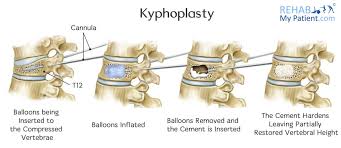
The balloon kyphoplasty procedure typically takes about one hour per fracture and may be performed in an outpatient setting. The procedure can be done using either local or general anesthesia; the specialty physician will determine the most appropriate method, based on the patient’s overall condition.
Recovery from Kyphoplasty
Pain relief will be immediate for some patients. In others, elimination or reduction of pain is reported within two days. At home, patients can return to their normal daily activities, although strenuous exertion, such as heavy lifting, should be avoided for at least six weeks. Patients should see their physician to begin or review their treatment plan for osteoporosis, including medications to prevent further bone loss.
Risks Involved in Surgery
The complication rate of Kyphoplasty has been demonstrated to be low. There are risks associated with the procedure (e.g., cement extravasations), including serious complications, and through rare, some of which may be fatal. Risks of acrylic bone cements include cement leakage, which may cause tissue damage, nerve or circulatory problems, and other serious adverse events, such as:
- ✓Cardiac arrest
- ✓Cerebrovascular accident
- ✓Myocardial infarction
- ✓Pulmonary embolism
- ✓Cardiac embolism
Free Medical Opinion
Expert review in 48 hours
Best Surgeon
Top specialists in India
Hospital Booking
NABH / JCI accredited
Visa Assistance
Invitation letter provided
Airport Transfer
Safe pickup & drop
Tele-Consultation
Video consult before travel
Hotel Booking
Near hospital, affordable
Multilingual Support
Arabic, French, English
📞 Get Started Today — It Is Free
Ready to Plan Your Treatment in India?
Send your medical reports and get a free expert opinion within 48 hours. Our coordinators speak Arabic, French and English.
Frequently Asked Questions
Pain relief will be immediate for some patients. In others, elimination or reduction of pain is reported within two days. At home, patients can return to their normal daily activities, although strenuous exertion, such as heavy lifting, should be avoided for at least six weeks.
Top doctors for KYPHOPLASTY BALLOON-SPINE treatment| Cost for KYPHOPLASTY BALLOON-SPINE repair|Book online appointment| Best treatment for KYPHOPLASTY BALLOON-SPINE in India. Search Results Web results for cost of KYPHOPLASTY BALLOON-SPINE treatment|




TOP HOSPITALS
Special High-quality Hospitals




HAPPY PATIENTS
What Our Patients Are Saying






























Our Gallery