Periacetabular Osteotomy (PAO) Hip Dysplasia Surgery
Assistance
Consultation
Services
Opinion
Care Coordination
What will your treatment cost?

See the cost breakdown by option, hospital and city →
| Surgery Name | Cost | Room | Hospitalization |
|---|---|---|---|
| Periacetabular Osteotomy (PAO) Hip Dysplasia Surgery | 6000 | Economy / Twin Sharing Room | 3-5 Days in Room; Total Stay in India 3-4 Weeks |
✓ Inclusion
- ✔Surgery (surgeon, anaesthesia and operating room)
- ✔Room rent for the package days
- ✔Consultation by the primary orthopaedic team during the package days
- ✔Basic investigations, routine pharmacy and consumables as per the hospital package
- ✔Hip spica cast for children where included in the quote
- ✔Satyug coordinator, interpreter and airport pick-up
✗ Exclusion
- ✖Evaluation before admission (USD 800–1,500 OPD depending on hospital) and CT/MRI in India
- ✖Implants (screws, plates) where quoted separately
- ✖Blood components and stay beyond the package days
- ✖Second-side surgery if both hips are treated separately
- ✖Physiotherapy, crutches or wheelchair after discharge
- ✖Hotel, flights, visa fees and meals
Know More About Procedure & Surgery
Periacetabular Osteotomy (PAO) Hip Dysplasia Surgery in India
In hip dysplasia, the hip socket is too shallow to hold the ball of the thigh bone properly, so the hip can slip out or wear out early. Surgery deepens or turns the socket to cover the ball: a pelvic osteotomy in children and a periacetabular osteotomy (PAO) in teenagers and young adults. The goal is a stable hip and a natural joint that lasts for decades.
📖 What is Hip Dysplasia?
The hip is a ball-and-socket joint. In developmental dysplasia of the hip (DDH), the socket (acetabulum) is too shallow and does not cover the ball (femoral head) well. In babies, the hip may be loose or fully dislocated. In older children and adults, a mildly shallow socket may cause no problems for years, but the edge of the socket carries too much load, the labrum and cartilage wear out, and painful arthritis can start as early as the 20s or 30s.
Treatment depends on age. Babies are treated with a harness; young children may need reduction of the hip into the socket with a pelvic osteotomy (Salter, Pemberton or Dega) and sometimes a femoral osteotomy. When the growth plates of the pelvis have closed (usually after about 12–14 years), the operation of choice is the periacetabular osteotomy (PAO), also called the Ganz or Bernese osteotomy: the socket is cut free from the pelvis and turned into a better position over the ball.
🖼️ Understand It in Pictures
Normal hip compared with a dysplastic hip

Treatment depends on age

🩺 Conditions Treated
⚠️ Symptoms That May Need Surgery
- ➤In babies: uneven skin creases or one leg looking shorter
- ➤Limping or walking on tiptoe on one side in a toddler
- ➤Waddling walk if both hips are affected
- ➤Groin pain in a teenager or young adult, worse after walking or sport
- ➤A feeling of the hip being tired, unstable or catching
- ➤Pain at the side of the hip or lower back from extra muscle work
- ➤Pain sitting or getting up from a low chair
- ➤X-ray showing the socket does not cover the ball (low centre-edge angle)
🔬 Tests Before Surgery
| Test | Why it is done |
|---|---|
| Hip ultrasound (babies under about 6 months) | Shows the shape of the socket and whether the hip is in place. |
| Standing X-rays of the pelvis | Measures cover of the ball (centre-edge angle, acetabular index) and joint space. |
| Special X-ray views (false-profile, abduction view) | Shows front cover and whether the hip moves into a better position. |
| CT scan with 3D reconstruction | Plans the bone cuts and measures twist of the socket and thigh bone. |
| MRI or MR arthrogram | Checks the labrum and cartilage, which affects the result of PAO. |
| Blood tests, blood group and anaesthesia check | Fitness for surgery; blood may be needed for PAO. |
🏥 The Procedure — Step by Step (PAO)

How the socket is re-positioned in PAO

⚖️ Types & Techniques
| Technique | What is done | Usual age |
|---|---|---|
| Pavlik harness | Soft harness keeps the hips flexed and apart | Birth to about 6 months |
| Closed reduction and spica cast | Hip put back under anaesthesia, held in a cast | About 6–18 months |
| Open reduction | Hip opened and put back into the socket | When closed reduction fails or after about 18 months |
| Salter innominate osteotomy | Whole socket rotated with a bone wedge | About 18 months to 6 years |
| Pemberton or Dega osteotomy | Socket roof bent down to deepen it | Young children with a large socket |
| Femoral (varus / derotation / shortening) osteotomy | Thigh bone cut and re-angled or shortened | Children; sometimes adults |
| Periacetabular osteotomy (PAO, Ganz) | Socket cut free and rotated, fixed with screws | Teenagers and adults with closed growth plates |
📅 Your Day-by-Day Plan in India (PAO)
| Day | What happens |
|---|---|
| Day 1 | Arrival in India ✈️, airport pick-up and hotel check-in |
| Days 2–3 | Surgeon consultation, X-rays, CT/MRI, blood tests and anaesthesia check |
| Day 4 | Admission and surgery 🦴 |
| Days 5–8 | Pain control, walking with crutches, physiotherapy, discharge |
| Days 9–20 | Rest at the hotel with physiotherapy; wound check and stitch removal |
| Days 21–28 | X-ray and surgeon review; rehabilitation plan for home |
| Fly home | With a fitness-to-fly letter, blood-clot prevention and teleconsultation follow-up ✈️ |
🌱 Recovery After Surgery
🏆 Success Rate
| Outcome | Result |
|---|---|
| Hips preserved without replacement 20 years after PAO (Bern series) | About 60% |
| Major complications after PAO (205 hips, multicentre prospective study) | About 6% |
| Best results after PAO | Younger patients with little or no arthritis before surgery |
| Babies treated early with a harness | Most hips develop normally without surgery |
🩹 Risks & Possible Complications
- •Numbness on the outer thigh from a small skin nerve (lateral femoral cutaneous nerve) – common after PAO, often improves
- •Blood loss needing transfusion – occasional
- •Delayed healing or non-union of a bone cut, usually the pubic bone – uncommon
- •Over- or under-correction of the socket, which may cause impingement or ongoing instability
- •Infection or wound problems – uncommon
- •Blood clots in the leg – prevented with blood thinners and early movement
- •Injury to the sciatic or femoral nerve – rare
- •In children: re-dislocation, stiffness or avascular necrosis of the femoral head – uncommon, needs follow-up
💰 Cost of Hip Dysplasia Surgery in India
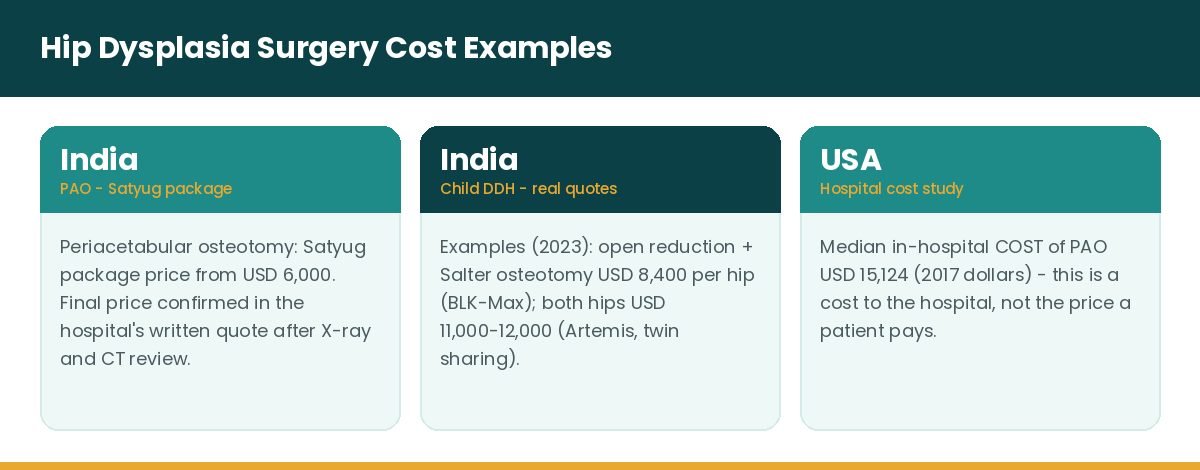
Satyug package price: from USD 6,000 for periacetabular osteotomy (PAO) for hip dysplasia. The final price is confirmed in the hospital’s written quote after your X-rays and CT are reviewed. The cost depends on the age of the patient, whether one or both hips are treated, whether a femoral osteotomy or hip arthroscopy is added, the implants used, the hospital and the room category. Children with DDH need different operations (open reduction with pelvic and femoral osteotomy); the dated real hospital quotes below are shown as examples for these child DDH procedures:
| Hospital / Procedure | Cost (USD) | Room | Hospital stay | Notes |
|---|---|---|---|---|
| Periacetabular osteotomy (PAO) – teenagers and adults | From 6,000 (Satyug package price) | — | About 3–5 days | Satyug package price: from USD 6,000 for PAO. The final price is confirmed in the hospital’s written quote after your X-rays and CT are reviewed by a hip preservation surgeon |
| Example (child DDH, real quote): Artemis Hospital, Gurugram – bilateral DDH in a young child: hip arthroscopy, pelvic osteotomy, femoral osteotomy and hip spica (Dr. Sanjay Sarup, Head Orthopaedics & Chief Paediatric Orthopaedics) | 11,000 – 12,000 | Twin sharing | 4–5 days | Hospital estimate (Mar 2023); evaluation USD 1,000–1,500 OPD; 2–3 weeks in India |
| Example (child, real quote): BLK-Max – child with a hip problem needing varus derotation (femoral) osteotomy and Salter innominate osteotomy (Dr. Nargesh Agarwal) | 6,400 / 7,050 / 7,750 + implants about 3,350 | Economy / twin / single | 3 days | Hospital estimate (Jun 2026); the case was hip AVN, not DDH, but the operations are the same as those used in DDH |
| Example (child DDH, real quote): BLK-Max Super Speciality Hospital, New Delhi – DDH in a young child: open reduction with Salter innominate osteotomy and hip spica (Dr. Nargesh Agarwal, Paediatric Orthopaedics) | 8,400 per hip | Economy | 3 days per hip | Hospital estimate (Feb 2023); second hip after about 2 weeks, also USD 8,400; evaluation USD 800–1,000 OPD; about 1 month in India |
📋 What the Package Includes
- ✔Surgery (surgeon, anaesthesia and operating room)
- ✔Room rent for the package days
- ✔Consultation by the primary orthopaedic team during the package days
- ✔Basic investigations, routine pharmacy and consumables as per the hospital package
- ✔Hip spica cast for children where included in the quote
- ✔Satyug coordinator, interpreter and airport pick-up
- ✖Evaluation before admission (USD 800–1,500 OPD depending on hospital) and CT/MRI in India
- ✖Implants (screws, plates) where quoted separately
- ✖Blood components and stay beyond the package days
- ✖Second-side surgery if both hips are treated separately
- ✖Physiotherapy, crutches or wheelchair after discharge
- ✖Hotel, flights, visa fees and meals
✈️ Your Medical Travel Process with Satyug Healthcare

| Step | Details |
|---|---|
| 1. Send reports | A standing X-ray of the pelvis (both hips), any earlier X-rays and ultrasound reports, CT or MRI if done, notes of earlier treatment (harness, cast or surgery), and a short video of the walk for children. |
| 2. Free opinion & quotes | Within 48-72 hours you receive opinions and cost estimates from 3-5 leading hospitals to compare. |
| 3. Choose hospital & doctor | We help you compare surgeons, success data, room options and total cost – with no hidden charges. |
| 4. Medical visa | The hospital issues a Visa Invitation Letter (VIL) and we help with the e-Medical visa for the patient and up to 2 attendants. |
| 5. Travel & arrival | Free airport pick-up, help with a local SIM card and currency, and a hotel or guest house close to the hospital. |
| 6. Treatment | A coordinator and interpreter stay with you for admission, tests, surgery and ward stay, and help with bills and insurance papers. |
| 7. Recovery & follow-up | FRRO registration if needed, fitness-to-fly certificate, discharge summary, and teleconsultation follow-up with your surgeon after you return home. |
🎒 Travel Checklist
- 📌Valid passport (6+ months) for the patient and attendants, plus 10 passport-size photos each
- 📌e-Medical visa / medical visa and the hospital’s Visa Invitation Letter (VIL)
- 📌All hip X-rays and ultrasound reports, CT/MRI images on CD or a download link, notes from earlier harness, cast or surgery, and current medicines
- 📌Yellow fever vaccination certificate (mandatory for travellers from African countries)
- 📌Polio vaccination certificate where applicable
- 📌Cash above USD 5,000 (or equivalent) must be declared to Indian Customs on arrival; carry an international debit/credit card
- 📌FRRO registration within 14 days if your visa or stay requires it (Satyug helps with this)
- 📌Comfortable clothes, phone charger, adapter, and a list of emergency contacts
⭐ Why Choose Satyug Healthcare?
❓ Frequently Asked Questions
➤ How much does hip dysplasia surgery cost in India?
➤ What is a periacetabular osteotomy (PAO)?
➤ At what age is PAO done?
➤ Can my baby be treated without surgery?
➤ How long is the hospital stay?
➤ How long must we stay in India?
➤ Will my child need a cast?
➤ When can I walk after PAO?
➤ Will the screws be removed?
➤ How long does a PAO last?
➤ Is hip replacement better than PAO?
➤ Can both hips be treated?
➤ What are the main risks of PAO?
➤ Do you provide an interpreter?
Medical disclaimer: This page is for general information and does not replace a consultation with a qualified paediatric orthopaedic or hip preservation surgeon. Treatment plans and costs are confirmed only after examination and imaging. Sources: NHS: Developmental dysplasia of the hip; Steppacher SD et al., Mean 20-year followup of Bernese periacetabular osteotomy, Clin Orthop Relat Res 2008;466:1633-1644; Zaltz I et al., Complications associated with the periacetabular osteotomy: a prospective multicenter study, J Bone Joint Surg Am 2014;96:1967-1974; US in-hospital cost study of hip arthroscopy and PAO (PubMed 33948212, median PAO cost USD 15,124 in 2017 dollars); International Hip Dysplasia Institute patient information; hospital estimates shared with Satyug Healthcare by BLK-Max Super Speciality Hospital (2023, 2026) and Artemis Hospital Gurugram (2023). Image credits: Hip dysplasia diagram: Londenp (nl.wikipedia), Wikimedia Commons, CC BY-SA 3.0 (https://commons.wikimedia.org/wiki/File:Hip_dysplasia_-_schematic.jpg). PAO illustration: Beckenrandgeschichten, Wikimedia Commons, CC BY-SA 4.0 (https://commons.wikimedia.org/wiki/File:Periacetabular_osteotomy_%E2%80%93_schematic_illustration.jpg). Infographics and banner: Satyug Healthcare.
✍️ Written & reviewed by Vikram Kashyap, Medical Consultant, Satyug Healthcare · Last updated: October 2026
Frequently Asked Questions
The Satyug package price for periacetabular osteotomy (PAO) starts from USD 6,000, confirmed in the hospital’s written quote after your X-rays and CT are reviewed. Child DDH surgery is different: as examples, open reduction with a Salter osteotomy was quoted at USD 8,400 per hip (BLK-Max, 2023) and a bilateral plan at Artemis at USD 11,000 to 12,000 (2023).
Periacetabular osteotomy (PAO) for hip dysplasia in India from USD 6,000. Saves the natural hip; child DDH surgery quotes shown as examples. Free opinion.


TOP HOSPITALS
Special High-quality Hospitals


HAPPY PATIENTS
What Our Patients Are Saying