Assistance
Consultation
Services
Opinion
Care Coordination
What will your treatment cost?
Benign prostatic hyperplasia (hypertrophy) treatment in india
Released Date: 2021-11-10

Benign prostatic hyperplasia (hypertrophy)
🖼️ Understand It in Pictures
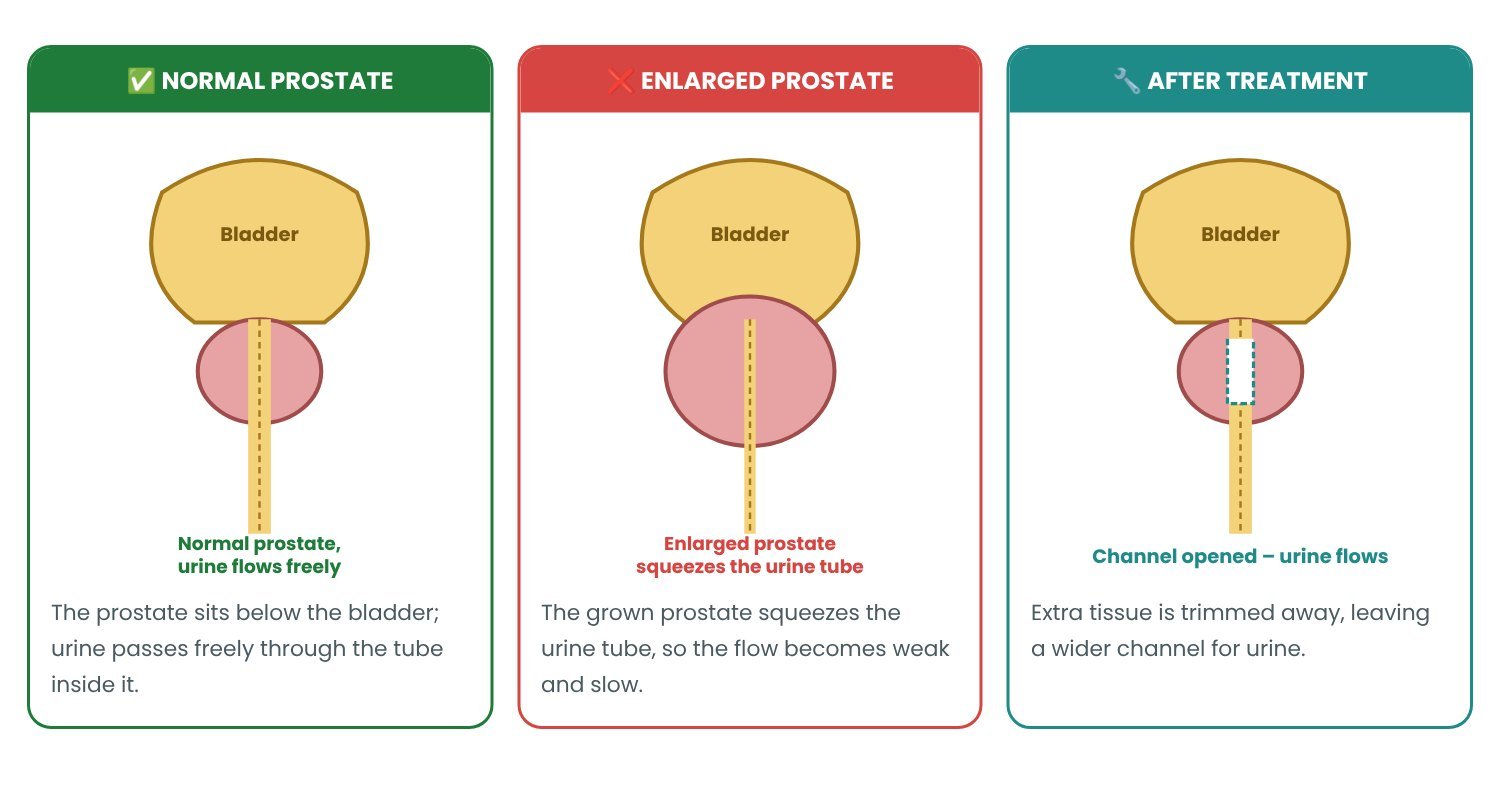
Normal vs enlarged prostate, and after TURP
👀 Symptoms in Pictures

🩻 Scans & Tests — What Doctors See

🎬 The Treatment Journey in Pictures

📅 Recovery at a Glance

Drawings: Satyug Healthcare (simplified, not to scale). Photos: Wikimedia Commons; author and licence under each photo.
The prostate is a gland that produces some of the fluid that carries sperm during ejaculation. The prostate gland surrounds the urethra, the tube through which urine passes out of the body. An enlarged prostate means the gland has grown bigger. Prostate enlargement happens to almost all men as they get older. An enlarged prostate is often called benign prostatic hyperplasia (BPH). It is not cancer, and it does not raise your risk of prostate cancer.
Causes
The actual cause of prostate enlargement is unknown. Factors linked to ageing and changes in the cells of the testicles may play a role in the growth of the gland, as may testosterone levels. Men who have had their testicles removed at a young age (for example, because of testicular cancer) do not develop BPH.
Also, if the testicles are removed after a man develops BPH, the prostate begins to shrink. However, this is not a standard treatment for an enlarged prostate.
Some facts about prostate enlargement:
- The likelihood of developing an enlarged prostate increases with age.
- BPH is so common that it has been said all men will have an enlarged prostate if they live long enough.
- A small amount of prostate enlargement is present in many men over age 40. More than 90% of men over age 80 have the condition.
- No risk factors have been identified, other than having normally functioning testicles.
Symptoms
Fewer than half of all men with BPH have symptoms of the disease. Symptoms may include:
- Dribbling at the end of urinating
- Inability to urinate (urinary retention)
- Incomplete emptying of your bladder
- Incontinence
- Needing to urinate 2 or more times per night
- Pain with urination or bloody urine (these may indicate infection)
- Slowed or delayed start of the urinary stream
- Straining to urinate
- Strong and sudden urge to urinate
- Weak urine stream
Testing and Diagnosis
Your health care provider will ask questions about your medical history. A digital rectal exam may also be done to feel the prostate gland. Other tests may include:
- Urine flow rate
- Post-void residual urine test to see how much urine is left in your bladder after you urinate
- Pressure-flow studies to measure the pressure in the bladder as you urinate
- Urinalysis to check for blood or infection
- Urine culture to check for infection
- Prostate-specific antigen (PSA) blood test to screen for prostate cancer
- Cystoscopy
- Blood urea nitrogen (BUN) and creatinine tests
You may be asked to fill out a form to rate how bad your symptoms are and how much they affect your daily life. Your provider can use this score to judge whether your condition is getting worse over time.
Treatment
The treatment you choose will be based on how bad your symptoms are and how much they bother you. Your provider will also take into account any other medical problems you may have.
Treatment options include "watchful waiting," lifestyle changes, medicines, or surgery.
If you are over 60, you are more likely to have symptoms. But many men with an enlarged prostate have only minor symptoms. Self-care steps are often enough to make you feel better.
If you have BPH, you should have a yearly exam to monitor your symptoms and see whether you need changes in treatment.
SELF-CARE
For mild symptoms:
- Urinate when you first get the urge. Also, go to the bathroom on a timed schedule, even if you do not feel a need to urinate.
- Avoid alcohol and caffeine, especially after dinner.
- DO NOT drink a lot of fluid all at once. Spread out fluids throughout the day. Avoid drinking fluids within 2 hours of bedtime.
- Try NOT to take over-the-counter cold and sinus medicines that contain decongestants or antihistamines. These medicines can increase BPH symptoms.
- Keep warm and exercise regularly. Cold weather and lack of physical activity may worsen symptoms.
- Reduce stress. Nervousness and tension can lead to more frequent urination.
MEDICINES
Alpha-1 blockers are a class of medicines that are also used to treat high blood pressure. These medicines relax the muscles of the bladder neck and prostate. This allows easier urination. Most people who take alpha-1 blockers notice an improvement in their symptoms, usually within 3 to 7 days after starting the medicine.
Finasteride and dutasteride lower levels of hormones produced by the prostate. These medicines also reduce the size of the gland, increase the urine flow rate, and reduce symptoms of BPH. You may need to take these medicines for 3 to 6 months before you notice your symptoms getting better. Possible side effects include decreased sex drive and impotence.
Antibiotics may be prescribed to treat chronic prostatitis (inflammation of the prostate), which may occur with BPH. BPH symptoms improve in some men after a course of antibiotics.
Watch out for medicines that can make your symptoms worse, such as the over-the-counter cold and sinus medicines mentioned above.
SAW PALMETTO
Many herbs have been tried for treating an enlarged prostate. Many men use saw palmetto to ease symptoms. Some studies have shown that it may help with symptoms, but results are mixed, and more research is needed. If you use saw palmetto and think it works, ask your doctor whether you should still take it.
SURGERY
Prostate surgery may be recommended if you have:
- Incontinence
- Recurrent blood in the urine
- Inability to completely empty the bladder (urinary retention)
- Recurrent urinary tract infections
- Decreasing kidney function
- Bladder stones
- Bothersome symptoms that do not respond to medicines
The choice of surgery is most often based on the severity of your symptoms and the size and shape of your prostate gland. Most men who have prostate surgery have an improvement in urine flow rates and symptoms.
Transurethral resection of the prostate (TURP): This is the most common and most proven surgical treatment for BPH. TURP is done by inserting a scope through the penis and removing the prostate piece by piece.
Simple prostatectomy: It is a procedure to remove the inner part of the prostate gland. It is done through a surgical cut in your lower belly. This treatment is most often done on men who have very large prostate glands.
Other less-invasive procedures use heat or a laser to destroy prostate tissue. Another less-invasive procedure works by "tacking" the prostate open without removing or destroying tissue. None has been proven to be better than TURP. People who have these procedures are more likely to need surgery again after 5 or 10 years. However, these procedures may be an option for:
- Younger men (some less-invasive procedures carry a lower risk of impotence and incontinence than TURP, although the risk with TURP is not very high)
- Older people
- People with serious medical conditions, such as uncontrolled diabetes, cirrhosis, alcoholism, psychosis, and serious lung, kidney, or heart disease
- Men who are taking blood-thinning medicines
- Men who are otherwise at increased surgical risk
Possible Complications
Men who have had BPH for a long time with slowly worsening symptoms may develop:
- Sudden inability to urinate
- Urinary tract infections
- Urinary stones
- Damage to the kidneys
- Blood in the urine
BPH may also come back over time, even after surgery.
You can tell us about your problem so that we can help you get advice from the doctor. If you are facing any urgent problem, consult your nearest doctor immediately. You can contact us anytime to get a doctor's advice.
If you have any related query, you can send us your reports at the email address below, or call or WhatsApp us for a second opinion.
Video/tele-consultation is also available
E-mail address- query@satyughealthcare.com
Phone number- +91-8860606766, +91-9910655125
Related Blogs



HAPPY PATIENTS
What Our Patients Are Saying






























Our Gallery