
Tetralogy of Fallot Total Correction Package
Assistance
Consultation
Services
Opinion
Care Coordination
What will your treatment cost?

See the cost breakdown by option, hospital and city →
| Surgery Name | Cost | Room | Hospitalization |
|---|---|---|---|
| Tetralogy of Fallot Total Correction Package | 5500 USD | Twin Sharing / Single Room (one parent stays with the child) | 7-10 days in hospital (including 2-4 days paediatric cardiac ICU); total stay in India 2-3 weeks |
| Total Correction (Intracardiac Repair) | 5500 USD | Twin Sharing | 7-10 days hospital |
| Total Correction - Single Room | 6500 USD | Single Room | 7-10 days hospital |
| Complex Repair with Transannular Patch or RV-PA Conduit | 7500 USD | Twin Sharing | 10-12 days hospital |
✓ Inclusion
- ✔Total correction (intracardiac repair) of tetralogy of Fallot by a senior paediatric cardiac surgeon
- ✔Paediatric cardiac anaesthesia and anaesthetist fee
- ✔Operating theatre and heart-lung (cardiopulmonary bypass) machine charges
- ✔2–4 days stay in the paediatric cardiac ICU
- ✔Ward stay in a twin sharing room with one parent (total 7–10 days in hospital)
- ✔Standard VSD and outflow patch materials
- ✔Echo, X-rays, ECG and routine lab tests during stay
- ✔Routine medicines, IV fluids and consumables during stay
- ✔Nursing care, physiotherapy and dietitian advice
- ✔Discharge summary and follow-up consultation
- ✔Free: airport pick-up & drop, visa invitation letter, interpreter & coordinator (Satyug Healthcare)
✗ Exclusion
- ✖Flight tickets and visa fees
- ✖Hotel stay before admission and after discharge
- ✖CT angiography, cardiac MRI or catheterisation before admission
- ✖RV–PA conduit, valves or special devices (complex repair package)
- ✖Single room upgrade (USD 6,500 package)
- ✖Extra ICU or hospital days and treatment of complications
- ✖Blood and blood products beyond package
- ✖Medicines after discharge
- ✖Food and expenses of a second attendant
Know More About Procedure & Surgery
Tetralogy of Fallot (TOF) Total Correction Surgery in India
Open-heart repair of tetralogy of Fallot, the most common 'blue baby' heart defect, for infants, children and adults. Performed by experienced paediatric cardiac surgeons at high-volume Indian centres, with excellent survival and a fraction of Western cost.
📖 What is Tetralogy of Fallot?
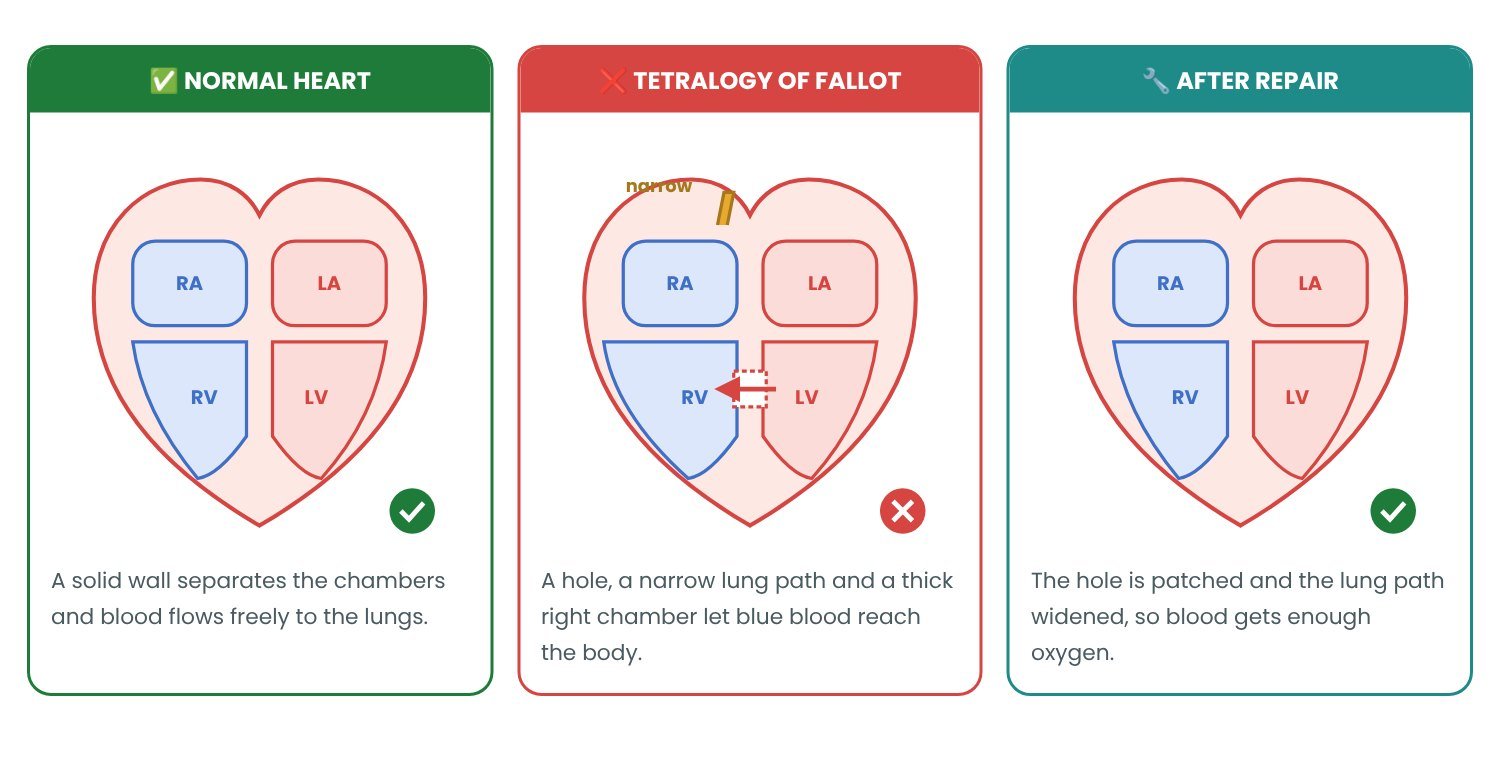
Tetralogy of Fallot (TOF) is a heart problem present from birth. It affects about 3–5 of every 10,000 babies and is the most common cyanotic ('blue') congenital heart defect. It has four parts: a hole between the two pumping chambers (ventricular septal defect, VSD), narrowing of the pathway to the lungs (pulmonary stenosis), an aorta that sits over the hole (overriding aorta), and a thickened right ventricle. Because of these, oxygen-poor blood goes to the body, making the lips and skin look blue.
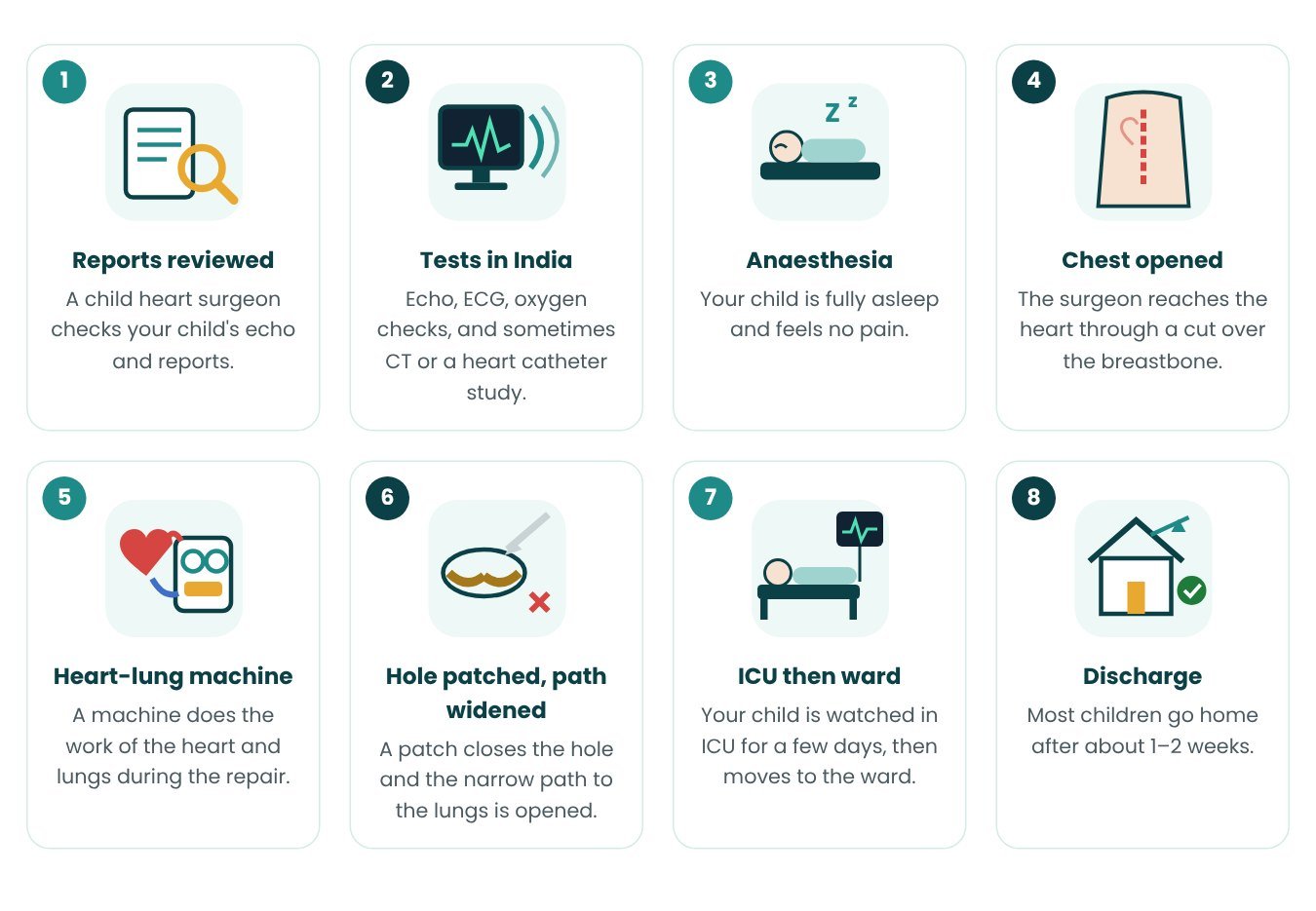
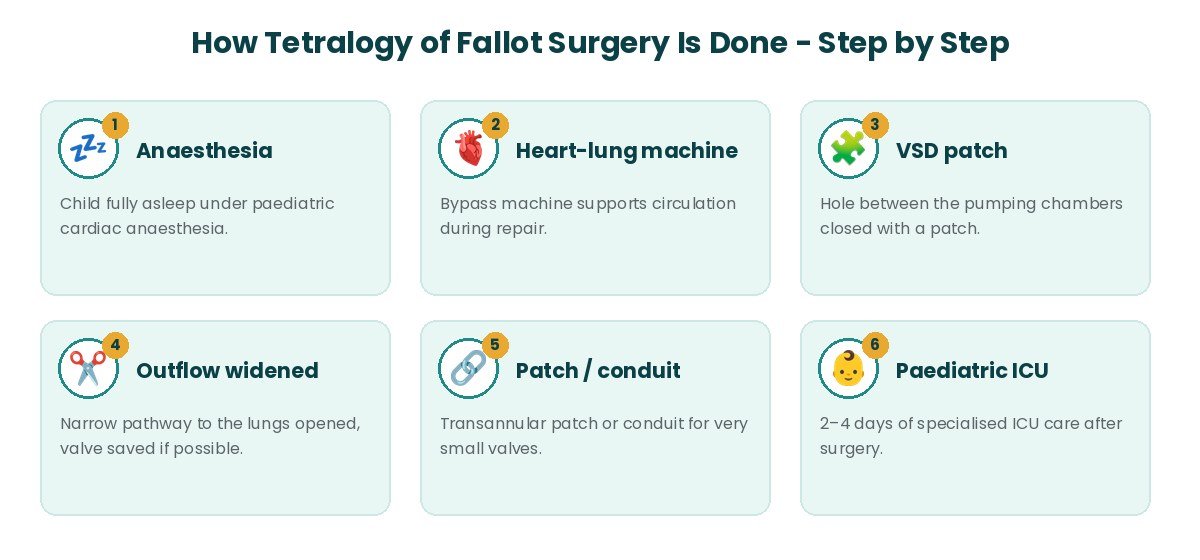
Total correction (also called intracardiac repair, ICR) is open-heart surgery that fixes the defect. Using a heart-lung machine, the surgeon closes the VSD with a patch and widens the narrowed pathway to the lungs, saving the pulmonary valve whenever possible. If the valve area is very small, a transannular patch or a tube (RV–PA conduit) is used. Surgery is usually done between 3 and 12 months of age, but older children and even adults with unrepaired TOF can be operated on.
🖼️ Understand It in Pictures
Normal heart vs Tetralogy of Fallot
👀 Symptoms in Pictures
📷 What It Looks Like (real photos)

🩻 Scans & Tests — What Doctors See


🎬 The Treatment Journey in Pictures


📅 Recovery at a Glance
Drawings: Satyug Healthcare (simplified, not to scale). Photos: Wikimedia Commons; author and licence under each photo.
🩺 Conditions Treated
⚠️ Signs That May Need Treatment
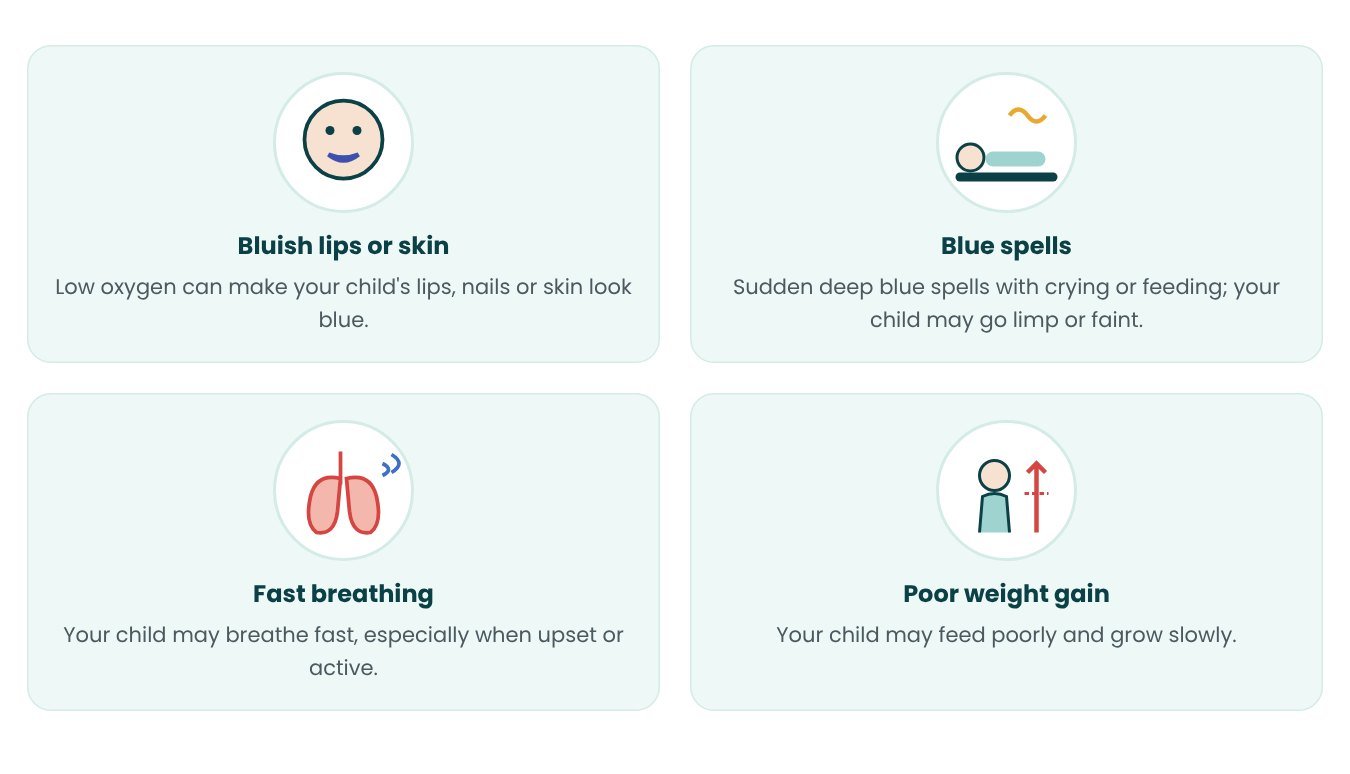
- ➤Blue lips, tongue or nails (cyanosis)
- ➤Sudden 'tet spells' – baby becomes very blue and limp
- ➤Fast breathing or breathlessness on feeding
- ➤Poor feeding and slow weight gain
- ➤Child squats after playing to rest
- ➤Clubbing of fingers and toes
- ➤Loud heart murmur
- ➤Low oxygen level (SpO2) on pulse oximeter
🔬 Tests Before Treatment
| Test | Why it is done |
|---|---|
| Echocardiogram | Main test; shows the VSD, outflow narrowing, valve size and lung artery size. |
| Pulse oximetry and ECG | Measures oxygen level and heart rhythm. |
| Chest X-ray | Shows the typical 'boot-shaped' heart and lung blood flow. |
| CT angiography / cardiac MRI | Shows lung arteries and coronary artery pattern in detail. |
| Cardiac catheterisation (selected) | Measures pressures and lung artery anatomy in complex cases. |
| Blood tests | Haemoglobin (often high), clotting, kidney function and blood group. |
| Genetic test (selected) | Checks for 22q11 deletion (DiGeorge syndrome) in some children. |
🏥 The Procedure — Step by Step
⚖️ Types & Techniques
| Technique | What is done | Best for |
|---|---|---|
| Total correction – valve-sparing | VSD closed and outflow widened, pulmonary valve preserved | Babies with near-normal valve size |
| Total correction – transannular patch | Patch placed across the narrow valve ring | Small pulmonary valve |
| Repair with RV–PA conduit | Tube connects right ventricle to lung artery | Pulmonary atresia or abnormal coronary artery crossing outflow |
| Palliative BT shunt / RVOT or PDA stent | Temporary extra blood flow to lungs | Very small, sick babies or tiny lung arteries |
| Pulmonary valve replacement (later) | Surgical or catheter valve in the leaking outflow | Repaired TOF with severe leak years later |
📅 Your Day-by-Day Plan in India
| Day | What happens |
|---|---|
| Day 1 | Arrive in India with child, airport pick-up, hotel check-in |
| Day 2–3 | Paediatric cardiology consultation, echo, CT angiography and blood tests |
| Day 4 | Admission with one parent |
| Day 5 | Total correction surgery |
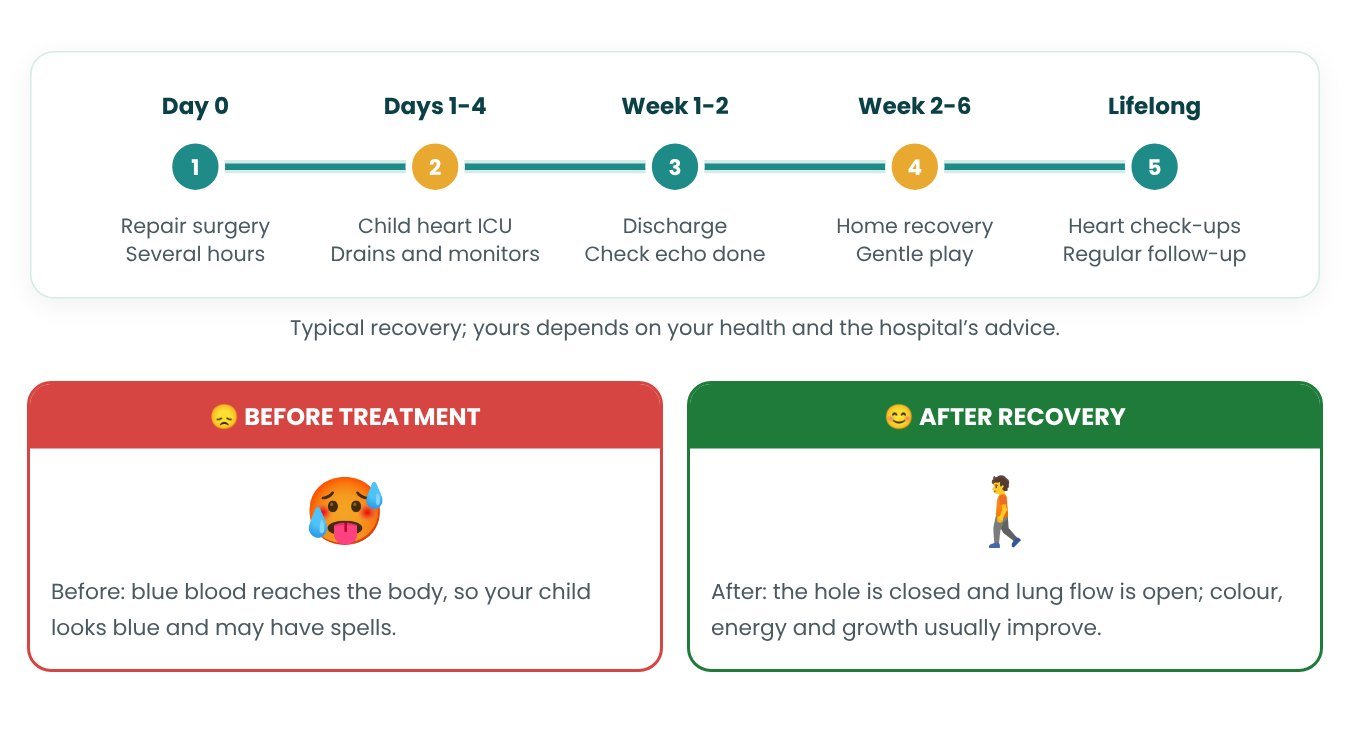
| Day 6–8 | Paediatric cardiac ICU (2–4 days): breathing tube removed, feeding starts |
| Day 9–14 | Ward care with parent; drains removed, echo check (7–10 days in hospital) |
| Day 15–20 | Hotel recovery, wound check and final echo; fit-to-fly — Fly home ✈️ |
🌱 Recovery After Treatment
🏆 Success Rate
| Outcome | Result |
|---|---|
| Early survival after total correction | About 97–98% |
| Survival at 30 years | About 85–90% |
| Children living normal active lives | Most |
| Need for re-operation by adulthood | About 10–20% (mostly valve replacement) |
| Need for pacemaker | About 1% |
Results depend on the child's age and weight, size of the lung arteries, TOF variant, genetic syndromes, and the experience of the paediatric cardiac team. Earlier repair in infancy generally gives the best long-term heart function.
🩹 Risks & Possible Complications
TOF repair is a well-established operation with excellent results in experienced centres.
- •Low cardiac output or right heart stiffness in the first days (common, managed in ICU)
- •Fast heart rhythm (junctional ectopic tachycardia) after surgery (about 5–10%)
- •Residual VSD or outflow narrowing needing treatment (about 5%)
- •Pulmonary valve leak causing later valve replacement (about 10–20% over decades)
- •Infection or wound problems (about 2–5%)
- •Heart block needing a pacemaker (about 1%)
- •Death (about 1–3%)
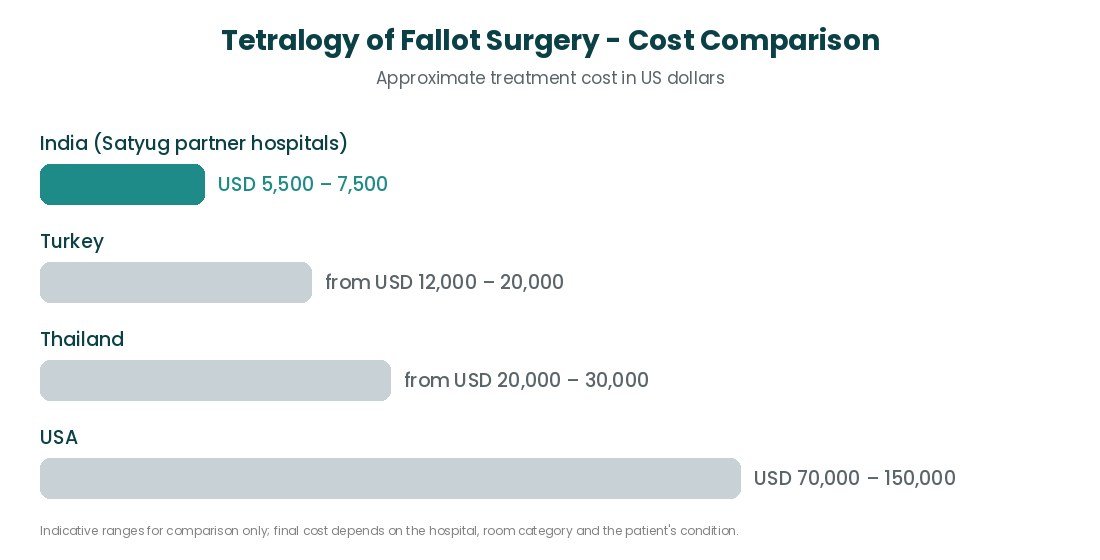
💰 Cost of Tetralogy of Fallot Surgery in India
The cost of tetralogy of Fallot surgery in India starts from about USD 5,500 for total correction. The package includes the surgeon and anaesthesia fees, heart-lung machine, 7–10 days in hospital including 2–4 days in the paediatric cardiac ICU, twin sharing or single room with one parent, and routine medicines. Complex repairs with a transannular patch or conduit, and a single room upgrade, cost more.
| Option / Hospital tier | Approx. cost (USD) | Hospital stay | Notes |
|---|---|---|---|
| Total correction (this package) | 5,500 | 7–10 days incl. 2–4 days PICU, twin sharing | One parent stays with the child |
| Total correction – single room | 6,500 | 7–10 days, single room | Private room for child and parent |
| Complex repair with transannular patch or RV–PA conduit | 7,500 | 10–12 days, twin sharing | Small valve, pulmonary atresia or coronary variants |
| Palliative BT shunt (staged) | 4,000 – 5,500 | 7–10 days | For very small babies before full repair |
✈️ Your Medical Travel Process with Satyug Healthcare

| Step | Details |
|---|---|
| 1. Send reports | Recent echocardiogram report (and video if available), oxygen saturation, chest X-ray, ECG, CT angiography or catheter reports if done, child's age, weight and growth details, and any previous shunt or surgery notes. |
| 2. Free opinion & quotes | Within 48-72 hours you receive opinions and cost estimates from 3-5 leading hospitals to compare. |
| 3. Choose hospital & doctor | We help you compare doctors, success rates, room options and total budget. |
| 4. Medical visa | The hospital issues a Visa Invitation Letter (VIL) to the Indian Embassy. The patient and up to 2 attendants apply for an e-Medical / Medical Attendant visa. |
| 5. Travel planning | Flight guidance, wheelchair assistance, airport pick-up, hotel or guest house near the hospital. |
| 6. Treatment in India | Your coordinator and interpreter stay with you for admission, treatment, discharge and billing. |
| 7. Return & follow-up | Fit-to-fly letter, medicines, and online follow-up with your doctor after you return home. |
🎒 Travel Checklist
- 📌Valid passport (6+ months) for the patient and attendants, plus 10 passport-size photos each
- 📌Medical visa / e-visa and the hospital’s Visa Invitation Letter
- 📌All echo, CT and catheter reports with CD / link, oxygen saturation records, previous surgery notes and prescriptions
- 📌Yellow fever vaccination certificate (mandatory for travellers from African countries)
- 📌Polio vaccination certificate where applicable
- 📌Declare cash above USD 5,000 at the airport; hospitals accept wire transfer and cards
- 📌Foreigners staying longer than permitted must register with the FRRO — our team assists
⭐ Why Choose Satyug Healthcare?
❓ Frequently Asked Questions
➤ What is the cost of tetralogy of Fallot surgery in India?
➤ What is the best age for TOF surgery?
➤ How long does the surgery take?
➤ How long will we stay in India?
➤ What is the success rate?
➤ Will my child be pink after surgery?
Medical disclaimer: This page is for general information and does not replace a consultation with a qualified specialist. Treatment plans and costs are confirmed only after the patient is examined. Sources: NCBI StatPearls: Tetralogy of Fallot; 2018 AHA/ACC Guideline for the Management of Adults with Congenital Heart Disease; CDC: Congenital Heart Defects – Tetralogy of Fallot; Cuypers JA et al., Circulation 2014 (long-term outcome after TOF repair); Mayo Clinic: Tetralogy of Fallot; NHS: Tetralogy of Fallot. Infographics: Satyug Healthcare.
Frequently Asked Questions
The cost of tetralogy of Fallot surgery in India starts from USD 5500. Total Correction (Intracardiac Repair): USD 5500; Total Correction - Single Room: USD 6500; Complex Repair with Transannular Patch or RV-PA Conduit: USD 7500. The final cost depends on the hospital, room category and medical condition.
Tetralogy of Fallot total correction in India from USD 5,500. Paediatric heart surgeons, dedicated cardiac ICU, 7–10 day stay, parent stays. Free opinion.




TOP HOSPITALS
Special High-quality Hospitals


HAPPY PATIENTS
What Our Patients Are Saying


















Our Gallery



Get a Free Quote
Tell us what you need and share your medical reports. Our medical team prepares your treatment plan and cost estimate.
- Free medical opinion on your reports
- Your quote within 24–48 hours
- Help with visa invitation letter, travel and airport pickup
- Coordinators available on WhatsApp
Prefer to talk? Call +91-8860606766 or WhatsApp us.
Thank you! Your request is received.
Reference . Our medical team will send your free quote within 24–48 hours by e-mail or WhatsApp.
Chat on WhatsApp now