ASD Closure Package
Assistance
Consultation
Services
Opinion
Care Coordination
What will your treatment cost?

| Surgery Name | Cost | Room | Hospitalization |
|---|---|---|---|
| ASD Closure Package | 4500 | Single | Patient - 4-5 days stay in a single room. |
✓ Inclusion
- ✔Consultation with paediatric / adult interventional cardiologist
- ✔Routine pre-procedure tests (blood tests, ECG, chest X-ray, echo)
- ✔Cardiologist / cardiac surgeon, assistant and anaesthetist fees
- ✔Cath lab or operation theatre charges
- ✔ASD closure as per package (standard occluder device or surgical closure as advised)
- ✔4–5 days stay in a single room, including routine ICU / recovery monitoring
- ✔Nursing care, routine medicines and consumables
- ✔Meals for the patient as per hospital diet
- ✔Echocardiography before discharge
- ✔Free: airport pick-up & drop, visa invitation letter, interpreter & coordinator (Satyug Healthcare)
✗ Exclusion
- ✖Imported or larger occluder device above package value
- ✖Transoesophageal echo, cardiac MRI / CT or cardiac catheterisation if not in quote
- ✖Extra ICU or hospital days beyond package
- ✖Blood and blood products
- ✖Management of complications or re-intervention
- ✖Treatment of other illnesses
- ✖Medicines after discharge
- ✖Hotel stay, food and local travel for patient and attendants
- ✖Flights, visa fees and travel insurance
Know More About Procedure & Surgery
ASD Closure Surgery in India
Closure of an atrial septal defect (a hole between the heart's upper chambers) in children and adults, by catheter device or open-heart surgery, done by expert congenital heart teams at accredited Indian hospitals – at a fraction of Western prices.
📖 What is ASD Closure?
The heart has four chambers. The two upper chambers (atria) are separated by a wall called the atrial septum. An atrial septal defect (ASD) is a hole in this wall that a person is born with. Through the hole, extra blood flows from the left side to the right side of the heart, so the right heart and lungs carry too much blood. Small holes may close by themselves in early childhood, but larger holes stay open and, over years, can cause breathlessness, irregular heartbeat (atrial fibrillation), heart failure and high pressure in the lungs (pulmonary hypertension).
ASD closure seals the hole. The most common type, secundum ASD, can usually be closed without open-heart surgery by transcatheter device closure: a folded umbrella-like device (occluder) is passed through a vein in the groin and opened on both sides of the hole. Holes that are very large, lack enough rim, or are of other types (primum, sinus venosus, coronary sinus) are closed by open-heart surgery with stitches or a patch.
🩺 Conditions Treated
⚠️ Symptoms / Signs That May Need ASD Closure
- ➤Breathlessness on exercise
- ➤Getting tired easily
- ➤Frequent chest infections in children
- ➤Poor weight gain in infants
- ➤Palpitations or irregular heartbeat
- ➤Swelling of legs or belly
- ➤Heart murmur found by a doctor
- ➤Enlarged right heart on echo
🔬 Tests Before Treatment
| Test | Why it is done |
|---|---|
| Transthoracic echocardiography (echo) | Shows the size and type of ASD and right heart enlargement. |
| Transoesophageal echo (TEE) | A probe in the food pipe measures the rims around the hole to decide device vs surgery. |
| ECG and Holter if needed | Checks heart rhythm and atrial fibrillation. |
| Chest X-ray | Shows heart size and lung blood flow. |
| CT / cardiac MRI (selected) | Maps abnormal lung veins in sinus venosus defects. |
| Cardiac catheterisation (selected) | Measures lung pressure in older patients or if pulmonary hypertension is suspected. |
🏥 The Procedure — Step by Step

⚖️ Types & Techniques
| Technique | What is done | Best for |
|---|---|---|
| Transcatheter device closure | Umbrella device placed through the groin vein; no chest cut. | Secundum ASD with good rims |
| Open surgical closure (stitch / patch) | Heart opened on bypass machine; hole closed with stitches or a patch. | Large, primum or sinus venosus ASD |
| Minimally invasive surgical closure | Surgery through a small side-chest cut or lower breastbone cut. | Surgical ASDs where better cosmetic result is wanted |
| PFO closure | Small device closes a flap opening. | Selected stroke patients under about 60 |
📅 Your Day-by-Day Plan in India
| Day | What happens |
|---|---|
| Day 1 | Arrival in India, airport pick-up and hotel check-in |
| Day 2 | Cardiologist consultation, echo, TEE and blood tests |
| Day 3 | Admission and ASD closure (device or surgery) |
| Day 4–7 | Hospital stay (4–5 days in total): monitoring, echo, discharge |
| Day 8–12 | Hotel rest, light walking; wound check after surgery |
| Day 12–14 | Final echo and review, fit-to-fly letter and fly home ✈️ |
🌱 Recovery After Treatment
🏆 Success Rate
| Outcome | Result |
|---|---|
| Complete closure (device) | About 95–98% |
| Surgical closure success | Over 98%, with very low risk in children |
| Serious complications (device) | About 1% or less |
| Device erosion (rare) | About 0.1–0.3% |
| Life expectancy after closure in childhood | Close to normal |
Results are best when the ASD is closed in childhood or young adulthood before lung pressure rises. In older adults closure still improves breathlessness and exercise capacity, but the risk of atrial fibrillation may remain.
🩹 Risks & Possible Complications
ASD closure is one of the safest heart procedures, but some risks exist.
- •Bleeding or bruising at the groin (common, minor)
- •Temporary irregular heartbeat (about 2–5%)
- •Device moving out of place (embolisation, under 1%) needing catheter retrieval or surgery
- •Small residual leak, usually closes with time
- •Device erosion through the heart wall (about 0.1–0.3%) – rare but serious
- •Blood clot on the device or stroke (rare)
- •For open surgery: bleeding, fluid around the heart, wound infection
💰 Cost of ASD Closure in India
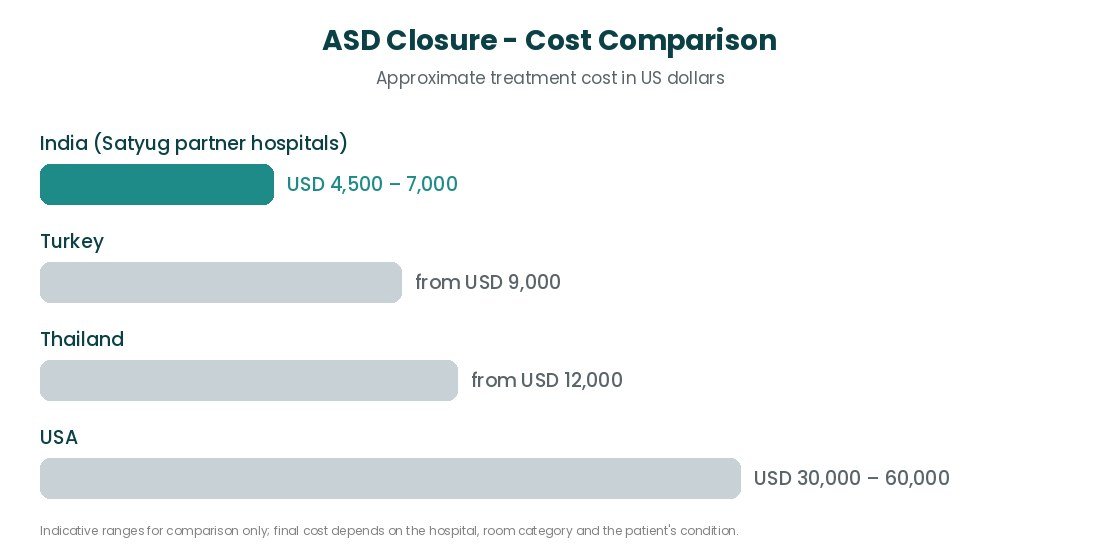
The cost of ASD closure in India starts from about USD 4,500 with 4–5 days in a single room. The package covers the cardiologist or surgeon fees, the procedure, routine tests and stay. The final cost depends on whether device closure or open surgery is needed and on the brand and size of the occluder device.
| Option / Hospital tier | Approx. cost (USD) | Hospital stay | Notes |
|---|---|---|---|
| ASD closure package (this package) | from 4,500 | 4–5 days, single room | Device or surgical closure as advised |
| ASD device closure, imported device | 5,000 – 6,500 | 2–4 days | Device brand affects cost |
| Open-heart surgical ASD closure | 5,000 – 7,000 | 5–7 days incl. ICU | Large or non-secundum ASD |
| Premium hospital, metro city | 6,500 – 8,000 | 4–6 days | Higher room and team charges |
📋 What the Package Includes
- ✔Cardiologist / heart surgeon fees
- ✔Anaesthesia and cath lab or theatre charges
- ✔4–5 days in a single room
- ✔Routine medicines and consumables
- ✔Echo before discharge
- ✔Nursing care and patient meals
- ✔Routine blood tests
- ✖Occluder device above package value
- ✖Extended ICU stay
- ✖Cardiac MRI / CT / catheter study
- ✖Blood products
- ✖Treatment of complications
- ✖Hotel stay and flights
- ✖Medicines after discharge
✈️ Your Medical Travel Process with Satyug Healthcare

| Step | Details |
|---|---|
| 1. Send reports | Recent echocardiography report and video (CD or link), TEE report if done, ECG, chest X-ray, any cardiac MRI / CT or cath report, patient's age and weight, and current medicines |
| 2. Free opinion & quotes | Within 48-72 hours you receive opinions and cost estimates from 3-5 leading hospitals to compare. |
| 3. Choose hospital & doctor | We help you compare doctors, success rates, room options and total budget. |
| 4. Medical visa | The hospital issues a Visa Invitation Letter (VIL) to the Indian Embassy. The patient and up to 2 attendants apply for an e-Medical / Medical Attendant visa. |
| 5. Travel planning | Flight guidance, wheelchair assistance, airport pick-up, hotel or guest house near the hospital. |
| 6. Treatment in India | Your coordinator and interpreter stay with you for admission, treatment, discharge and billing. |
| 7. Return & follow-up | Fit-to-fly letter, medicines, and online follow-up with your doctor after you return home. |
🎒 Travel Checklist
- 📌Valid passport (6+ months) for the patient and attendants, plus 10 passport-size photos each
- 📌Medical visa / e-visa and the hospital’s Visa Invitation Letter
- 📌All echo / TEE reports with video clips, ECG, chest X-ray and prescriptions
- 📌Yellow fever vaccination certificate (mandatory for travellers from African countries)
- 📌Polio vaccination certificate where applicable
- 📌Declare cash above USD 5,000 at the airport; hospitals accept wire transfer and cards
- 📌Foreigners staying longer than permitted must register with the FRRO — our team assists
⭐ Why Choose Satyug Healthcare?
❓ Frequently Asked Questions
➤ What is the cost of ASD closure in India?
➤ Will my child need open-heart surgery?
➤ At what age should an ASD be closed?
➤ How long does the procedure take?
➤ How long will I stay in hospital and in India?
➤ Is it painful?
➤ What is the success rate?
➤ What are the risks?
➤ Will I need medicines after closure?
➤ When can my child return to school or play?
➤ Can adults over 40 have ASD closure?
➤ Is it safe to fly home afterwards?
➤ What follow-up is needed?
➤ Can parents or family come along?
Medical disclaimer: This page is for general information and does not replace a consultation with a qualified specialist. Treatment plans and costs are confirmed only after the patient is examined. Sources: AHA/ACC 2018 Guideline for Adults with Congenital Heart Disease; ESC 2020 Guidelines for Adult Congenital Heart Disease; NCBI StatPearls: Atrial Septal Defect; Mayo Clinic: Atrial septal defect; Cleveland Clinic: ASD closure; NHS: Congenital heart disease. Infographics: Satyug Healthcare.
Frequently Asked Questions
Some congenital heart defects have genetic links and are passed down in certain families. Most atrial septal defects, however, occur by chance. Doctors can find no clear reason why atrial septal defects occur.
ASD closure in India from USD 4,500: device or surgical closure of a hole in the heart for children & adults at NABH/JCI hospitals. Free opinion in 48 h.







TOP HOSPITALS
Special High-quality Hospitals


HAPPY PATIENTS
What Our Patients Are Saying










Our Gallery