
Paediatric Cardiac Surgery Package
Assistance
Consultation
Services
Opinion
Care Coordination
What will your treatment cost?

See the cost breakdown by option, hospital and city →
| Surgery Name | Cost | Room | Hospitalization |
|---|---|---|---|
| Paediatric Cardiac Surgery Package | 6000 | Economy / Twin Sharing / Single Room | 5-6 Days in Hospital incl. ICU; Total Stay in India 3-4 Weeks |
✓ Inclusion
- ✔Paediatric cardiac surgeon and cardiologist consultations during the package
- ✔Surgery, paediatric anaesthesia and shunt graft
- ✔ICU and ward stay for the package days
- ✔Routine medicines, consumables and blood tests during the stay
- ✔Echocardiogram before discharge
- ✔One parent/attendant stay in the room (as per hospital policy)
- ✔Satyug coordinator, interpreter and airport pick-up
✗ Exclusion
- ✖Evaluation before admission (USD 500–800)
- ✖CT angiography or catheterisation if not quoted
- ✖Extra ICU days, ECMO or re-intervention
- ✖Blood products beyond the package
- ✖The next-stage operation (full repair, Glenn)
- ✖Hotel, flights, visa fees and meals for the family
Know More About Procedure & Surgery
Blalock-Taussig (BT) Shunt Surgery in India
A Blalock-Taussig shunt is a small tube that connects an artery from the body to the lung artery, so more blood reaches the lungs to pick up oxygen. It is used in babies born with “blue” (cyanotic) heart defects where too little blood flows to the lungs, as a life-saving bridge until the full repair or the next stage of surgery.
👶 What is a BT Shunt?
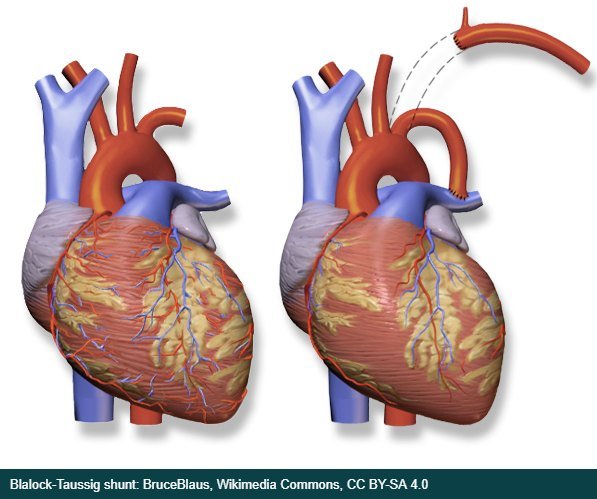
In some heart defects, blood cannot flow easily from the heart to the lungs, so the baby’s oxygen level is low and the lips and skin look blue. A Blalock-Taussig shunt – today usually a modified Blalock-Thomas-Taussig shunt – is a small synthetic tube (usually 3–4 mm Gore-Tex) stitched between the subclavian or innominate artery and the pulmonary artery. Blood from the body’s circulation flows through the tube into the lungs, raising oxygen levels.
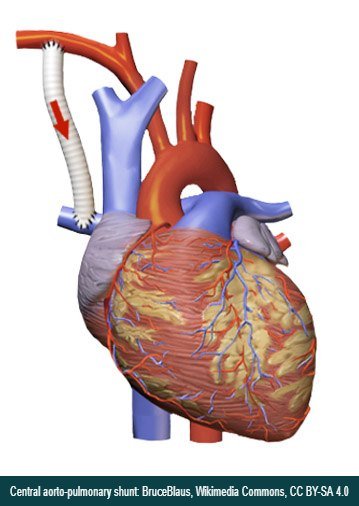
The shunt does not correct the heart defect. It is a palliative bridge: it keeps the baby well and lets the lung arteries grow until the next operation – complete repair (for example Tetralogy of Fallot repair) or the next stage of single-ventricle surgery (Glenn, then Fontan). A central shunt from the aorta, or a catheter stent in the ductus arteriosus, are alternatives in some babies. See our Tetralogy of Fallot, Bidirectional Glenn and Fontan packages.
🖼️ Understand It in Pictures
Modified BT shunt: subclavian artery to pulmonary artery
Central shunt: aorta to pulmonary artery (an alternative)
Who may need a shunt
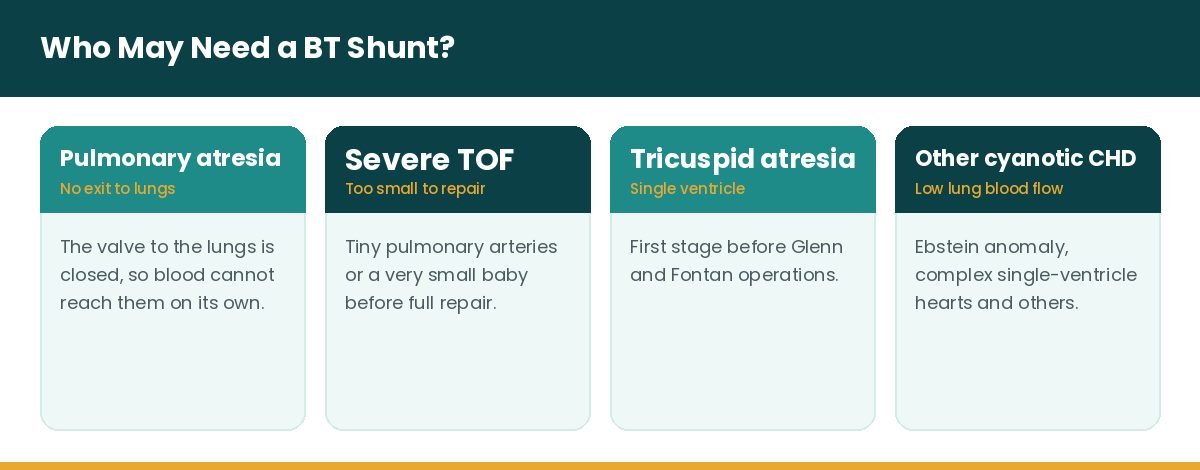
🩺 Conditions Treated
⚠️ Symptoms of Low Lung Blood Flow
- ➤Blue lips, tongue or nails (cyanosis)
- ➤Low oxygen saturation on a finger probe
- ➤Fast breathing
- ➤Poor feeding and tiredness during feeds
- ➤Slow weight gain
- ➤Blue spells (sudden worsening of colour, crying, limpness)
- ➤Squatting in older children
- ➤Clubbing of fingers in older children
🔬 Tests Before Surgery
| Test | Why it is done |
|---|---|
| Echocardiogram | Main test: defect type and size of the pulmonary arteries. |
| CT angiography | Measures arteries and plans the best shunt route. |
| Oxygen saturation and blood gas | Severity of cyanosis. |
| Chest X-ray and ECG | Lungs, heart size and rhythm. |
| Cardiac catheterisation (selected) | Pressures and detailed artery anatomy. |
| Blood tests | Blood count (often high in cyanosis), clotting and kidney tests. |
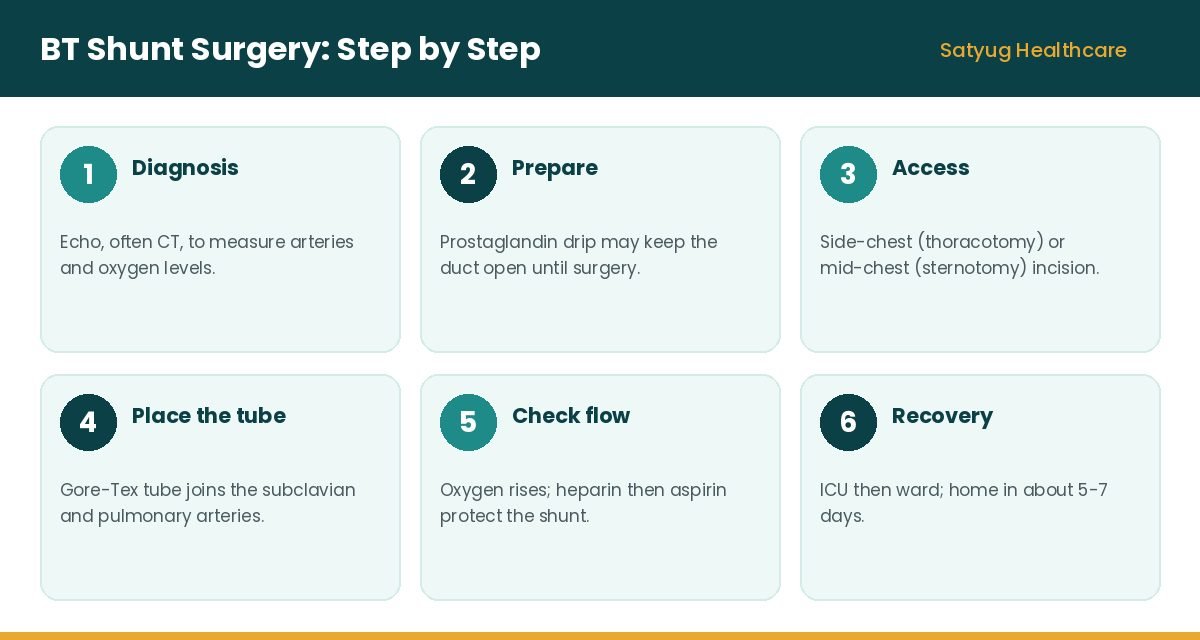
🏥 The Procedure — Step by Step
⚖️ Shunt Types & Prices
| Option | How it is done | Hospital stay | Price in India (USD) |
|---|---|---|---|
| Modified BT shunt (economy) | Subclavian/innominate to pulmonary artery tube | 5–6 days | 6,000 (BLK-Max quote) |
| Modified BT shunt (twin sharing) | Same | 5–6 days / 4 days + 3 ICU | 6,600 (BLK-Max); 6,500 (Artemis) |
| Modified BT shunt (single room) | Same | 5–6 days | 7,300 (BLK-Max quote) |
| Central shunt | Aorta to pulmonary artery tube | About 5–7 days | Quoted case by case |
| Ductal stenting (catheter alternative) | Stent keeps the ductus open | 3–5 days | Quoted case by case |
📅 Your Plan in India
| Day | What happens |
|---|---|
| Day 1 | Arrival in India ✈️ (with medical escort if advised), transfer to hospital |
| Days 1–2 | Paediatric cardiology review, echo, CT, blood tests |
| Day 2–3 | BT shunt surgery ❤️ |
| Days 3–6 | ICU: ventilator weaning, drain removal, aspirin started |
| Days 6–9 | Ward care, feeding and echo check of the shunt |
| Weeks 2–4 | Outpatient review and plan for the next operation; fitness to fly ✈️ |
🌱 Recovery and Care at Home
🏆 Results & Outlook
| Outcome | Result |
|---|---|
| Survival to discharge after neonatal BT shunt (US STS database, 1,273 babies) | About 93% (discharge mortality 7.2%) |
| Long-term | Depends on the heart defect and on the next stage of surgery |
🩹 Risks & Possible Complications
- •Shunt narrowing or clotting – the main early risk; may need urgent catheter or surgical treatment
- •Too much lung blood flow (over-circulation) causing breathlessness or low blood pressure – managed with medicines or shunt adjustment
- •Chylothorax (lymph fluid around the lung) – occasional
- •Nerve injury (phrenic or recurrent laryngeal) – uncommon
- •Bleeding or infection – uncommon
- •Distortion of the pulmonary artery at the shunt site – occasional, repaired at the next operation
💰 Cost of BT Shunt Surgery in India
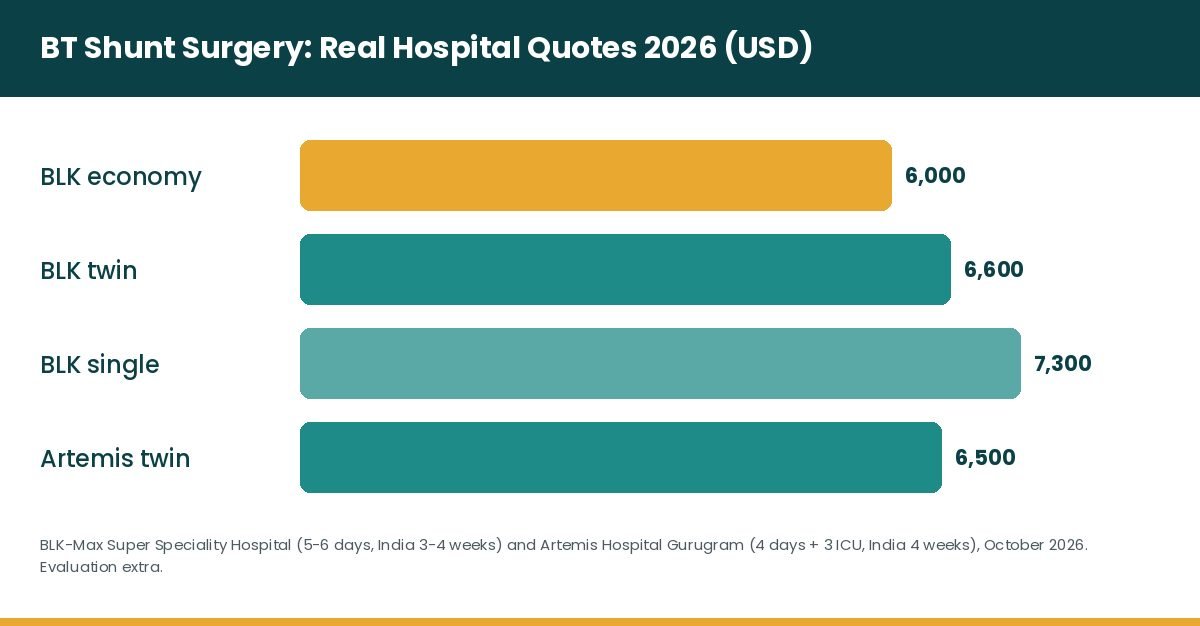
BT shunt surgery at leading Delhi NCR hospitals costs about USD 6,000–7,300, depending on the room category, plus about USD 500–800 for evaluation. The cost depends on the baby’s condition, ICU days, whether the heart-lung machine is needed, and the length of stay.
Real hospital estimates shared with Satyug (October 2026)
| Hospital | Room | Cost (USD) | Hospital stay | Evaluation | Stay in India |
|---|---|---|---|---|---|
| BLK-Max Super Speciality Hospital, New Delhi | Economy | 6,000 | 5–6 days | 600–800 (OPD) | 3–4 weeks |
| BLK-Max Super Speciality Hospital, New Delhi | Twin sharing | 6,600 | 5–6 days | ||
| BLK-Max Super Speciality Hospital, New Delhi | Single room | 7,300 | 5–6 days | ||
| Artemis Hospital, Gurugram | Twin sharing | 6,500 | 4 days + 3 days ICU | 500–800 (OPD) | 4 weeks |
📋 What the Package Includes
- ✔Paediatric cardiac surgeon and cardiologist consultations during the package
- ✔Surgery, paediatric anaesthesia and shunt graft
- ✔ICU and ward stay for the package days
- ✔Routine medicines, consumables and blood tests during the stay
- ✔Echocardiogram before discharge
- ✔One parent/attendant stay in the room (as per hospital policy)
- ✔Satyug coordinator, interpreter and airport pick-up
- ✖Evaluation before admission (USD 500–800)
- ✖CT angiography or catheterisation if not quoted
- ✖Extra ICU days, ECMO or re-intervention
- ✖Blood products beyond the package
- ✖The next-stage operation (full repair, Glenn)
- ✖Hotel, flights, visa fees and meals for the family
✈️ Your Medical Travel Process with Satyug Healthcare

| Step | Details |
|---|---|
| 1. Send reports | The baby’s echo report (and video if possible), oxygen saturation, weight, CT scan if done, and hospital discharge summaries. |
| 2. Free opinion & quotes | Within 48-72 hours you receive opinions and cost estimates from 3-5 leading hospitals to compare. |
| 3. Choose hospital & doctor | We help you compare surgeons, success data, room options and total cost – with no hidden charges. |
| 4. Medical visa | The hospital issues a Visa Invitation Letter (VIL) and we help with the e-Medical visa for the patient and up to 2 attendants. |
| 5. Travel & arrival | Free airport pick-up, help with a local SIM card and currency, and a hotel or guest house close to the hospital. |
| 6. Treatment | A coordinator and interpreter stay with you for admission, tests, surgery and ward stay, and help with bills and insurance papers. |
| 7. Recovery & follow-up | FRRO registration if needed, fitness-to-fly certificate, discharge summary, and teleconsultation follow-up with your surgeon after you return home. |
🎒 Travel Checklist
- 📌Valid passport (6+ months) for the patient and attendants, plus 10 passport-size photos each
- 📌e-Medical visa / medical visa and the hospital’s Visa Invitation Letter (VIL)
- 📌Echo and CT reports and CDs, birth certificate and passports for baby and parents, vaccination record, discharge summaries, and a fitness-to-fly letter from the treating paediatrician
- 📌Yellow fever vaccination certificate (mandatory for travellers from African countries)
- 📌Polio vaccination certificate where applicable
- 📌Cash above USD 5,000 (or equivalent) must be declared to Indian Customs on arrival; carry an international debit/credit card
- 📌FRRO registration within 14 days if your visa or stay requires it (Satyug helps with this)
- 📌Comfortable clothes, phone charger, adapter, and a list of emergency contacts
⭐ Why Choose Satyug Healthcare?
❓ Frequently Asked Questions
➤ How much does BT shunt surgery cost in India?
➤ Is a BT shunt a cure?
➤ How long will my baby be in hospital?
➤ How long do we need to stay in India?
➤ Is the heart-lung machine used?
➤ What oxygen level should my baby have after the shunt?
➤ Why is aspirin needed?
➤ What happens next?
➤ What are the main risks?
➤ Is there an alternative to surgery?
➤ What should I do if my baby has diarrhoea or fever?
➤ Can one parent stay with the baby?
➤ When can we fly home?
➤ Do you provide an interpreter?
Medical disclaimer: This page is for general information and does not replace a consultation with a qualified paediatric cardiologist or cardiac surgeon. Treatment plans and prices are confirmed only after examination and tests. Sources: StatPearls (NCBI Bookshelf): Blalock-Taussig Shunt; Petrucci O et al., Risk factors for mortality and morbidity after the neonatal Blalock-Taussig shunt procedure, Ann Thorac Surg 2011;92:642-651; Children’s Hospital of Philadelphia and Great Ormond Street Hospital patient information on BT shunts; hospital estimates shared with Satyug Healthcare by BLK-Max Super Speciality Hospital and Artemis Hospital Gurugram (Oct 2026). Image credits: BT shunt and central shunt illustrations: BruceBlaus, Wikimedia Commons, CC BY-SA 4.0 (https://commons.wikimedia.org/wiki/File:Blalock_Taussig_Shunt_-_Subclavian_to_Pulmonary.png, https://commons.wikimedia.org/wiki/File:Blalock_Taussig_Shunt_-_Aortic_to_Pulmonary.png). Infographics and banner: Satyug Healthcare.
✍️ Written & reviewed by Vikram Kashyap, Medical Consultant, Satyug Healthcare · Last updated: October 2026
Frequently Asked Questions
About USD 6,000-7,300 at leading Delhi NCR hospitals (BLK-Max and Artemis quotes, Oct 2026), plus USD 500-800 for evaluation.
Blalock-Taussig (BT) shunt surgery in India from USD 6,000 (BLK-Max and Artemis 2026 quotes), 5-6 days in hospital, senior paediatric heart surgeons.




TOP HOSPITALS
Special High-quality Hospitals


HAPPY PATIENTS
What Our Patients Are Saying

























Our Gallery



Get a Free Quote
Tell us what you need and share your medical reports. Our medical team prepares your treatment plan and cost estimate.
- Free medical opinion on your reports
- Your quote within 24–48 hours
- Help with visa invitation letter, travel and airport pickup
- Coordinators available on WhatsApp
Prefer to talk? Call +91-8860606766 or WhatsApp us.
Thank you! Your request is received.
Reference . Our medical team will send your free quote within 24–48 hours by e-mail or WhatsApp.
Chat on WhatsApp now