
Nasopharyngeal Angiofibroma Surgery Package
Assistance
Consultation
Services
Opinion
Care Coordination
What will your treatment cost?

See the cost breakdown by option, hospital and city →
| Surgery Name | Cost | Room | Hospitalization |
|---|---|---|---|
| Nasopharyngeal Angiofibroma Surgery Package | $2746 | Single | Patient - 3 days stay in a single room. |
✓ Inclusion
- ✔Consultation with a senior ENT / skull base surgeon
- ✔Diagnostic nasal endoscopy
- ✔Routine pre-operative tests: blood tests, blood grouping, ECG and chest X-ray
- ✔Endoscopic endonasal excision of the angiofibroma
- ✔Surgeon, assistant and anaesthesia fees
- ✔Operation theatre, endoscopy equipment and routine consumables
- ✔3 days hospital stay in a single room
- ✔Nursing care, routine medicines and diet in hospital
- ✔Histopathology of the removed tumour
- ✔One post-operative nasal endoscopy and crust cleaning visit
- ✔Free: airport pick-up & drop, visa invitation letter, interpreter & coordinator (Satyug Healthcare)
✗ Exclusion
- ✖CT, MRI and CT/DSA angiography scans
- ✖Pre-operative embolisation and its materials
- ✖Blood and blood products
- ✖Open, combined or skull base surgery for advanced tumours
- ✖ICU stay or extra hospital days
- ✖Navigation system or special haemostatic materials if needed
- ✖Radiotherapy
- ✖Medicines after discharge
- ✖Hotel stay, food, local travel, flights and attendant's expenses
Know More About Procedure & Surgery
Juvenile Nasopharyngeal Angiofibroma Surgery in India
Endoscopic, scarless removal of juvenile nasopharyngeal angiofibroma (JNA) – a bleeding, non-cancerous tumour at the back of the nose in teenage boys – by experienced ENT and skull base surgeons at accredited Indian hospitals, at a fraction of Western costs.
📖 What is Nasopharyngeal Angiofibroma?
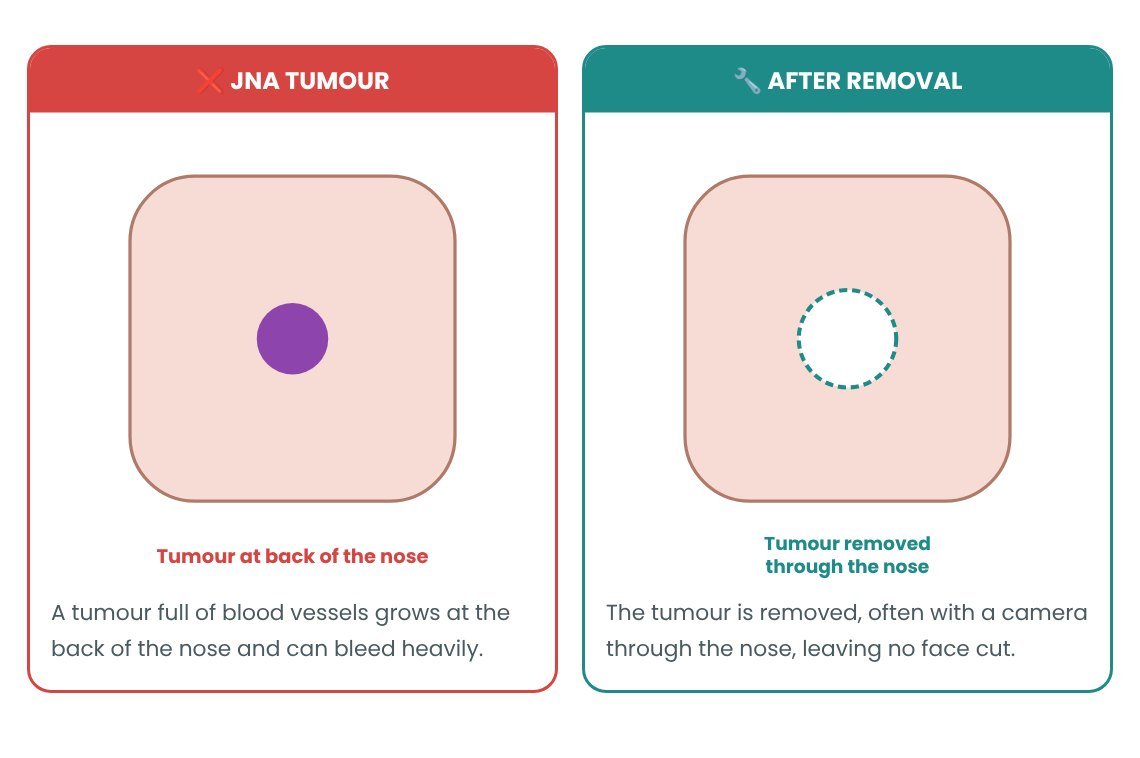
The nasopharynx is the space at the very back of the nose, above the throat. A juvenile nasopharyngeal angiofibroma (JNA) is a rare tumour that grows there. It is benign (not cancer and does not spread to other organs), but it is full of blood vessels, so it bleeds easily and can grow into the sinuses, cheek, eye socket and skull base. It occurs almost only in boys and young men, usually between 10 and 20 years of age, and makes up less than 0.5% of all head and neck tumours.
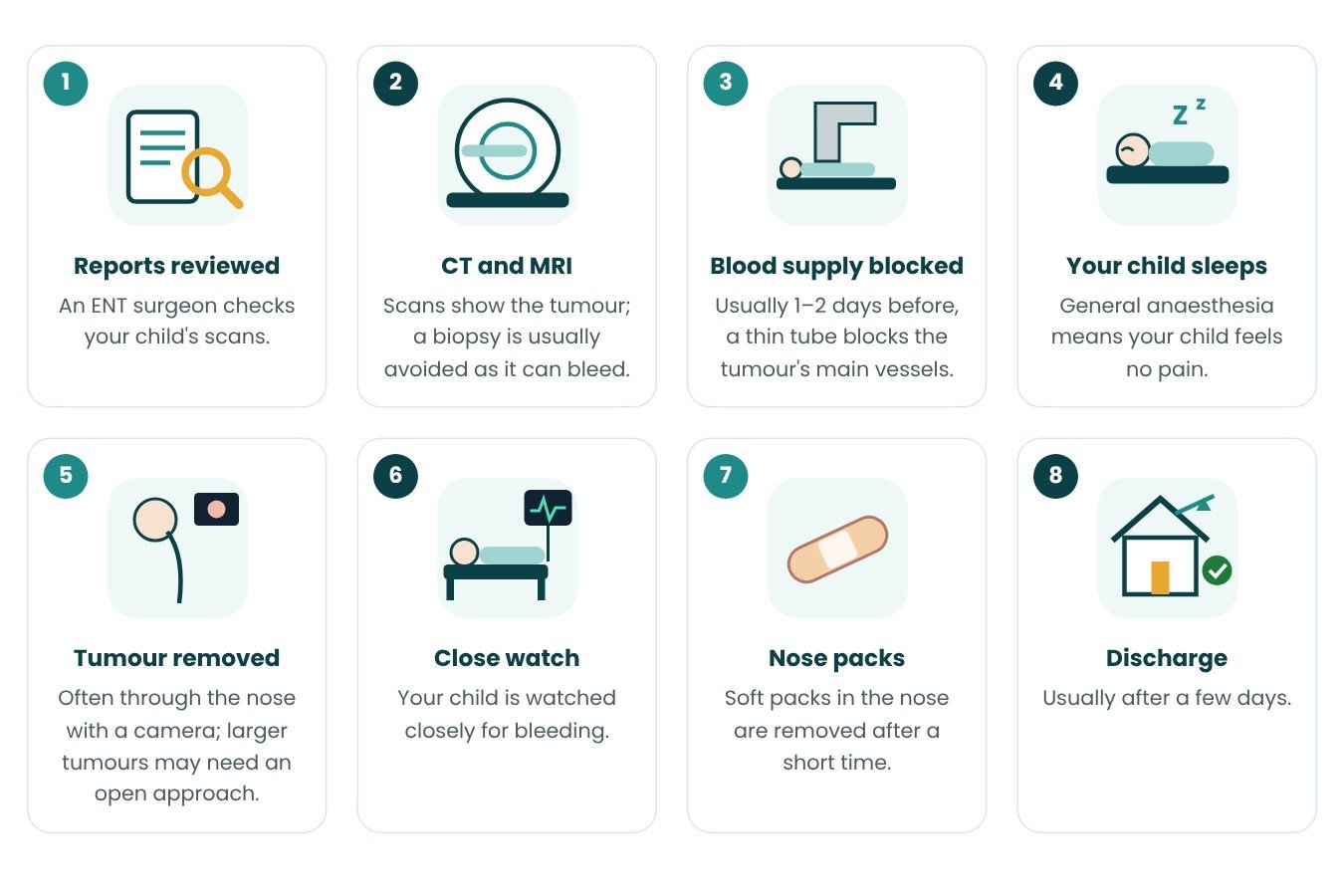
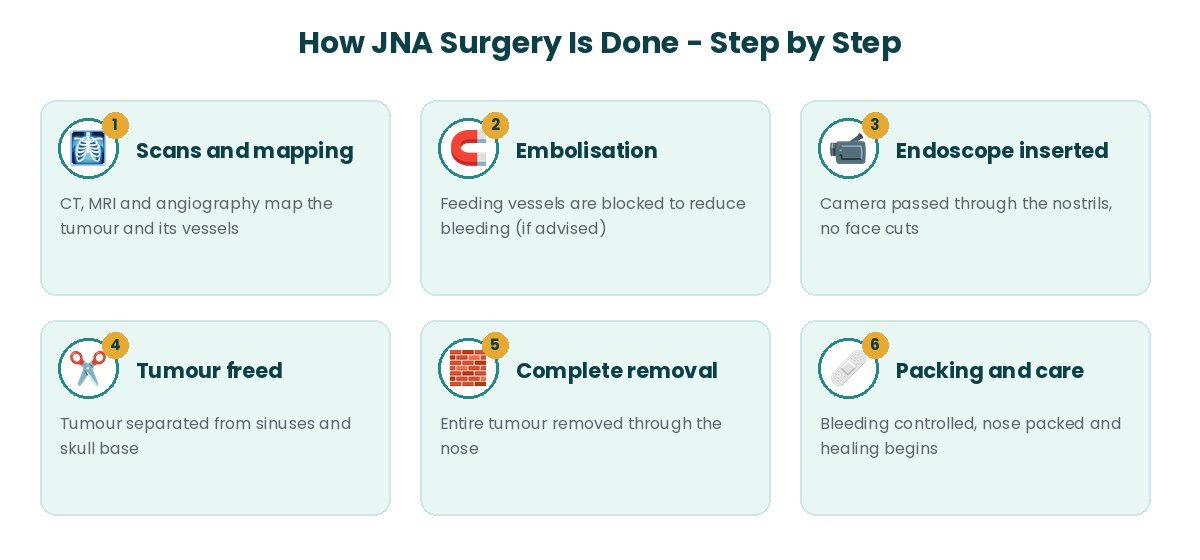
Treatment is surgical removal of the whole tumour. Today most JNAs are removed by endoscopic endonasal surgery – through the nostrils with a thin camera, without cutting the face. Because the tumour is so full of blood, many patients first have pre-operative embolisation, where a radiologist blocks the feeding blood vessels through a thin tube from the groin 24–72 hours before surgery, to reduce bleeding. Very large tumours may need an open or combined approach.
🖼️ Understand It in Pictures
Tumour at the back of the nose and after removal
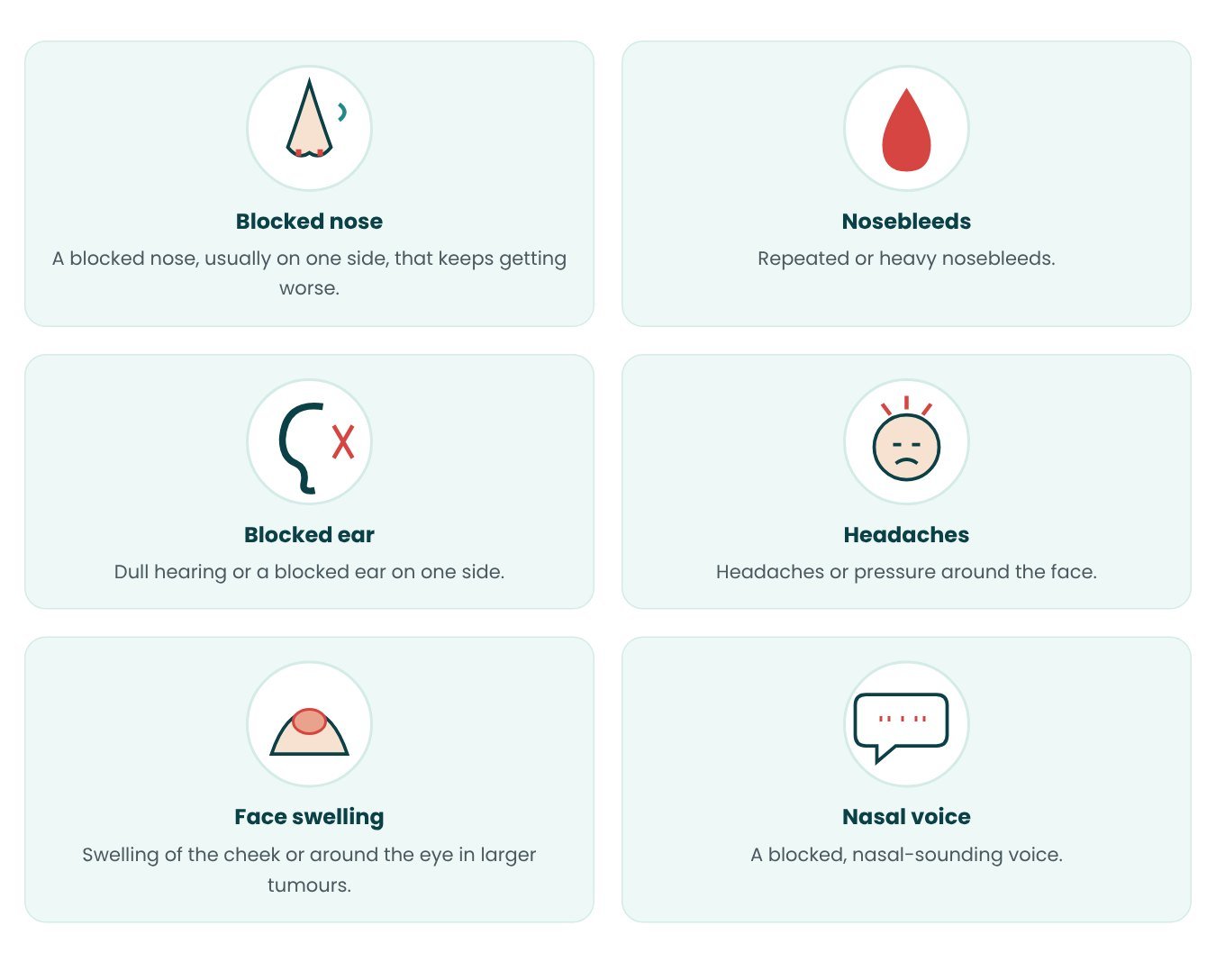
👀 Symptoms in Pictures
🎬 The Treatment Journey in Pictures
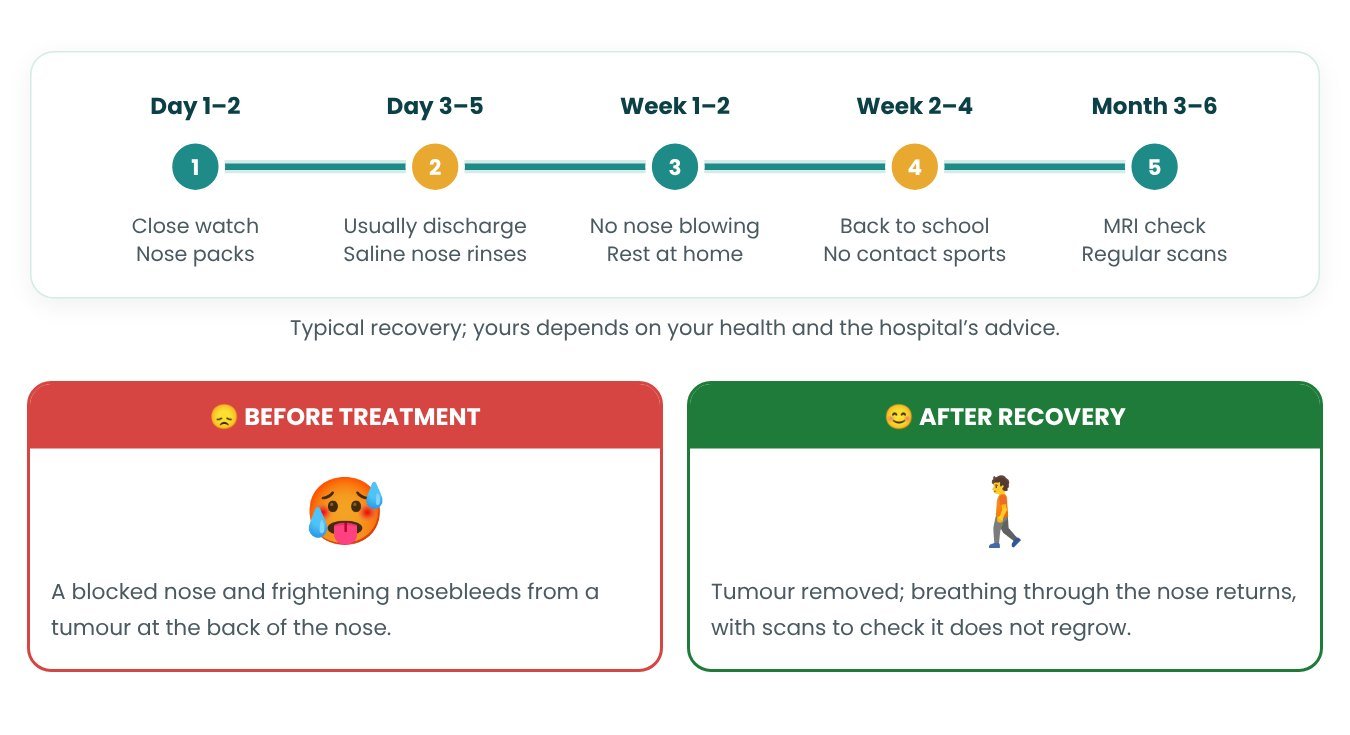
📅 Recovery at a Glance
🩺 Conditions Treated
⚠️ Symptoms of Nasopharyngeal Angiofibroma
- ➤Repeated, heavy nosebleeds
- ➤Blocked nose, usually one side
- ➤Nasal or blocked-sounding voice
- ➤Snoring or mouth breathing
- ➤Ear blockage or hearing loss
- ➤Swelling of the cheek
- ➤Bulging eye or double vision
- ➤Headache or facial pain
🔬 Tests Before Treatment
| Test | Why it is done |
|---|---|
| Nasal endoscopy | A thin camera shows a red, smooth mass at the back of the nose. |
| Contrast CT scan of nose and sinuses | Shows bone erosion and the tumour's spread – used for staging. |
| MRI with contrast | Shows soft-tissue spread to the eye, cheek and skull base. |
| CT or DSA angiography | Maps the blood vessels feeding the tumour; DSA is used for embolisation. |
| Blood tests and blood grouping | Check haemoglobin and clotting; blood is kept ready for surgery. |
| Hearing and eye tests (if needed) | Check ear and vision effects of the tumour. |
🏥 The Procedure — Step by Step
⚖️ Types & Techniques
| Technique | What is done | Best for |
|---|---|---|
| Endoscopic endonasal excision | Tumour removed through the nostrils with a camera | Most early and moderately advanced JNAs |
| Pre-operative embolisation | Feeding arteries blocked through a groin catheter before surgery | Most JNAs, to reduce blood loss |
| Open approaches (midfacial degloving, Weber-Ferguson) | Access through the mouth or a cut beside the nose | Very large tumours not reachable through the nose |
| Combined endoscopic and open / skull base surgery | ENT and neurosurgery teams work together | Tumours reaching inside the skull |
| Radiotherapy | Focused radiation to stop tumour growth | Unresectable or residual tumour near vital structures |
📅 Your Day-by-Day Plan in India
| Day | What happens |
|---|---|
| Day 1 | Arrival in India ✈️, airport pick-up and hotel check-in |
| Day 2 | ENT consultation, nasal endoscopy and review of CT and MRI |
| Day 3 | Angiography and embolisation if advised; admission |
| Day 4 | Endoscopic tumour removal surgery 🏥 |
| Day 5–6 | Hospital stay (3 days): monitoring, nasal pack removal, discharge |
| Day 7–10 | Hotel rest; nasal saline washes; crust cleaning visit |
| Day 11–12 | Endoscopic check and histopathology report review |
| Day 12–14 | Fit-to-fly review and fly home ✈️ |
🌱 Recovery After Treatment
🏆 Success Rate
| Outcome | Result |
|---|---|
| Complete removal, early-stage tumours | About 90–95% |
| Recurrence after endoscopic surgery | About 10% (5–25%, higher in advanced stages) |
| Blood loss reduction with embolisation | Often about 50% less |
| Return to school or work | About 2–3 weeks |
Results are best for smaller tumours and when the whole tumour, including the part in the sphenoid bone base, is removed. Advanced tumours touching the skull base have a higher chance of leftover or regrowth, so regular MRI follow-up is important.
🩹 Risks & Possible Complications
JNA surgery is delicate because the tumour bleeds heavily; an experienced team and embolisation keep risks low.
- •Bleeding during surgery, sometimes needing blood transfusion – common in large tumours
- •Leftover or recurring tumour – about 10%, usually within 1–2 years
- •Nasal crusting, dryness or adhesions – common, settles over weeks
- •Nosebleed after discharge – uncommon
- •Numbness of the cheek or upper teeth – usually temporary
- •Rare embolisation problems (stroke, vision problems) – under 1%
- •Rare eye or skull base injury, or spinal fluid leak in advanced cases
💰 Cost of JNA Surgery in India
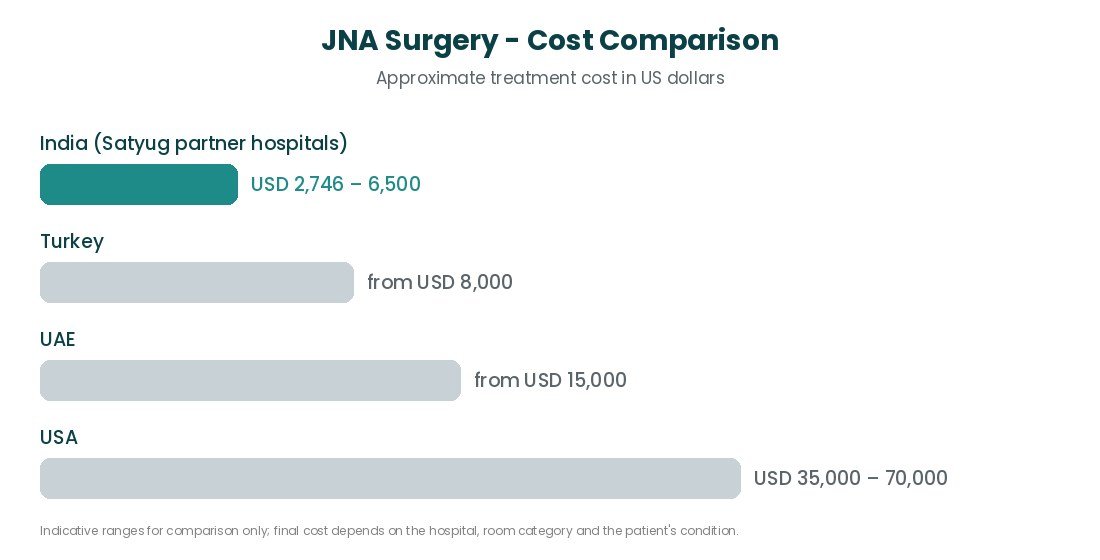
The cost of nasopharyngeal angiofibroma surgery in India starts from about USD 2,746. This covers endoscopic removal of the tumour, surgeon and anaesthesia fees, a 3-day stay in a single room, routine medicines and the biopsy report. Embolisation, blood transfusion and open or skull base surgery for large tumours cost extra.
| Option / Hospital tier | Approx. cost (USD) | Hospital stay | Notes |
|---|---|---|---|
| Endoscopic JNA excision (this package) | 2,746 | 3 days, single room | Early to moderate stage tumour |
| Pre-operative angiography + embolisation | 1,200 – 2,000 | Adds 1 day | Done 24–72 hours before surgery |
| Endoscopic excision + embolisation, advanced tumour | 4,500 – 6,500 | 4–6 days | Sinus and cheek extension |
| Combined open / skull base surgery | 6,000 – 9,000 | 5–7 days | Tumour reaching the skull base |
📋 What the Package Includes
- ✔Endoscopic tumour removal
- ✔Surgeon and anaesthesia fees
- ✔3-day stay in a single room
- ✔Operation theatre and consumables
- ✔Routine medicines and nursing care
- ✔Histopathology report
- ✔Nasal endoscopy follow-up visit
- ✔Free airport pick-up, visa letter and interpreter
- ✖Angiography and embolisation
- ✖Blood transfusion
- ✖CT, MRI or angiography scans
- ✖Open or skull base surgery
- ✖Extra hospital or ICU days
- ✖Medicines after discharge
- ✖Hotel, flights and food
- ✖Attendant's stay and meals
✈️ Your Medical Travel Process with Satyug Healthcare

| Step | Details |
|---|---|
| 1. Send reports | Contrast CT of the nose and sinuses and MRI with contrast (images on CD or link), any nasal endoscopy video or report, haemoglobin level, details of nosebleeds and blood transfusions, the patient's age, and reports of any previous surgery or embolisation. |
| 2. Free opinion & quotes | Within 48-72 hours you receive opinions and cost estimates from 3-5 leading hospitals to compare. |
| 3. Choose hospital & doctor | We help you compare doctors, success rates, room options and total budget. |
| 4. Medical visa | The hospital issues a Visa Invitation Letter (VIL) to the Indian Embassy. The patient and up to 2 attendants apply for an e-Medical / Medical Attendant visa. |
| 5. Travel planning | Flight guidance, wheelchair assistance, airport pick-up, hotel or guest house near the hospital. |
| 6. Treatment in India | Your coordinator and interpreter stay with you for admission, treatment, discharge and billing. |
| 7. Return & follow-up | Fit-to-fly letter, medicines, and online follow-up with your doctor after you return home. |
🎒 Travel Checklist
- 📌Valid passport (6+ months) for the patient and attendants, plus 10 passport-size photos each
- 📌Medical visa / e-visa and the hospital’s Visa Invitation Letter
- 📌All CT, MRI and angiography scans on CD / link, endoscopy reports, blood tests and prescriptions
- 📌Yellow fever vaccination certificate (mandatory for travellers from African countries)
- 📌Polio vaccination certificate where applicable
- 📌Declare cash above USD 5,000 at the airport; hospitals accept wire transfer and cards
- 📌Foreigners staying longer than permitted must register with the FRRO — our team assists
⭐ Why Choose Satyug Healthcare?
❓ Frequently Asked Questions
➤ How much does JNA surgery cost in India?
➤ Is nasopharyngeal angiofibroma cancer?
➤ Who gets JNA?
➤ Will there be a scar on the face?
➤ What is embolisation and is it needed?
➤ How long will we stay in hospital and in India?
➤ Is the surgery painful?
➤ Can the tumour come back?
➤ When can my son go back to school?
➤ Will he need radiotherapy?
➤ Can a biopsy be done first?
➤ How many attendants can come with the patient?
➤ What follow-up is needed at home?
➤ Will we get an interpreter?
Medical disclaimer: This page is for general information and does not replace a consultation with a qualified specialist. Treatment plans and costs are confirmed only after the patient is examined. Sources: NCBI StatPearls: Juvenile Nasopharyngeal Angiofibroma; Cleveland Clinic: Juvenile Nasopharyngeal Angiofibroma; Johns Hopkins Medicine: Juvenile Nasopharyngeal Angiofibroma; American Academy of Otolaryngology–Head and Neck Surgery patient information; Boghani Z et al., Laryngoscope 2013 (systematic review of endoscopic vs open JNA surgery); Radkowski staging system. Infographics: Satyug Healthcare.
Frequently Asked Questions
Most nasopharyngeal angiofibromas are removed by endoscopic endonasal surgery: through the nostrils with a thin camera, without cutting the face. Because the tumour is full of blood vessels, its feeding vessels are often blocked first (pre-operative embolisation) 24–72 hours before surgery to reduce bleeding. Very large tumours may need an open or combined approach.
Nasopharyngeal angiofibroma (JNA) surgery in India from USD 2,746. Scarless endoscopic removal by expert ENT surgeons, free opinion, visa & interpreter help.



TOP HOSPITALS
Special High-quality Hospitals


HAPPY PATIENTS
What Our Patients Are Saying





















Our Gallery



Get a Free Quote
Tell us what you need and share your medical reports. Our medical team prepares your treatment plan and cost estimate.
- Free medical opinion on your reports
- Your quote within 24–48 hours
- Help with visa invitation letter, travel and airport pickup
- Coordinators available on WhatsApp
Prefer to talk? Call +91-8860606766 or WhatsApp us.
Thank you! Your request is received.
Reference . Our medical team will send your free quote within 24–48 hours by e-mail or WhatsApp.
Chat on WhatsApp now