Tonsillectomy or Tonsillitis cost in India
Assistance
Consultation
Services
Opinion
Care Coordination
What will your treatment cost?

| Surgery Name | Cost | Room | Hospitalization |
|---|---|---|---|
| Tonsillectomy or Tonsillitis cost in India | $1340 | Single | Patient - 1 days stay in a single room. |
✓ Inclusion
- Room Rent,
- Cost of Surgery,
- Consultation by Primary Team in Package days,
- Basic Investigations.
- Routine Pharmacy and Consumables,
- Patient Food.
- Surgeon’s Fees.
- Anesthetist Fee.
- Operation Theatre Charges.
- Pharmacy Services Charges including Drugs &Medical Consumables
✗ Exclusion
1.Overstay more than package days,
2. Any other Specialty Consultations,
3. Special Equipment,
4. Additional Procedure/Surgery.
5. Blood Components.
Know More About Procedure & Surgery
🇮🇳 Medical Package — India
Tonsillectomy or Tonsillitis cost in India
World-class treatment • NABH & JCI Accredited Hospitals • Save up to 80% vs USA/UK
What is Tonsillectomy?
A tonsillectomy is a surgical procedure to remove the tonsils. Tonsils are two small glands located in the back of your throat. Tonsils house white blood cells to help you fight infection, but sometimes the tonsils themselves become infected. Tonsillitis is an infection of the tonsils that can make your tonsils swell and give you a sore throat. Frequent episodes of tonsillitis might be a reason you need to have a tonsillectomy. Other symptoms of tonsillitis include fever, trouble swallowing, and swollen glands around your neck. A tonsillectomy can also be a treatment for breathing problems, like heavy snoring and sleep apnea.
What is tonsillitis?
Tonsils are the two lymph nodes located on each side of the back of your throat. They function as a defense mechanism and help prevent your body from getting an infection. When tonsils become infected, the condition is called tonsillitis.
Acute tonsillitis
Tonsillitis is incredibly common in children. In fact, almost every child will probably get tonsillitis at least once. If symptoms last around 10 days or less, it’s considered acute tonsillitis. If symptoms last longer, or if tonsillitis comes back multiple times during the year, it may be chronic or recurrent tonsillitis. Acute tonsillitis will likely improve with home treatments, but in some cases may require other treatments, like antibiotics.
Chronic tonsillitis
Chronic tonsillitis symptoms continue longer than acute. You may experience long-lasting:
- ✓sore throat
- ✓bad breath (halitosis)
- ✓tender lymph nodes in the neck
Chronic tonsillitis may also cause tonsil stones, where materials like dead cells, saliva, and food build up in the crevices of your tonsils. Eventually, the debris can harden into small stones. These may come loose on their own, or they may need to be removed by a doctor. Your doctor may recommend a tonsillectomy to surgically remove your tonsils if you have chronic tonsillitis.
Recurrent tonsillitis
As with chronic tonsillitis, a standard treatment for recurrent tonsillitis is a tonsillectomy. Recurrent tonsillitis is often defined as:
- ✓a sore throat or tonsillitis at least 5 to 7 times in 1 year
- ✓occurrences at least 5 times in each of the previous 2 years
- ✓occurrences a least 3 times in each of the previous 3 years
Chronic and recurrent tonsillitis may be caused by biofilms in the folds of the tonsils. Biofilms are communities of microorganisms with increased antibiotic resistance that can cause repeated infections. Genetics may also be a reason for recurrent tonsillitis.
Tonsillectomy can also treat other medical problems, including:
- ✓breathing problems related to swollen tonsils
- ✓frequent and loud snoring
- ✓periods in which you stop breathing during sleep, or sleep apnea
- ✓bleeding of the tonsils
- ✓cancer of the tonsils
Risks
Tonsillectomy, like other surgeries, has certain risks:
- ✓Reactions to anesthetics. Medication to make you sleep during surgery often causes minor, short-term problems, such as headache, nausea, vomiting or muscle soreness. Serious, long-term problems are rare, though general anesthesia is not without the risk of death.
- ✓Swelling. Swelling of the tongue and soft roof of the mouth (soft palate) can cause breathing problems, particularly during the first few hours after the procedure.
- ✓Bleeding during surgery. In rare cases, severe bleeding occurs during surgery and requires additional treatment and a longer hospital stay.
- ✓Bleeding during healing. Bleeding can occur during the healing process, particularly if the scab from the wound is dislodged too soon.
- ✓Infection. Rarely, surgery can lead to an infection that requires further treatment.
Preparation
You may need to stop taking anti-inflammatory medicines two weeks before your surgery. This type of medication includes aspirin, ibuprofen, and naproxen. Drugs of this kind can increase your risk of bleeding during and after your surgery. You should let your doctor know about any medications, herbs, or vitamins you’re taking.
You’ll also need to fast after midnight before your tonsillectomy. An empty stomach reduces the risk of feeling nauseous from the anesthetic. Be sure to plan for your at-home recovery. Someone will need to drive you home and help you for the first couple of days following your tonsillectomy. Most people stay home from work or school for about a week following surgery.
Procedure
There are several different ways to remove tonsils. One common method is called “cold knife (steel) dissection.” In this case, your surgeon removes your tonsils with a scalpel. Another common method for tonsillectomy involves burning away the tissues through a process called cauterization. Ultrasonic vibration (using sound waves) is also used in some tonsillectomy procedures. Tonsillectomies usually take about a half hour.
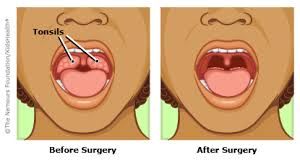
No matter what surgical method your doctor chooses, you’ll be asleep with a general anesthetic. You won’t be aware of the surgery or feel any pain. When you wake up after the tonsillectomy, you’ll be in a recovery room. Medical staff will monitor your blood pressure and heart rate as you wake up. Most people can go home the same day after a successful tonsillectomy.
After the procedure
Common issues after a tonsillectomy include the following:
- ✓Moderate to severe pain in the throat for one to two weeks
- ✓Pain in the ears, neck or jaw
- ✓Nausea and vomiting for a few days
- ✓Mild fever for several days
- ✓Bad breath for up to two weeks
- ✓Swelling of the tongue or throat
- ✓Feeling of something stuck in the throat
- ✓Anxiety or sleep disturbances in children
Steps to manage pain and promote a good recovery include the following:
- ✓Medications. Take pain medications as directed by your surgeon or the hospital staff.
- ✓Fluids. It's important to get plenty of fluids after surgery to avoid dehydration. Water and ice pops are good choices.
- ✓Food. Bland foods that are easy to swallow, such as applesauce or broth, are the best choices immediately after surgery. Foods such as ice cream and pudding can be added to the diet if they're tolerated. Foods that are easy to chew and swallow should be added to the diet as soon as possible. Avoid acidic, spicy, hard or crunchy foods that may cause pain or bleeding.
- ✓Rest. Bed rest is important for several days after surgery and strenuous activities such as running and bike riding — should be avoided for two weeks after surgery. You or your child should be able to return to work or school after resuming a normal diet, sleeping normally through the night and not needing pain medication.
Free Medical Opinion
Expert review in 48 hours
Best Surgeon
Top specialists in India
Hospital Booking
NABH / JCI accredited
Visa Assistance
Invitation letter provided
Airport Transfer
Safe pickup & drop
Tele-Consultation
Video consult before travel
Hotel Booking
Near hospital, affordable
Multilingual Support
Arabic, French, English
📞 Get Started Today — It Is Free
Ready to Plan Your Treatment in India?
Send your medical reports and get a free expert opinion within 48 hours. Our coordinators speak Arabic, French and English.
Frequently Asked Questions
Tonsillectomy is a surgery that causes a mild or moderate pain in most cases, although few patients complain of severe pain. We found that during first day after surgery, 85.5% of the patients had mild or moderate pain, and only 14.5% a severe pain.
Top doctors for Tonsillectomy or Tonsillitis treatment| Cost for Tonsillectomy or Tonsillitis repair|Book online appointment| Best treatment for Tonsillectomy or Tonsillitis in India. Search Results Web results for cost of Tonsillectomy or Tonsillitis treatment|





TOP HOSPITALS
Special High-quality Hospitals


HAPPY PATIENTS
What Our Patients Are Saying






























Our Gallery