Assistance
Consultation
Services
Opinion
Care Coordination
What will your treatment cost?
What illnesses will a UGI Endoscopy show?
Released Date: 2021-08-27

Has your doctor advised an upper GI (UGI) endoscopy because of stomach pain, heartburn or trouble swallowing? Many people feel nervous about this test. This article explains in simple words what a UGI endoscopy is, what it can show and what to expect before and after it.
🖼️ Understand It in Pictures
What the camera can see in the stomach

👀 Symptoms in Pictures

🎬 The Treatment Journey in Pictures
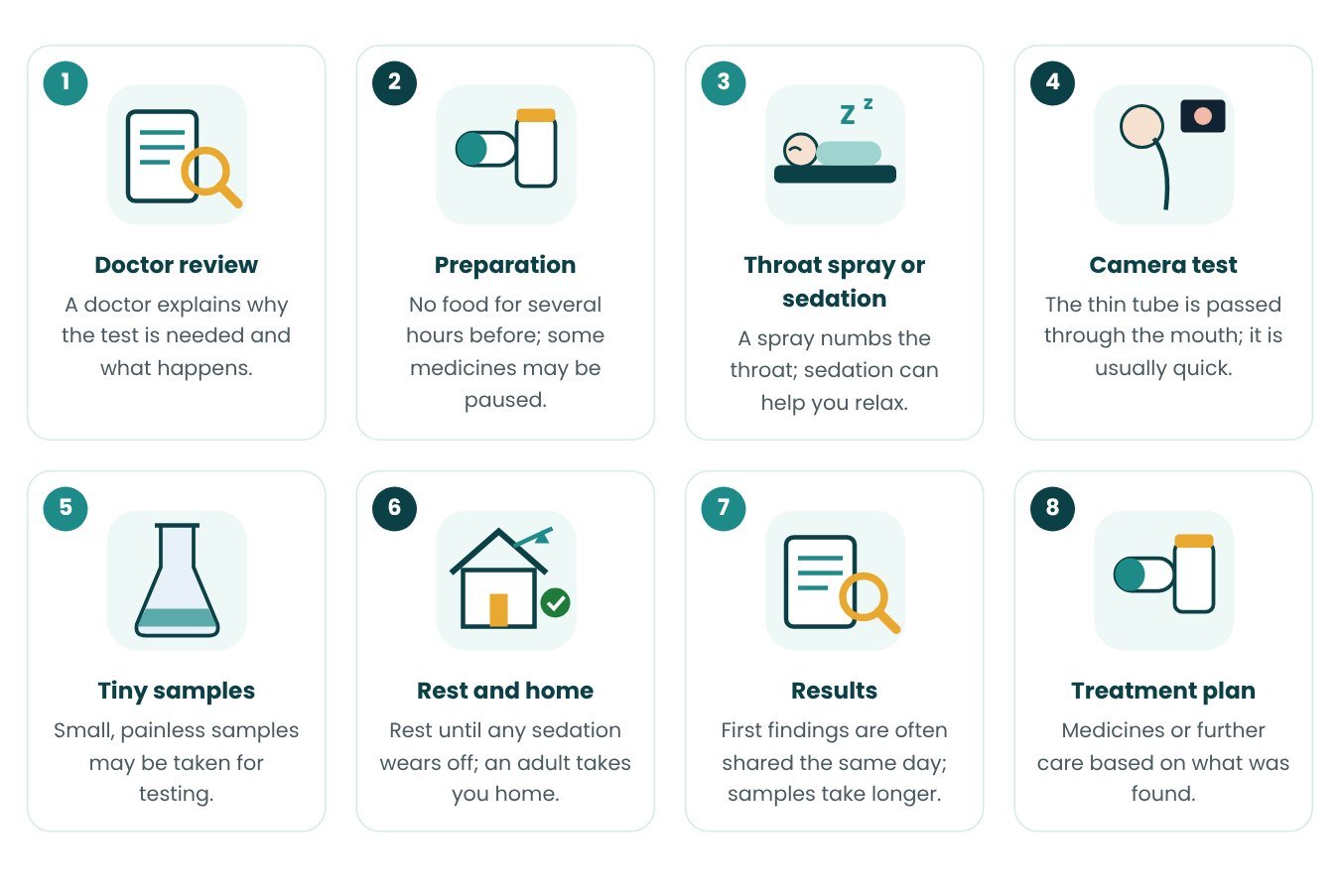
📅 Recovery at a Glance

What is UGI endoscopy?
UGI stands for upper gastrointestinal tract: the food pipe (oesophagus), the stomach and the first part of the small intestine (duodenum). A UGI endoscopy is a test that lets the doctor look inside these organs. It uses a thin, flexible tube called an endoscope, which has a small light and a camera at its end. The tube is passed gently through the mouth into the oesophagus, stomach and duodenum, and the pictures are shown on a monitor. It is often done to find the cause of problems such as continuing weight loss, upper abdominal pain, unexplained vomiting or difficulty in swallowing.
What illnesses can a UGI endoscopy show?
- Ulcers in the stomach or duodenum, and inflammation of the stomach lining (gastritis)
- Acid reflux damage to the food pipe (oesophagitis) and hiatus hernia
- Infection with Helicobacter pylori, using a small tissue sample (biopsy)
- Coeliac disease, using biopsies from the duodenum
- Narrowing of the food pipe, swollen veins (varices) and the source of bleeding
- Cancer of the oesophagus or stomach, or changes that may lead to cancer
How long does a UGI endoscopy take?
The procedure normally takes 15 to 30 minutes. The time can vary depending on what is found and how complex the case is.
How long does it take to recover from a UGI endoscopy?
Recovery is much quicker than after surgery. After the test you will rest in the recovery area for 30 to 40 minutes while the staff check on you.
Can I eat after a UGI endoscopy?
For the next 24 to 48 hours, avoid heavy meals. Eat light, easily digested food such as soups and juices. Once you feel back to normal, you can return to your usual diet.
Will I be asleep during my UGI endoscopy?
A routine UGI endoscopy does not need general anaesthesia. Your throat is usually numbed with a spray, and you may be given a sedative to help you relax. If you have a sedative, someone should take you home.
Can I drink alcohol after a UGI endoscopy?
Do not drink alcohol for 24 hours after the test. After that, follow your doctor’s advice.
Will my throat hurt after a UGI endoscopy?
It is normal to have a sore throat, nausea or a cough after the test. Your doctor will advise you on what to eat. You will usually be back to normal and swallowing as usual within 1 to 2 days.
Why do I have abdominal pain after a UGI endoscopy?
During the test, air is gently passed into the stomach so that the doctor can see clearly. This can cause bloating or mild pain in the abdomen afterwards. The air usually passes out quickly.
Can I return to work after a UGI endoscopy?
If you were given a sedative to make you comfortable and reduce anxiety, its effect can last up to one day, so it is better to take one day off. The effect of the sedative varies from person to person.
Can I talk during and after the procedure?
You cannot talk while the tube is in your food pipe, but you can breathe normally. After the test you can talk, although your throat may feel sore.
What are the side effects of UGI endoscopy?
Side effects may include vomiting, coughing, a sore throat, and pain in the chest or upper abdomen. If these problems last more than 72 hours, or if you have severe pain, fever, black stools or vomit blood, contact your doctor.
If you have any related query, you can send us your report at the email address below, or call or WhatsApp us for a second opinion.
Video/tele consultation is also available.
E-mail address- query@satyughealthcare.com
Phone number- +91-8860606766, +91-9910655125
Related Blogs



HAPPY PATIENTS
What Our Patients Are Saying





























Our Gallery