Liver Cancer TACE Package
Assistance
Consultation
Services
Opinion
Care Coordination
What will your treatment cost?
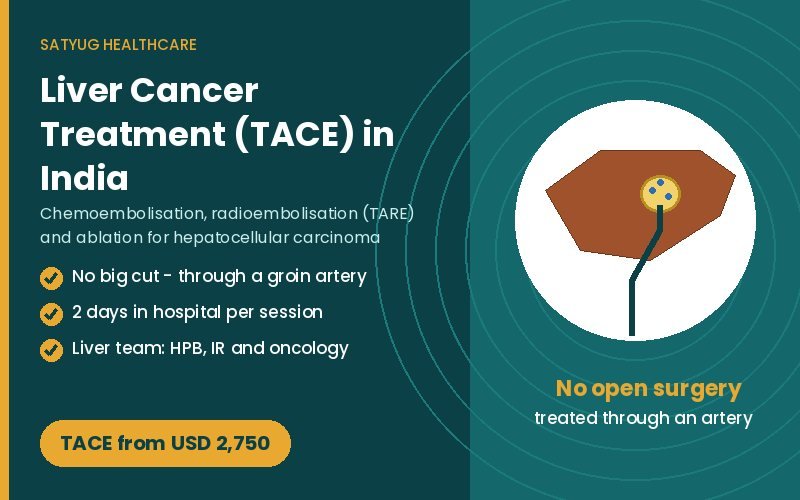
See the cost breakdown by option, hospital and city →
| Surgery Name | Cost | Room | Hospitalization |
|---|---|---|---|
| Liver Cancer TACE Package | 2750 | Economy / Twin Sharing / Single | 2 Days in Room per TACE Session; Total Stay in India 1-2 Weeks |
✓ Inclusion
- ✔TACE procedure (one session) with standard chemotherapy and embolic agent
- ✔Room rent for the package days
- ✔Interventional radiologist, anaesthesia/sedation and cath-lab charges
- ✔Consultation by the primary team during the package days
- ✔Basic investigations during admission
- ✔Satyug coordinator, interpreter and airport pick-up
✗ Exclusion
- ✖Evaluation before admission (USD 1,000–2,000 OPD), including CT/MRI
- ✖Repeat TACE sessions, TARE, ablation or surgery
- ✖Drug-eluting beads or special devices if not included in the quote
- ✖Stay beyond the package days
- ✖Other speciality consultations, blood components, routine pharmacy and consumables
- ✖Hotel, flights, visa fees and meals
Know More About Procedure & Surgery
Liver Cancer Treatment (TACE, TARE & Ablation) in India
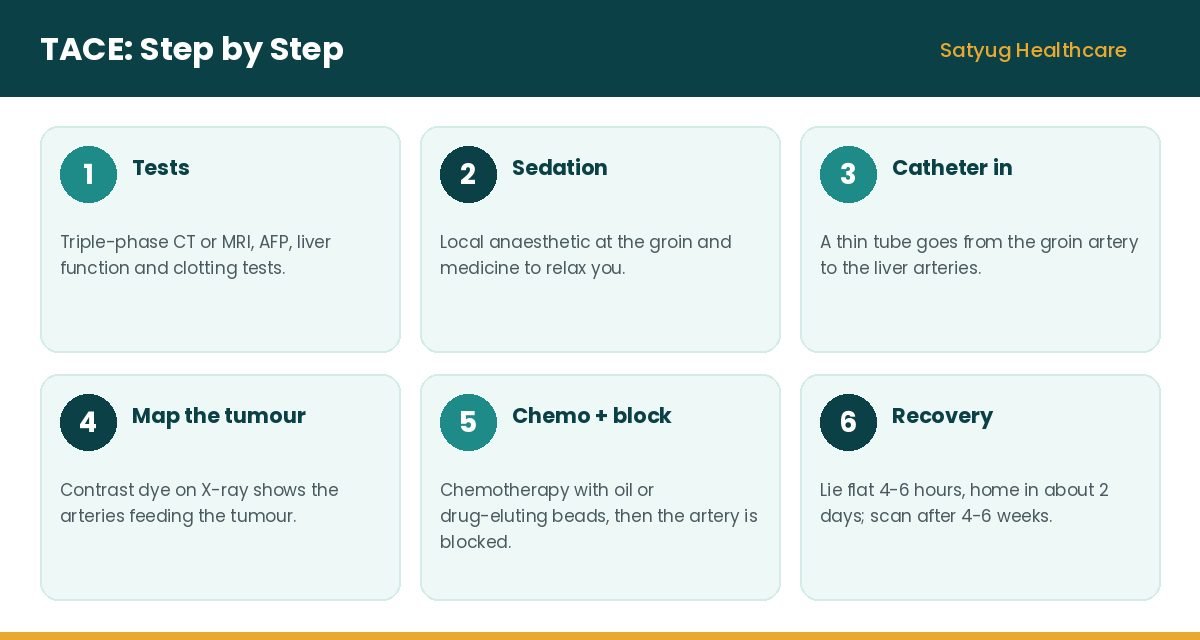
TACE – transarterial chemoembolisation – treats liver cancer from inside the blood vessels. A thin tube passed from the groin delivers chemotherapy straight into the tumour and then blocks its blood supply, with no open surgery. It is the standard treatment for intermediate-stage hepatocellular carcinoma (HCC) and is also used to control cancer while waiting for a liver transplant.
📖 What is Liver Cancer Treatment with TACE?
The most common primary liver cancer is hepatocellular carcinoma (HCC). It usually develops in a liver already damaged by cirrhosis – most often from long-term hepatitis B or C infection, alcohol, or fatty liver disease. Because the liver has a large reserve, HCC often causes no symptoms until it is large, which is why people with cirrhosis or hepatitis B are advised to have an ultrasound every 6 months.
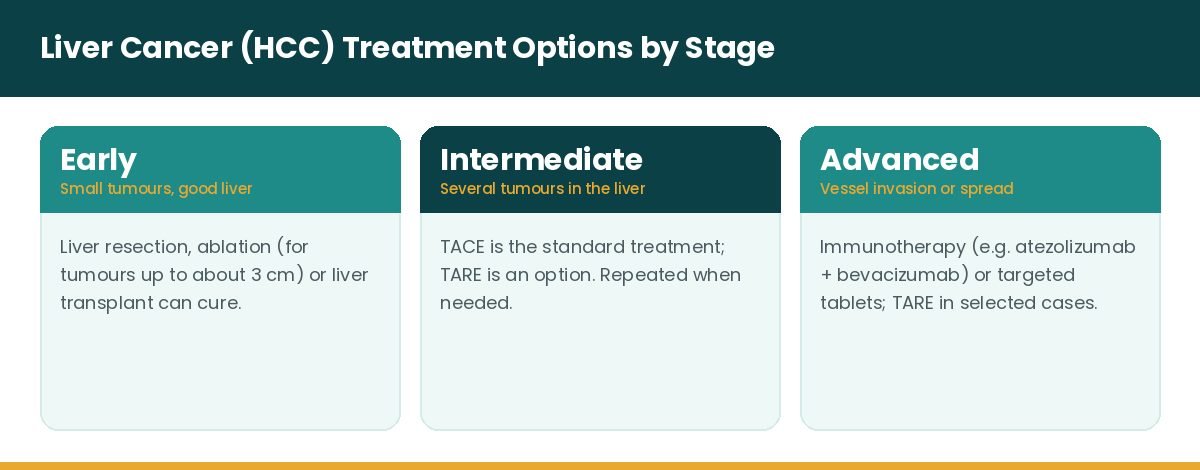
Treatment depends on the size and number of tumours, whether blood vessels are involved, and how well the liver works (Child-Pugh score). Small tumours in a healthy-enough liver can be cured by liver resection, ablation or liver transplant. When there are several tumours or surgery is not possible, TACE is used: liver tumours get most of their blood from the hepatic artery, so blocking that artery after giving chemotherapy starves the tumour while the normal liver survives on its portal vein blood supply. TARE (radioembolisation, Y-90) works the same way but uses tiny radioactive beads.
🖼️ Understand It in Pictures
Stage 1 liver cancer
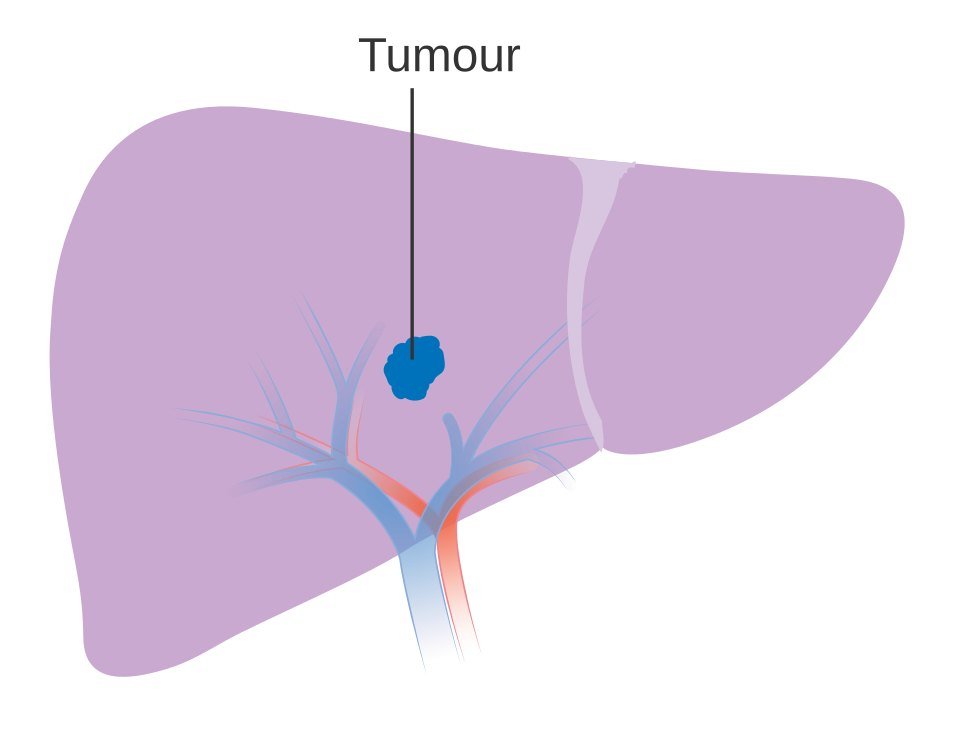
Which treatment for which stage?
🩺 Conditions Treated
⚠️ Symptoms That May Need Evaluation
- ➤Pain or a lump in the upper right side of the tummy
- ➤Unexplained weight loss and loss of appetite
- ➤Feeling full after small meals
- ➤Yellow eyes or skin (jaundice)
- ➤Swelling of the tummy (ascites)
- ➤Worsening of known cirrhosis
- ➤A rising AFP blood test
- ➤A new liver lesion on a surveillance ultrasound
🔬 Tests Before Treatment
| Test | Why it is done |
|---|---|
| Triple-phase contrast CT or MRI of the liver | Typical HCC pattern (arterial enhancement and wash-out) confirms the diagnosis in cirrhosis, often without biopsy. |
| AFP (alpha-fetoprotein) blood test | Tumour marker used for diagnosis and follow-up. |
| Liver function tests, albumin, bilirubin, INR, platelets | Child-Pugh and ALBI scores show if the liver can tolerate treatment. |
| Hepatitis B and C tests (viral load) | Antiviral treatment protects the liver during and after TACE. |
| Kidney function tests | Contrast dye is used during the procedure. |
| CT chest or PET-CT | Checks for spread outside the liver. |
| Upper GI endoscopy (if cirrhosis) | Looks for varices that may bleed. |
🏥 The Procedure — Step by Step
⚖️ Types & Techniques
| Technique | What is done | Best for |
|---|---|---|
| Conventional TACE (cTACE) | Chemotherapy mixed with lipiodol, then embolisation | Intermediate HCC; most widely used |
| DEB-TACE | Drug-eluting beads release chemotherapy slowly | Similar uses; may cause less systemic side effects |
| Bland embolisation (TAE) | Blocking the artery without chemotherapy | Selected patients, bleeding tumours |
| TARE / SIRT (Y-90) | Radioactive microspheres into the tumour artery; needs a planning angiogram first | Large tumours, portal vein branch invasion in selected cases |
| Radiofrequency / microwave ablation | Needle through the skin heats and destroys the tumour | Tumours up to about 3 cm (sometimes up to 5 cm with TACE) |
| Liver resection or transplant (separate packages) | Surgical removal or replacement of the liver | Early HCC; Milan criteria for transplant |
📅 Your Day-by-Day Plan in India
| Day | What happens |
|---|---|
| Day 1 | Arrival in India ✈️, airport pick-up and hotel check-in |
| Days 2–3 | Hepatology / HPB consultation, triple-phase CT or MRI, AFP, liver and kidney tests |
| Day 4 | Liver tumour board decision; admission |
| Day 5 | TACE procedure 🩺 |
| Days 6–7 | Observation for pain and fever; discharge to hotel |
| Days 8–12 | Rest at the hotel, review of blood tests; fit-to-fly check |
| Fly home | With discharge summary and plan; response scan after 4–6 weeks, and a repeat session if needed ✈️ |
🌱 Recovery After Treatment
🏆 Success Rate
| Outcome | Result |
|---|---|
| 1-year survival, chemoembolisation vs conservative treatment (Llovet 2002 RCT) | 82% vs 63% |
| 2-year survival, chemoembolisation vs conservative treatment (same trial) | 63% vs 27% |
| Patients with some post-embolisation syndrome (Leeds NHS leaflet) | About half |
| Typical hospital stay per session | 2–3 days |
🩹 Risks & Possible Complications
- •Post-embolisation syndrome (fever, pain, nausea, tiredness) – common, about half of patients
- •Bruising or bleeding at the groin puncture – common bruise; bleeding usually controlled by pressure
- •Worsening of liver function, especially in advanced cirrhosis – uncommon
- •Liver abscess or bile duct injury – uncommon
- •Gallbladder irritation (chemical cholecystitis) causing pain – rare
- •Chemotherapy side effects such as hair thinning or low blood counts – rare
- •Kidney strain from contrast dye – rare; fluids are given to protect the kidneys
- •Liver failure or serious bleeding – rare
💰 Cost of Liver Cancer Treatment (TACE) in India
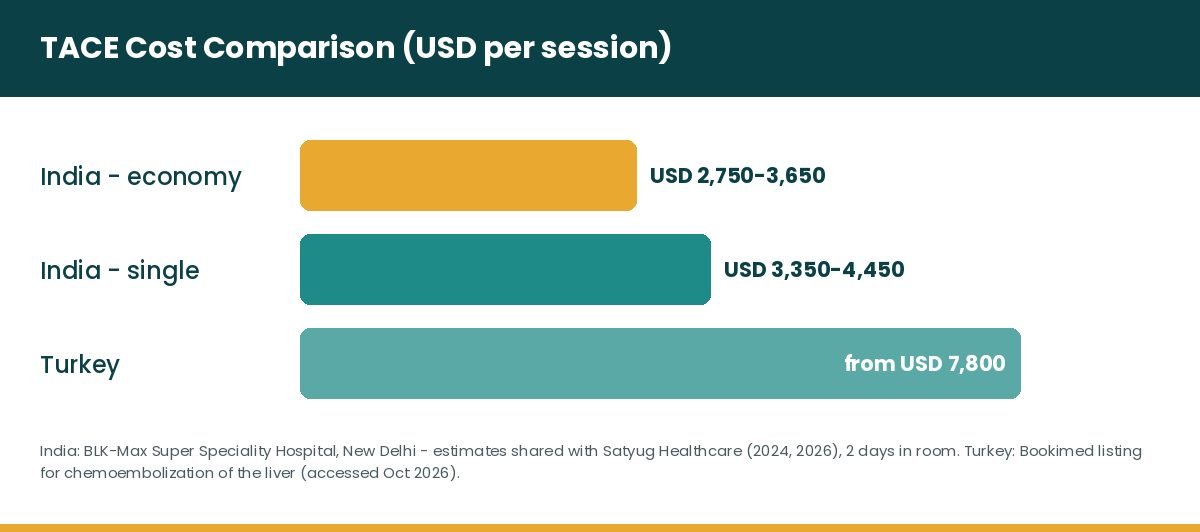
TACE for liver cancer in India starts from about USD 2,750 per session in an economy room. Estimated cost range (USD), final price per hospital quote: TACE USD 2,750–4,450 per session; TARE (Y-90) USD 21,700–26,300, depending on room category, drug-eluting beads and the number of sessions.
| Hospital / Option | Cost (USD) | Room | Hospital stay | Notes |
|---|---|---|---|---|
| BLK-Max Super Speciality Hospital, New Delhi – TACE (Dr. Abhideep Chaudhary, Vice Chairman & HOD, HPB Surgery & Liver Transplantation) | 2,750–3,650 | Economy | 2 days | Hospital estimate shared with Satyug (Jun 2026); evaluation USD 1,000–1,500 |
| Same hospital – TACE | 3,050–4,050 / 3,350–4,450 | Twin / single | 2 days | Hospital estimate (Jun 2026) |
| Same hospital – TARE (Y-90 radioembolisation), including medicine | 21,700 / 23,900 / 26,300 | Economy / twin / single | 2 days | Hospital estimate (Jun 2026) |
| BLK-Max – TACE or TARE (Dr. Ajay Kumar, Chairman, Institute for Digestive & Liver Diseases; Dr. Nitesh Agarwal, Interventional Radiology) | TACE 2,750–3,650; TARE 21,700 | Economy | 2 days | Hospital estimate (Jun 2024); evaluation USD 2,000 OPD |
| BLK-Max – living donor liver transplant (if eligible) | 25,000 | Package | 30 days (recipient + donor) | Hospital estimate (Jun 2026); family donor required |
📋 What the Package Includes
- ✔TACE procedure (one session) with standard chemotherapy and embolic agent
- ✔Room rent for the package days
- ✔Interventional radiologist, anaesthesia/sedation and cath-lab charges
- ✔Consultation by the primary team during the package days
- ✔Basic investigations during admission
- ✔Satyug coordinator, interpreter and airport pick-up
- ✖Evaluation before admission (USD 1,000–2,000 OPD), including CT/MRI
- ✖Repeat TACE sessions, TARE, ablation or surgery
- ✖Drug-eluting beads or special devices if not included in the quote
- ✖Stay beyond the package days
- ✖Other speciality consultations, blood components, routine pharmacy and consumables
- ✖Hotel, flights, visa fees and meals
✈️ Your Medical Travel Process with Satyug Healthcare

| Step | Details |
|---|---|
| 1. Send reports | Your triple-phase CT or MRI of the liver (with CD), AFP, liver function tests, hepatitis B/C reports, endoscopy report if done, and a list of current medicines. |
| 2. Free opinion & quotes | Within 48-72 hours you receive opinions and cost estimates from 3-5 leading hospitals to compare. |
| 3. Choose hospital & doctor | We help you compare surgeons, success data, room options and total cost – with no hidden charges. |
| 4. Medical visa | The hospital issues a Visa Invitation Letter (VIL) and we help with the e-Medical visa for the patient and up to 2 attendants. |
| 5. Travel & arrival | Free airport pick-up, help with a local SIM card and currency, and a hotel or guest house close to the hospital. |
| 6. Treatment | A coordinator and interpreter stay with you for admission, tests, surgery and ward stay, and help with bills and insurance papers. |
| 7. Recovery & follow-up | FRRO registration if needed, fitness-to-fly certificate, discharge summary, and teleconsultation follow-up with your surgeon after you return home. |
What HCC looks like on a CT scan

🎒 Travel Checklist
- 📌Valid passport (6+ months) for the patient and attendants, plus 10 passport-size photos each
- 📌e-Medical visa / medical visa and the hospital’s Visa Invitation Letter (VIL)
- 📌All liver scans on CD, blood test reports (AFP, LFT, INR), hepatitis reports and antiviral medicines, and a letter from your doctor
- 📌Yellow fever vaccination certificate (mandatory for travellers from African countries)
- 📌Polio vaccination certificate where applicable
- 📌Cash above USD 5,000 (or equivalent) must be declared to Indian Customs on arrival; carry an international debit/credit card
- 📌FRRO registration within 14 days if your visa or stay requires it (Satyug helps with this)
- 📌Comfortable clothes, phone charger, adapter, and a list of emergency contacts
⭐ Why Choose Satyug Healthcare?
❓ Frequently Asked Questions
➤ How much does TACE cost in India?
➤ What is the difference between TACE and TARE?
➤ Is TACE painful?
➤ How many TACE sessions will I need?
➤ Can TACE cure liver cancer?
➤ How long must I stay in India?
➤ Who is not suitable for TACE?
➤ Is a liver biopsy needed?
➤ Can I have a liver transplant instead?
➤ What medicines are used for advanced liver cancer?
➤ Do I need to treat my hepatitis B or C?
➤ When can I fly home after TACE?
➤ What follow-up is needed?
➤ Do you provide an interpreter?
Medical disclaimer: This page is for general information and does not replace a consultation with a qualified hepatologist, HPB surgeon or interventional radiologist. Treatment plans and costs are confirmed only after the patient is examined and scans are reviewed. Sources: Llovet JM et al., Arterial embolisation or chemoembolisation versus symptomatic treatment in unresectable HCC, Lancet 2002;359:1734-9; Finn RS et al., IMbrave150, N Engl J Med 2020; Leeds Teaching Hospitals NHS Trust: Liver cancer transarterial chemoembolisation (TACE) patient leaflet (2023); BCLC staging system and EASL clinical practice guidelines on HCC; hospital estimates shared with Satyug Healthcare by BLK-Max Super Speciality Hospital (2024, 2026); Bookimed price listings for chemoembolization of the liver (accessed Oct 2026). Image credits: Liver cancer diagram: Cancer Research UK, Wikimedia Commons, CC BY-SA 4.0 (https://commons.wikimedia.org/wiki/File:Diagram_showing_stage_1_liver_cancer_CRUK_426.svg). CT image: Kristie Guite, Louis Hinshaw and Fred Lee, Wikimedia Commons, CC BY 3.0 (https://commons.wikimedia.org/wiki/File:Arterial_and_portal_venous_phase_CT_of_cirrhosis_and_hepatocellular_carcinoma.jpg). Infographics and banner: Satyug Healthcare.
✍️ Written & reviewed by Vikram Kashyap, Medical Consultant, Satyug Healthcare · Last updated: October 2026
Frequently Asked Questions
At BLK-Max, New Delhi, TACE costs about USD 2,750–3,650 per session in an economy room (USD 3,050–4,050 twin, USD 3,350–4,450 single), with about 2 days in hospital. Evaluation of USD 1,000–2,000 is extra.
Liver cancer (HCC) treatment in India: TACE from USD 2,750 per session, TARE and ablation options, 2-day stay, real hospital estimates and a free opinion.


TOP HOSPITALS
Special High-quality Hospitals


HAPPY PATIENTS
What Our Patients Are Saying






















Our Gallery