Balloon Pulmonary Valvuloplasty Package
Assistance
Consultation
Services
Opinion
Care Coordination
What will your treatment cost?

See the cost breakdown by option, hospital and city →
| Surgery Name | Cost | Room | Hospitalization |
|---|---|---|---|
| Balloon Pulmonary Valvuloplasty Package | 7000 USD | Economy / Twin Sharing | 3-4 days in hospital; total stay in India 7-10 days |
| Balloon Pulmonary Valvuloplasty - Economy Room | 7000 USD | Economy | 3-4 days |
| Balloon Pulmonary Valvuloplasty - Twin Sharing | 9250 USD | Twin Sharing | 3-4 days |
| Balloon Pulmonary Valvuloplasty - Single Room | 10200 USD | Single Room | 3-4 days |
✓ Inclusion
- ✔Consultation with senior paediatric / structural heart cardiologist
- ✔Pre-procedure echocardiogram, ECG, chest X-ray and routine blood tests
- ✔Balloon pulmonary valvuloplasty in the cath lab
- ✔Standard balloon catheter, sheaths and guide wires
- ✔Cardiologist and anaesthetist fees (sedation or general anaesthesia)
- ✔Cath lab charges and consumables
- ✔3–4 days hospital stay in an economy room
- ✔Post-procedure echocardiogram
- ✔Routine medicines and nursing care
- ✔Meals for the patient as per hospital diet
- ✔Free: airport pick-up & drop, visa invitation letter, interpreter & coordinator (Satyug Healthcare)
✗ Exclusion
- ✖International flights and visa fees
- ✖Hotel stay before admission and after discharge
- ✖Room upgrade to twin sharing or single room (see package options)
- ✖Cardiac MRI, CT and tests not in the package
- ✖NICU / PICU stay and extra hospital days
- ✖Additional balloons, stents or second procedure
- ✖Surgery for failed valvuloplasty or other heart defects
- ✖Blood and blood products
- ✖Take-home medicines
- ✖Attendant meals and personal expenses
Know More About Procedure & Surgery
Balloon Pulmonary Valvuloplasty (PVBD) in India
Catheter-based balloon treatment of pulmonary valve stenosis in newborns, children and adults, done by experienced paediatric and structural heart cardiologists at accredited Indian heart centres – no open-heart surgery, at a fraction of Western prices.
📖 What is Balloon Pulmonary Valvuloplasty?
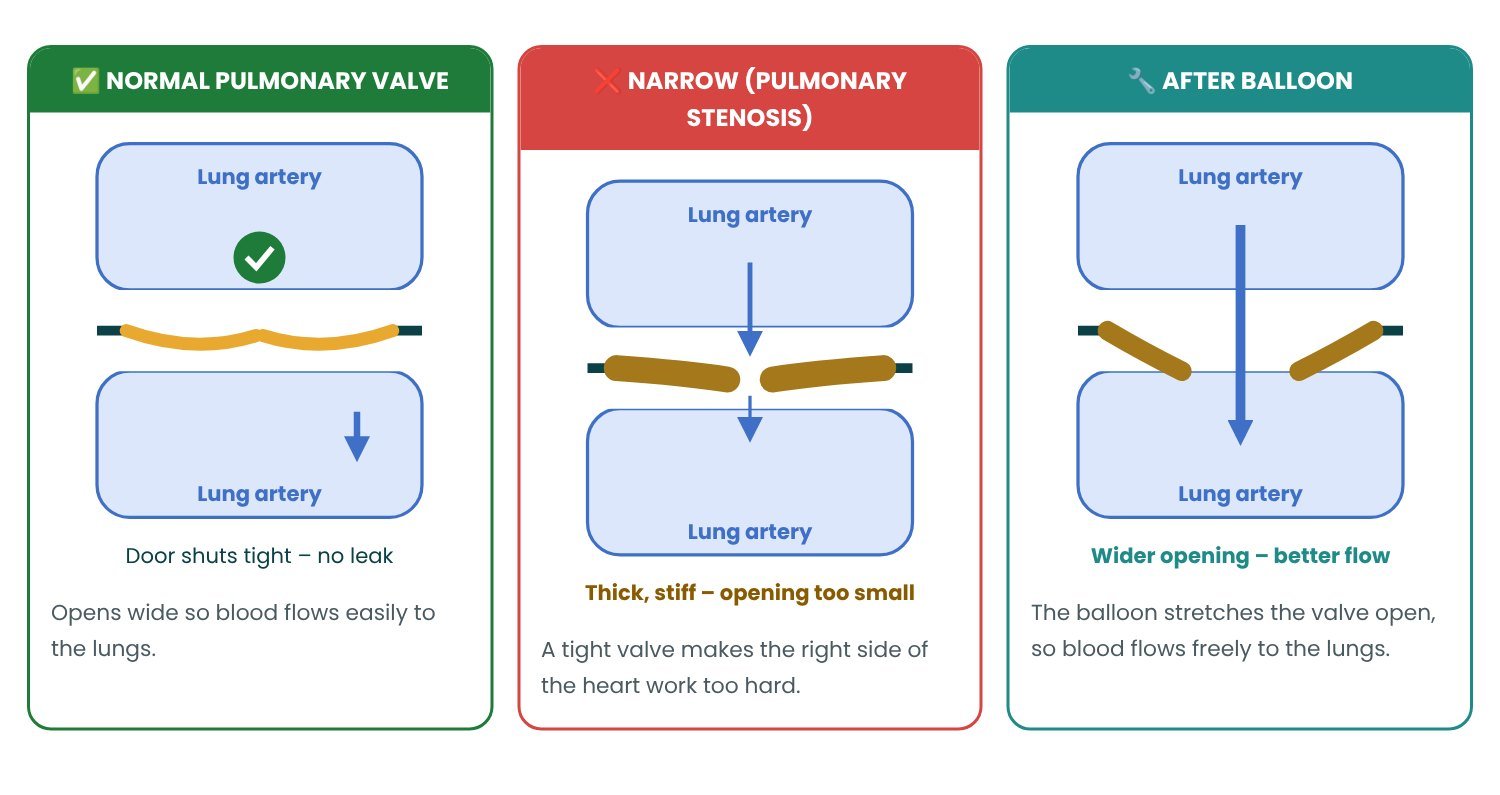
The pulmonary valve sits between the right pumping chamber of the heart (right ventricle) and the artery that carries blood to the lungs. Normally it opens fully with each heartbeat. In pulmonary valve stenosis, the valve leaflets are thick or stuck together, so the opening is narrow. The right ventricle must pump harder, which over time thickens and strains the heart. It is usually present from birth and makes up about 8–10% of all congenital heart defects.
Balloon pulmonary valvuloplasty (also called pulmonary valve balloon dilatation, PVBD, or BPV) is the treatment of choice. A thin tube (catheter) with a balloon at its tip is passed through a vein in the groin up to the heart, guided by X-ray and echo. The balloon is inflated across the valve for a few seconds to stretch it open. There is no cut on the chest and no heart-lung machine.
🖼️ Understand It in Pictures
Normal vs narrow pulmonary valve
👀 Symptoms in Pictures

🩻 Scans & Tests — What Doctors See


🎬 The Treatment Journey in Pictures


📅 Recovery at a Glance
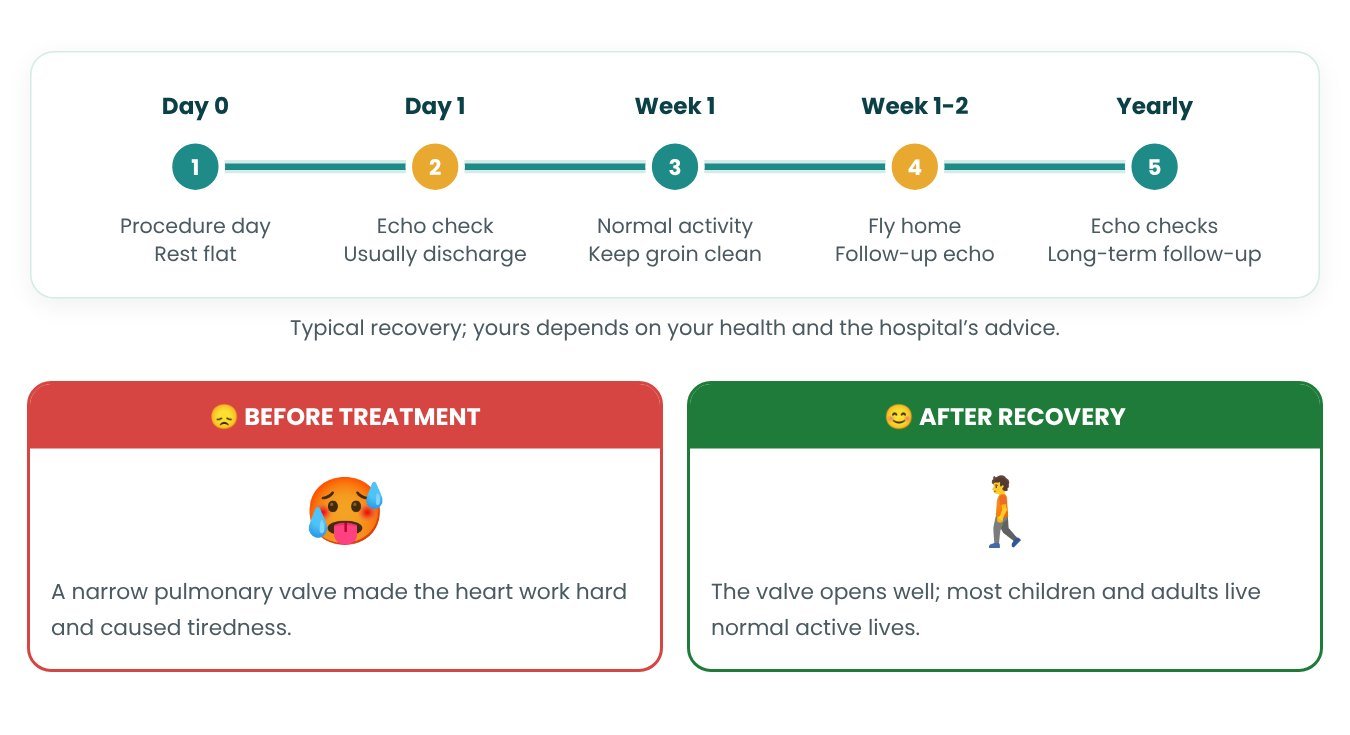
Drawings: Satyug Healthcare (simplified, not to scale). Photos: Wikimedia Commons; author and licence under each photo.
🩺 Conditions Treated
⚠️ Symptoms That May Need Treatment
- ➤Heart murmur found on check-up
- ➤Breathlessness on exercise
- ➤Tiring easily
- ➤Chest pain on exertion
- ➤Fainting or dizziness
- ➤Blue lips or skin in babies (cyanosis)
- ➤Poor feeding and weight gain in infants
- ➤Swelling of the legs or belly in severe cases
🔬 Tests Before Treatment
| Test | Why it is done |
|---|---|
| Echocardiogram with Doppler | Measures the valve gradient, valve shape and right ventricle size – the main test. |
| ECG | Shows strain or thickening of the right ventricle. |
| Chest X-ray | Shows heart size and the lung artery. |
| Blood tests (CBC, kidney, clotting, blood group) | Check fitness for the procedure. |
| Cardiac MRI or CT (selected cases) | Detailed view of the valve, pulmonary arteries and right ventricle. |
| Oxygen saturation | Checks for blue colour (cyanosis) in babies. |
🏥 The Procedure — Step by Step

⚖️ Types & Techniques
| Technique | What is done | Best for |
|---|---|---|
| Single-balloon valvuloplasty | One balloon 1.2–1.4 times the valve size | Most children and adults |
| Double-balloon valvuloplasty | Two balloons side by side | Large valve rings, mostly adults |
| Neonatal critical PS valvuloplasty | Gradual dilatation with small balloons in ICU setting | Newborns with critical stenosis |
| Surgical valvotomy (alternative) | Open-heart surgery to cut or reshape the valve | Very thick (dysplastic) valves or failed balloon |
| Pulmonary valve replacement (later) | Surgical or catheter valve replacement | Severe leakage years after earlier treatment |
📅 Your Day-by-Day Plan in India
| Day | What happens |
|---|---|
| Day 1 | Arrival in India, airport pick-up and hotel check-in |
| Day 2 | Consultation with paediatric / structural cardiologist, echo, ECG and blood tests |
| Day 3 | Admission and balloon pulmonary valvuloplasty |
| Day 4–5 | Ward monitoring, echo check and groin wound check |
| Day 6 | Discharge after 3–4 days in hospital |
| Day 7–9 | Hotel rest and final echo review |
| Day 10 | Fly home ✈️ |
🌱 Recovery After Treatment
🏆 Success Rate
| Outcome | Result |
|---|---|
| Immediate success (gradient reduced) | About 90–95% |
| Need for repeat procedure over 10 years | About 5–10% |
| Major complications | Under 1–2% (higher in newborns) |
| Mild valve leakage after treatment | Common, usually not important |
| Long-term survival | Close to normal life expectancy |
Results are best for thin, domed valves. Very thick (dysplastic) valves, often seen in Noonan syndrome, respond less well and may later need surgery. Newborns with critical stenosis need closer follow-up.
🩹 Risks & Possible Complications
Balloon pulmonary valvuloplasty is a safe, well-established procedure.
- •Bruising or bleeding at the groin – common, usually minor
- •Temporary irregular heartbeat during balloon inflation
- •Pulmonary valve leakage (regurgitation) – common, usually mild
- •Temporary narrowing below the valve (reactive infundibular spasm) – managed with medicines
- •Re-narrowing needing repeat procedure – about 5–10%
- •Vein damage or clot in the leg – uncommon, more often in infants
- •Serious complications (tear of the heart or valve) – rare, under 1%
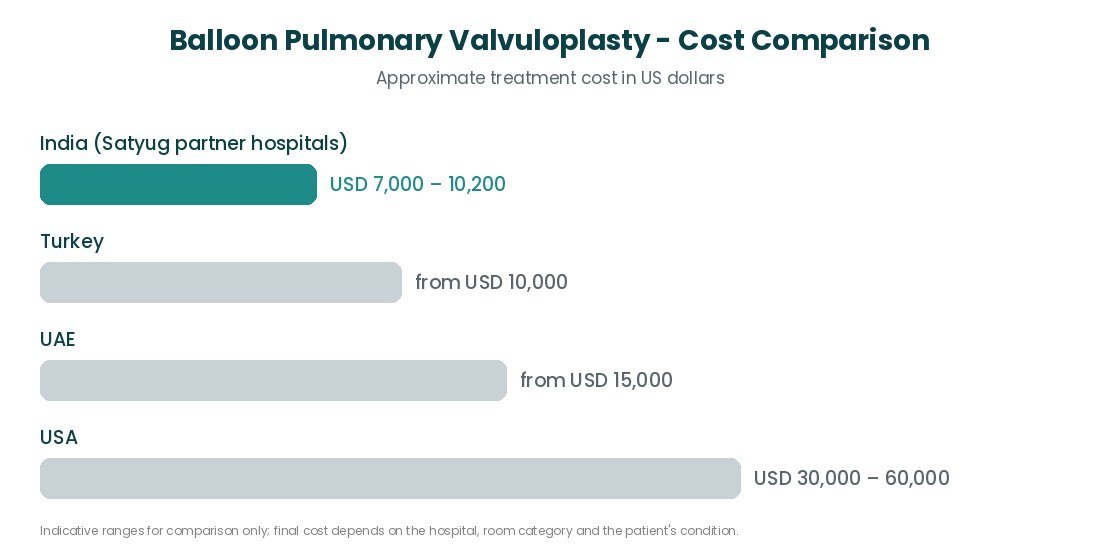
💰 Cost of Balloon Pulmonary Valvuloplasty in India
The cost of balloon pulmonary valvuloplasty in India starts from about USD 7,000 in an economy room. This package includes the procedure, cardiologist and anaesthesia fees, the balloon catheter, 3–4 days in hospital and routine medicines. Twin-sharing and single rooms cost more, as shown below.
| Option / Hospital tier | Approx. cost (USD) | Hospital stay | Notes |
|---|---|---|---|
| Balloon Pulmonary Valvuloplasty – Economy Room (this package) | 7,000 | 3–4 days | Economy |
| Balloon Pulmonary Valvuloplasty – Twin Sharing | 9,250 | 3–4 days | Twin sharing |
| Balloon Pulmonary Valvuloplasty – Single Room | 10,200 | 3–4 days | Single room |
| Newborn critical PS (NICU care) | Quoted after review | 5–10 days | Extra NICU days and care |
📋 What the Package Includes
- ✔Balloon pulmonary valvuloplasty
- ✔Balloon catheter and sheaths
- ✔Cardiologist and anaesthesia fees
- ✔Cath lab charges
- ✔3–4 days in hospital
- ✔Echo after the procedure
- ✔Routine medicines and nursing
- ✔Airport pick-up, visa letter and interpreter
- ✖Flights and visa fees
- ✖Hotel stay outside hospital
- ✖Cardiac MRI / CT
- ✖NICU or extra ICU days
- ✖Extra balloons or a second procedure
- ✖Room upgrades
- ✖Treatment of other heart defects
- ✖Take-home medicines
✈️ Your Medical Travel Process with Satyug Healthcare

| Step | Details |
|---|---|
| 1. Send reports | Latest echocardiogram report (with pulmonary valve gradient), ECG, chest X-ray, child's age and weight, oxygen saturation and any previous heart procedure records. |
| 2. Free opinion & quotes | Within 48-72 hours you receive opinions and cost estimates from 3-5 leading hospitals to compare. |
| 3. Choose hospital & doctor | We help you compare doctors, success rates, room options and total budget. |
| 4. Medical visa | The hospital issues a Visa Invitation Letter (VIL) to the Indian Embassy. The patient and up to 2 attendants apply for an e-Medical / Medical Attendant visa. |
| 5. Travel planning | Flight guidance, wheelchair assistance, airport pick-up, hotel or guest house near the hospital. |
| 6. Treatment in India | Your coordinator and interpreter stay with you for admission, treatment, discharge and billing. |
| 7. Return & follow-up | Fit-to-fly letter, medicines, and online follow-up with your doctor after you return home. |
🎒 Travel Checklist
- 📌Valid passport (6+ months) for the patient and attendants, plus 10 passport-size photos each
- 📌Medical visa / e-visa and the hospital’s Visa Invitation Letter
- 📌All echo reports or videos, ECG, chest X-ray, MRI/CT on CD / link and prescriptions
- 📌Yellow fever vaccination certificate (mandatory for travellers from African countries)
- 📌Polio vaccination certificate where applicable
- 📌Declare cash above USD 5,000 at the airport; hospitals accept wire transfer and cards
- 📌Foreigners staying longer than permitted must register with the FRRO — our team assists
⭐ Why Choose Satyug Healthcare?
❓ Frequently Asked Questions
➤ How much does balloon pulmonary valvuloplasty cost in India?
➤ How long will I stay in hospital?
➤ How long should I stay in India?
➤ Is open-heart surgery needed?
➤ Is the procedure painful?
➤ What is the success rate?
➤ Is it safe for newborn babies?
➤ Will my child live a normal life?
➤ Can the valve narrow again?
➤ When can my child return to school?
➤ What are the risks?
➤ Can both parents come with the child?
Medical disclaimer: This page is for general information and does not replace a consultation with a qualified specialist. Treatment plans and costs are confirmed only after the patient is examined. Sources: NCBI StatPearls: Pulmonic Stenosis; NCBI StatPearls: Balloon Valvuloplasty; 2018 AHA/ACC Guideline for Adults with Congenital Heart Disease; AHA Scientific Statement on Indications for Cardiac Catheterization in Pediatric Heart Disease (2011); Cleveland Clinic; Boston Children's Hospital. Infographics: Satyug Healthcare.
Frequently Asked Questions
The cost of balloon pulmonary valvuloplasty in India starts from USD 7000. Balloon Pulmonary Valvuloplasty - Economy Room: USD 7000; Balloon Pulmonary Valvuloplasty - Twin Sharing: USD 9250; Balloon Pulmonary Valvuloplasty - Single Room: USD 10200. The final cost depends on the hospital, room category and medical condition.
Balloon pulmonary valvuloplasty (PVBD) in India from USD 7,000 – treat pulmonary stenosis without open-heart surgery, 3–4 day stay, expert cardiologists, visa help.


TOP HOSPITALS
Special High-quality Hospitals


HAPPY PATIENTS
What Our Patients Are Saying