
SBRT / SABR Package
Assistance
Consultation
Services
Opinion
Care Coordination
What will your treatment cost?

See the cost breakdown by option, hospital and city →
| Surgery Name | Cost | Room | Hospitalization |
|---|---|---|---|
| SBRT / SABR Package | USD 4800 - USD 6500 | OPD / Day-care (no admission); hotel or guest house near hospital | No admission - 3 to 5 sessions (1 to 8 possible) over 1 to 2 weeks; total stay in India 10 to 14 days |
✓ Inclusion
- ✔Consultation with a radiation oncologist and tumour board review
- ✔Custom immobilisation (vacuum cushion or body mould)
- ✔4D-CT planning scan (simulation) with motion assessment
- ✔Image registration with your MRI / PET-CT for target contouring
- ✔Advanced treatment planning by medical physicists (VMAT / IMRT-based SBRT)
- ✔Patient-specific quality assurance of the plan
- ✔3–5 SBRT sessions on OPD / day-care basis
- ✔Daily cone-beam CT image guidance and motion management (gating / breath-hold)
- ✔Weekly review by the radiation oncologist during treatment
- ✔Treatment summary and follow-up plan at completion
- ✔Free: airport pick-up & drop, visa invitation letter, interpreter & coordinator (Satyug Healthcare)
✗ Exclusion
- ✖PET-CT, MRI and diagnostic CT scans
- ✖Biopsy, histopathology or slide review
- ✖Fiducial (gold marker) placement and rectal spacer gel
- ✖Extra sessions beyond 5 or treatment of additional sites
- ✖CyberKnife-based treatment upgrade
- ✖Chemotherapy, hormone therapy or immunotherapy
- ✖Medicines for side effects
- ✖Hospital admission if needed for complications
- ✖Hotel or guest house, flights, local travel and food
Know More About Procedure & Surgery
SBRT / SABR – Stereotactic Body Radiation Therapy in India
Very high, pin-point radiation doses for tumours of the lung, liver, prostate, spine and limited metastases, completed in 3–5 outpatient sessions instead of 6–7 weeks, planned by experienced radiation oncologists at leading Indian cancer centres – at a fraction of Western prices.
📖 What is SBRT / SABR?
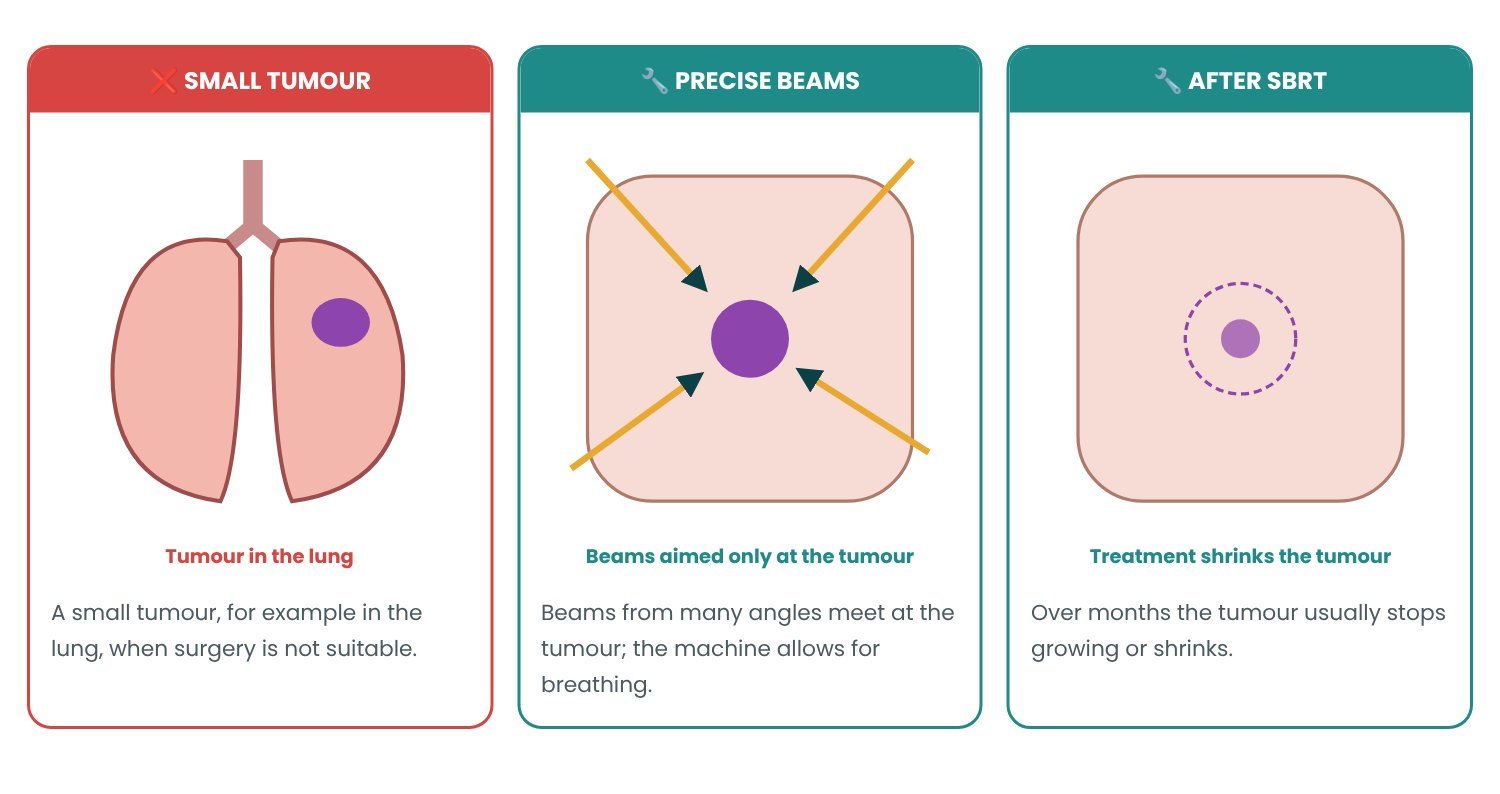
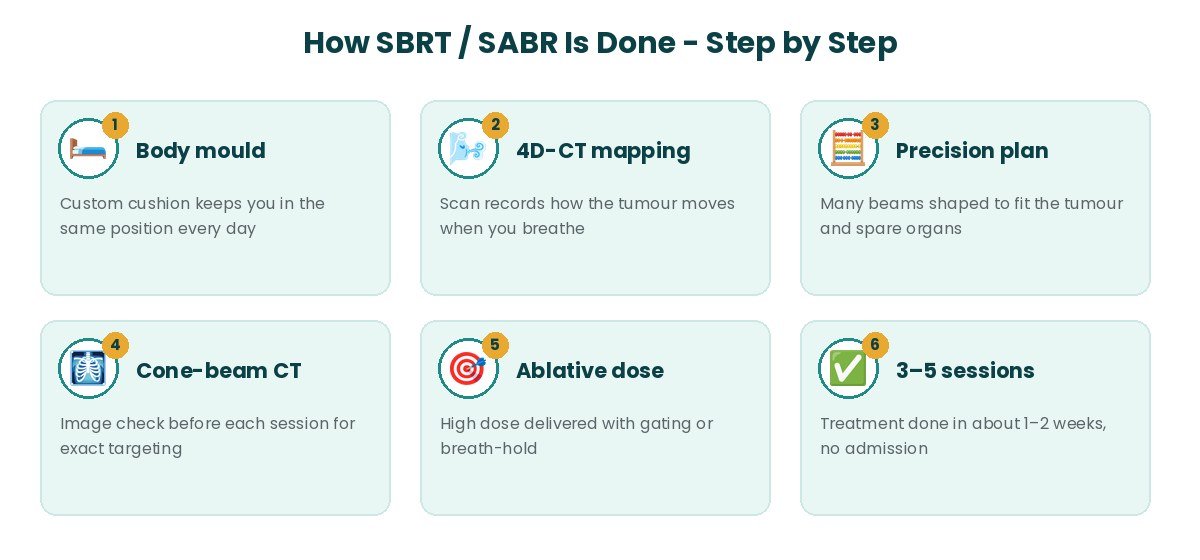
SBRT (Stereotactic Body Radiation Therapy), also called SABR (Stereotactic Ablative Radiotherapy), is a very precise form of radiation for tumours in the body. Many beams aimed from different angles meet at the tumour and deliver a very high, tumour-destroying (ablative) dose, while the dose to nearby healthy organs falls away sharply. Because each dose is so strong, treatment is finished in 1–8 sessions (usually 3–5) instead of 25–35 daily sessions of normal radiotherapy.
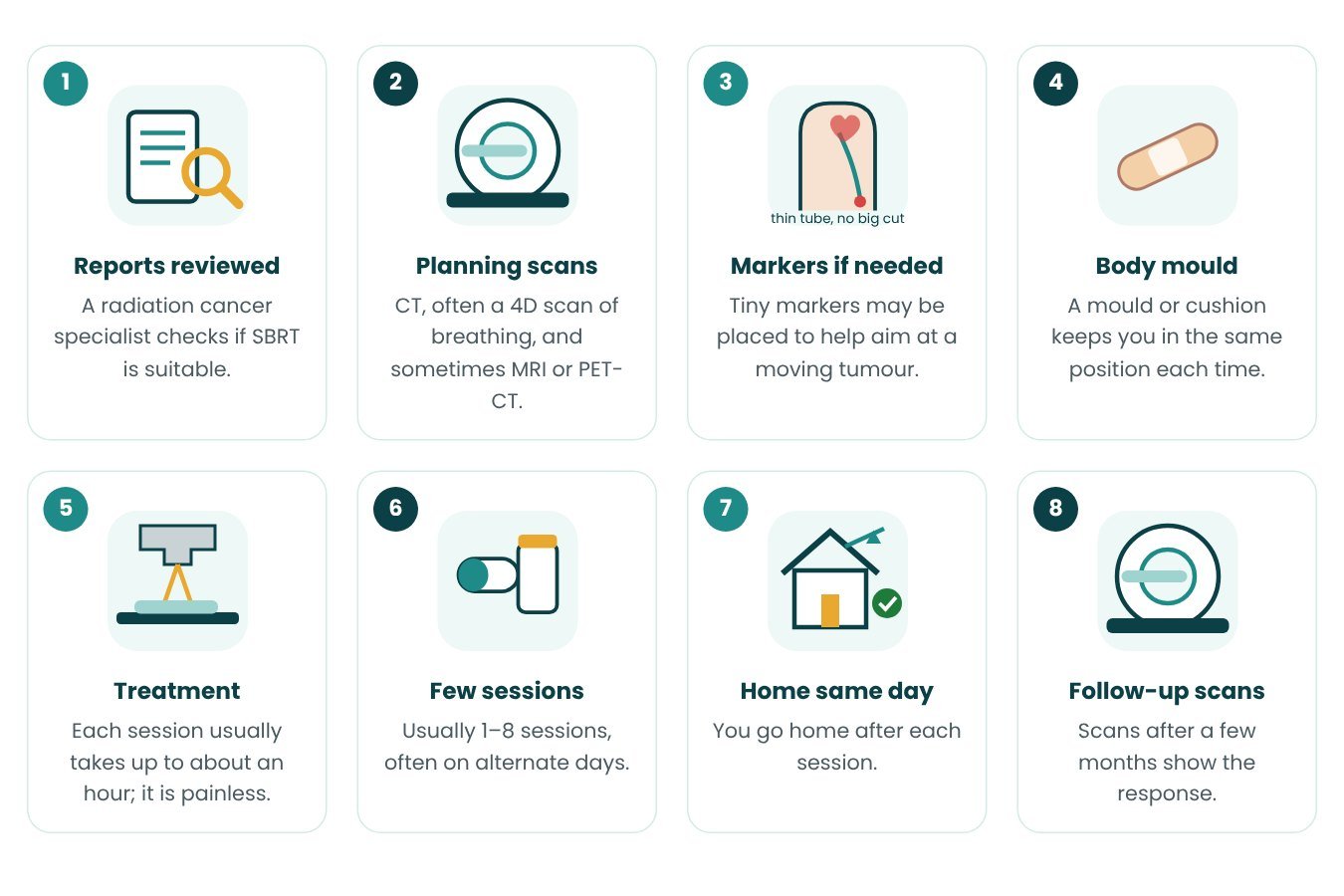
Body tumours move when you breathe, so SBRT uses special motion management: a 4D-CT scan maps the movement, breath-hold or gating switches the beam on only when the tumour is in position, and a cone-beam CT scan checks the position before every session. For liver, pancreas and prostate, tiny gold markers (fiducials) may be placed first so the machine can track the tumour. It is painless, needs no cut or anaesthesia, and you walk out after each session.
🖼️ Understand It in Pictures
How SBRT treats a tumour
👀 Symptoms in Pictures
🩻 Scans & Tests — What Doctors See


🎬 The Treatment Journey in Pictures

📅 Recovery at a Glance
Drawings: Satyug Healthcare (simplified, not to scale). Photos: Wikimedia Commons; author and licence under each photo.
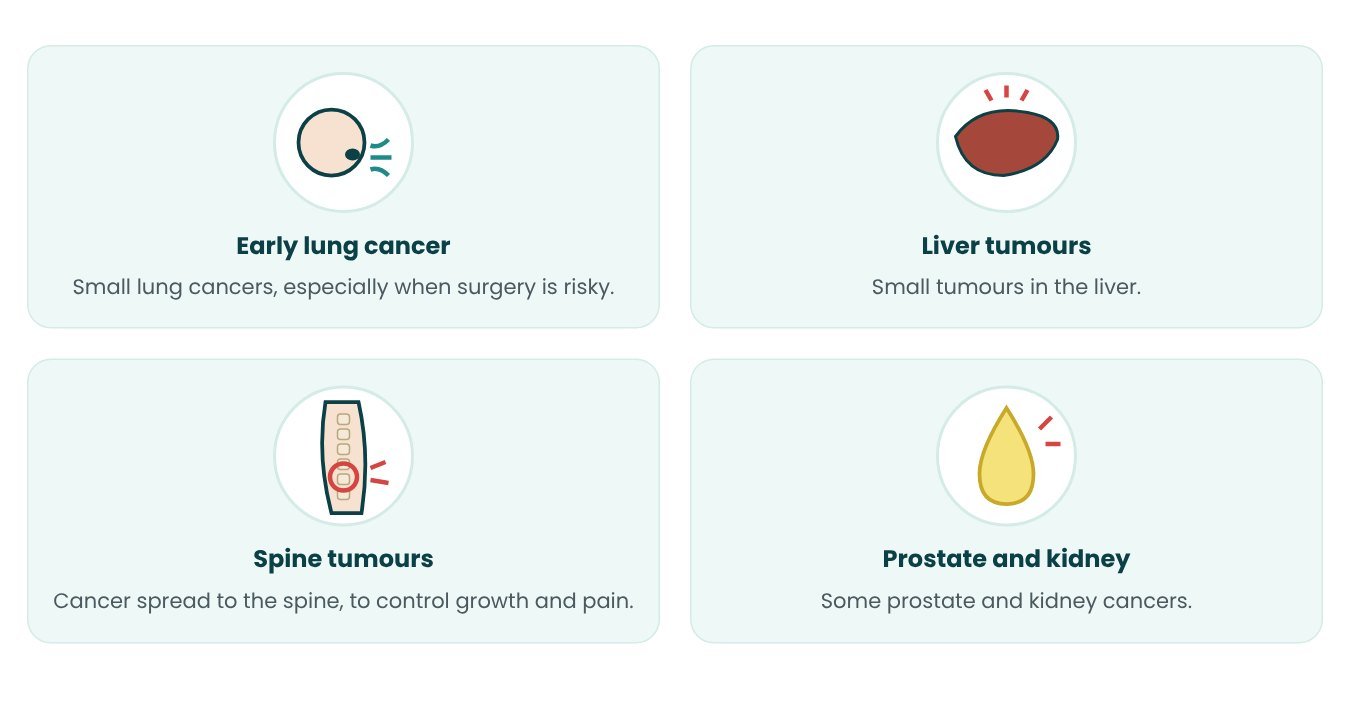
🩺 Cancers Treated with SBRT
⚠️ Who May Benefit from SBRT
- ➤Small lung tumour but not fit for surgery
- ➤Liver tumour not suitable for surgery or transplant
- ➤Localised prostate cancer wanting a short treatment
- ➤Spine metastasis causing pain
- ➤Only 1–5 spots of cancer spread
- ➤Tumour that came back after previous treatment
- ➤Patients who prefer to avoid surgery
- ➤Need to finish treatment quickly and fly home
🔬 Tests Before Treatment
| Test | Why it is done |
|---|---|
| Biopsy / histopathology report | Confirms the type of cancer (sometimes not needed for small lung nodules in high-risk patients). |
| PET-CT scan | Shows all active disease and confirms that cancer is limited enough for SBRT. |
| MRI (liver, prostate, spine, brain) | Gives detailed outlines of the tumour and nearby organs. |
| 4D-CT planning scan | Records how the tumour moves with breathing for precise targeting. |
| Lung function / liver function tests | Checks the organ can safely tolerate high-dose radiation. |
| Fiducial marker placement (selected cases) | Tiny gold markers placed in liver, pancreas or prostate for tracking. |
| Blood tests (CBC, kidney, PSA / AFP / tumour markers) | Baseline for follow-up and safety. |
🏥 The Procedure — Step by Step
⚖️ SBRT Treatments by Site
| Tumour site | Typical schedule | Notes |
|---|---|---|
| Early lung cancer (peripheral) | 3–5 sessions (e.g. 54 Gy in 3 or 50–60 Gy in 5) | 8 sessions for central tumours near airways |
| Liver (HCC / metastases) | 3–6 sessions | Fiducials and breath-hold often used |
| Prostate | 5 sessions over 1–2 weeks | Rectal spacer gel may be used to protect the rectum |
| Spine metastases | 1–5 sessions | MRI-based planning to protect the spinal cord |
| Oligometastases (lung, adrenal, nodes, bone) | 1–5 sessions per site | Often combined with chemo, hormone or immunotherapy |
📅 Your Day-by-Day Plan in India
| Day | What happens |
|---|---|
| Day 1 | Arrival in India ✈️, airport pick-up and hotel check-in |
| Day 2–3 | Radiation oncology consultation, review of PET-CT/MRI, blood tests, tumour board |
| Day 3–4 | Body mould and 4D-CT / MRI simulation (fiducials placed earlier if needed) |
| Day 4–7 | Treatment planning and quality checks by physicists |
| Day 7–12 | 3–5 SBRT sessions on OPD basis (daily or alternate days) – stay at hotel |
| Day 12–14 | Final review, summary and follow-up plan – Fly home ✈️ |
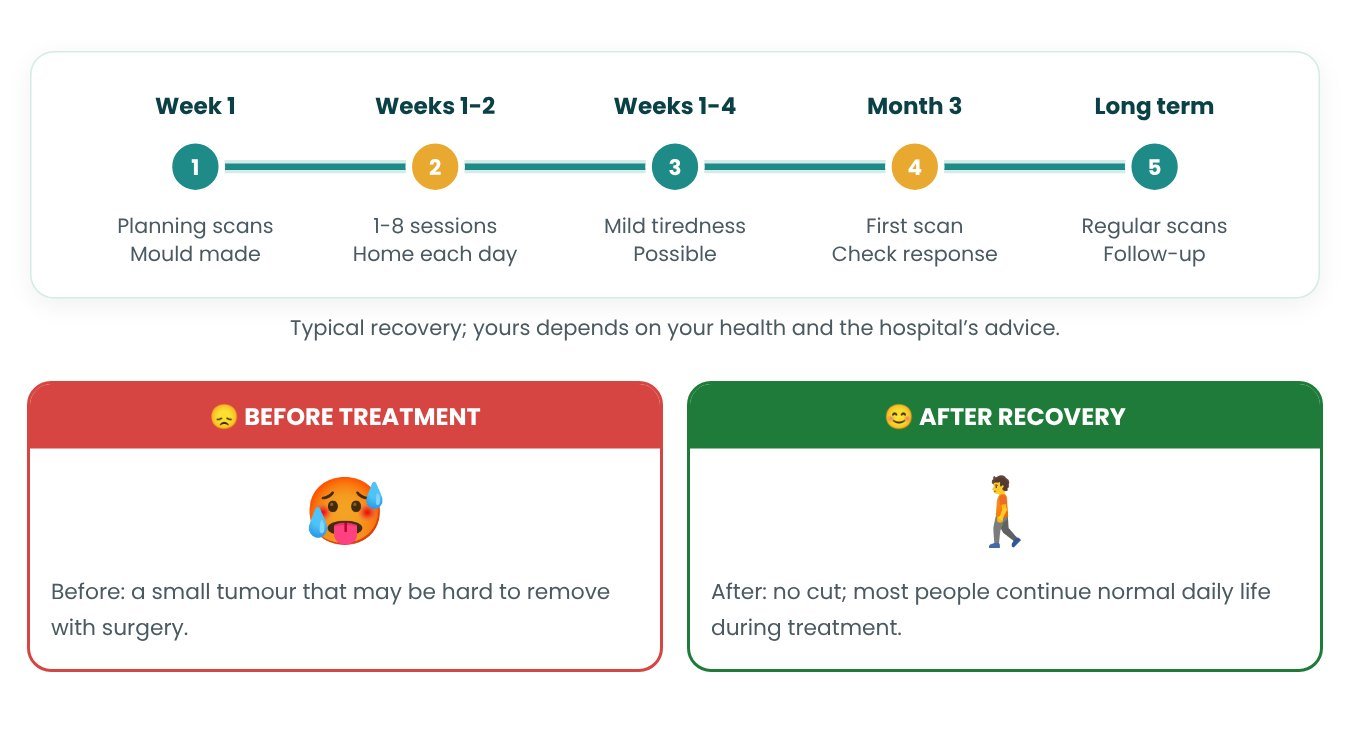
🌱 Recovery After Treatment
🏆 Success Rate
| Outcome | Result |
|---|---|
| Local control, early-stage lung cancer (3 years) | About 90–98% |
| Local control, liver tumours (2 years) | About 80–95% |
| 5-year biochemical control, low/intermediate-risk prostate | About 90–95% |
| Pain relief, spine metastases | About 80–90% of patients |
| Local control of treated metastases | About 80–90% |
Results depend on tumour type, size and location, the number of metastases, the total dose that can be given safely, and other treatments such as chemotherapy, hormone therapy or immunotherapy. SBRT controls the treated tumour but does not treat cancer elsewhere in the body.
🩹 Risks & Possible Complications
SBRT is usually very well tolerated; side effects depend on the area treated.
- •Tiredness – common, mild and temporary
- •Skin redness or chest-wall soreness – mild, mostly with lung SBRT
- •Radiation pneumonitis (lung inflammation) – about 5–10%, usually mild, treated with steroids
- •Urinary frequency or rectal irritation after prostate SBRT – usually mild and temporary
- •Nausea or liver function changes after liver SBRT – uncommon
- •Rib fracture or vertebral compression after lung or spine SBRT – about 5–15%
- •Rare serious injury to nearby organs (bowel, airway, spinal cord)
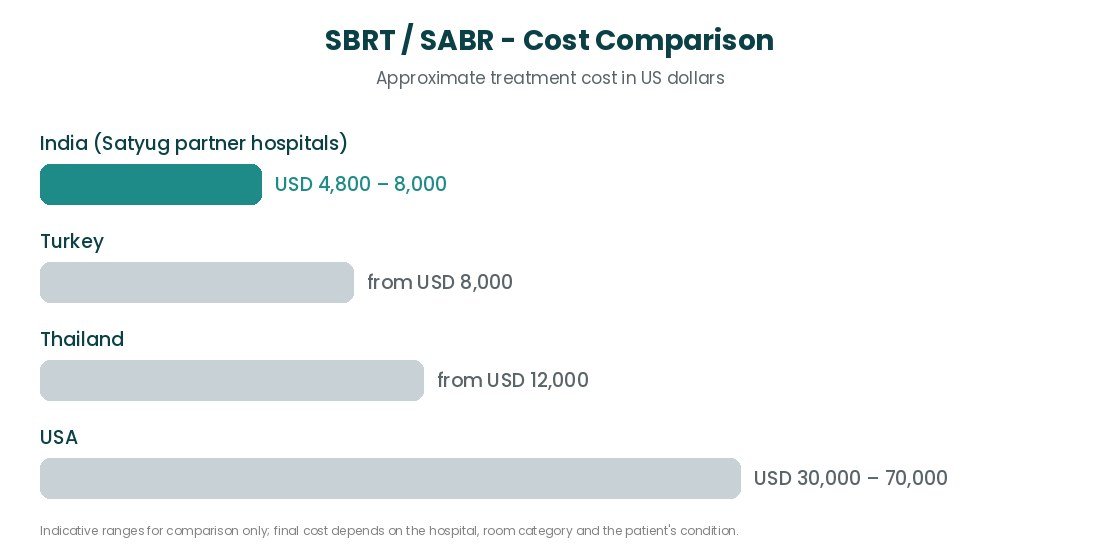
💰 Cost of SBRT / SABR in India
The cost of SBRT / SABR in India starts from about USD 4,800 for a full course of 3–5 sessions on an OPD basis, with no hospital admission. This covers consultation, immobilisation, 4D-CT simulation, treatment planning, quality assurance and all treatment sessions with daily image guidance. PET-CT, MRI, fiducial markers and CyberKnife-based treatment may cost extra.
| Option / Hospital tier | Approx. cost (USD) | Hospital stay | Notes |
|---|---|---|---|
| SBRT / SABR course, 3–5 sessions (this package) | 4,800 | No admission – OPD / day-care | Lung, liver, prostate, spine |
| SBRT with fiducial marker placement | 5,300 – 6,000 | OPD / day-care | Liver, pancreas, prostate tracking |
| CyberKnife SBRT | 6,000 – 8,000 | OPD | Real-time robotic tracking |
| SBRT for 2–3 metastatic sites | 6,500 – 9,000 | OPD | Oligometastatic disease |
| Conventional IMRT/IGRT (5–7 weeks) | 3,500 – 6,000 | OPD | Alternative for larger tumours |
📋 What the Package Includes
- ✔Radiation oncologist consultation
- ✔Immobilisation mould
- ✔4D-CT simulation and planning
- ✔Physics quality assurance
- ✔3–5 SBRT sessions
- ✔Daily cone-beam CT image guidance
- ✔Weekly doctor reviews
- ✔Free airport pick-up, visa letter and interpreter
- ✖PET-CT and MRI scans
- ✖Biopsy and pathology review
- ✖Fiducial marker placement
- ✖Extra sessions or extra sites
- ✖Chemotherapy, hormone or immunotherapy
- ✖Medicines for side effects
- ✖Hotel or guest house stay
- ✖Flights and food
✈️ Your Medical Travel Process with Satyug Healthcare

| Step | Details |
|---|---|
| 1. Send reports | Latest PET-CT scan and any CT/MRI (reports and images), biopsy/histopathology report, summary of previous cancer treatment (surgery, chemotherapy, radiation with doses), tumour marker reports (PSA, AFP, CEA), lung or liver function tests and current medicines. |
| 2. Free opinion & quotes | Within 48-72 hours you receive opinions and cost estimates from 3-5 leading hospitals to compare. |
| 3. Choose hospital & doctor | We help you compare doctors, success rates, room options and total budget. |
| 4. Medical visa | The hospital issues a Visa Invitation Letter (VIL) to the Indian Embassy. The patient and up to 2 attendants apply for an e-Medical / Medical Attendant visa. |
| 5. Travel planning | Flight guidance, wheelchair assistance, airport pick-up, hotel or guest house near the hospital. |
| 6. Treatment in India | Your coordinator and interpreter stay with you for admission, treatment, discharge and billing. |
| 7. Return & follow-up | Fit-to-fly letter, medicines, and online follow-up with your doctor after you return home. |
🎒 Travel Checklist
- 📌Valid passport (6+ months) for the patient and attendants, plus 10 passport-size photos each
- 📌Medical visa / e-visa and the hospital’s Visa Invitation Letter
- 📌All PET-CT / CT / MRI scans on CD or link, biopsy reports, previous radiation records and current prescriptions
- 📌Yellow fever vaccination certificate (mandatory for travellers from African countries)
- 📌Polio vaccination certificate where applicable
- 📌Declare cash above USD 5,000 at the airport; hospitals accept wire transfer and cards
- 📌Foreigners staying longer than permitted must register with the FRRO — our team assists
⭐ Why Choose Satyug Healthcare?
❓ Frequently Asked Questions
➤ How much does SBRT cost in India?
➤ How long do I need to stay in India?
➤ Do I need to stay in hospital?
➤ Is SBRT painful?
➤ How is SBRT different from normal radiation?
➤ Is SBRT as good as surgery for lung cancer?
➤ Can SBRT treat cancer that has spread?
Medical disclaimer: This page is for general information and does not replace a consultation with a qualified specialist. Treatment plans and costs are confirmed only after the patient is examined. Sources: NCBI StatPearls: Stereotactic Body Radiation Therapy; Timmerman R et al., RTOG 0236, JAMA 2010; Palma DA et al., SABR-COMET, Lancet 2019; PACE-B trial (Lancet Oncology 2019 / NEJM 2024) for prostate SBRT; ASTRO Clinical Practice Guideline on SBRT for early-stage NSCLC (2017); NCCN Guidelines (NSCLC, prostate, hepatobiliary cancers); American College of Radiology – RadiologyInfo: SBRT; NHS: Stereotactic radiotherapy. Infographics: Satyug Healthcare.
Frequently Asked Questions
Normal radiotherapy gives a small dose every day for 5 to 8 weeks. SBRT gives a much higher, very precise dose in just 3 to 5 sessions, using image guidance and breathing control so that healthy organs are protected.
SBRT / SABR in India from USD 4,800. Pin-point radiation for lung, liver, prostate & spine tumours in 3–5 OPD sessions, no admission, free opinion & visa help.





TOP HOSPITALS
Special High-quality Hospitals




HAPPY PATIENTS
What Our Patients Are Saying

















Our Gallery



Get a Free Quote
Tell us what you need and share your medical reports. Our medical team prepares your treatment plan and cost estimate.
- Free medical opinion on your reports
- Your quote within 24–48 hours
- Help with visa invitation letter, travel and airport pickup
- Coordinators available on WhatsApp
Prefer to talk? Call +91-8860606766 or WhatsApp us.
Thank you! Your request is received.
Reference . Our medical team will send your free quote within 24–48 hours by e-mail or WhatsApp.
Chat on WhatsApp now