
Mitral Valve Replacement Package
Assistance
Consultation
Services
Opinion
Care Coordination
What will your treatment cost?

See the cost breakdown by option, hospital and city →
| Surgery Name | Cost | Room | Hospitalization |
|---|---|---|---|
| Mitral Valve Replacement Package | 9500 | Single | 8 Days (6 Days ICU + 2 Days Room); Total Stay in India 3-4 Weeks |
| Mitral Valve Replacement(MVR) Surgery with Tissue Valve | USD 10000-15000 | Single | 2 days in ward and 6 days in ICU |
✓ Inclusion
- ✔Consultation with senior cardiac surgeon and cardiologist
- ✔Pre-operative blood tests, ECG, chest X-ray and 2D echo
- ✔Anaesthesia fitness assessment
- ✔Mitral valve replacement with standard mechanical valve
- ✔Surgeon, anaesthetist and perfusionist fees
- ✔Operation theatre, heart-lung machine and consumables
- ✔6 days ICU stay and 2 days stay in a single room
- ✔Nursing care, routine medicines and IV fluids
- ✔Routine blood units for surgery
- ✔Physiotherapy and INR monitoring during stay
- ✔Discharge summary and anticoagulation plan
- ✔Free: airport pick-up & drop, visa invitation letter, interpreter & coordinator (Satyug Healthcare)
✗ Exclusion
- ✖Coronary angiography and extra investigations
- ✖Tissue (bioprosthetic) valve – priced separately
- ✖Additional valve repair/replacement or bypass surgery
- ✖Extra ICU or hospital days due to complications
- ✖Pacemaker if needed
- ✖Medicines after discharge
- ✖Hotel stay, food for attendants and local travel
- ✖Flights and visa fees
Know More About Procedure & Surgery
Mitral Valve Replacement (MVR) Surgery in India
Open-heart replacement of a damaged mitral valve – most often from rheumatic heart disease – with a durable mechanical valve or a tissue valve, by experienced cardiac surgeons at NABH & JCI hospitals in India, at a fraction of Western cost.
📖 What is Mitral Valve Replacement?
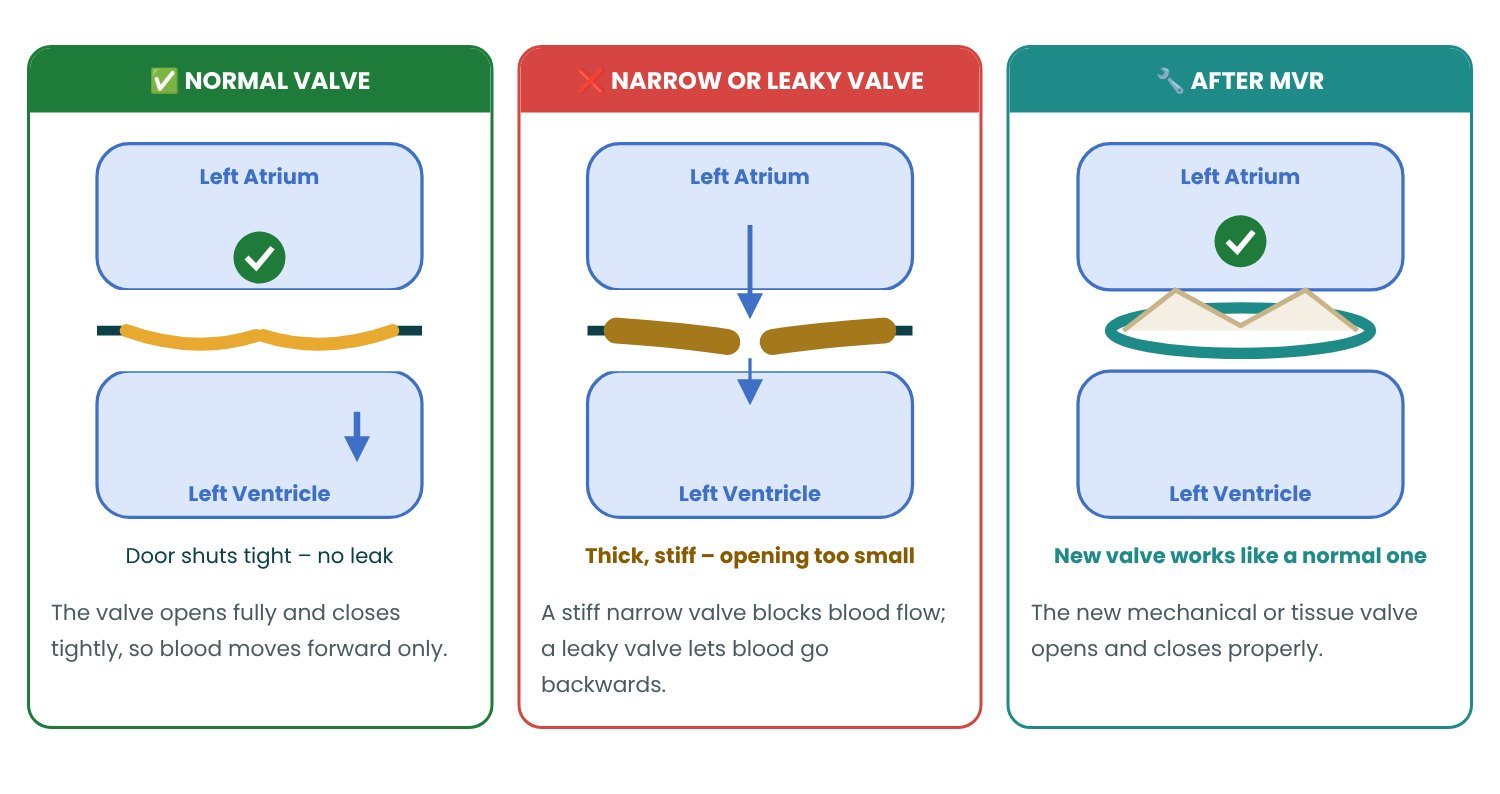
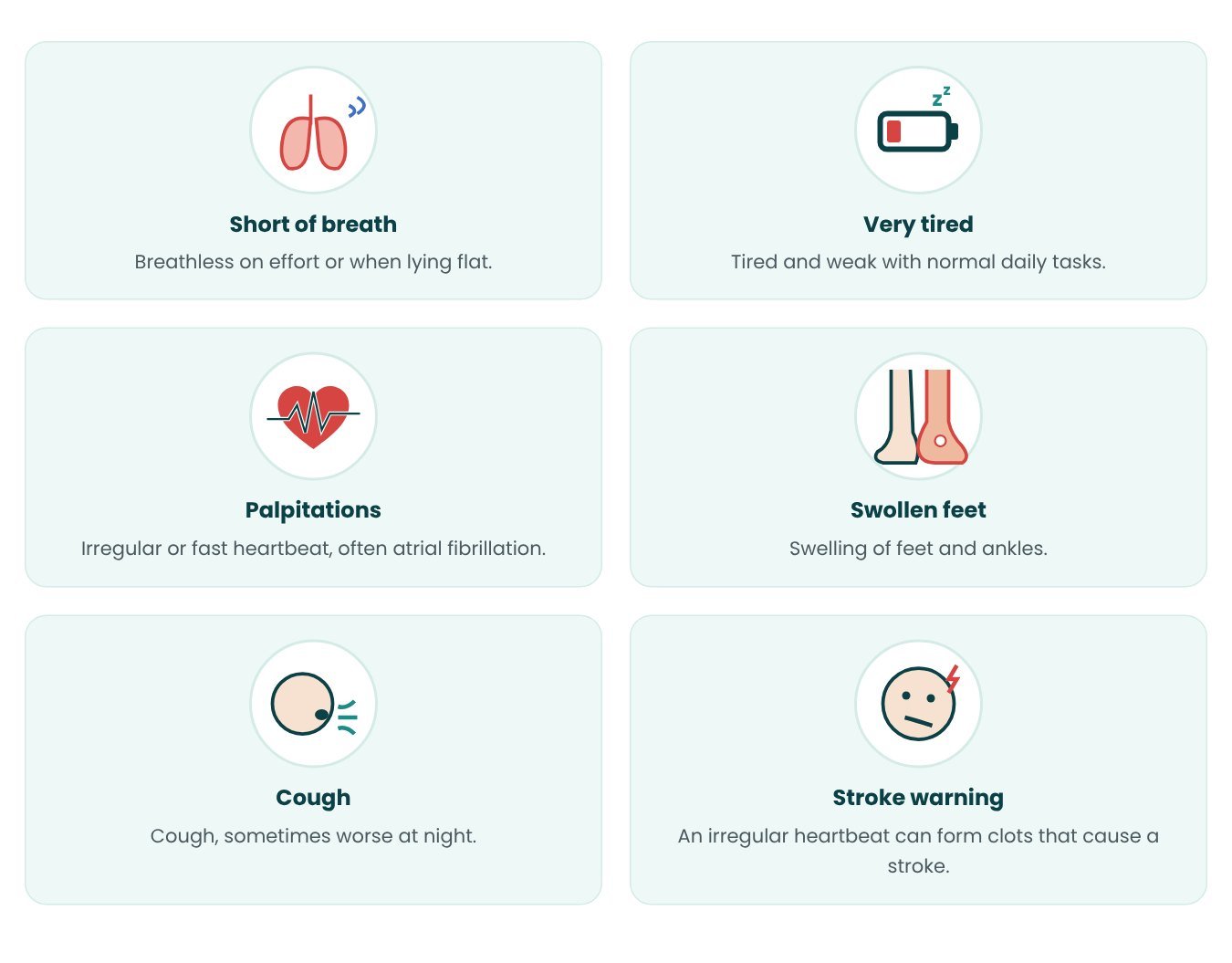
The heart has four valves that act like one-way doors. The mitral valve sits between the left upper chamber (left atrium) and the main pumping chamber (left ventricle). If it becomes narrow (mitral stenosis) or leaky (mitral regurgitation), blood backs up into the lungs. This causes breathlessness, tiredness, swelling of the legs and an irregular heartbeat (atrial fibrillation). Rheumatic heart disease, which follows untreated throat infections in childhood, is the most common cause in Africa, the Middle East and Asia.
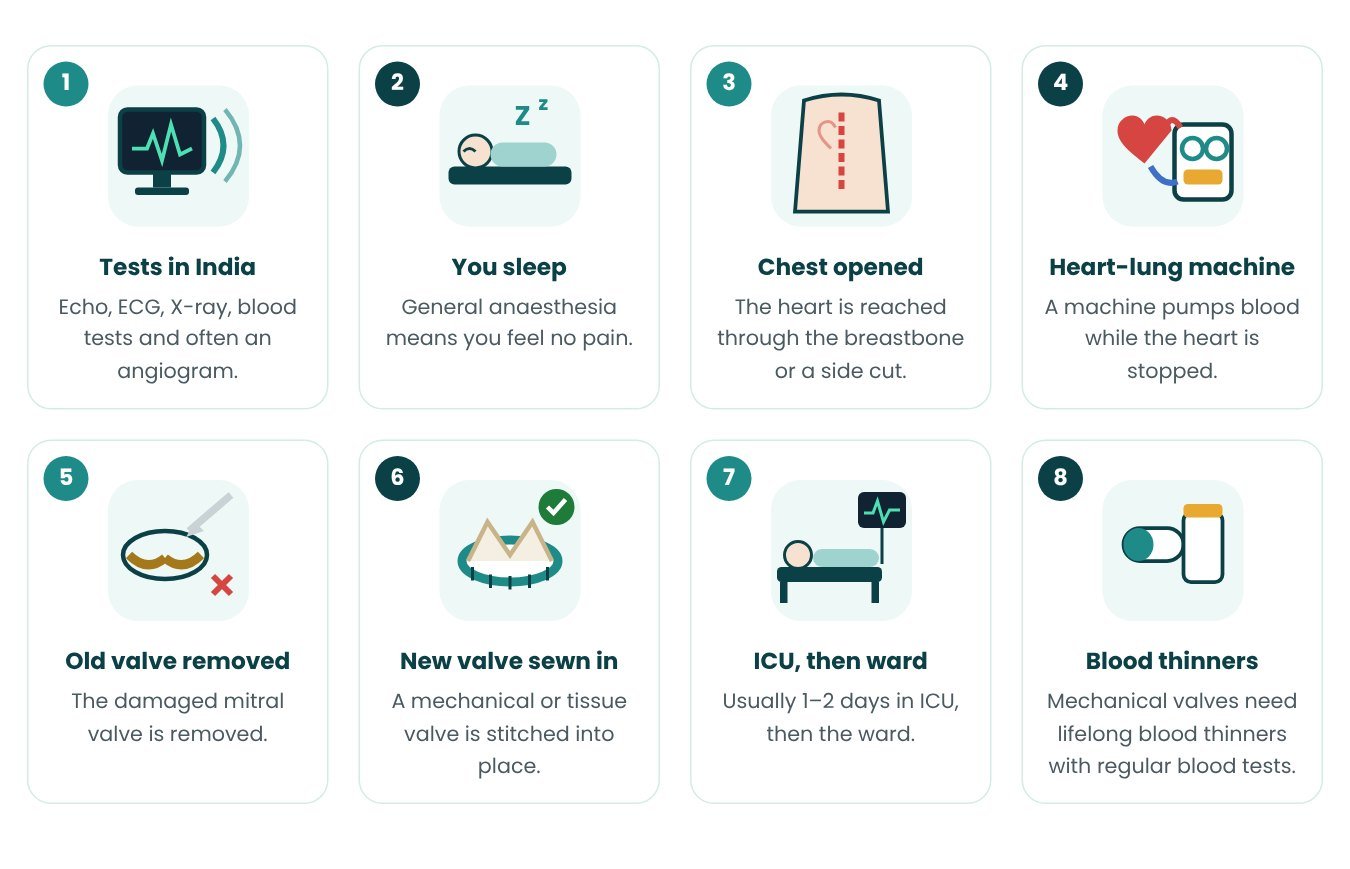
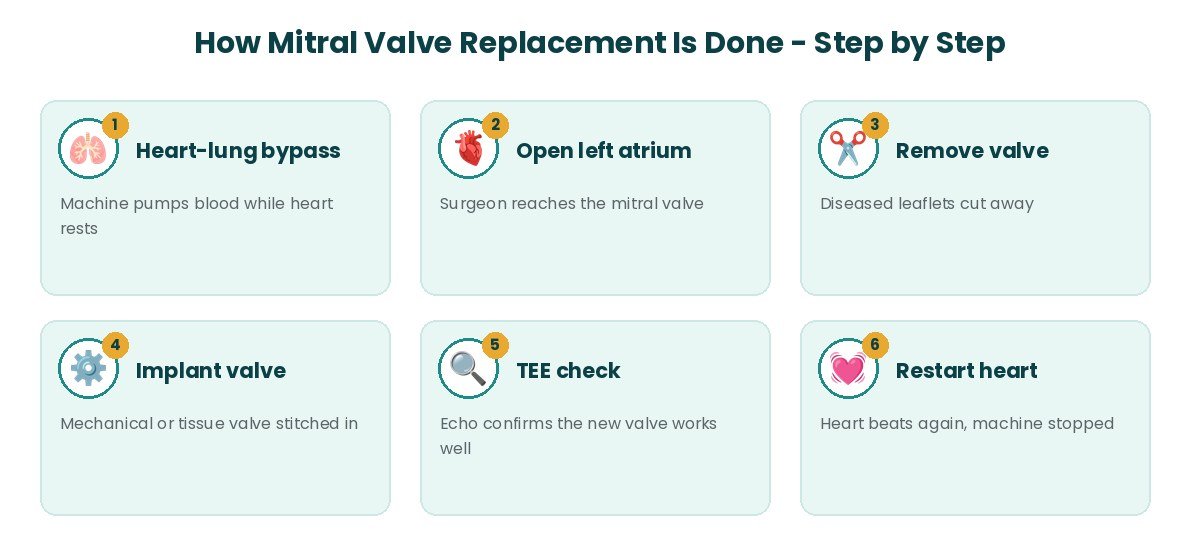
In mitral valve replacement (MVR) the surgeon opens the chest, connects you to a heart-lung machine, removes the damaged valve and stitches in a new artificial valve. A mechanical valve (made of carbon) lasts a lifetime but needs lifelong blood thinner (warfarin) with regular INR blood tests. A tissue (bioprosthetic) valve needs no lifelong warfarin but may wear out after 10–15 years. When possible, surgeons repair the valve instead of replacing it.
🖼️ Understand It in Pictures
Normal vs diseased mitral valve
👀 Symptoms in Pictures
📷 What It Looks Like (real photos)

🩻 Scans & Tests — What Doctors See


🎬 The Treatment Journey in Pictures


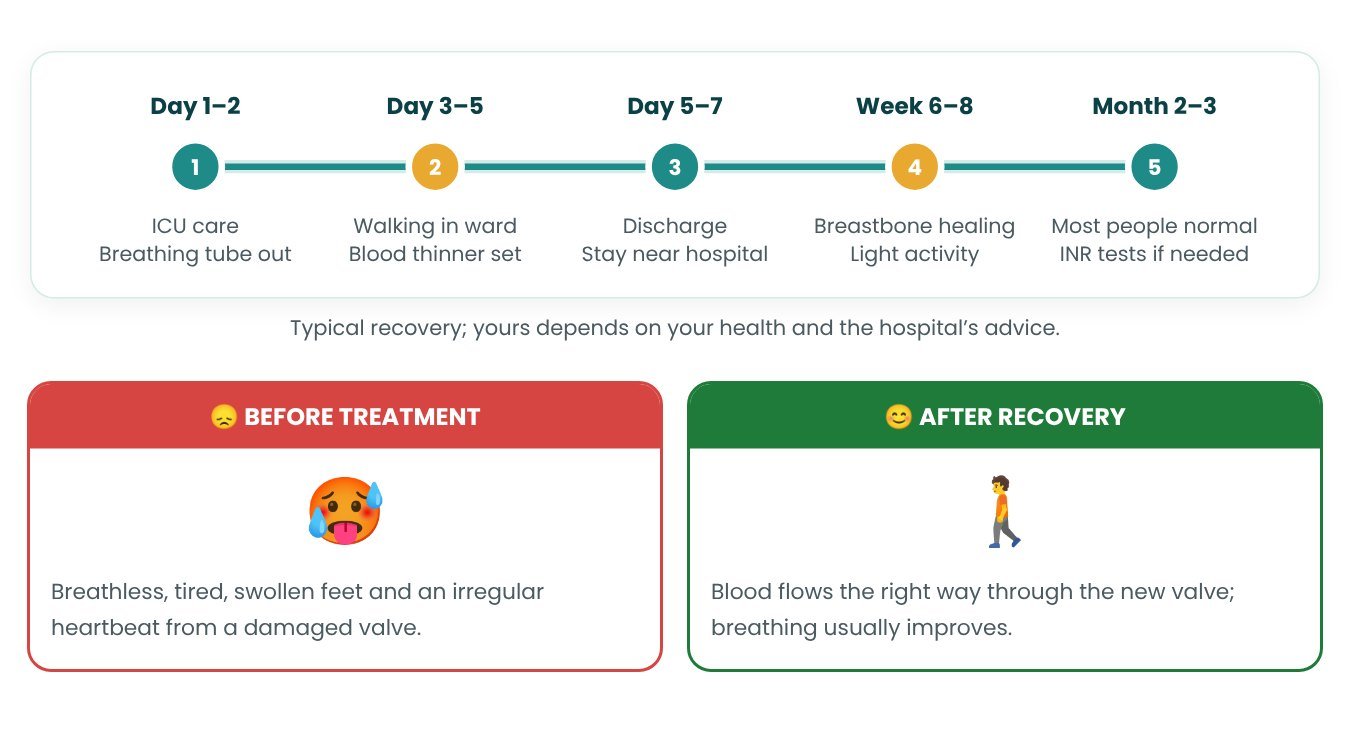
📅 Recovery at a Glance
Drawings: Satyug Healthcare (simplified, not to scale). Photos: Wikimedia Commons; author and licence under each photo.
🩺 Conditions Treated
⚠️ Symptoms That May Need Valve Surgery
- ➤Breathlessness on walking or lying flat
- ➤Waking at night short of breath
- ➤Tiredness and weakness
- ➤Fast or irregular heartbeat (palpitations)
- ➤Swelling of feet and ankles
- ➤Coughing, sometimes with blood
- ➤Chest discomfort
- ➤Stroke or mini-stroke from clots
🔬 Tests Before Treatment
| Test | Why it is done |
|---|---|
| Echocardiogram (2D echo / TEE) | Measures valve narrowing, leakage and heart pumping |
| ECG | Shows rhythm, such as atrial fibrillation |
| Coronary angiography (age over 40) | Checks for blocked arteries that may need bypass at the same time |
| Chest X-ray | Shows heart size and lung congestion |
| Blood tests (kidney, liver, clotting, INR) | Fitness for surgery |
| Dental check-up | Treats infections to protect the new valve |
| Pulmonary function test | Lung fitness before surgery |
🏥 The Procedure — Step by Step
⚖️ Valve Options & Techniques
| Option | What is done | Best for |
|---|---|---|
| MVR – mechanical valve | Carbon valve, lasts a lifetime, lifelong warfarin | Younger patients (under ~60) who can do INR tests |
| MVR – tissue valve | Pig or cow tissue valve, no lifelong warfarin | Over ~65, women planning pregnancy, poor INR access |
| Mitral valve repair | Own valve repaired with ring and stitches | Degenerative leaky valves – preferred when possible |
| Minimally invasive MVR | Small right-side chest cut | Selected patients, faster recovery (extra cost) |
| Balloon mitral valvotomy | Balloon opens narrow valve via the groin | Pliable rheumatic stenosis without heavy calcium |
📅 Your Day-by-Day Plan in India
| Day | What happens |
|---|---|
| Day 1 | Arrival in India, airport pick-up, hotel check-in |
| Day 2–3 | Cardiology consultation, echo, angiography if needed, blood tests |
| Day 4 | Admission and pre-operative preparation |
| Day 5 | Mitral valve replacement surgery |
| Day 5–10 | ICU care – about 6 days |
| Day 11–12 | Ward care in single room – 2 days, physiotherapy and INR checks |
| Day 13–22 | Hotel stay; wound check, INR monitoring and echo |
| Day 23–25 | Final review with surgeon, fit-to-fly |
| Day 26 | Fly home ✈️ |
🌱 Recovery After Treatment
🏆 Success Rate
| Outcome | Result |
|---|---|
| Operative survival (elective MVR) | About 95–98% |
| Symptom improvement (NYHA class) | Over 85–90% of patients |
| Mechanical valve durability | Usually lifelong (over 20–25 years) |
| Tissue valve freedom from re-operation at 10 years | About 70–90% (lower in the young) |
| 10-year survival after MVR | About 60–75% |
Results depend on heart pumping strength before surgery, lung pressure, other valve disease, age, kidney function and – for mechanical valves – keeping the INR in the target range for life.
🩹 Risks & Possible Complications
MVR is major heart surgery, but outcomes in experienced centres are very good.
- •Atrial fibrillation (irregular beat) – about 20–40% after surgery, often already present
- •Bleeding needing re-exploration – about 2–5%
- •Infection of wound or lungs – about 2–5%
- •Stroke – about 1–3%
- •Kidney problems – about 2–5%, mostly temporary
- •Heart block needing pacemaker – about 1–3%
- •Valve clot or bleeding from warfarin over the long term – about 1–2% per year
💰 Cost of Mitral Valve Replacement in India
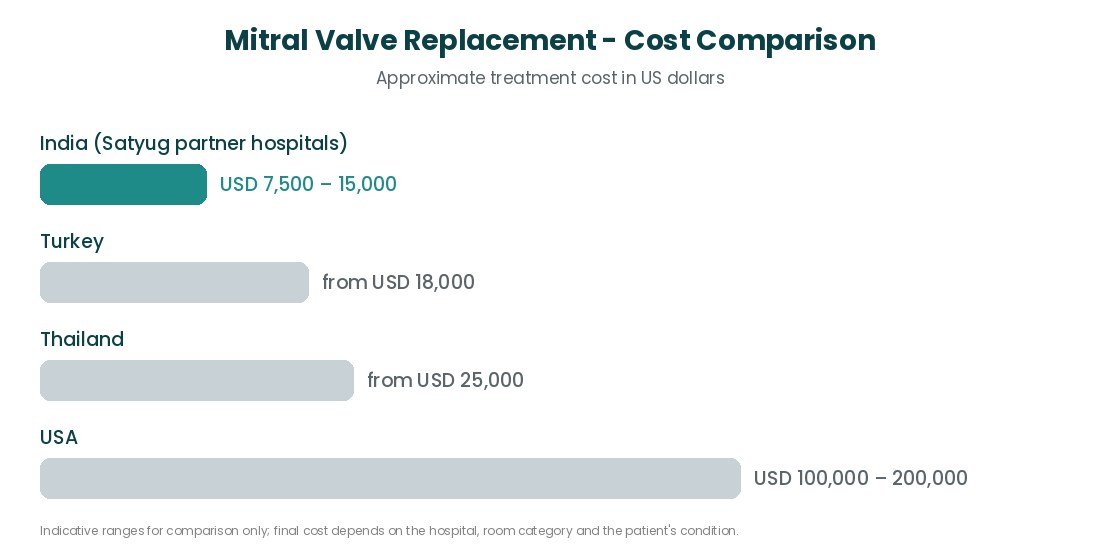
The cost of mitral valve replacement with a mechanical valve in India starts from about USD 9,500, including surgery, the valve, 6 days in ICU and 2 days in a single room. A tissue valve costs about USD 10,000–15,000. Cost varies with extra valve surgery, longer ICU stay and the hospital chosen.
| Option / Hospital tier | Approx. cost (USD) | Hospital stay | Notes |
|---|---|---|---|
| MVR with mechanical valve (this package) | 9,500 | 6 days ICU + 2 days ward, single room | Lifelong warfarin needed |
| MVR with tissue valve | 10,000 – 15,000 | 6 days ICU + 2 days ward, single room | No lifelong warfarin; cost depends on valve brand |
| Double valve replacement (MVR + AVR) | 9,500 – 13,000 | 8–10 days | Mitral and aortic both replaced |
| Minimally invasive MVR | 10,000 – 14,000 | 6–7 days | Small chest cut, premium tier |
📋 What the Package Includes
- ✔Surgeon, anaesthetist and perfusionist fees
- ✔Mechanical mitral valve
- ✔Operation theatre and heart-lung machine
- ✔6 days ICU + 2 days single room
- ✔Routine medicines and consumables
- ✔Pre-op blood tests, ECG and echo
- ✔Nursing care and diet
- ✖Coronary angiography
- ✖Tissue valve upgrade
- ✖Extra valve or bypass surgery
- ✖Extra ICU days or complications
- ✖Blood products beyond routine
- ✖Hotel, flights and visa fees
✈️ Your Medical Travel Process with Satyug Healthcare

| Step | Details |
|---|---|
| 1. Send reports | Recent 2D echo report (and video if possible), ECG, chest X-ray, angiography (if done), blood tests and a list of current medicines. |
| 2. Free opinion & quotes | Within 48-72 hours you receive opinions and cost estimates from 3-5 leading hospitals to compare. |
| 3. Choose hospital & doctor | We help you compare doctors, success rates, room options and total budget. |
| 4. Medical visa | The hospital issues a Visa Invitation Letter (VIL) to the Indian Embassy. The patient and up to 2 attendants apply for an e-Medical / Medical Attendant visa. |
| 5. Travel planning | Flight guidance, wheelchair assistance, airport pick-up, hotel or guest house near the hospital. |
| 6. Treatment in India | Your coordinator and interpreter stay with you for admission, treatment, discharge and billing. |
| 7. Return & follow-up | Fit-to-fly letter, medicines, and online follow-up with your doctor after you return home. |
🎒 Travel Checklist
- 📌Valid passport (6+ months) for the patient and attendants, plus 10 passport-size photos each
- 📌Medical visa / e-visa and the hospital’s Visa Invitation Letter
- 📌All echo, ECG, angiography reports, scans on CD / link and prescriptions
- 📌Yellow fever vaccination certificate (mandatory for travellers from African countries)
- 📌Polio vaccination certificate where applicable
- 📌Declare cash above USD 5,000 at the airport; hospitals accept wire transfer and cards
- 📌Foreigners staying longer than permitted must register with the FRRO — our team assists
⭐ Why Choose Satyug Healthcare?
❓ Frequently Asked Questions
➤ What is the cost of mitral valve replacement in India?
➤ Which valve is better – mechanical or tissue?
➤ How long will I stay in hospital?
➤ How long should I stay in India?
➤ What is the success rate?
➤ Can my valve be repaired instead?
Medical disclaimer: This page is for general information and does not replace a consultation with a qualified specialist. Treatment plans and costs are confirmed only after the patient is examined. Sources: NCBI StatPearls: Mitral Valve Replacement; 2020 ACC/AHA Guideline for Valvular Heart Disease; 2021 ESC/EACTS Guidelines for Valvular Heart Disease; STS Adult Cardiac Surgery Database; World Heart Federation: Rheumatic Heart Disease; Cleveland Clinic: Mitral valve replacement. Infographics: Satyug Healthcare.
Frequently Asked Questions
Mechanical valves are designed to last a lifetime but need lifelong blood-thinning medicine (warfarin). Tissue valves avoid long-term warfarin in most patients but wear out over time, often after 10 to 15 years or more, and may need replacing. Your surgeon will help you choose.
Mitral valve replacement in India from USD 9,500 with mechanical valve. Tissue valve option, top cardiac surgeons, 8-day stay, visa and interpreter support.





TOP HOSPITALS
Special High-quality Hospitals


HAPPY PATIENTS
What Our Patients Are Saying





























Our Gallery



Get a Free Quote
Tell us what you need and share your medical reports. Our medical team prepares your treatment plan and cost estimate.
- Free medical opinion on your reports
- Your quote within 24–48 hours
- Help with visa invitation letter, travel and airport pickup
- Coordinators available on WhatsApp
Prefer to talk? Call +91-8860606766 or WhatsApp us.
Thank you! Your request is received.
Reference . Our medical team will send your free quote within 24–48 hours by e-mail or WhatsApp.
Chat on WhatsApp now