Clubfoot Tenotomy Package
Assistance
Consultation
Services
Opinion
Care Coordination
What will your treatment cost?

See the cost breakdown by option, hospital and city →
| Surgery Name | Cost | Room | Hospitalization |
|---|---|---|---|
| Clubfoot Tenotomy Package | 2500 USD | Private | 2 days |
✓ Inclusion
- ✔Consultation with paediatric orthopaedic surgeon
- ✔Clinical assessment and Pirani scoring
- ✔Pre-anaesthesia check and basic blood tests
- ✔Surgeon's and anaesthetist's fees
- ✔Percutaneous Achilles tenotomy (one or both feet as per plan)
- ✔Operation theatre charges and consumables
- ✔Final long-leg plaster cast
- ✔2-day hospital stay in a private room
- ✔Nursing care and medicines during stay
- ✔Cast care and brace counselling for parents
- ✔Free: airport pick-up & drop, visa invitation letter, interpreter & coordinator (Satyug Healthcare)
✗ Exclusion
- ✖Serial Ponseti casting sessions before tenotomy
- ✖Foot abduction brace (boots and bar)
- ✖Cast change or removal visits beyond those planned
- ✖Additional surgery for relapse or rigid clubfoot
- ✖Extra hospital days beyond the package
- ✖Medicines after discharge
- ✖Hotel stay, meals and local travel
- ✖Flights, visa fees and travel insurance
- ✖Treatment of unrelated conditions
Know More About Procedure & Surgery
Clubfoot (CTEV) Tenotomy Surgery in India
Gentle Ponseti treatment – serial casting and a small Achilles tendon release (tenotomy) – to correct clubfoot in babies and young children, by experienced paediatric orthopaedic surgeons at accredited Indian hospitals, at a fraction of Western cost.
📖 What is Clubfoot (CTEV)?
Clubfoot, medically called congenital talipes equinovarus (CTEV), is a birth condition in which one or both feet are turned inward and downward. The tendons on the inside and back of the foot are too short and tight, pulling the foot out of shape. It affects about 1 in 1,000 babies and is twice as common in boys. It is not painful for the baby, but without treatment the child will walk on the side or top of the foot, which leads to pain, disability and difficulty wearing shoes.
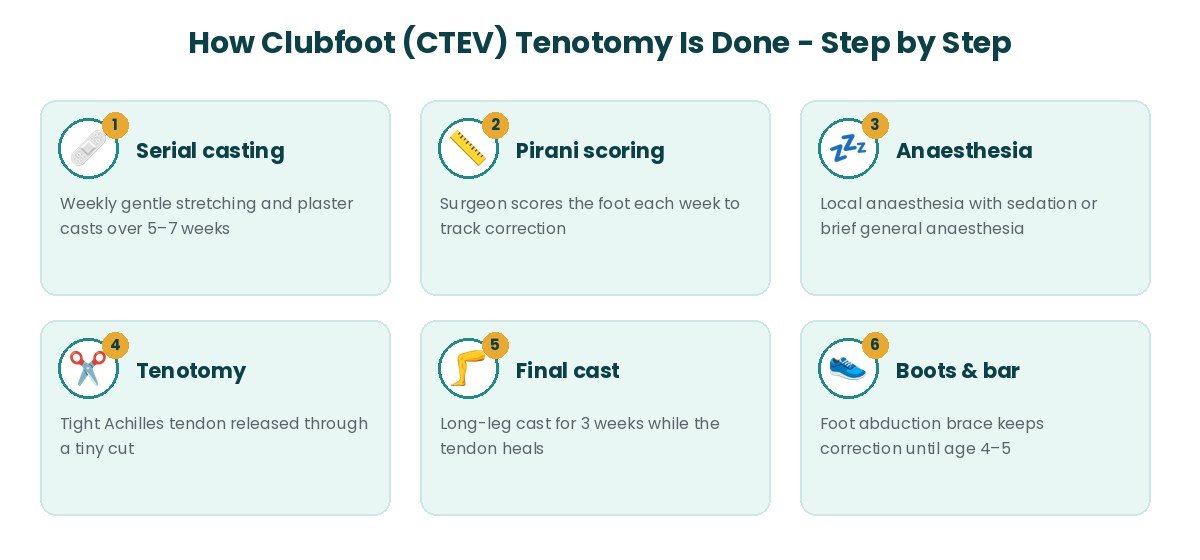
The modern treatment is the Ponseti method. The foot is gently stretched and held in a series of plaster casts, changed every week for about 5–7 weeks. In most children (about 80–90%) a small procedure called percutaneous Achilles tenotomy is then done: the tight heel cord (Achilles tendon) is released through a tiny needle-sized cut under anaesthesia. A final cast is worn for 3 weeks while the tendon heals at its new length, followed by special foot abduction braces (boots and bar) to prevent the clubfoot from coming back.
🖼️ Understand It in Pictures
Bent vs corrected foot

👀 Symptoms in Pictures

📷 What It Looks Like (real photos)

🎬 The Treatment Journey in Pictures


📅 Recovery at a Glance

Drawings: Satyug Healthcare (simplified, not to scale). Photos: Wikimedia Commons; author and licence under each photo.
🩺 Conditions Treated
⚠️ Signs of Clubfoot
- ➤Foot turned inward and downward at birth
- ➤Heel small and pulled up
- ➤Deep crease on the inside of the foot
- ➤Calf on the affected side looks thinner
- ➤Foot cannot be easily moved to a normal position
- ➤Affected foot may be shorter
- ➤Child walks on the side or top of the foot (if untreated)
- ➤Clubfoot seen on pregnancy ultrasound
🔬 Tests Before Treatment
| Test | Why it is done |
|---|---|
| Clinical examination by paediatric orthopaedic surgeon | Confirms clubfoot and measures severity with the Pirani score. |
| Pirani / Dimeglio scoring | Grades severity and tracks progress with each cast. |
| Hip and spine examination | Checks for associated conditions such as hip dysplasia. |
| Neurological examination | Rules out nerve or spine problems causing the deformity. |
| Foot X-rays (older children only) | Used in older or relapsed cases; usually not needed in babies. |
| Basic blood tests (if anaesthesia planned) | Fitness check before tenotomy under anaesthesia. |
🏥 The Procedure — Step by Step
⚖️ Treatment Options for Clubfoot
| Option | What is done | Best for |
|---|---|---|
| Ponseti casting + tenotomy (this package) | Weekly casts, Achilles tenotomy, 3-week cast, then brace | Most babies and young children |
| Ponseti casting alone | Casting and brace without tenotomy | Mild, flexible clubfeet (about 10–20%) |
| Tibialis anterior tendon transfer | Moving a tendon to the outer foot | Relapse with dynamic in-turning, age 3+ years |
| Repeat casting with re-tenotomy | Further casts and tendon release | Early relapse |
| Posteromedial release / bony surgery | Open soft-tissue or bone surgery | Neglected, rigid or syndromic clubfoot in older children |
📅 Your Day-by-Day Plan in India
| Day | What happens |
|---|---|
| Week 1–6 | (If not done at home) Arrival in India ✈️; weekly Ponseti casting with the paediatric orthopaedic surgeon |
| Day 1 of tenotomy week | Review of the foot and pre-anaesthesia check |
| Day 2 | Admission and percutaneous Achilles tenotomy; final cast applied |
| Day 3 | Discharge after 2-day stay; cast care training for parents |
| Week 1–3 after tenotomy | Rest at hotel; cast and skin check visits |
| End of week 3 | Cast removal, boots and bar fitted, brace training for parents |
| Week 3–4 | Brace check visit and home plan – Fly home ✈️ |
🌱 Recovery After Treatment
🏆 Success Rate
| Outcome | Result |
|---|---|
| Initial correction with Ponseti | About 90–95% |
| Children needing tenotomy | About 80–90% |
| Need for major open surgery | Under 5% |
| Relapse with good brace use | About 5–15% |
| Relapse without brace use | Up to 80% |
The most important factor for long-term success is wearing the boots and bar exactly as advised until age 4–5. Starting early (in the first weeks of life) also makes casting quicker and easier.
🩹 Risks & Possible Complications
The Ponseti method and tenotomy are very safe.
- •Skin pressure sores or blisters from casts (about 5–10%, usually minor)
- •Cast slipping, needing a new cast
- •Minor bleeding from the tenotomy site
- •Relapse of deformity, mainly if the brace is not used
- •Brace-related skin irritation
- •Need for later tendon transfer surgery (about 10–20%)
- •Very rarely, injury to a nearby blood vessel or nerve
💰 Cost of Clubfoot (CTEV) Tenotomy in India
The cost of clubfoot tenotomy surgery in India starts from about USD 2,500, including the tenotomy procedure, anaesthesia, a 2-day stay in a private room and the final cast. Serial casting before tenotomy, the boots and bar brace, and treatment of both feet or relapsed clubfoot may change the final cost.
| Option / Hospital tier | Approx. cost (USD) | Hospital stay | Notes |
|---|---|---|---|
| Clubfoot tenotomy (this package) | 2,500 | 2 days | Private room; tenotomy + final cast |
| Full Ponseti programme (casting + tenotomy + brace) | 3,000 – 4,000 | 2 days + weekly OPD | One or both feet |
| Tibialis anterior tendon transfer (relapse) | 3,500 – 5,000 | 2–3 days | Children over 3 years |
| Open clubfoot surgery (neglected / rigid) | 4,500 – 7,000 | 3–5 days | Soft-tissue or bony correction |

📋 What the Package Includes
- ✔Paediatric orthopaedic surgeon's fee
- ✔Anaesthesia for tenotomy
- ✔Percutaneous Achilles tenotomy
- ✔Final long-leg cast
- ✔2-day stay in a private room
- ✔Nursing care
- ✔Medicines during stay
- ✖Serial casting before tenotomy (if needed)
- ✖Foot abduction brace (boots and bar)
- ✖Treatment of relapse
- ✖Extra hospital days
- ✖Hotel stay and meals
- ✖Flights and visa fees
✈️ Your Medical Travel Process with Satyug Healthcare

| Step | Details |
|---|---|
| 1. Send reports | Clear photos or a short video of the baby's feet from the front, side and sole, child's age and weight, details of any casting or treatment already done, birth history and any other medical conditions. |
| 2. Free opinion & quotes | Within 48-72 hours you receive opinions and cost estimates from 3-5 leading hospitals to compare. |
| 3. Choose hospital & doctor | We help you compare doctors, success rates, room options and total budget. |
| 4. Medical visa | The hospital issues a Visa Invitation Letter (VIL) to the Indian Embassy. The patient and up to 2 attendants apply for an e-Medical / Medical Attendant visa. |
| 5. Travel planning | Flight guidance, wheelchair assistance, airport pick-up, hotel or guest house near the hospital. |
| 6. Treatment in India | Your coordinator and interpreter stay with you for admission, treatment, discharge and billing. |
| 7. Return & follow-up | Fit-to-fly letter, medicines, and online follow-up with your doctor after you return home. |
🎒 Travel Checklist
- 📌Valid passport (6+ months) for the patient and attendants, plus 10 passport-size photos each
- 📌Medical visa / e-visa and the hospital’s Visa Invitation Letter
- 📌All photos/videos of the feet, previous treatment notes, any X-ray reports and prescriptions
- 📌Yellow fever vaccination certificate (mandatory for travellers from African countries)
- 📌Polio vaccination certificate where applicable
- 📌Declare cash above USD 5,000 at the airport; hospitals accept wire transfer and cards
- 📌Foreigners staying longer than permitted must register with the FRRO — our team assists
⭐ Why Choose Satyug Healthcare?
❓ Frequently Asked Questions
➤ What is the cost of clubfoot tenotomy in India?
➤ At what age should treatment start?
➤ How long do we need to stay in India?
➤ Is tenotomy painful for my baby?
➤ Is it major surgery?
➤ What is the success rate?
➤ Why is the brace so important?
➤ How long must my child wear the brace?
➤ Will my child walk normally?
➤ Can both feet be treated together?
➤ What if the clubfoot comes back?
➤ Can both parents travel?
➤ What should we send for a free opinion?
➤ Will an interpreter be available?
Medical disclaimer: This page is for general information and does not replace a consultation with a qualified specialist. Treatment plans and costs are confirmed only after the patient is examined. Sources: NCBI StatPearls: Clubfoot (Congenital Talipes Equinovarus); Ponseti International Association; AAOS OrthoInfo: Clubfoot; NHS: Club foot; Pediatric Orthopaedic Society of North America (POSNA); Morcuende JA et al., J Pediatr Orthop 2004 (Ponseti outcomes). Infographics: Satyug Healthcare.
Clubfoot (CTEV) tenotomy in India from USD 2,500 – Ponseti casting & Achilles tendon release by paediatric orthopaedic surgeons, 2-day stay, ~95% success.


TOP HOSPITALS
Special High-quality Hospitals



HAPPY PATIENTS
What Our Patients Are Saying