Abdominoperineal Resection Surgery
Assistance
Consultation
Services
Opinion
Care Coordination
What will your treatment cost?

See the cost breakdown by option, hospital and city →
| Surgery Name | Cost | Room | Hospitalization |
|---|---|---|---|
| Abdominoperineal Resection Surgery | $6500 | Single | Patient - 2 days stay in a single room. |
✓ Inclusion
- ✔Consultation with colorectal / surgical oncologist
- ✔Routine pre-operative blood tests, ECG and chest X-ray
- ✔Stoma site marking and stoma nurse counselling
- ✔Surgeon's and anaesthetist's fees
- ✔Operation theatre charges and standard consumables
- ✔Abdominoperineal resection with total mesorectal excision and end colostomy
- ✔2-day hospital stay in a single room
- ✔Nursing care and hospital meals
- ✔Medicines during the package stay
- ✔Histopathology of the removed specimen
- ✔Initial stoma supplies and care training
- ✔Free: airport pick-up & drop, visa invitation letter, interpreter & coordinator (Satyug Healthcare)
✗ Exclusion
- ✖Hospital days beyond the 2-day package (most patients need 6–9 days)
- ✖ICU / HDU stay
- ✖Laparoscopic or robotic surgery surcharge
- ✖Flap reconstruction or biological mesh
- ✖Staging scans (MRI, CT, PET-CT) and colonoscopy
- ✖Chemotherapy and radiotherapy
- ✖Blood and blood products
- ✖Stoma supplies and medicines after discharge
- ✖Hotel stay, meals, flights, visa fees and travel insurance
- ✖Treatment of complications or unrelated conditions
Know More About Procedure & Surgery
Abdominoperineal Resection (APR) Surgery in India
APR removes very low rectal and anal canal cancers with the anus and sphincter muscles and creates a permanent colostomy. Done by fellowship-trained colorectal and surgical oncologists at accredited Indian cancer centres, with stoma nurse training, at a fraction of Western cost.
📖 What is Abdominoperineal Resection?
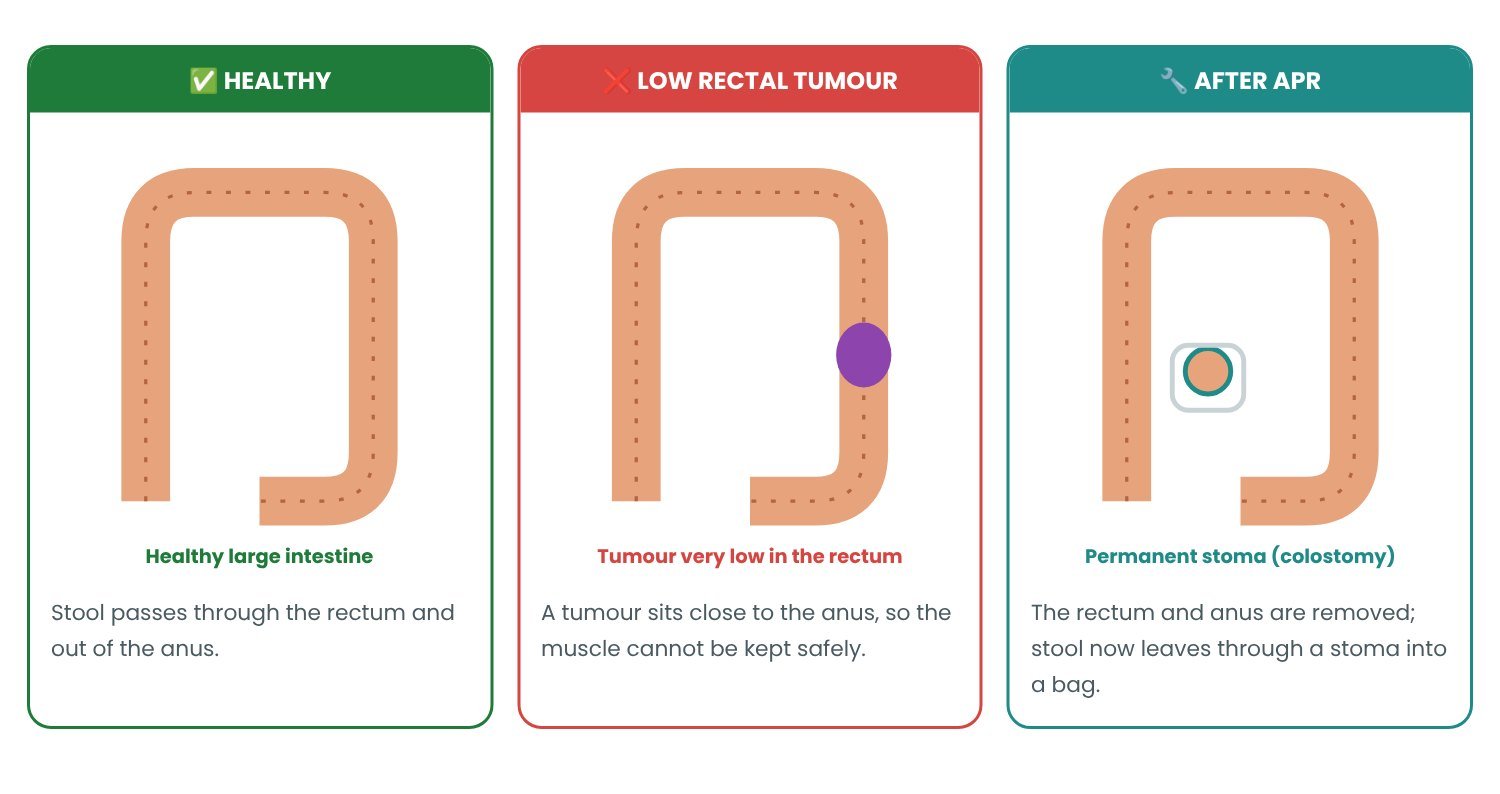
The rectum is the last 12–15 cm of the large bowel, where stool is stored before it leaves through the anus. The anus is closed by ring-shaped muscles called sphincters. When a cancer grows very low in the rectum, close to or into these muscles, it often cannot be removed safely while keeping the anus working.
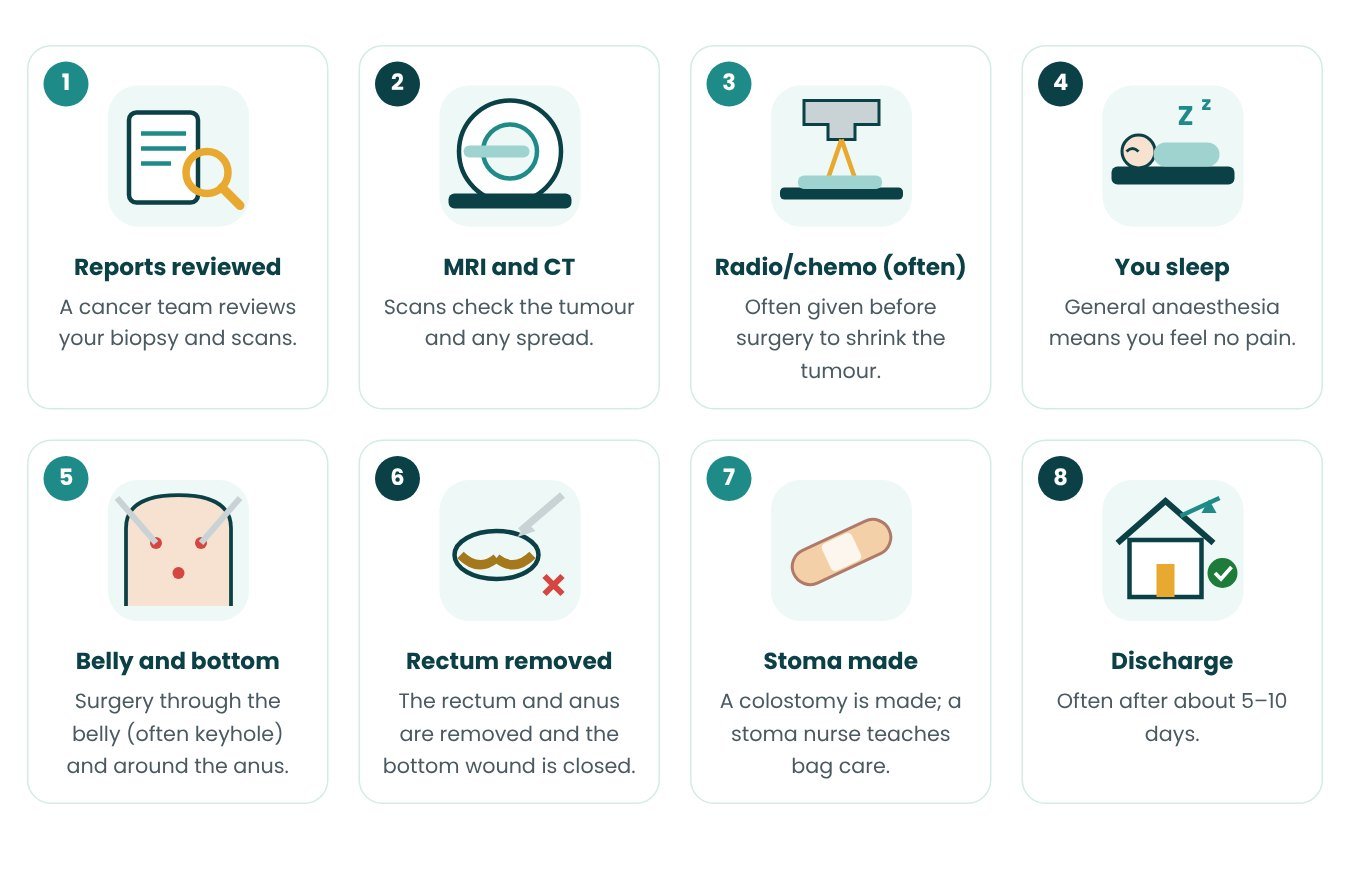
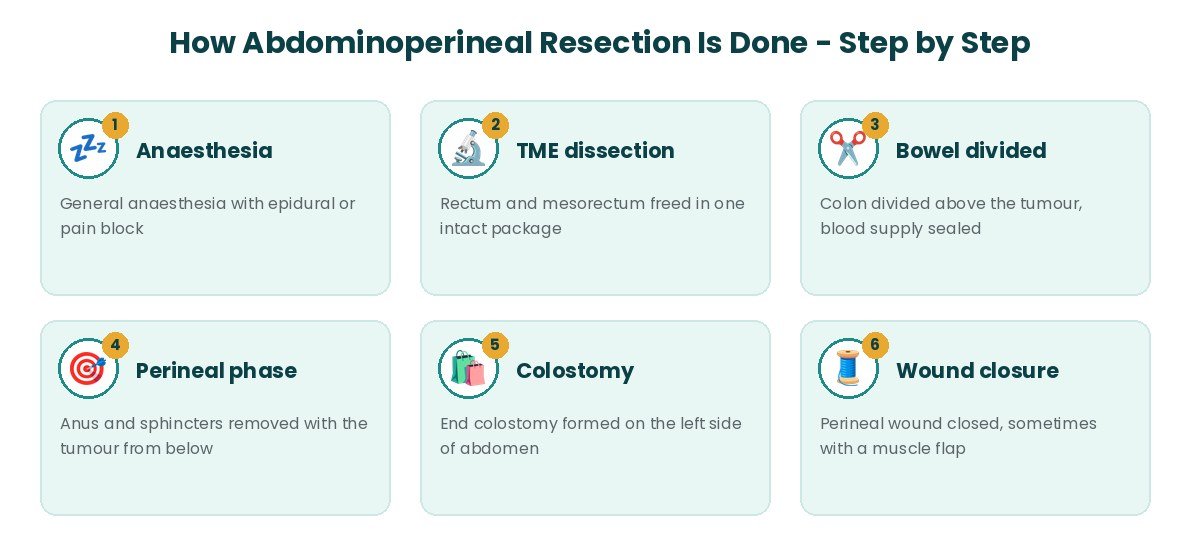
Abdominoperineal resection (APR), also called the Miles operation, removes the lower part of the bowel, the rectum, the anus and the sphincter muscles through the abdomen and the area between the legs (perineum). The surrounding fatty tissue and lymph nodes (mesorectum) are removed in one piece to lower the chance of cancer returning. The end of the bowel is brought out on the left side of the abdomen as a permanent colostomy, where stool collects in a bag. APR can be done open, laparoscopically (keyhole) or robotically; an extended version (ELAPE) is used for some tumours.
🖼️ Understand It in Pictures
Healthy bowel vs low rectal tumour vs after APR
👀 Symptoms in Pictures
🩻 Scans & Tests — What Doctors See


🎬 The Treatment Journey in Pictures

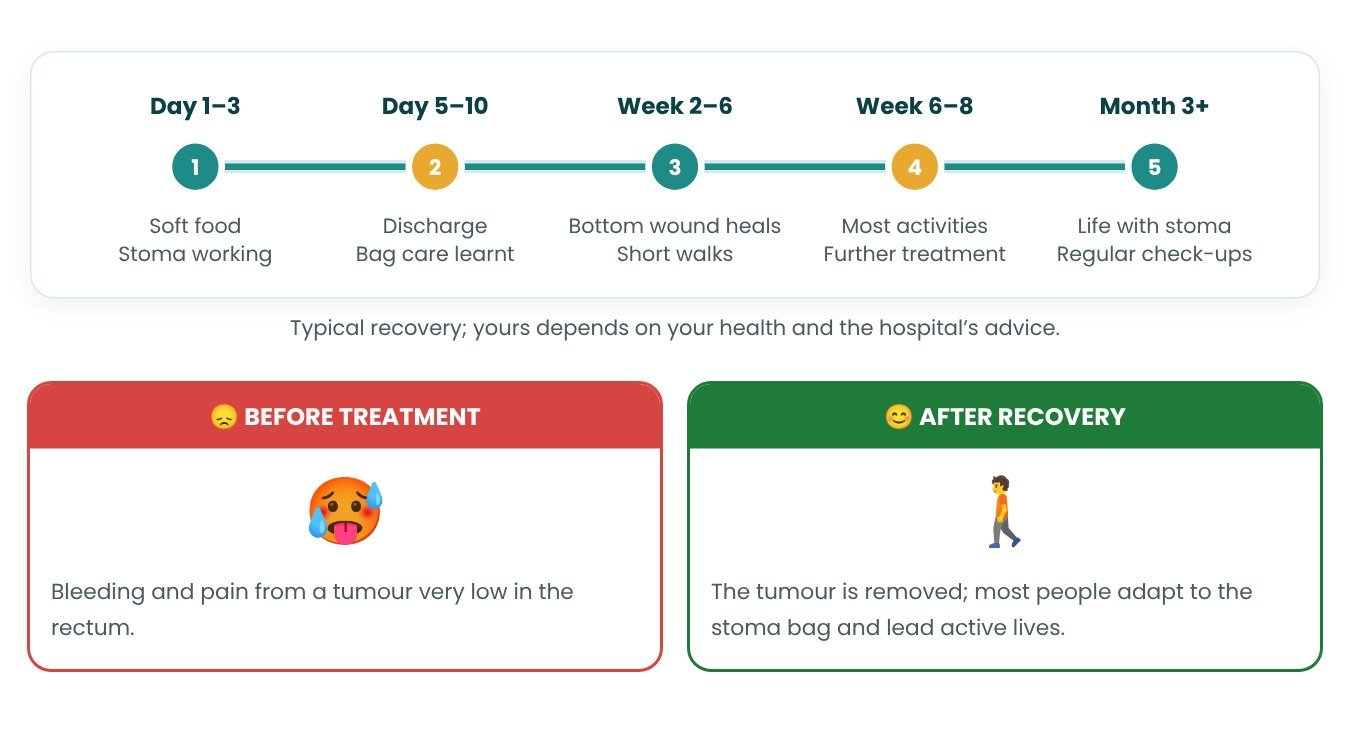
📅 Recovery at a Glance
Drawings: Satyug Healthcare (simplified, not to scale). Photos: Wikimedia Commons; author and licence under each photo.
🩺 Conditions Treated
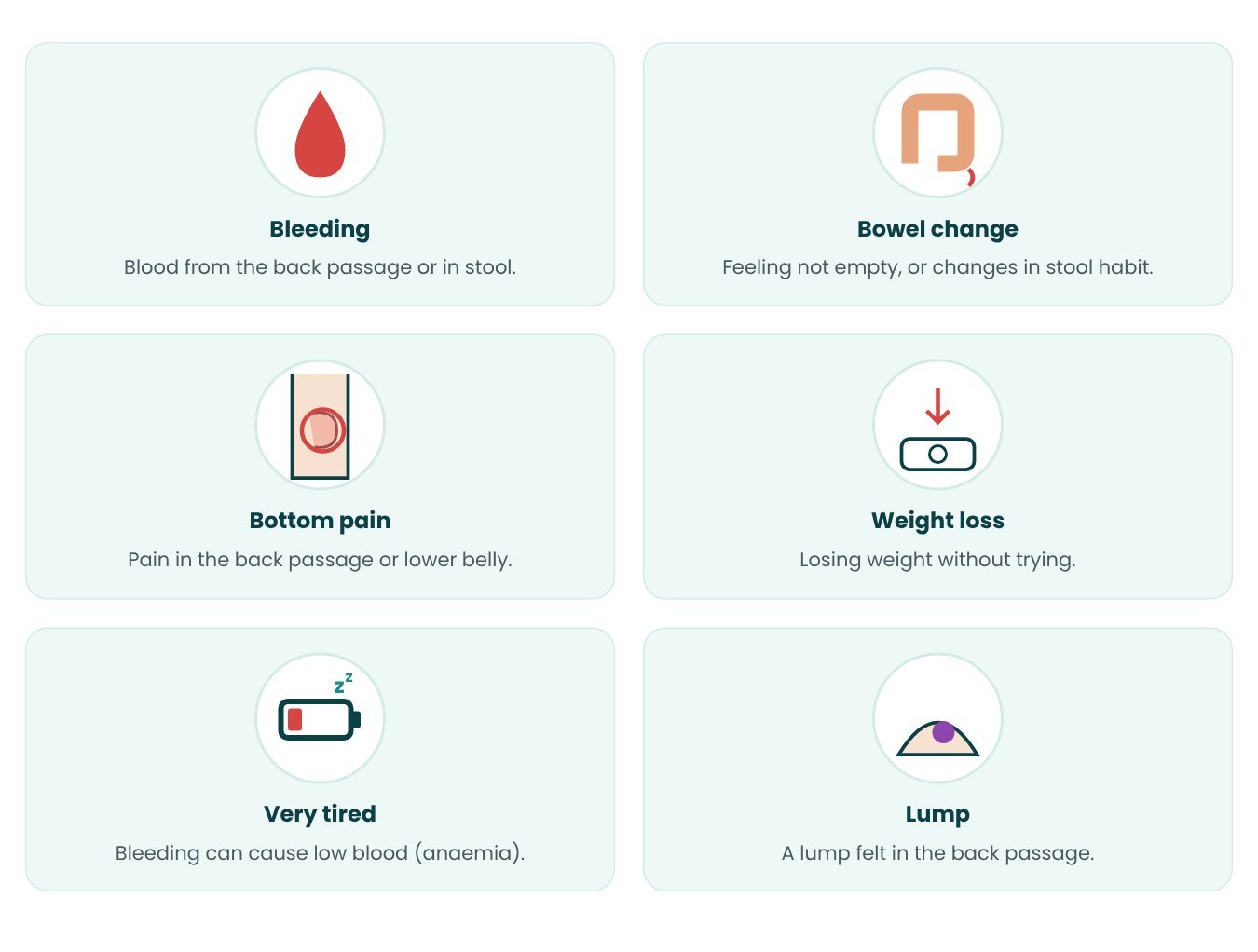
⚠️ Symptoms That May Need Evaluation
- ➤Blood in or on the stool
- ➤Change in bowel habit for more than 3 weeks
- ➤Feeling of incomplete emptying
- ➤Pain or a lump near the anus
- ➤Mucus discharge from the back passage
- ➤Unexplained weight loss
- ➤Tiredness from anaemia
- ➤Thin or pencil-like stools
🔬 Tests Before Treatment
| Test | Why it is done |
|---|---|
| Colonoscopy with biopsy | Confirms cancer and checks the rest of the bowel. |
| Pelvic MRI (rectal cancer protocol) | Shows tumour depth, distance from sphincters and lymph nodes; key for planning. |
| CT chest, abdomen and pelvis or PET-CT | Checks for spread to liver, lungs or other organs. |
| CEA blood test | Tumour marker used as a baseline and for follow-up. |
| Blood tests, ECG, echo and lung function | Check fitness for major surgery and anaesthesia. |
| Stoma site marking | A stoma nurse marks the best place for the colostomy before surgery. |
🏥 The Procedure — Step by Step
⚖️ Types & Techniques
| Technique | What is done | Best for |
|---|---|---|
| Open APR | Abdominal phase through a midline cut | Large tumours, previous surgery, limited access |
| Laparoscopic APR | Abdominal phase by keyhole surgery | Most patients; less pain and faster recovery |
| Robotic APR | Abdominal phase with robotic arms for precise pelvic work | Narrow pelvis, obese patients, nerve preservation |
| Extralevator APR (ELAPE) | Wider removal of pelvic floor muscles (cylindrical specimen) | Tumours invading the levator muscles |
| Low anterior resection (alternative) | Rectum removed, bowel joined, anus kept | Tumours higher than the sphincters |
📅 Your Day-by-Day Plan in India
| Day | What happens |
|---|---|
| Day 1 | Arrival in India ✈️, airport pick-up and hotel check-in |
| Day 2–4 | Surgical oncologist consultation, MRI/CT/PET review, fitness tests and tumour board |
| Day 5 | Admission, stoma site marking and preparation |
| Day 6 | Abdominoperineal resection surgery |
| Day 7–8 | Package hospital stay (2 days); early walking and stoma care starts – further in-hospital days as advised by the surgeon are charged extra |
| Day 9–14 | Recovery (in hospital or nearby hotel as advised), stoma care training for patient and caregiver |
| Day 15–21 | Wound checks, histopathology report, oncologist review for further treatment |
| Day 22–28 | Final review and fit-to-fly check – Fly home ✈️ |
🌱 Recovery After Treatment
🏆 Success Rate
| Outcome | Result |
|---|---|
| Clear resection margin (R0) | About 90–95% in expert centres |
| Local recurrence at 3–5 years | About 5–10% |
| 5-year survival – stage I | About 85–90% |
| 5-year survival – stage III | About 60–70% |
| Perineal wound problems | About 20–40% |
Results depend mainly on cancer stage, response to chemoradiation, a complete TME and clear margins, and the surgeon's experience. Perineal wound healing is slower after radiation, smoking or diabetes.
🩹 Risks & Possible Complications
APR is major cancer surgery. Possible risks include:
- •Perineal wound infection or slow healing (about 20–40%)
- •Urinary problems – difficulty passing urine (about 10–30%, often temporary)
- •Sexual problems – erectile or ejaculation difficulty in men, painful intercourse in women
- •Stoma problems – hernia (parastomal hernia up to 30%), skin irritation, retraction
- •Blood clots, chest infection, bleeding needing transfusion
- •Small bowel obstruction from adhesions
- •Perineal hernia (uncommon)
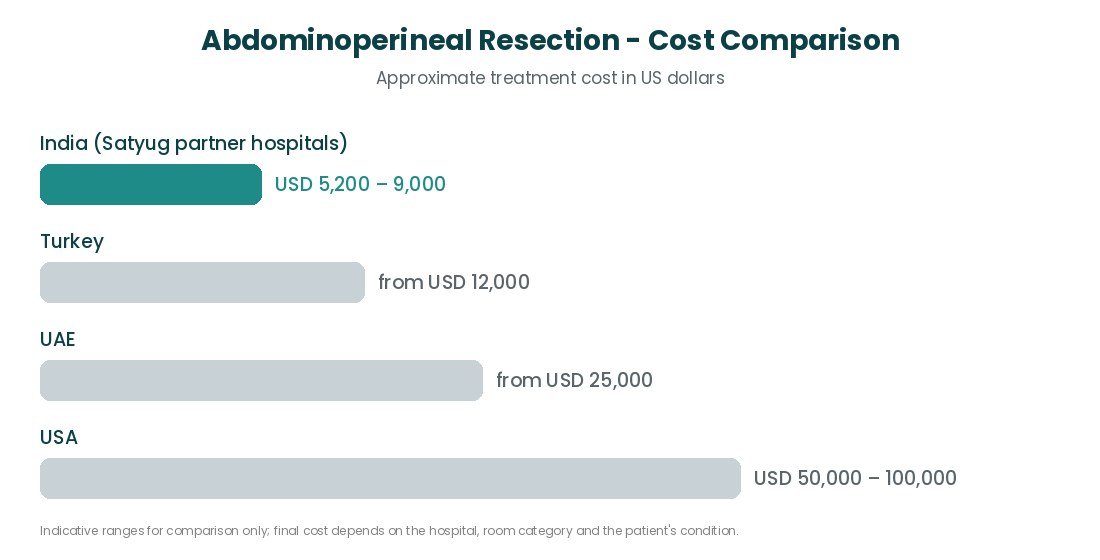
💰 Cost of Abdominoperineal Resection in India
The cost of abdominoperineal resection in India starts from about USD 6,500 for the surgery package with a 2-day single-room stay. Most patients need a longer hospital stay of about 6–9 days, which is charged extra. Laparoscopic or robotic surgery, ELAPE with flap reconstruction, ICU care, chemotherapy and radiation also add to the cost.
| Option / Hospital tier | Approx. cost (USD) | Hospital stay | Notes |
|---|---|---|---|
| APR surgery (this package) | 6,500 | 2 days (package) | Single room; extra days charged |
| Laparoscopic APR (typical full stay) | 7,000 – 9,000 | 6–9 days | Keyhole abdominal phase |
| Robotic APR | 9,000 – 12,000 | 5–8 days | Premium cancer centres |
| ELAPE with flap reconstruction | 9,000 – 13,000 | 8–12 days | Plastic surgery flap for perineal closure |
| Pre-operative chemoradiation (if needed) | 4,000 – 7,000 | Outpatient | 5–6 weeks of treatment |
📋 What the Package Includes
- ✔Surgical oncologist and anaesthesia fees
- ✔Operation theatre charges
- ✔2-day stay in a single room
- ✔Nursing care
- ✔Routine medicines and consumables
- ✔Stoma nurse counselling
- ✔Histopathology of the specimen
- ✖Extra hospital days beyond 2 days
- ✖ICU stay
- ✖Laparoscopic/robotic surcharge
- ✖Flap reconstruction
- ✖Chemotherapy and radiotherapy
- ✖PET-CT and other staging scans
- ✖Stoma bags after discharge
- ✖Hotel stay, flights and visa
✈️ Your Medical Travel Process with Satyug Healthcare

| Step | Details |
|---|---|
| 1. Send reports | Colonoscopy and biopsy report, pelvic MRI (rectal protocol) and CT/PET-CT with images, CEA level, details of any chemotherapy or radiation given, and a summary of other illnesses and medicines. |
| 2. Free opinion & quotes | Within 48-72 hours you receive opinions and cost estimates from 3-5 leading hospitals to compare. |
| 3. Choose hospital & doctor | We help you compare doctors, success rates, room options and total budget. |
| 4. Medical visa | The hospital issues a Visa Invitation Letter (VIL) to the Indian Embassy. The patient and up to 2 attendants apply for an e-Medical / Medical Attendant visa. |
| 5. Travel planning | Flight guidance, wheelchair assistance, airport pick-up, hotel or guest house near the hospital. |
| 6. Treatment in India | Your coordinator and interpreter stay with you for admission, treatment, discharge and billing. |
| 7. Return & follow-up | Fit-to-fly letter, medicines, and online follow-up with your doctor after you return home. |
🎒 Travel Checklist
- 📌Valid passport (6+ months) for the patient and attendants, plus 10 passport-size photos each
- 📌Medical visa / e-visa and the hospital’s Visa Invitation Letter
- 📌All colonoscopy, biopsy, MRI, CT/PET-CT reports, scans on CD / link and prescriptions
- 📌Yellow fever vaccination certificate (mandatory for travellers from African countries)
- 📌Polio vaccination certificate where applicable
- 📌Declare cash above USD 5,000 at the airport; hospitals accept wire transfer and cards
- 📌Foreigners staying longer than permitted must register with the FRRO — our team assists
⭐ Why Choose Satyug Healthcare?
❓ Frequently Asked Questions
➤ What is the cost of abdominoperineal resection in India?
➤ How long will I be in hospital?
➤ How long should I stay in India?
➤ Will I have a permanent colostomy bag?
➤ Can I avoid a permanent stoma?
➤ Do I need chemotherapy or radiation?
➤ What is the success rate?
➤ Is laparoscopic or robotic surgery better?
Medical disclaimer: This page is for general information and does not replace a consultation with a qualified specialist. Treatment plans and costs are confirmed only after the patient is examined. Sources: NCBI StatPearls: Abdominoperineal Resection; NCCN Guidelines: Rectal Cancer (2024); ESMO Rectal Cancer Clinical Practice Guidelines (2017); COLOR II trial (NEJM 2015); ACOSOG Z6051 and ALaCaRT trials (JAMA 2015); Cancer Research UK; Cleveland Clinic: Abdominoperineal Resection. Infographics: Satyug Healthcare.
Frequently Asked Questions
Abdominoperineal resection (APR) is surgery for low rectal or anal cancer that removes the lower colon, rectum, anus and sphincter muscles through incisions in the abdomen and the perineum. Because the anus is removed, a permanent colostomy is created.
Abdominoperineal resection (APR) in India from USD 6,500 – low rectal cancer surgery by colorectal oncologists, laparoscopic & robotic options, stoma care.


TOP HOSPITALS
Special High-quality Hospitals


HAPPY PATIENTS
What Our Patients Are Saying






























Our Gallery