
TAVI / TAVR Package – Meitra Hospital
Assistance
Consultation
Services
Opinion
Care Coordination
What will your treatment cost?

See the cost breakdown by option, hospital and city →
| Surgery Name | Cost | Room | Hospitalization |
|---|---|---|---|
| TAVI / TAVR Package – Meitra Hospital | 35000-40000 USD | Single | Patient - 2 days in ICU and 3 days in a single room |
✓ Inclusion
- ✔Transfemoral TAVI / TAVR procedure
- ✔Transcatheter aortic heart valve (as per package brand)
- ✔Interventional cardiologist, cardiac surgeon and anaesthetist fees
- ✔Cath lab / hybrid theatre charges and standard consumables
- ✔Temporary pacing wire and vascular closure device
- ✔2 days ICU stay after the procedure
- ✔3 days stay in a single room
- ✔Echocardiogram before discharge
- ✔Routine medicines, blood tests and nursing care during stay
- ✔Patient meals during admission
- ✔Free: airport pick-up & drop, visa invitation letter, interpreter & coordinator (Satyug Healthcare)
✗ Exclusion
- ✖Airfare, visa fees and travel insurance
- ✖Pre-procedure TAVI CT, coronary angiography and consultations unless listed
- ✖Permanent pacemaker if required
- ✖Coronary angioplasty or stents if required
- ✖Alternative access routes or embolic protection devices
- ✖Extra ICU or hospital days beyond the package
- ✖Treatment of complications
- ✖Medicines after discharge
- ✖Hotel, food and expenses of attendants
Know More About Procedure & Surgery
TAVI / TAVR Aortic Valve Replacement at Meitra Hospital, Kozhikode
A new aortic valve placed through a small puncture in the groin for patients with severe aortic stenosis, especially older or high-risk patients. Performed by the dedicated TAVI Centre heart team at NABH-accredited Meitra Hospital, Kerala, at far lower cost than the West.
📖 What is TAVI / TAVR?
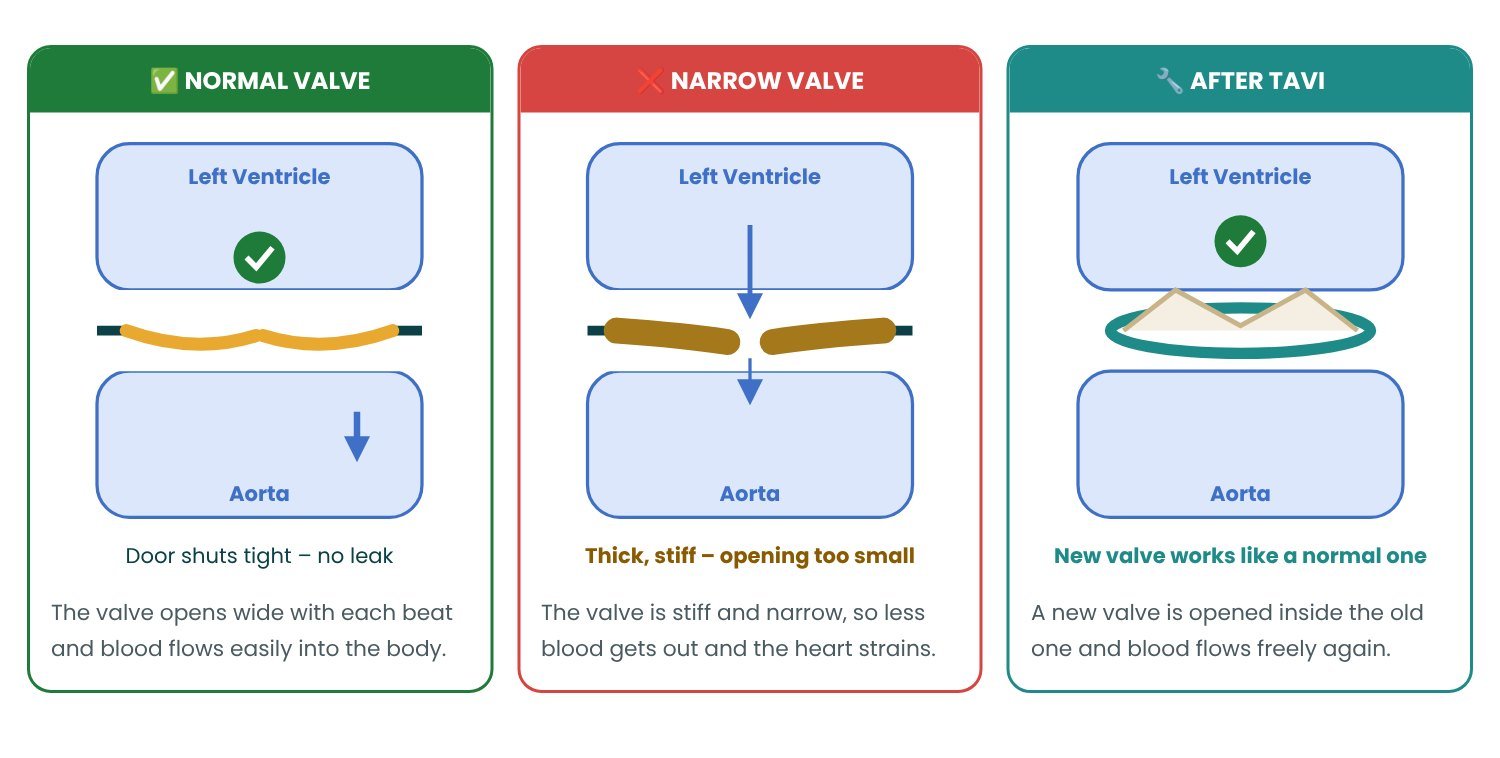
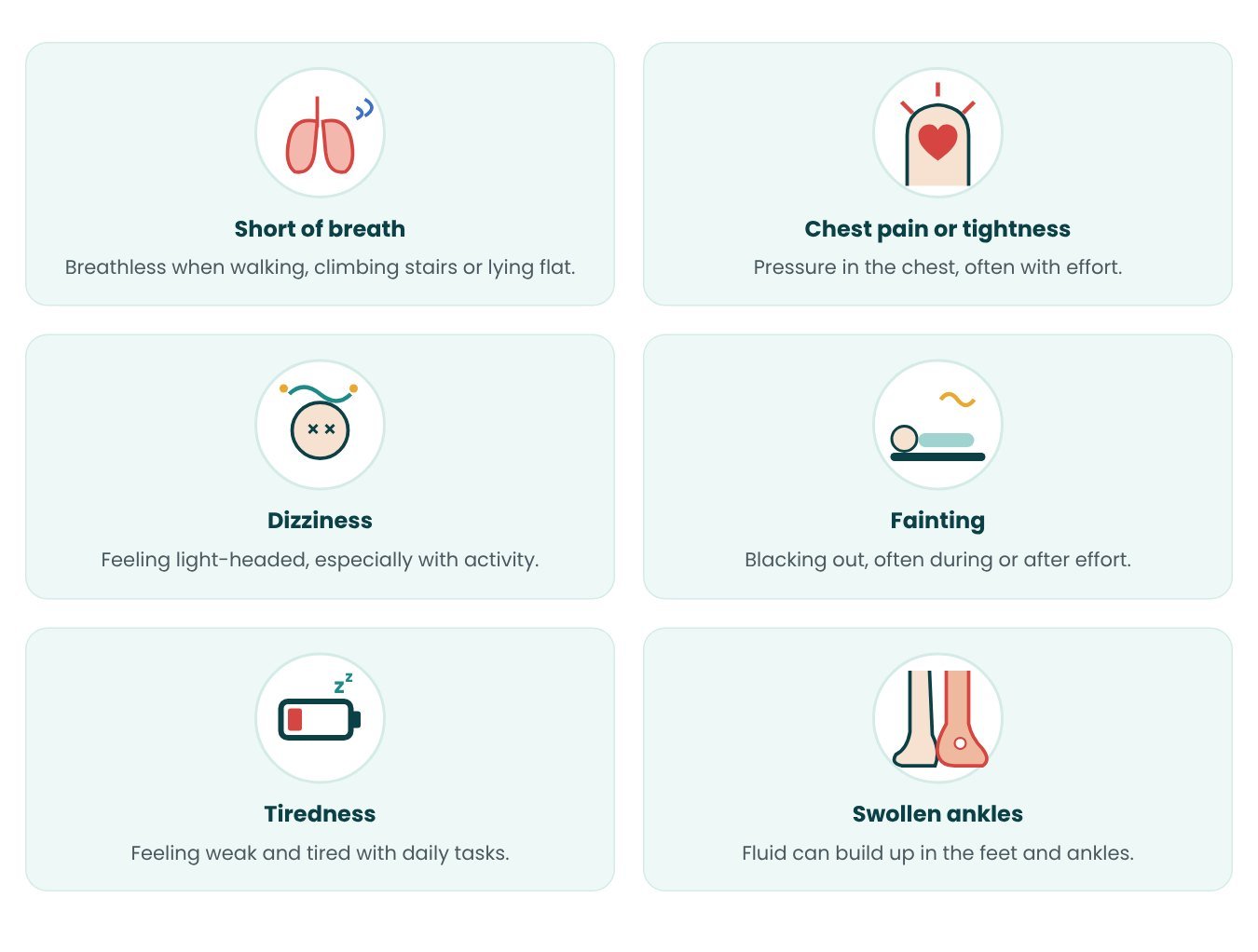
The aortic valve is the door between the heart's main pumping chamber and the main artery (aorta) that carries blood to the whole body. With age, calcium can build up on the valve so it becomes stiff and narrow. This is called aortic stenosis. The heart must push harder, causing breathlessness, chest pain and fainting. Once symptoms start, severe aortic stenosis is dangerous: without valve replacement, about half of patients die within 2 years.
TAVI (transcatheter aortic valve implantation), also called TAVR, replaces the valve without opening the chest. A new valve made of animal tissue on a metal frame is folded onto a thin tube (catheter), passed through an artery in the groin up to the heart, and opened inside the old valve. It starts working immediately. Most patients are awake with light sedation, walk the next day and recover much faster than after open-heart surgery.
🖼️ Understand It in Pictures
Normal vs narrowed aortic valve
👀 Symptoms in Pictures
🩻 Scans & Tests — What Doctors See


🎬 The Treatment Journey in Pictures


📅 Recovery at a Glance
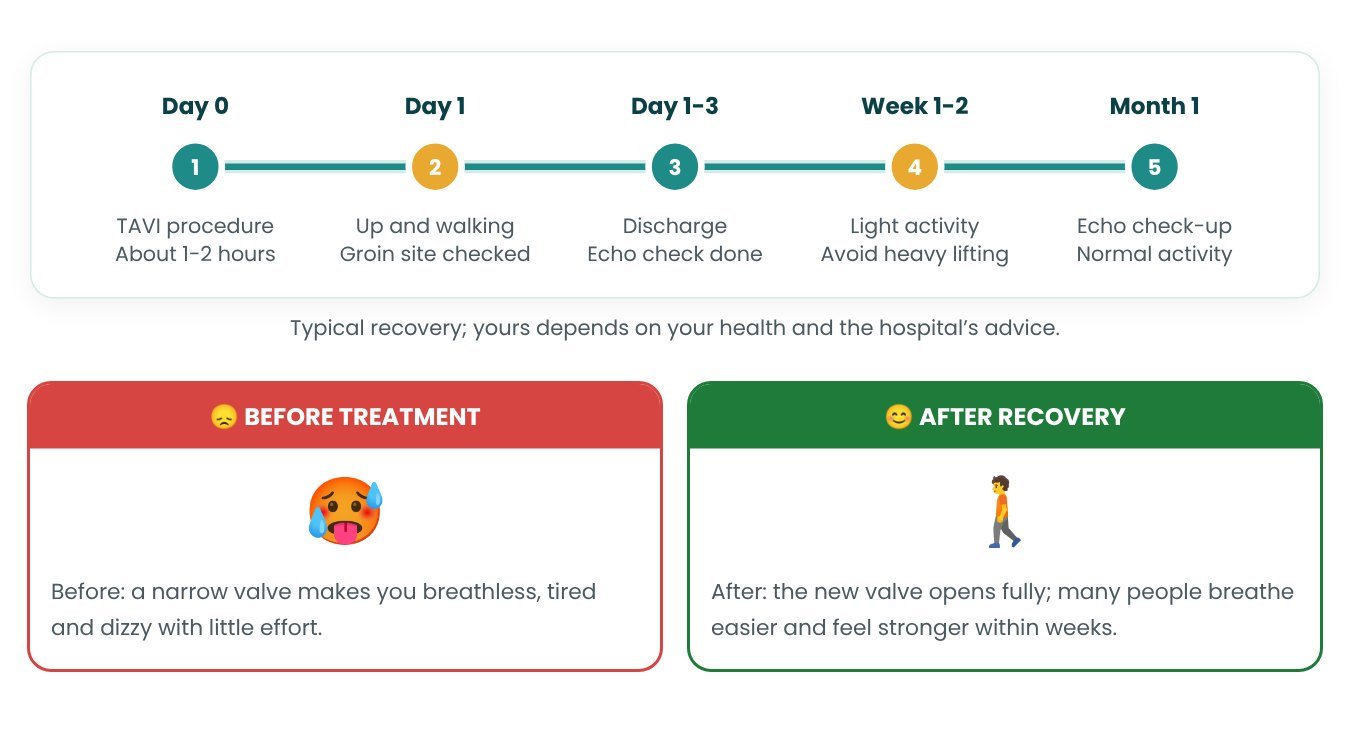
Drawings: Satyug Healthcare (simplified, not to scale). Photos: Wikimedia Commons; author and licence under each photo.
🩺 Who Needs TAVI
⚠️ Symptoms of Severe Aortic Stenosis
- ➤Breathlessness on walking or climbing stairs
- ➤Chest pain or tightness on exertion
- ➤Dizziness or fainting
- ➤Tiredness and reduced ability to exercise
- ➤Swelling of the ankles
- ➤Fast or pounding heartbeat
- ➤Heart murmur heard by a doctor
- ➤Waking at night short of breath
🔬 Tests Before Treatment
| Test | Why it is done |
|---|---|
| Echocardiogram | Measures valve narrowing (valve area, pressure gradient) and heart function. |
| CT angiography (TAVI CT) | Measures the valve ring and checks groin and aorta arteries for valve sizing and access. |
| Coronary angiography | Checks for blocked heart arteries that may need stents. |
| ECG | Checks heart rhythm and conduction (risk of pacemaker). |
| Blood tests | Kidney function, blood count, clotting and blood group. |
| Lung function and frailty assessment | Helps the heart team choose TAVI or surgery. |
| Dental check | Treats tooth infections to protect the new valve. |
🏥 The Procedure — Step by Step

⚖️ Types & Techniques
| Option | What is done | Best for |
|---|---|---|
| Transfemoral TAVI | Valve passed through the groin artery | Most patients (about 90%) |
| Alternative access (transapical / trans-aortic / subclavian) | Valve passed through chest or shoulder artery | Patients with narrow or diseased leg arteries |
| Balloon-expandable valve | Valve opened with a balloon | Suitable anatomy chosen by the heart team |
| Self-expanding valve | Valve opens by itself from its frame | Small valve rings, valve-in-valve |
| Surgical AVR (open heart) | Chest opened, valve replaced on heart-lung machine | Younger, low-risk patients |
📅 Your Day-by-Day Plan in India
| Day | What happens |
|---|---|
| Day 1 | Arrival in Kozhikode (Calicut), airport pick-up and hotel check-in |
| Day 2–3 | Heart team consultation, echo, TAVI CT, angiography and tests |
| Day 4 | Admission and TAVI procedure |
| Day 5 | ICU care – up and sitting, heart rhythm monitored (2 days ICU) |
| Day 6–8 | Single room stay, walking, echo check (3 days) |
| Day 9 | Discharge |
| Day 10–12 | Hotel rest and outpatient review |
| Day 13–14 | Final check with cardiologist and fly home ✈️ |
🌱 Recovery After Treatment
🏆 Success Rate
| Outcome | Result |
|---|---|
| Procedure success (valve correctly placed) | About 97–99% |
| 30-day survival | About 97–99% |
| Major stroke at 30 days | About 1–3% |
| Need for permanent pacemaker | About 5–15% (depends on valve type) |
| Improvement in breathlessness | Most patients within weeks |
Results depend on age, frailty, kidney and lung function, artery size and valve anatomy. Careful CT planning and an experienced heart team are key to good outcomes.
🩹 Risks & Possible Complications
TAVI is much less invasive than open surgery, but it still has risks:
- •Heart rhythm block needing a permanent pacemaker (about 5–15%)
- •Bleeding or damage at the groin artery (about 2–8%)
- •Stroke (about 1–3%)
- •Leak around the new valve (mild in many, moderate or worse in about 1–5%)
- •Kidney strain from X-ray dye
- •Valve infection (endocarditis) – rare
- •Rare emergencies such as coronary blockage or tear needing surgery (under 1%)
💰 Cost of TAVI / TAVR in India
The cost of TAVI / TAVR at Meitra Hospital, Kerala starts from about USD 35,000, including the transcatheter valve, the procedure, 2 days in ICU and 3 days in a single room. The valve itself is the largest part of the cost; the brand, extra devices and any pacemaker can change the final price.
| Option / Hospital tier | Approx. cost (USD) | Hospital stay | Notes |
|---|---|---|---|
| TAVI at Meitra Hospital – this package | 35,000 | 2 days ICU + 3 days single room | Transfemoral TAVI with imported valve |
| TAVI with alternative access | 37,000 – 42,000 | 6–8 days | Transapical / trans-aortic / subclavian |
| Valve-in-valve TAVI | 35,000 – 40,000 | 5–6 days | Inside a failed surgical valve |
| Surgical aortic valve replacement (open) | 8,000 – 12,000 | 7–10 days | For younger, low-risk patients |

📋 What the Package Includes
- ✔TAVI procedure (transfemoral)
- ✔Transcatheter heart valve
- ✔Heart team and anaesthesia fees
- ✔Cath lab charges and standard consumables
- ✔2 days ICU + 3 days single room
- ✔Echo before discharge
- ✔Routine medicines
- ✔Nursing care and meals
- ✖Flights and visa fees
- ✖Hotel stay
- ✖Pre-procedure TAVI CT and angiography unless listed
- ✖Permanent pacemaker if needed
- ✖Coronary stents if needed
- ✖Extra ICU or hospital days
- ✖Medicines after discharge
- ✖Attendant food and stay
✈️ Your Medical Travel Process with Satyug Healthcare

| Step | Details |
|---|---|
| 1. Send reports | Recent echocardiogram report (with valve area, peak velocity and mean gradient), any TAVI CT angiography and coronary angiography (images on CD or link), ECG, kidney function test, list of medicines, age, and details of other illnesses or previous heart surgery. |
| 2. Free opinion & quotes | Within 48-72 hours you receive opinions and cost estimates from 3-5 leading hospitals to compare. |
| 3. Choose hospital & doctor | We help you compare doctors, success rates, room options and total budget. |
| 4. Medical visa | The hospital issues a Visa Invitation Letter (VIL) to the Indian Embassy. The patient and up to 2 attendants apply for an e-Medical / Medical Attendant visa. |
| 5. Travel planning | Flight guidance, wheelchair assistance, airport pick-up, hotel or guest house near the hospital. |
| 6. Treatment in India | Your coordinator and interpreter stay with you for admission, treatment, discharge and billing. |
| 7. Return & follow-up | Fit-to-fly letter, medicines, and online follow-up with your doctor after you return home. |
🎒 Travel Checklist
- 📌Valid passport (6+ months) for the patient and attendants, plus 10 passport-size photos each
- 📌Medical visa / e-visa and the hospital’s Visa Invitation Letter
- 📌All echo, CT angiography and angiography reports on CD / link, and prescriptions
- 📌Yellow fever vaccination certificate (mandatory for travellers from African countries)
- 📌Polio vaccination certificate where applicable
- 📌Declare cash above USD 5,000 at the airport; hospitals accept wire transfer and cards
- 📌Foreigners staying longer than permitted must register with the FRRO — our team assists
⭐ Why Choose Satyug Healthcare?
❓ Frequently Asked Questions
➤ How much does TAVI cost at Meitra Hospital, Kerala?
➤ Why is TAVI more expensive than open valve surgery?
➤ How long is the hospital stay?
➤ How long should I stay in India?
➤ Am I asleep during TAVI?
➤ Who is suitable for TAVI?
➤ What is the success rate?
➤ What are the main risks?
➤ How long does a TAVI valve last?
Medical disclaimer: This page is for general information and does not replace a consultation with a qualified specialist. Treatment plans and costs are confirmed only after the patient is examined. Sources: NCBI StatPearls: Transcatheter Aortic Valve Replacement and Aortic Stenosis; Mack et al., PARTNER 3, NEJM 2019; Leon et al., PARTNER 1B, NEJM 2010; 2020 ACC/AHA Valvular Heart Disease Guideline; 2021 ESC/EACTS Guidelines for valvular heart disease; Meitra Hospital TAVI Centre information. Infographics: Satyug Healthcare.
Frequently Asked Questions
A minimally invasive procedure to replace a diseased aortic valve through a catheter, without open-heart surgery.
TAVI / TAVR at Meitra Hospital, Kerala from USD 35,000: aortic valve replacement without open-heart surgery by a dedicated TAVI heart team. Free opinion.




TOP HOSPITALS
Special High-quality Hospitals


HAPPY PATIENTS
What Our Patients Are Saying




















Our Gallery



Get a Free Quote
Tell us what you need and share your medical reports. Our medical team prepares your treatment plan and cost estimate.
- Free medical opinion on your reports
- Your quote within 24–48 hours
- Help with visa invitation letter, travel and airport pickup
- Coordinators available on WhatsApp
Prefer to talk? Call +91-8860606766 or WhatsApp us.
Thank you! Your request is received.
Reference . Our medical team will send your free quote within 24–48 hours by e-mail or WhatsApp.
Chat on WhatsApp now