Rotablation (Rotational Atherectomy) Package
Assistance
Consultation
Services
Opinion
Care Coordination
What will your treatment cost?

See the cost breakdown by option, hospital and city →
| Surgery Name | Cost | Room | Hospitalization |
|---|---|---|---|
| Rotablation (Rotational Atherectomy) Package | 6000 USD | Private / Twin Sharing Room + 1 day CCU | 2-3 days in hospital; total stay in India 7-10 days |
| Rotablation + PTCA with 1 Drug-Eluting Stent | 6000 USD | Twin Sharing | 2-3 days hospital (1 day CCU) |
| Rotablation + PTCA with 2 Drug-Eluting Stents | 7500 USD | Twin Sharing | 3 days hospital (1 day CCU) |
✓ Inclusion
- ✔Rotablation (rotational atherectomy) with PTCA by a senior interventional cardiologist
- ✔Cath lab charges, guiding catheter, guidewires and balloons
- ✔Rotablation burr, RotaWire and advancer
- ✔One drug-eluting stent (DES)
- ✔2–3 days hospital stay including 1 day CCU (private / twin sharing room)
- ✔Local anaesthesia and sedation
- ✔Routine blood tests and ECG during admission
- ✔Routine medicines and consumables during stay
- ✔Nursing care, cardiologist visits and discharge summary
- ✔Free: airport pick-up & drop, visa invitation letter, interpreter & coordinator (Satyug Healthcare)
✗ Exclusion
- ✖Flight tickets and visa fees
- ✖Hotel stay before and after hospital admission
- ✖Additional stents, burrs or balloons
- ✖IVUS, OCT, FFR or intravascular lithotripsy
- ✖Pre-admission coronary angiography if done separately
- ✖Room upgrade beyond package room
- ✖Extra hospital days or treatment of complications
- ✖Medicines after discharge
- ✖Attendant food and personal expenses
Know More About Procedure & Surgery
Rotablation (Rotational Atherectomy) with Stenting in India
An advanced angioplasty technique that grinds away rock-hard calcium in heart arteries so a stent can be fully expanded, often avoiding bypass surgery in elderly or high-risk patients. Done by expert interventional cardiologists at leading Indian heart hospitals, at a fraction of Western cost.
📖 What is Rotablation?
In coronary artery disease, fatty plaque narrows the arteries that feed the heart. In older people, diabetics and patients with kidney disease, this plaque often turns hard with calcium, like bone. A normal angioplasty balloon cannot crack this calcium, and a stent placed in such an artery may not open fully. A poorly expanded stent has a higher chance of re-blocking or clotting.
Rotablation (rotational atherectomy, also called Rotablator or Rota PCI) uses a tiny, olive-shaped burr coated with diamond chips. It spins at about 140,000–180,000 rpm over a special wire and grinds the calcium into microscopic particles smaller than red blood cells, which are cleared naturally by the body. After this 'plaque modification', the artery is ballooned and a drug-eluting stent is placed, often guided by intravascular imaging (IVUS or OCT) to make sure it is fully expanded.
🖼️ Understand It in Pictures
Healthy vs hard calcified heart artery

👀 Symptoms in Pictures

🩻 Scans & Tests — What Doctors See


🎬 The Treatment Journey in Pictures
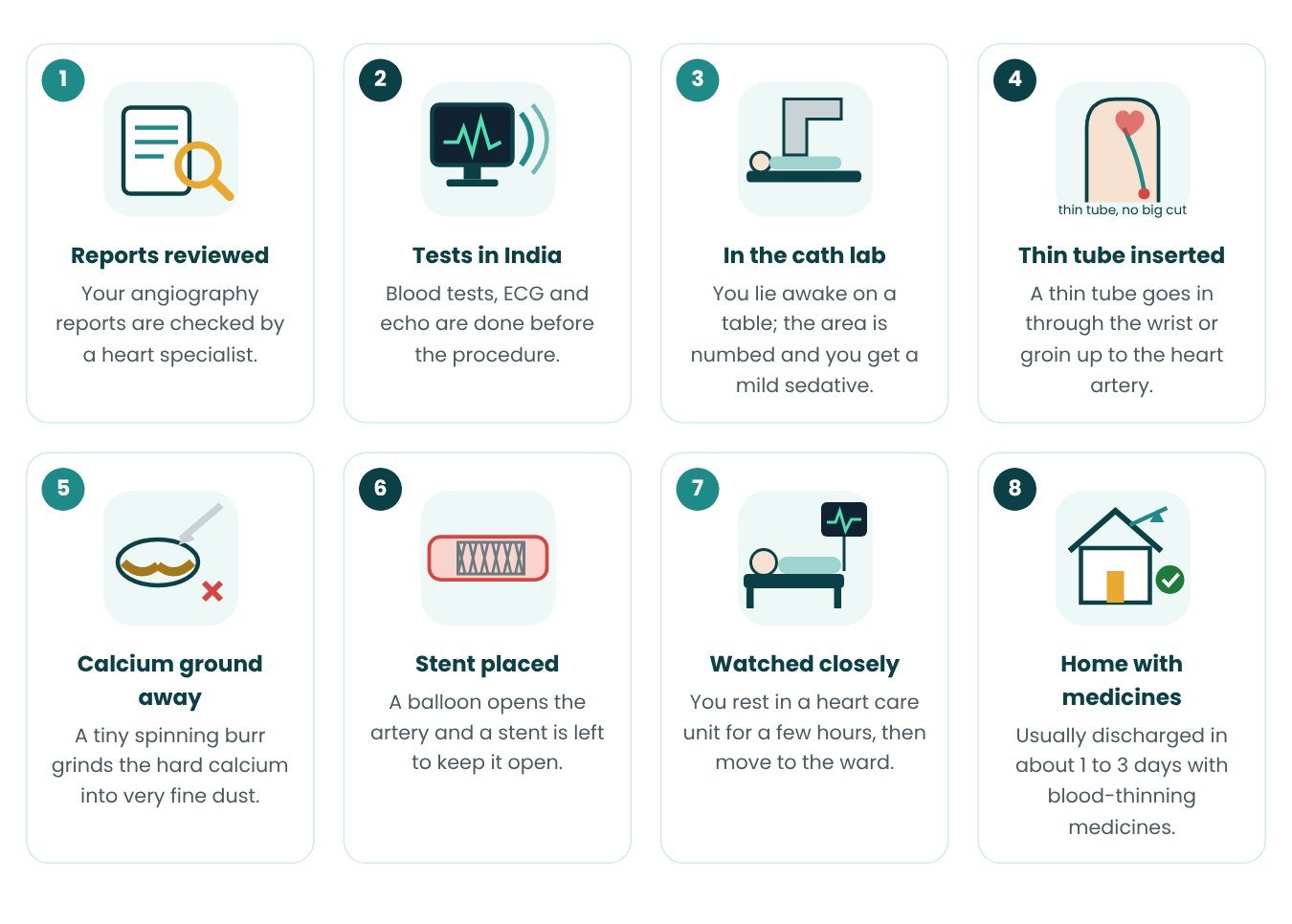

📅 Recovery at a Glance
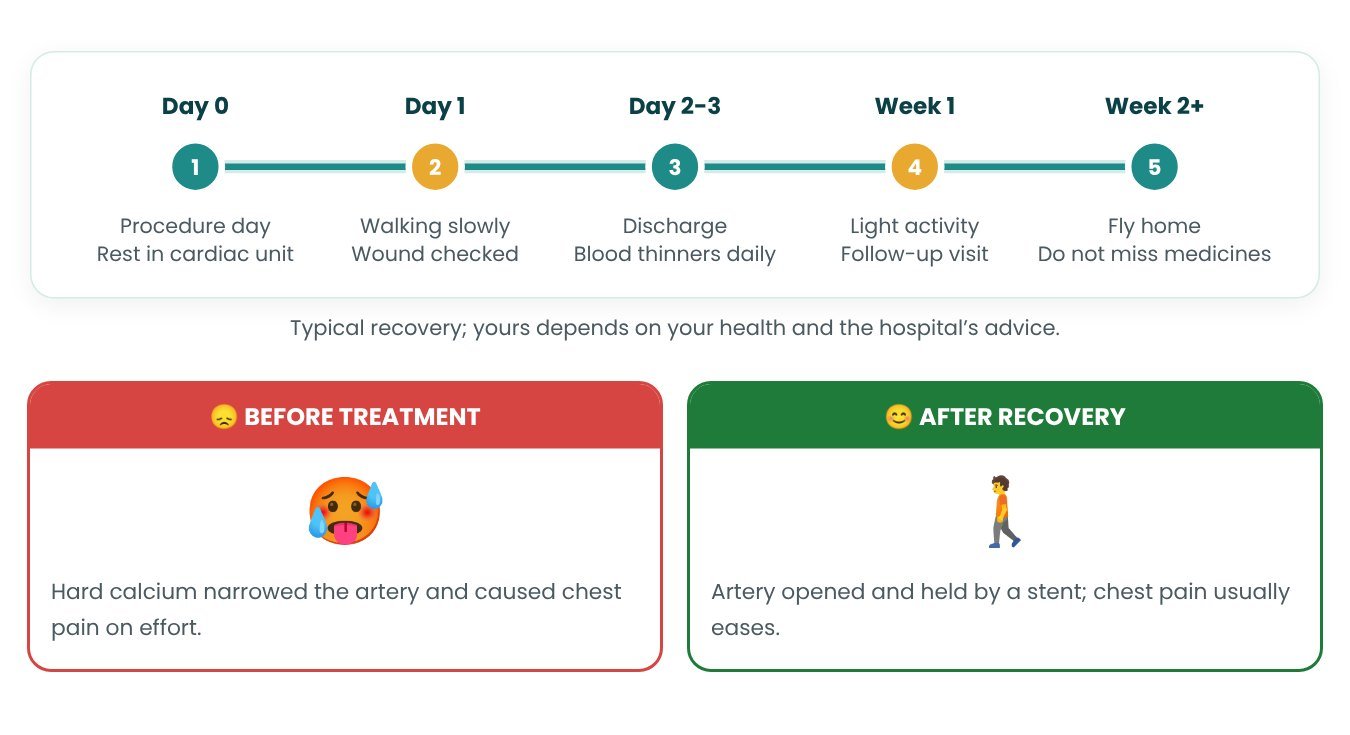
Drawings: Satyug Healthcare (simplified, not to scale). Photos: Wikimedia Commons; author and licence under each photo.
🩺 Conditions Treated
⚠️ Symptoms That May Need Treatment
- ➤Chest pain or pressure on exertion
- ➤Breathlessness on walking
- ➤Pain spreading to arm, jaw or back
- ➤Tiredness and reduced stamina
- ➤Previous heart attack
- ➤Failed earlier angioplasty attempt
- ➤Heavy calcium on CT or angiography
- ➤Positive stress test
🔬 Tests Before Treatment
| Test | Why it is done |
|---|---|
| Coronary angiography | Shows blockage location, length and calcium. |
| IVUS / OCT imaging | Measures the calcium arc and thickness to decide if rotablation is needed. |
| Echocardiogram | Checks heart pumping strength (ejection fraction). |
| ECG and TMT / stress test | Shows heart rhythm and signs of reduced blood supply. |
| Blood tests | Blood count, kidney and liver function, sugar, clotting and viral markers. |
| CT coronary angiography (selected) | Calcium score and planning in some cases. |
🏥 The Procedure — Step by Step

⚖️ Types & Techniques
| Technique | What is done | Best for |
|---|---|---|
| Rotational atherectomy (Rotablation) | Spinning diamond burr grinds calcium | Severe calcium, lesions a balloon cannot cross |
| Orbital atherectomy | Eccentric crown orbits to sand calcium | Severe calcium (limited availability) |
| Intravascular lithotripsy (IVL / Shockwave) | Sound waves crack calcium inside the wall | Deep calcium in crossable lesions |
| Cutting / scoring balloon | Balloon with blades or wires scores plaque | Moderate calcium |
| Bypass surgery (CABG) | New grafts bypass blocked arteries | Multi-vessel complex disease, diabetes |
📅 Your Day-by-Day Plan in India
| Day | What happens |
|---|---|
| Day 1 | Arrive in India, airport pick-up, hotel check-in |
| Day 2 | Cardiology consultation, ECG, echo, blood tests and angiography review |
| Day 3 | Admission; rotablation + PTCA with drug-eluting stent; overnight CCU |
| Day 4–5 | Ward monitoring and discharge (2–3 days hospital stay) |
| Day 6–8 | Rest at hotel, wrist/groin check, follow-up with cardiologist |
| Day 9–10 | Fit-to-fly clearance — Fly home ✈️ |
🌱 Recovery After Treatment
🏆 Success Rate
| Outcome | Result |
|---|---|
| Procedure success (artery opened and stented) | About 92–97% |
| Major complications | About 2–5% |
| Coronary perforation | About 0.5–1.5% |
| Repeat procedure at 1 year | About 5–10% |
| Relief of angina | About 85–90% |
Results depend on the amount and position of calcium, kidney function, heart pumping strength and the experience of the operator. Rotablation is best done in high-volume centres using IVUS or OCT guidance.
🩹 Risks & Possible Complications
Rotablation is more complex than a routine angioplasty, so it is done only by experienced operators.
- •Bleeding or bruising at the wrist or groin (about 2–5%)
- •Slow flow or no-reflow in the artery (about 1–3%)
- •Temporary slow heart rate during burr runs (common, usually managed easily)
- •Artery tear (dissection) or perforation (about 0.5–1.5%)
- •Burr getting stuck (rare, under 1%)
- •Contrast-related kidney strain
- •Heart attack, emergency surgery or death (about 1–2%)
💰 Cost of Rotablation Angioplasty in India
The cost of rotablation in India starts from about USD 6,000 for rotablation with PTCA and one drug-eluting stent. The package includes the cardiologist's fee, cath lab charges, rotablation burr and RotaWire, one DES, a 2–3 day hospital stay with 1 day in CCU in a private/twin sharing room, and routine medicines. A second stent costs about USD 7,500 in total; IVUS/OCT and extra devices add to the cost.
| Option / Hospital tier | Approx. cost (USD) | Hospital stay | Notes |
|---|---|---|---|
| Rotablation + PTCA with 1 DES (this package) | 6,000 | 2–3 days (1 day CCU), private / twin sharing | Rota burr, RotaWire and one stent |
| Rotablation + PTCA with 2 DES | 7,500 | 3 days (1 day CCU), twin sharing | Two stents or long lesion |
| Rotablation with IVUS / OCT guidance | 7,000 – 9,000 | 2–3 days | Imaging-optimised stenting |
| Intravascular lithotripsy (IVL) + PTCA | 7,500 – 9,500 | 2–3 days | Alternative calcium-cracking device |

📋 What the Package Includes
- ✔Interventional cardiologist fee
- ✔Cath lab charges
- ✔Rotablation burr & RotaWire
- ✔One drug-eluting stent
- ✔2–3 day stay incl. 1 day CCU
- ✔Routine medicines & consumables
- ✔ECG & routine blood tests
- ✔Airport pick-up & interpreter
- ✖Flights & visa fees
- ✖Hotel stay outside hospital
- ✖Additional stents or burrs
- ✖IVUS / OCT / IVL devices
- ✖Pre-admission angiography
- ✖Extra stay due to complications
- ✖Medicines after discharge
- ✖Attendant expenses
✈️ Your Medical Travel Process with Satyug Healthcare

| Step | Details |
|---|---|
| 1. Send reports | Coronary angiography report with CD or video, IVUS/OCT report if done, echocardiogram, ECG, recent kidney function and blood tests, and current medicines (especially blood thinners). |
| 2. Free opinion & quotes | Within 48-72 hours you receive opinions and cost estimates from 3-5 leading hospitals to compare. |
| 3. Choose hospital & doctor | We help you compare doctors, success rates, room options and total budget. |
| 4. Medical visa | The hospital issues a Visa Invitation Letter (VIL) to the Indian Embassy. The patient and up to 2 attendants apply for an e-Medical / Medical Attendant visa. |
| 5. Travel planning | Flight guidance, wheelchair assistance, airport pick-up, hotel or guest house near the hospital. |
| 6. Treatment in India | Your coordinator and interpreter stay with you for admission, treatment, discharge and billing. |
| 7. Return & follow-up | Fit-to-fly letter, medicines, and online follow-up with your doctor after you return home. |
🎒 Travel Checklist
- 📌Valid passport (6+ months) for the patient and attendants, plus 10 passport-size photos each
- 📌Medical visa / e-visa and the hospital’s Visa Invitation Letter
- 📌All angiography reports with CD / video link, echo, ECG and blood reports, and prescriptions
- 📌Yellow fever vaccination certificate (mandatory for travellers from African countries)
- 📌Polio vaccination certificate where applicable
- 📌Declare cash above USD 5,000 at the airport; hospitals accept wire transfer and cards
- 📌Foreigners staying longer than permitted must register with the FRRO — our team assists
⭐ Why Choose Satyug Healthcare?
❓ Frequently Asked Questions
➤ What is the cost of rotablation in India?
➤ How is rotablation different from normal angioplasty?
➤ How long does the procedure take?
➤ How long must I stay in India?
➤ Is rotablation painful?
➤ Is rotablation safe?
➤ Can rotablation avoid bypass surgery?
➤ What is the success rate?
➤ When can I return to work?
➤ What medicines will I need?
➤ Can it be done in elderly patients?
➤ Can a family member come with me?
➤ What reports do I need for a free opinion?
Medical disclaimer: This page is for general information and does not replace a consultation with a qualified specialist. Treatment plans and costs are confirmed only after the patient is examined. Sources: Barbato E et al., European Expert Consensus on Rotational Atherectomy (EuroIntervention 2015) and EAPCI 2019 update; Abdel-Wahab M et al., ROTAXUS Trial (JACC Cardiovasc Interv 2013); 2018 ESC/EACTS Guidelines on Myocardial Revascularization; NCBI StatPearls: Coronary Atherectomy; Cleveland Clinic: Atherectomy. Infographics: Satyug Healthcare.
Frequently Asked Questions
The cost of rotablation in India starts from USD 6000. Rotablation + PTCA with 1 Drug-Eluting Stent: USD 6000; Rotablation + PTCA with 2 Drug-Eluting Stents: USD 7500. The final cost depends on the hospital, room category and medical condition.
Rotablation (rotational atherectomy) with stent in India from USD 6,000. Calcified artery angioplasty by expert cardiologists, 2–3 day stay. Free opinion.




TOP HOSPITALS
Special High-quality Hospitals


HAPPY PATIENTS
What Our Patients Are Saying