Intracoronary OCT Package
Assistance
Consultation
Services
Opinion
Care Coordination
What will your treatment cost?

See the cost breakdown by option, hospital and city →
| Surgery Name | Cost | Room | Hospitalization |
|---|---|---|---|
| Intracoronary OCT Package | 1000 USD | Day-care / along with angiography or angioplasty | Add-on; no extra hospital days; total stay in India 3-10 days depending on main procedure |
| OCT imaging add-on (with angiography or angioplasty) | 1000 USD | As per main procedure | No extra stay |
| Coronary Angiography + OCT | 1500 USD | Day-care | Day-care / 1 day |
| OCT-guided PTCA with 1 DES | 6200 USD | Twin Sharing | 2 days |
✓ Inclusion
- ✔Intracoronary OCT imaging during coronary angiography or angioplasty
- ✔OCT imaging catheter (one catheter per package)
- ✔Pre-stent and post-stent OCT runs as required
- ✔Interventional cardiologist's image interpretation and measurements
- ✔Cath-lab charges for the imaging part of the procedure
- ✔Written OCT report with key images
- ✔Discussion of findings and treatment plan
- ✔Free: airport pick-up & drop, visa invitation letter, interpreter & coordinator (Satyug Healthcare)
✗ Exclusion
- ✖Coronary angiography or angioplasty procedure charges (quoted separately or as combined package)
- ✖Coronary stents, balloons, guide wires and other devices
- ✖Hospital room and stay for the main procedure
- ✖FFR/iFR, IVUS, rotablation or intravascular lithotripsy
- ✖Pre-procedure investigations (blood tests, echo, stress test)
- ✖Medicines and blood thinners
- ✖Treatment of complications or ICU stay
- ✖Hotel accommodation, food and local travel
- ✖Flights and visa fees
Know More About Procedure & Surgery
Intracoronary OCT (Optical Coherence Tomography) in India
An add-on imaging test during angiography or angioplasty that shows the inside of the heart arteries in microscopic detail, so the cardiologist can choose the right stent size and confirm a perfect result. Done by experienced interventional cardiologists at accredited Indian heart hospitals, with no extra hospital days.
📖 What is Intracoronary OCT?
The heart muscle gets blood through the coronary arteries. Fat and calcium build up inside their walls as plaque, narrowing them and causing chest pain or a heart attack. A normal coronary angiogram shows the arteries as a shadow (silhouette) filled with dye, but it cannot show what the plaque is made of, how big the artery really is, or whether a stent is fully opened.
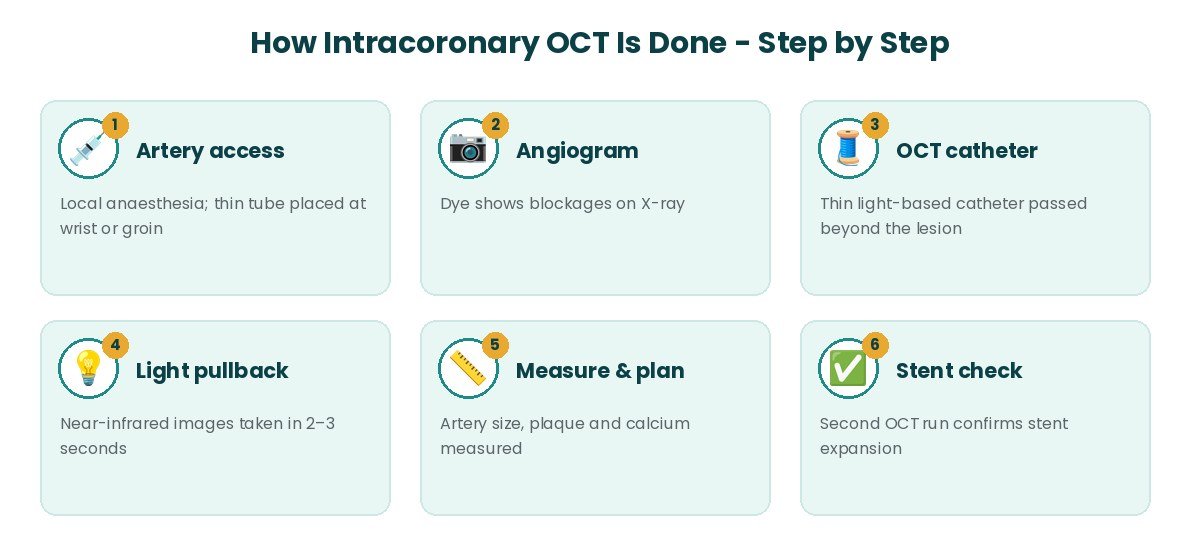
Intracoronary optical coherence tomography (OCT) uses a very thin catheter with a tiny light source passed into the artery during angiography or angioplasty. As it is pulled back over 2–3 seconds, it uses near-infrared light to take cross-section pictures of the artery wall with a resolution of about 10–20 micrometres – roughly 10 times sharper than intravascular ultrasound (IVUS). The cardiologist uses these images to measure the artery, see calcium and soft plaque, choose the correct stent size and length, and check that the stent is fully expanded and well positioned.
🖼️ Understand It in Pictures
What OCT shows inside the artery

👀 Symptoms in Pictures

🩻 Scans & Tests — What Doctors See


🎬 The Treatment Journey in Pictures

📅 Recovery at a Glance

Drawings: Satyug Healthcare (simplified, not to scale). Photos: Wikimedia Commons; author and licence under each photo.
🩺 When is OCT Used?
⚠️ Symptoms That Lead to Coronary Evaluation
- ➤Chest pain or pressure on exertion
- ➤Pain spreading to arm, jaw or back
- ➤Breathlessness on walking
- ➤Recent heart attack
- ➤Chest pain returning after stenting
- ➤Abnormal treadmill test or stress scan
- ➤Unexplained tiredness or sweating
- ➤Known blockages on CT coronary angiogram
🔬 Tests Before Treatment
| Test | Why it is done |
|---|---|
| ECG and echocardiogram | Check heart rhythm and pumping function. |
| Blood tests (kidney function, CBC, sugar, clotting) | Kidney function is important because OCT uses extra contrast dye. |
| Treadmill or stress test / stress imaging | Shows if blockages reduce blood flow. |
| CT coronary angiogram (if done) | Shows where blockages are before the invasive test. |
| Coronary angiography | The main procedure during which OCT is performed. |
| FFR / iFR (pressure wire, if needed) | Measures whether a borderline blockage limits blood flow. |
🏥 The Procedure — Step by Step
⚖️ Intracoronary Imaging Options
| Technique | What is done | Best for |
|---|---|---|
| Optical coherence tomography (OCT) | Light-based imaging, ~10–20 µm resolution | Stent optimisation, calcium, stent failure, plaque rupture |
| Intravascular ultrasound (IVUS) | Sound-based imaging, deeper penetration | Left main, large vessels, kidney disease (less contrast) |
| FFR / iFR (pressure wire) | Measures pressure drop across a blockage | Deciding if a borderline lesion needs a stent |
| Angiography alone | X-ray dye picture of the artery | Simple, straightforward lesions |
📅 Your Day-by-Day Plan in India
| Day | What happens |
|---|---|
| Day 1 | Arrive in India; airport pick-up; consultation with interventional cardiologist |
| Day 2 | Blood tests, ECG, echo; admission |
| Day 3 | Angiography with OCT (and angioplasty if needed) – OCT adds no extra hospital days |
| Day 3–5 | Day-care discharge after angiography, or 1–2 days after angioplasty |
| Day 4–8 | Rest at hotel; review with cardiologist; medicine plan |
| Day 5–10 | Fly home ✈️ (timing depends on the main procedure) |
🌱 Recovery After Treatment
🏆 Success Rate
| Outcome | Result |
|---|---|
| Technical success of OCT imaging | About 95–98% |
| Change in treatment plan due to OCT | About 30–50% of cases |
| Stent under-expansion detected and corrected | About 20–40% of stents |
| Serious complications from OCT itself | Under 1% |
The benefit of OCT is greatest in complex, long, calcified or bifurcation lesions and in repeat-stent cases. Results also depend on good stent technique, the patient's adherence to blood thinners and control of risk factors.
🩹 Risks & Possible Complications
OCT itself is very safe; most risks are those of angiography or angioplasty.
- •Extra contrast dye (about 20–40 ml) – may affect weak kidneys
- •Temporary chest discomfort during the flush – common, seconds only
- •Bruising at the wrist or groin – about 2–5%
- •Brief artery spasm – uncommon, treated with medicines
- •Coronary dissection or vessel injury – rare (under 0.5%)
- •Allergy to contrast dye – rare
- •Abnormal heart rhythm during imaging – very rare, quickly treated
💰 Cost of Intracoronary OCT in India
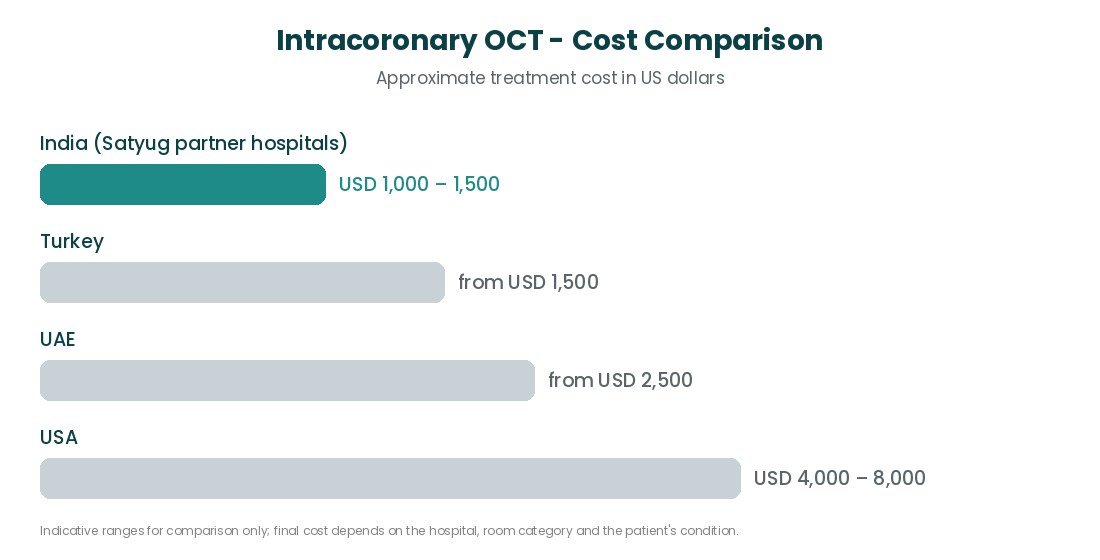
The cost of intracoronary OCT in India starts from about USD 1,000 as an add-on to angiography or angioplasty. This covers the OCT catheter, imaging and the cardiologist's analysis. The main procedure (angiography or angioplasty with stents) is charged separately; combined packages are available.
| Option / Hospital tier | Approx. cost (USD) | Hospital stay | Notes |
|---|---|---|---|
| OCT imaging add-on (this package) | 1,000 | As per main procedure | No extra stay |
| Coronary angiography + OCT | 1,500 | Day-care | Day-care / 1 day |
| OCT-guided PTCA with 1 DES | 6,200 | Twin sharing | 2 days |
| IVUS imaging add-on (alternative) | 900 – 1,300 | As per main procedure | Preferred in some kidney or left main cases |
📋 What the Package Includes
- ✔OCT imaging catheter
- ✔OCT imaging runs (pre- and post-stent)
- ✔Cardiologist image analysis
- ✔Cath-lab use for imaging
- ✔Report with images
- ✔Interpreter and patient coordinator
- ✖Angiography or angioplasty charges
- ✖Stents, balloons and other devices
- ✖Hospital stay for the main procedure
- ✖FFR/iFR, rotablation or lithotripsy
- ✖Pre-procedure tests and medicines
- ✖Hotel stay, food and flights
✈️ Your Medical Travel Process with Satyug Healthcare

| Step | Details |
|---|---|
| 1. Send reports | Previous coronary angiography CD and report, ECG, echocardiogram, stress test or CT coronary angiogram, details of earlier stents (date, location, type), kidney function test and current medicines. |
| 2. Free opinion & quotes | Within 48-72 hours you receive opinions and cost estimates from 3-5 leading hospitals to compare. |
| 3. Choose hospital & doctor | We help you compare doctors, success rates, room options and total budget. |
| 4. Medical visa | The hospital issues a Visa Invitation Letter (VIL) to the Indian Embassy. The patient and up to 2 attendants apply for an e-Medical / Medical Attendant visa. |
| 5. Travel planning | Flight guidance, wheelchair assistance, airport pick-up, hotel or guest house near the hospital. |
| 6. Treatment in India | Your coordinator and interpreter stay with you for admission, treatment, discharge and billing. |
| 7. Return & follow-up | Fit-to-fly letter, medicines, and online follow-up with your doctor after you return home. |
🎒 Travel Checklist
- 📌Valid passport (6+ months) for the patient and attendants, plus 10 passport-size photos each
- 📌Medical visa / e-visa and the hospital’s Visa Invitation Letter
- 📌All angiography CDs/links and reports, echo, ECG, stress test, previous stent details and prescriptions
- 📌Yellow fever vaccination certificate (mandatory for travellers from African countries)
- 📌Polio vaccination certificate where applicable
- 📌Declare cash above USD 5,000 at the airport; hospitals accept wire transfer and cards
- 📌Foreigners staying longer than permitted must register with the FRRO — our team assists
⭐ Why Choose Satyug Healthcare?
❓ Frequently Asked Questions
➤ How much does intracoronary OCT cost in India?
➤ Does OCT increase my hospital stay?
➤ How long do I need to stay in India?
➤ Is OCT painful?
➤ What is the difference between OCT and IVUS?
➤ Why is OCT useful during stenting?
➤ Does everyone need OCT?
➤ What are the risks?
➤ Can OCT find why my old stent failed?
➤ Can patients with kidney disease have OCT?
➤ Is OCT safe for elderly patients?
➤ Can a family member come with me?
➤ What reports should I send?
➤ What follow-up is needed after I go home?
Medical disclaimer: This page is for general information and does not replace a consultation with a qualified specialist. Treatment plans and costs are confirmed only after the patient is examined. Sources: NCBI StatPearls: Intravascular Optical Coherence Tomography; Ali et al. NEJM 2023 (ILUMIEN IV); Holm et al. NEJM 2023 (OCTOBER trial); 2021 ACC/AHA/SCAI Guideline for Coronary Artery Revascularization; 2024 ESC Guidelines for Chronic Coronary Syndromes; EAPCI consensus on intracoronary imaging. Infographics: Satyug Healthcare.
Frequently Asked Questions
The cost of intracoronary OCT in India starts from USD 1000. OCT imaging add-on (with angiography or angioplasty): USD 1000; Coronary Angiography + OCT: USD 1500; OCT-guided PTCA with 1 DES: USD 6200. The final cost depends on the hospital, room category and medical condition.
Intracoronary OCT in India from USD 1,000 as an add-on to angiography or angioplasty. Precise stent sizing by senior cardiologists. Free opinion & visa help.




TOP HOSPITALS
Special High-quality Hospitals


HAPPY PATIENTS
What Our Patients Are Saying