EPS + RFA Ablation Package
Assistance
Consultation
Services
Opinion
Care Coordination
What will your treatment cost?

See the cost breakdown by option, hospital and city →
| Surgery Name | Cost | Room | Hospitalization |
|---|---|---|---|
| EPS + RFA Ablation Package | 4000-5000 USD | Twin Sharing Ward | 1 Day |
| EPS + 3D RFA Ablation Package Cost | 5000-6000 USD | Twin Sharing | 2-3 days |
✓ Inclusion
- ✔Consultation with cardiac electrophysiologist
- ✔Routine pre-procedure tests (blood tests, ECG)
- ✔Electrophysiologist, assistant and anaesthesia / sedation fees
- ✔Cath lab charges
- ✔Electrophysiology study (EPS)
- ✔Conventional radiofrequency ablation with standard catheters
- ✔1 day stay in a twin-sharing ward
- ✔Nursing care, routine medicines and consumables
- ✔Meals for the patient
- ✔ECG and groin check before discharge
- ✔Free: airport pick-up & drop, visa invitation letter, interpreter & coordinator (Satyug Healthcare)
✗ Exclusion
- ✖3D mapping system (CARTO / EnSite) and mapping catheters
- ✖Cryoablation, irrigated or contact-force catheters if needed
- ✖Atrial fibrillation or ventricular tachycardia ablation
- ✖Echo, Holter, cardiac MRI / CT if not in quote
- ✖Extra hospital days or private room upgrade
- ✖Pacemaker or management of complications
- ✖Medicines after discharge
- ✖Hotel stay, food and local travel
- ✖Flights, visa fees and travel insurance
Know More About Procedure & Surgery
EPS + RFA Ablation in India
Electrophysiology study (EPS) and radiofrequency ablation (RFA) to find and permanently treat fast heart rhythms such as SVT, WPW syndrome and atrial flutter, done by senior electrophysiologists at accredited Indian heart hospitals.
📖 What is EPS and RFA Ablation?
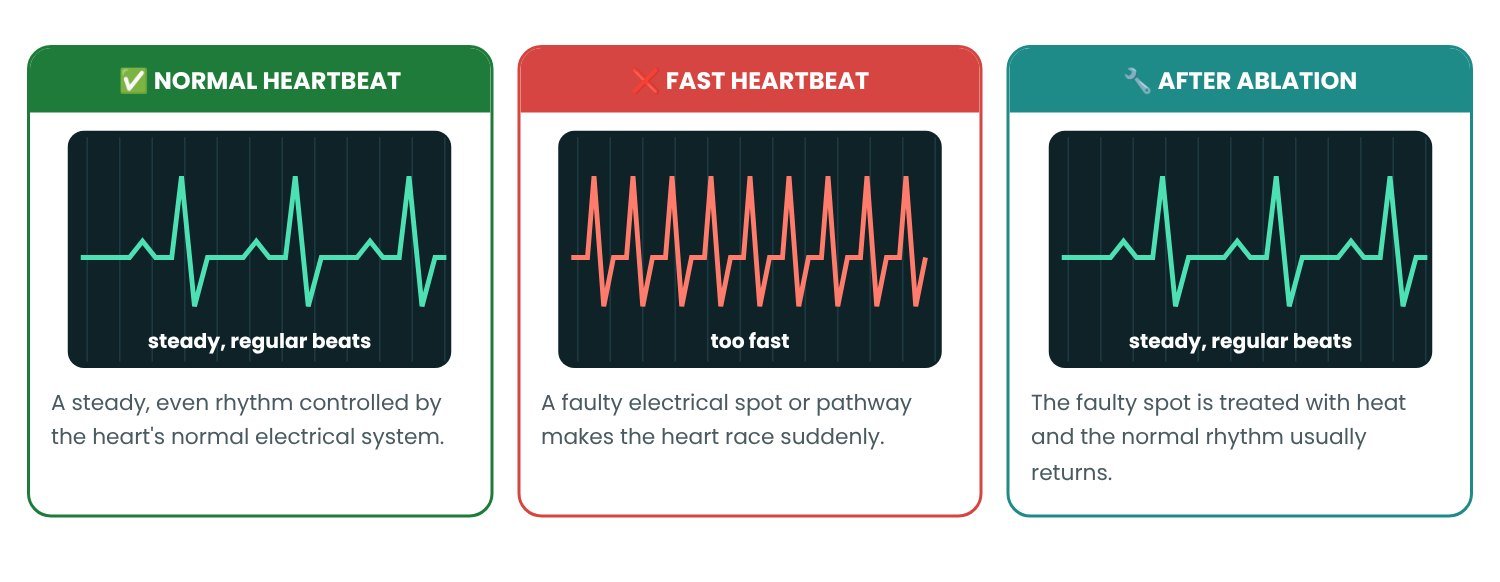
Your heartbeat is controlled by electrical signals that travel along fixed pathways in the heart. Some people are born with an extra electrical pathway or a short circuit, which can suddenly make the heart race at 150–250 beats per minute. This is called a tachycardia or arrhythmia. Common types are SVT (supraventricular tachycardia, including AVNRT), WPW syndrome and atrial flutter. Episodes cause palpitations, dizziness, breathlessness and sometimes fainting.
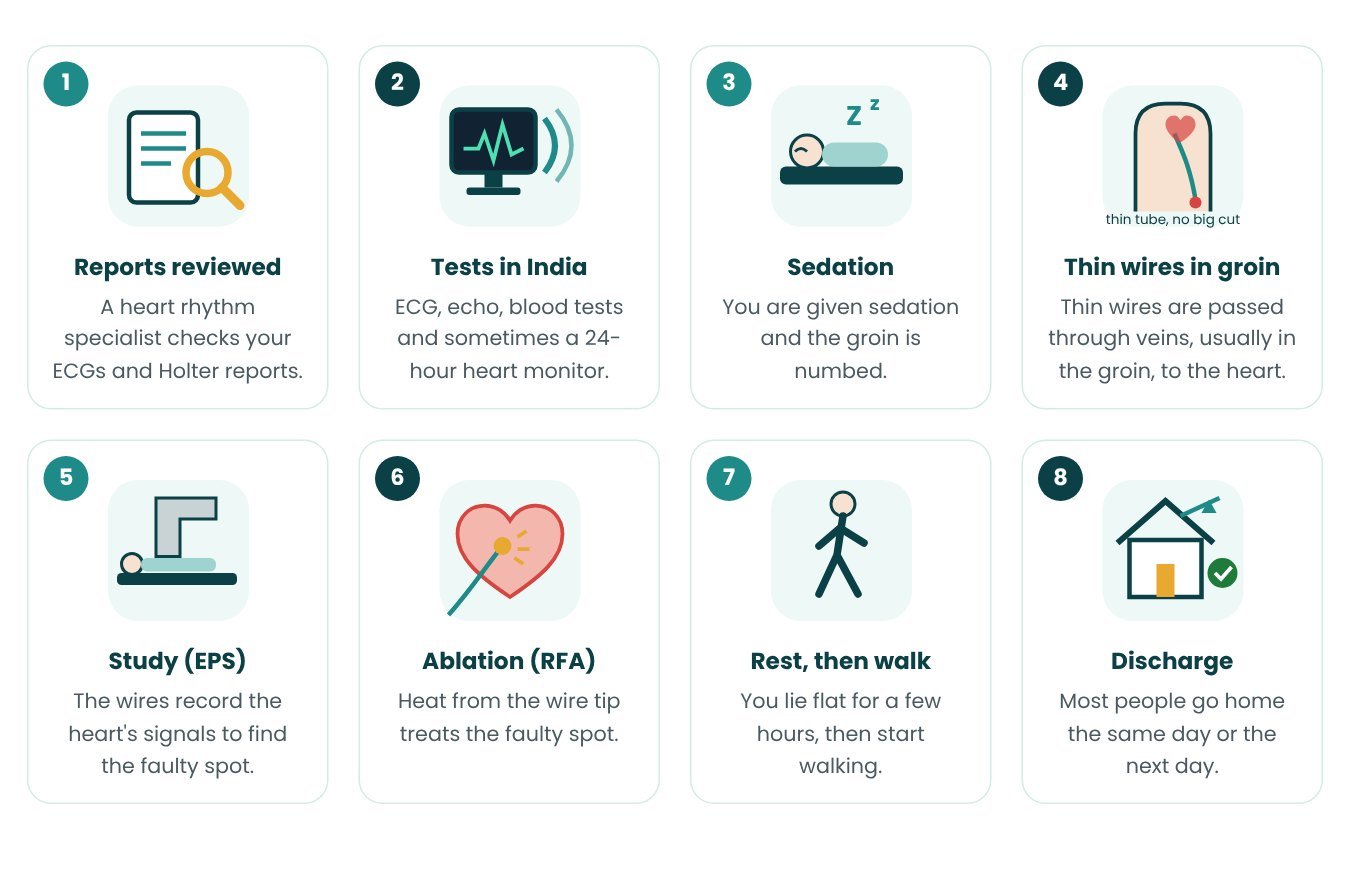
An electrophysiology study (EPS) is a test in which thin wires (catheters) are passed through veins in the groin into the heart to record its electrical activity and find the exact source of the abnormal rhythm. Radiofrequency ablation (RFA) is done in the same sitting: the tip of a catheter delivers controlled heat to destroy the tiny area causing the problem. For most SVTs this is a permanent cure, so patients can often stop lifelong medicines. Complex rhythms may need 3D mapping, which builds a computer map of the heart.
🖼️ Understand It in Pictures
Normal vs fast heartbeat
👀 Symptoms in Pictures

🩻 Scans & Tests — What Doctors See


🎬 The Treatment Journey in Pictures

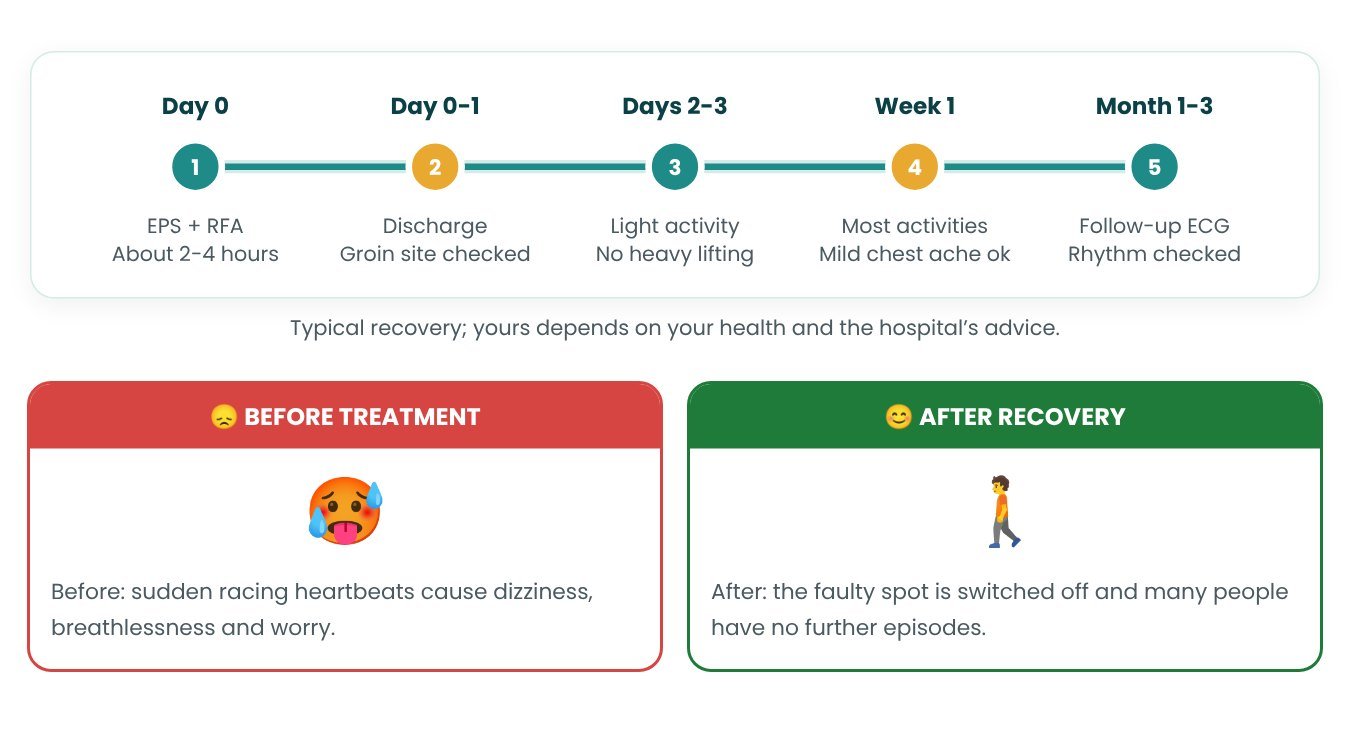
📅 Recovery at a Glance
Drawings: Satyug Healthcare (simplified, not to scale). Photos: Wikimedia Commons; author and licence under each photo.
🩺 Conditions Treated
⚠️ Symptoms That May Need EPS + RFA
- ➤Sudden racing or pounding heartbeat
- ➤Heartbeat that starts and stops suddenly
- ➤Dizziness or light-headedness
- ➤Fainting or near-fainting
- ➤Breathlessness during episodes
- ➤Chest discomfort with palpitations
- ➤Episodes needing emergency injections
- ➤WPW pattern on a routine ECG
🔬 Tests Before Treatment
| Test | Why it is done |
|---|---|
| 12-lead ECG (and ECG during an episode) | The most useful record – often shows the type of tachycardia. |
| Holter or event monitor | Records the heartbeat for 24 hours to 2 weeks to catch episodes. |
| Echocardiography | Checks heart structure and pumping strength. |
| Treadmill test (selected) | Checks rhythm during exercise, especially in WPW. |
| Blood tests incl. thyroid and electrolytes | Rule out other causes of fast heartbeat and check fitness. |
| Cardiac MRI / CT (selected) | For complex ablations such as ventricular tachycardia or AF. |
🏥 The Procedure — Step by Step

⚖️ Types & Techniques
| Technique | What is done | Best for |
|---|---|---|
| EPS only | Diagnostic study to find the rhythm without ablation. | Unexplained palpitations or fainting |
| EPS + conventional RFA | Study and ablation guided by X-ray and signals. | AVNRT, WPW, typical atrial flutter |
| EPS + 3D mapping RFA | Computer 3D map of the heart guides ablation with less X-ray. | Atrial tachycardia, PVCs, complex or redo cases |
| Cryoablation | Freezing instead of heat near the normal conduction system. | Pathways very close to the AV node, children |
| AF ablation (PVI) | Pulmonary veins isolated with RF or cryo-balloon. | Symptomatic atrial fibrillation |
📅 Your Day-by-Day Plan in India
| Day | What happens |
|---|---|
| Day 1 | Arrival in India, airport pick-up and hotel check-in |
| Day 2 | Electrophysiologist consultation, ECG, echo and blood tests |
| Day 3 | Admission, EPS + RFA ablation and overnight observation (1 day stay) |
| Day 4 | Discharge after ECG and groin check |
| Day 5–6 | Hotel rest, light walking and review visit |
| Day 6–7 | Fit-to-fly letter and fly home ✈️ |
🌱 Recovery After Treatment
🏆 Success Rate
| Outcome | Result |
|---|---|
| AVNRT cure rate | About 95–98% |
| Accessory pathway (WPW) cure rate | About 93–97% |
| Typical atrial flutter cure rate | About 95%+ |
| Recurrence needing repeat ablation | About 2–5% for SVT |
| Major complications | About 1% or less |
Results depend on the type of arrhythmia and where the abnormal spot is. Simple SVT and WPW have very high cure rates; atrial fibrillation, ventricular rhythms and redo cases have lower success and often need 3D mapping.
🩹 Risks & Possible Complications
EPS and RFA are low-risk procedures in experienced hands.
- •Groin bruising or small haematoma (common, minor)
- •Recurrence of the arrhythmia (about 2–5% for SVT)
- •Permanent heart block needing a pacemaker (under 1% in AVNRT, mostly for pathways near the AV node)
- •Bleeding or vessel injury at the groin (under 1%)
- •Fluid around the heart (tamponade, under 0.5%)
- •Blood clot or stroke (very rare, higher in left-sided procedures)
💰 Cost of EPS + RFA Ablation in India
The cost of EPS + RFA ablation in India starts from about USD 4,000 with 1 day in a twin-sharing ward. This covers the electrophysiologist, cath lab, catheters for conventional ablation and the hospital stay. Complex rhythms needing 3D mapping cost about USD 5,000–6,000 with a 2–3 day stay.
| Option / Hospital tier | Approx. cost (USD) | Hospital stay | Notes |
|---|---|---|---|
| EPS + RFA Ablation package (this package) | from 4,000 | 1 day, twin sharing ward | Conventional ablation for SVT / WPW / flutter |
| EPS + 3D RFA Ablation package | 5,000 – 6,000 | 2–3 days, twin sharing | 3D mapping for complex rhythms |
| EPS (diagnostic) only | 1,500 – 2,000 | 1 day | No ablation |
| AF ablation (3D / cryo-balloon), premium hospital | 7,500 – 10,000 | 2–3 days | Pulmonary vein isolation |

📋 What the Package Includes
- ✔Electrophysiologist and team fees
- ✔Cath lab charges
- ✔EPS and conventional RF ablation catheters
- ✔1 day in a twin-sharing ward
- ✔Sedation and routine medicines
- ✔Nursing care and patient meals
- ✔ECG before discharge
- ✖3D mapping system and special catheters
- ✖Cryoablation or AF ablation
- ✖Extra hospital days
- ✖Echo / MRI / Holter in India if not quoted
- ✖Pacemaker if needed
- ✖Hotel stay and flights
- ✖Medicines after discharge
✈️ Your Medical Travel Process with Satyug Healthcare

| Step | Details |
|---|---|
| 1. Send reports | 12-lead ECGs (especially one taken during a fast-heartbeat episode), Holter or event monitor reports, echocardiography report, any previous EPS / ablation reports, and current heart medicines |
| 2. Free opinion & quotes | Within 48-72 hours you receive opinions and cost estimates from 3-5 leading hospitals to compare. |
| 3. Choose hospital & doctor | We help you compare doctors, success rates, room options and total budget. |
| 4. Medical visa | The hospital issues a Visa Invitation Letter (VIL) to the Indian Embassy. The patient and up to 2 attendants apply for an e-Medical / Medical Attendant visa. |
| 5. Travel planning | Flight guidance, wheelchair assistance, airport pick-up, hotel or guest house near the hospital. |
| 6. Treatment in India | Your coordinator and interpreter stay with you for admission, treatment, discharge and billing. |
| 7. Return & follow-up | Fit-to-fly letter, medicines, and online follow-up with your doctor after you return home. |
🎒 Travel Checklist
- 📌Valid passport (6+ months) for the patient and attendants, plus 10 passport-size photos each
- 📌Medical visa / e-visa and the hospital’s Visa Invitation Letter
- 📌All ECGs, Holter / monitor reports, echo report and prescriptions
- 📌Yellow fever vaccination certificate (mandatory for travellers from African countries)
- 📌Polio vaccination certificate where applicable
- 📌Declare cash above USD 5,000 at the airport; hospitals accept wire transfer and cards
- 📌Foreigners staying longer than permitted must register with the FRRO — our team assists
⭐ Why Choose Satyug Healthcare?
❓ Frequently Asked Questions
➤ What is the cost of EPS + RFA ablation in India?
➤ How do I know if I need 3D mapping?
➤ Is it surgery?
➤ Will I be awake?
➤ How long does it take?
➤ How long will I stay in hospital and in India?
➤ Is it a permanent cure?
➤ What are the risks?
➤ Should I stop my medicines before the procedure?
➤ When can I go back to work?
➤ Can children have ablation?
➤ When can I fly home?
➤ What follow-up is needed?
➤ Is language support available?
Medical disclaimer: This page is for general information and does not replace a consultation with a qualified specialist. Treatment plans and costs are confirmed only after the patient is examined. Sources: 2015 ACC/AHA/HRS Guideline for the Management of Adult Patients with SVT; 2019 ESC Guidelines for the Management of SVT; NCBI StatPearls: Electrophysiologic Study Interpretation, Catheter Ablation, AV Nodal Reentrant Tachycardia; Mayo Clinic: Cardiac ablation; Cleveland Clinic: Electrophysiology study; NHS: Supraventricular tachycardia. Infographics: Satyug Healthcare.
EPS + RFA ablation in India from USD 4,000: permanent catheter cure for SVT, WPW & atrial flutter by senior electrophysiologists. 3D mapping available.




TOP HOSPITALS
Special High-quality Hospitals


HAPPY PATIENTS
What Our Patients Are Saying