Hirschsprung’s disease
Hirschsprung's disease is a condition that affects the large intestine (colon) and causes problems with passing stool. This condition is present at birth (congenital) because of missing nerve cells in the muscles of the baby's colon. A newborn who has Hirschsprung's disease usually cannot have a bowel movement in the days after birth. In mild cases, the condition might not be detected until later in childhood. Uncommonly, Hirschsprung's disease is first diagnosed in adults.
Symptoms
The most obvious sign is a newborn's failure to have a bowel movement within 48 hours after birth.
Other signs and symptoms in newborns as follows:
- Swollen belly
- Vomiting, including vomiting a green or brown substance
- Constipation or gas, which might make a newborn fussy
- Diarrhea
In older children, signs and symptoms may include:
- Swollen belly
- Chronic constipation
- Gas
- Failure to thrive
- Fatigue
Causes
It sometimes occurs in families and might, in some cases, be associated with a genetic mutation.
Risk Factors
- Having a sibling who has Hirschsprung's disease - If you have one child who has the condition, future biological children could be at risk.
- Being male - Hirschsprung's disease is more common in males.
- Having other inherited conditions - Hirschsprung's disease is associated with certain inherited conditions, such as Down syndrome and other abnormalities present at birth, such as congenital heart disease.
Diagnosis
- Abdominal X-ray using a contrast dye. Wherein Barium or another contrast dye is placed into the bowel through a special tube inserted in the rectum. The barium fills and coats the lining of the bowel, creating a clear silhouette of the colon and rectum. The X-ray will often show a clear contrast between the narrow section of bowel without nerves and the normal but often swollen section of bowel behind it.
- Measuring control of the muscles around the rectum (anal manometry). A manometry test is typically done on older children and adults. The doctor inflates a balloon inside the rectum. The surrounding muscle should relax as a result. If it does not, Hirschsprung's disease could be the cause.
- Removing a sample of colon tissue for testing (biopsy). A biopsy sample can be collected using a suction device, then examined under a microscope to determine whether nerve cells are missing.
Treatment
Hirschsprung's disease is treated with surgery to bypass the part of the colon that is lacking nerve cells. There are two ways this can be done: a pull-through surgery or an ostomy surgery.
- Pull-through surgery - In this procedure, the lining of the diseased part of the colon is stripped away. Then, the normal section is pulled through the colon from the inside and attached to the anus. This is usually done using minimally invasive (laparoscopic) methods, operating through the anus.
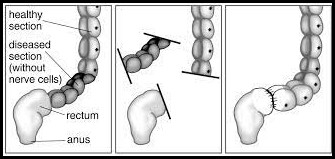
- Ostomy surgery - In children who are extremely ill, surgery might be done in two steps. First, the abnormal portion of the colon is removed and the top, healthy portion of the colon is connected to an opening the surgeon creates in the child's abdomen. Stool then leaves the body through the opening into a bag that attaches to the end of the intestine that protrudes through the hole in the abdomen (stoma). This allows time for the lower part of the colon to heal. Once the colon has had time to heal, a second procedure is done to close the stoma and connect the healthy portion of the intestine to the rectum or anus. After surgery, most children can pass stool through the anus.
Risk Involved in Surgery
- Diarrhea
- Constipation
- Leaking stool (fecal incontinence)
- Delays in toilet training
- Children also continue to be at risk of developing a bowel infection (enterocolitis) after surgery, especially in the first year.
When should you contact your doctor:
- Bleeding from the rectum
- Diarrhea
- Fever
- Swollen abdomen
- Vomiting
Home Remedies
- Include severe high-fiber foods in your diet.
- Increase Fluid, by encouraging your child to drink more water.
- Encourage physical activity.
If you have any related query, you can send us your report on below mention email address or you can call us or whatsApp for any second opinion.
Video/tele consultation also available.
E-mail address- query@satyughealthcare.com
Phone number- +91888-242-4372, +91991-065-5125
Frequently asked questions
Q. Can Hirschsprung's disease be cured?
Treatment almost always requires surgery. Most children who have surgery are fully cured and able to pass bowel movements (BMs) normally.
Q. Is Hirschsprung disease painful?
Children with this disorder are missing nerve cells in all or part of the large intestine. Without these nerve cells, stool cannot move forward through the large intestine. This can cause constipation, swelling, pain, and infection. Most of the children with Hirschsprung disease show symptoms in the first few weeks of life.
Q. What to expect after surgery for Hirschsprung's?
Immediately following successful surgery, many children with Hirschsprung's disease have diarrhea for weeks. Diarrhea may break down sensitive skin under the diaper, and the child recognizes intense pain after each bowel movement.
Q. How long child will stay in a hospital?
If your baby has trans anal surgery without a stoma, he or she will go home in about one to three days. If your baby has a stoma, he or she may stay in the hospital longer.
Q. Is Hirschsprung disease life threatening?
Hirschsprung disease is a life-threatening illness, and treatment requires surgery. Children who have surgery for Hirschsprung disease most often feel better after surgery.