Plantar calluses are tough, thickened skin that forms on the surface of the bottom part of your foot (the plantar side). Plantar calluses occur commonly on the plantar fascia. This is the thick band of tissue that connects your heel bone to your toes and the ball of the foot. They can be uncomfortable, but they are very treatable.
Most plantar calluses can be treated at home. Soaking your feet in warm water for at least ten minutes, and using thick moisturizers and lotions once the skin is dry can help soften the callus. You can also use pumice stones or metal files to trim down the callus. This treatment is most effective after soaking your feet in warm water.
Shoe pad inserts and shoes with more support and padding can also be used to relieve pressure on problem areas. If home treatments are not effective, a doctor can help you treat your plantar callus. Your physician has two primary methods of treating plantar calluses. The first is to remove the thick skin of the callus with a scalpel. The second is to apply patches or creams containing 40 percent salicylic acid to the callus. The latter is most effective when reapplied daily, and when it’s used after using a pumice stone or metal file to remove the callus. If a bone deformity is causing the calluses and other symptoms, your doctor can recommend surgery to correct it.
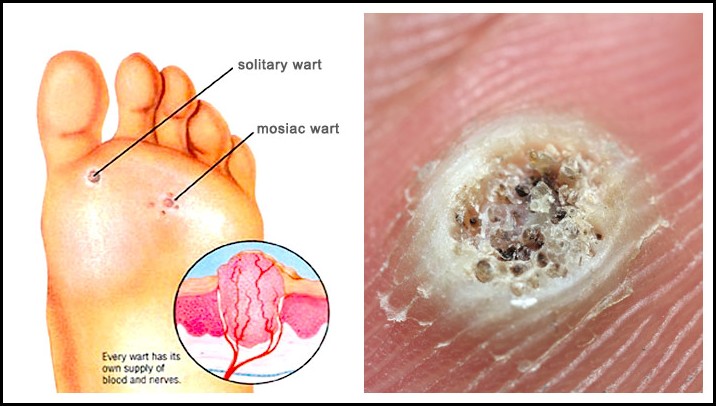
Warts are small skin growths that can form on the feet, but this isn’t the only place you’ll find one. They can appear anywhere on the body. The human papillomavirus (HPV) causes warts. It’s a contagious virus that spreads from person to person through direct and indirect contact. Some warts don’t immediately develop after exposure to the virus. Sometimes it can take up to 6 months after exposure for one to appear.
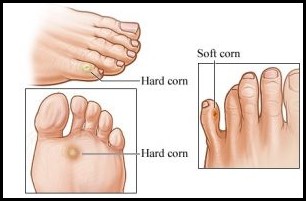
Corn is a thick layer of skin that develops from constant friction and pressure. That’s why they often develop on the toes and feet. While warts have a grainy, fleshly appearance with black pinpoints, corns look more like a raised, hard bump surrounded by dry, flaky skin. Another important difference is that corns aren’t caused by a virus, nor are they contagious.
|
Warts |
Corns |
|
can appear anywhere on the body |
only appear on the feet |
|
have grainy bumps with black pinpoints |
are hard, raised, and flaky |
|
are caused by a virus |
are caused by friction and pressure |
Warts don’t usually require treatment and go away on their own. But, just as it can take 6 months for one to appear, it can take almost as long for one to disappear sometimes as long as 1 to 2 years. To get rid of a painful wart sooner, you can use an over-the-counter wart removal product. These are available as a patch, liquid, or ointment. They help soften and dissolve the wart. If these products don’t work, your doctor might recommend a prescription-strength wart remover. They may also suggest other therapies, such as:
To treat a corn, the first thing you’ll need to do is stop the cause of constant friction and pressure.
Frequently asked questions
Q.What happens if a corn is left untreated?
An Untreated Foot Corn Can Cause Blisters, Arthritis, or Worse. If your job involves wearing high heels or tight boots, there's a good chance you've experienced the pain a corn can cause.
Q.Can a corn go away on its own?
Mild corns don't usually need treatment and will go away on their own. But there are things you can do to help them go away: Wear thick socks to protect your skin. Rub your callus with a pumice stone while you're in the bath or shower.
Q.What does a corn look like when it comes out?
They are usually small and circular, with a clearly defined center that can be hard of soft. Hard corns tend to be small, and they occur in areas of firm, hard skin, where the skin has thickened or where there are calluses, and in bony areas of the foot. Soft corns tend to be whitish in color, with a rubbery texture.
Q.Does removing a corn leave a hole?
As a hard corn is actually a callus but with a deep hard centre, once the callus part has been removed, the centre needs to be cut out. This is called “enucleation” of the centre. Removal, or enucleation, of the centre will leave a dimple or hole in the tissue of the foot.
Q.How do podiatrists remove corns?
Larger corns and calluses are most effectively reduced (made smaller) with a surgical blade. A podiatrist can use the blade to carefully shave away the thickened, dead skin—right in the office. The procedure is painless because the skin is already dead. Additional treatments may be needed if the corn or callus recurs.
Q.How long does corn removal take to heal?
Corn removal is a minor surgery, so your recovery should be relatively fast — lasting three to seven days. You will need to limit your normal activities until your foot has fully healed. Wearing normal shoes will also be prohibited during recovery.