Assistance
Consultation
Services
Opinion
Care Coordination
What will your treatment cost?
Bleomycin TACE for Hemangioma Treatment in India
Released Date: 2026-05-10
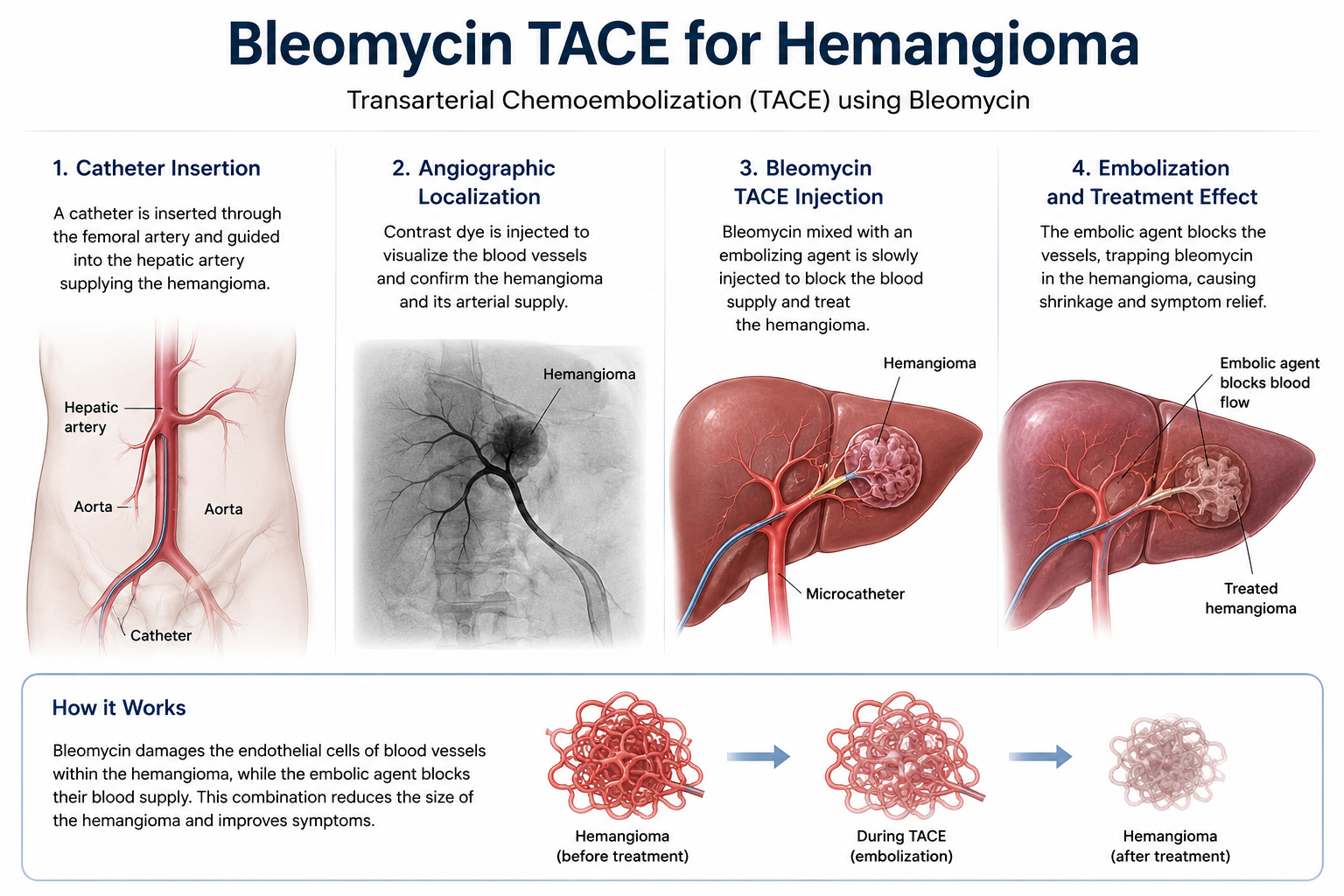
Bleomycin TACE for Hepatic Hemangioma Treatment in India
A complete guide for international patients — procedure, results, costs and how Satyug Healthcare makes your journey seamless from the first consultation to recovery.
If you or a loved one has been diagnosed with a large liver hemangioma that is causing pain, abdominal discomfort or complications, you are not alone. Hepatic hemangiomas are the most common benign liver tumours worldwide, found in up to 20% of the general population. While most small hemangiomas require no treatment at all, giant hemangiomas — those larger than 5 cm — can cause significant symptoms and may need intervention. The good news is that surgery, once the only option, has largely been replaced by a safer, far less invasive procedure called Bleomycin TACE (Transarterial Chemoembolization) — and India is now one of the world's leading destinations for this procedure at a fraction of Western costs.
🩺 What is a Hepatic Hemangioma?
A hepatic (liver) hemangioma is a non-cancerous tumour made up of a cluster of abnormal blood vessels. It is not cancer and does not become cancer. It originates from the hepatic artery and is lined by endothelial cells. Hemangiomas are more common in women and are typically discovered accidentally during an ultrasound or CT scan done for an unrelated reason.
✅ Small Hemangioma (<5 cm)
Almost always asymptomatic. Requires only periodic imaging observation — no treatment needed in the vast majority of cases.
⚠️ Giant Hemangioma (>5 cm)
Symptomatic in 80–90% of cases. May require treatment when causing pain, compression of nearby organs, or rapid growth.
🖼️ Understand It in Pictures
Haemangioma before and after bleomycin

👀 Symptoms in Pictures

🎬 The Treatment Journey in Pictures

📅 Recovery at a Glance

🔍 Symptoms — When Does a Hemangioma Become a Problem?
Small hemangiomas are asymptomatic in 80–86% of cases. However, giant hemangiomas are symptomatic in up to 90% of cases. Symptoms arise because the growing lesion compresses neighbouring structures — the stomach, bile duct, diaphragm and blood vessels.
- Persistent pain or heaviness in the upper right abdomen
- Nausea, vomiting and reduced appetite
- Feeling of fullness after eating small amounts (early satiety)
- Abdominal bloating and distension
- Pain radiating to the right shoulder (capsular stretching)
- Palpable abdominal mass in very large lesions
- Rare but serious: Spontaneous rupture with internal bleeding
- Kasabach-Merritt Syndrome — rare complication with abnormal clotting within the hemangioma
🔬 How is Hepatic Hemangioma Diagnosed?
Diagnosis is made through imaging alone. No biopsy is needed or recommended — the risk of bleeding from a biopsy outweighs any diagnostic benefit. Indian hospitals offer all required imaging with fast turnaround times.
💉 What is Bleomycin TACE and How Does it Work?
Bleomycin TACE — formally known as Superselective Transarterial Chemoembolization using Bleomycin–Lipiodol Emulsion — is a minimally invasive interventional radiology procedure now recognised as the preferred treatment for symptomatic giant hepatic hemangiomas, replacing surgery in most patients worldwide.
💡 The Core Principle
Since hemangiomas are fed exclusively by hepatic artery branches, blocking those feeding arteries while delivering bleomycin (a sclerosing agent) directly into the lesion causes the abnormal blood vessels to collapse, scar and shrink — without surgery, without general anaesthesia, and without removing any part of the liver.
Bleomycin damages the endothelial cells lining the abnormal vessels, triggering fibrosis and collapse. When mixed with lipiodol (an oily contrast agent), it forms a stable emulsion that concentrates within the hemangioma and persists for weeks, providing a sustained therapeutic effect.
Step-by-Step Procedure
A small puncture is made in the common femoral artery (groin) under local anaesthesia. A 5–6F introducer sheath is placed. No general anaesthesia required.
A catheter maps the hepatic artery blood supply, identifies all feeding arteries of the hemangioma and checks for arterio-portal shunts.
A 2.4–2.7 Fr Progreat microcatheter is advanced into the specific feeding artery with extraordinary precision — as close to the hemangioma as possible.
The bleomycin–lipiodol emulsion (15 mg bleomycin + 10–15 mL lipiodol) is slowly injected under fluoroscopic guidance until satisfactory filling of the hemangioma is confirmed.
Catheter removed. Patient observed for 3–4 days. Most patients return to normal activity within one week of discharge.
📊 Published Results — What to Expect
Data from multiple international peer-reviewed studies (PubMed Central, MDPI) consistently demonstrate the following outcomes:
77.5% of patients achieved hemangioma coverage exceeding 75% on a single session. Maximum shrinkage is typically reached by the 12th month post-procedure. Long-term follow-up studies of over 5 years show durable results with no symptomatic recurrence in the majority of successfully treated patients.
Bleomycin TACE vs Surgery — Side by Side
⚠️ Possible Risks and Side Effects
- Post-Embolization Syndrome (PES) — fever, fatigue, mild abdominal pain — occurs in ~45% of patients, resolves within 5–7 days with supportive care.
- Hepatic Artery Dissection — rare (~3–5%), usually detected and managed during the same procedure.
- Temporary Liver Enzyme Rise — common, normalises within 1–4 weeks.
- Access Site Bruising — minor haematoma at groin puncture site in ~2–3% of patients.
- Contrast Allergy — rare; managed with pre-procedure antihistamines and steroids.
Serious complications such as liver abscess or bile duct injury are exceedingly rare when performed by an experienced interventional radiologist using superselective technique.
🌍 Why Choose India for Bleomycin TACE?
🎓 World-Class Interventional Radiologists
India's leading IR specialists are trained at top institutions in the USA and Europe, performing superselective TACE with outcomes matching global benchmarks.
🏥 Advanced Technology
State-of-the-art biplane DSA suites, Progreat microcatheter systems and all embolic materials identical to leading European and US centres.
⏱️ No Waiting Lists
International patients are typically scheduled within days of arrival — not weeks or months as in many countries.
💰 60–80% Cost Savings
The same procedure that costs USD 15,000–30,000+ in the USA can be performed in India at USD 3,000–6,000 — without any compromise on quality.
Costs vary by hospital, city and case complexity. Contact Satyug Healthcare for a personalised estimate.
🤝 How Satyug Healthcare Helps You
Travelling abroad for medical care can feel overwhelming. Satyug Healthcare takes care of every detail so you can focus entirely on your treatment and recovery.
Share your CT scan, MRI and blood reports. We arrange a written opinion from a senior interventional radiologist at a JCI/NABH hospital — at no charge.
BLK-Max (New Delhi), Apollo Indraprastha (New Delhi), Medanta Medicity (Gurugram), Fortis Memorial Research Institute (Gurugram), Manipal Hospital Dwarka (Delhi), KIMS Hospitals (Hyderabad).
Airport pick-up → hotel accommodation → pre-procedure tests → TACE procedure → hospital stay → discharge → follow-up imaging. We manage everything.
We provide the official invitation letter and guide you through the Indian medical visa process from your home country.
Our team communicates in English, Arabic, Russian, French and other languages — no communication barrier between you and your medical team.
After returning home, we coordinate your follow-up CT/MRI review with your treating interventional radiologist in India via video consultation.
❓ Frequently Asked Questions
Ready to Explore Treatment in India?
Share your CT scan or MRI reports with us and receive a FREE written medical opinion from a senior interventional radiologist at a JCI/NABH hospital within 24–48 hours — no obligation.
📞 +91-8860606766 | +91-9910655125
✉ query@satyughealthcare.com
Related Blogs


HAPPY PATIENTS
What Our Patients Are Saying




















Our Gallery