
Spinal Fusion (TLIF / PLIF) Package
Assistance
Consultation
Services
Opinion
Care Coordination
What will your treatment cost?

See the cost breakdown by option, hospital and city →
| Surgery Name | Cost | Room | Hospitalization |
|---|---|---|---|
| Spinal Fusion (TLIF / PLIF) Package | 5500 USD | Private / Twin Sharing Room | 5-7 days in hospital; total stay in India 3-4 weeks |
| Single-Level Open TLIF / PLIF | 5500 USD | Twin Sharing | 5-6 days hospital |
| Single-Level Minimally Invasive (MIS) TLIF | 6500 USD | Twin Sharing | 4-5 days hospital |
| Two-Level TLIF / PLIF | 8000 USD | Private Room | 6-7 days hospital |
✓ Inclusion
- ✔Spine surgeon consultation and pre-operative evaluation
- ✔Surgeon, assistant surgeon and anaesthetist fees
- ✔General anaesthesia and intra-operative X-ray (C-arm) guidance
- ✔Operation theatre charges
- ✔Standard pedicle screws, rods and interbody cage(s)
- ✔Hospital stay in the selected room category for the package duration (5–7 days)
- ✔Routine post-operative medicines, consumables and nursing care
- ✔Post-operative X-ray and routine blood tests during admission
- ✔Inpatient physiotherapy sessions and lumbar brace (where advised)
- ✔Meals for the patient and one attendant during the hospital stay
- ✔Free: airport pick-up & drop, visa invitation letter, interpreter & coordinator (Satyug Healthcare)
✗ Exclusion
- ✖Flights, visa fees and travel insurance
- ✖Hotel / guest-house stay outside the hospital and food for attendants
- ✖Pre-operative MRI / CT done outside the package
- ✖Additional or premium implants, navigation or robotic assistance
- ✖Bone graft substitutes (BMP, synthetic graft) if used
- ✖Extra hospital days, ICU stay or complications beyond the package
- ✖Blood and blood products, special high-cost drugs
- ✖Outpatient physiotherapy and medicines after discharge
- ✖Treatment of pre-existing illnesses
Know More About Procedure & Surgery
Spinal Fusion Surgery (TLIF / PLIF) in India
Lumbar interbody fusion for spondylolisthesis, spinal instability, recurrent disc herniation and severe degenerative disc disease – done by experienced spine surgeons at NABH and JCI accredited hospitals in India, at a fraction of Western prices.
📖 What is Spinal Fusion (TLIF / PLIF)?
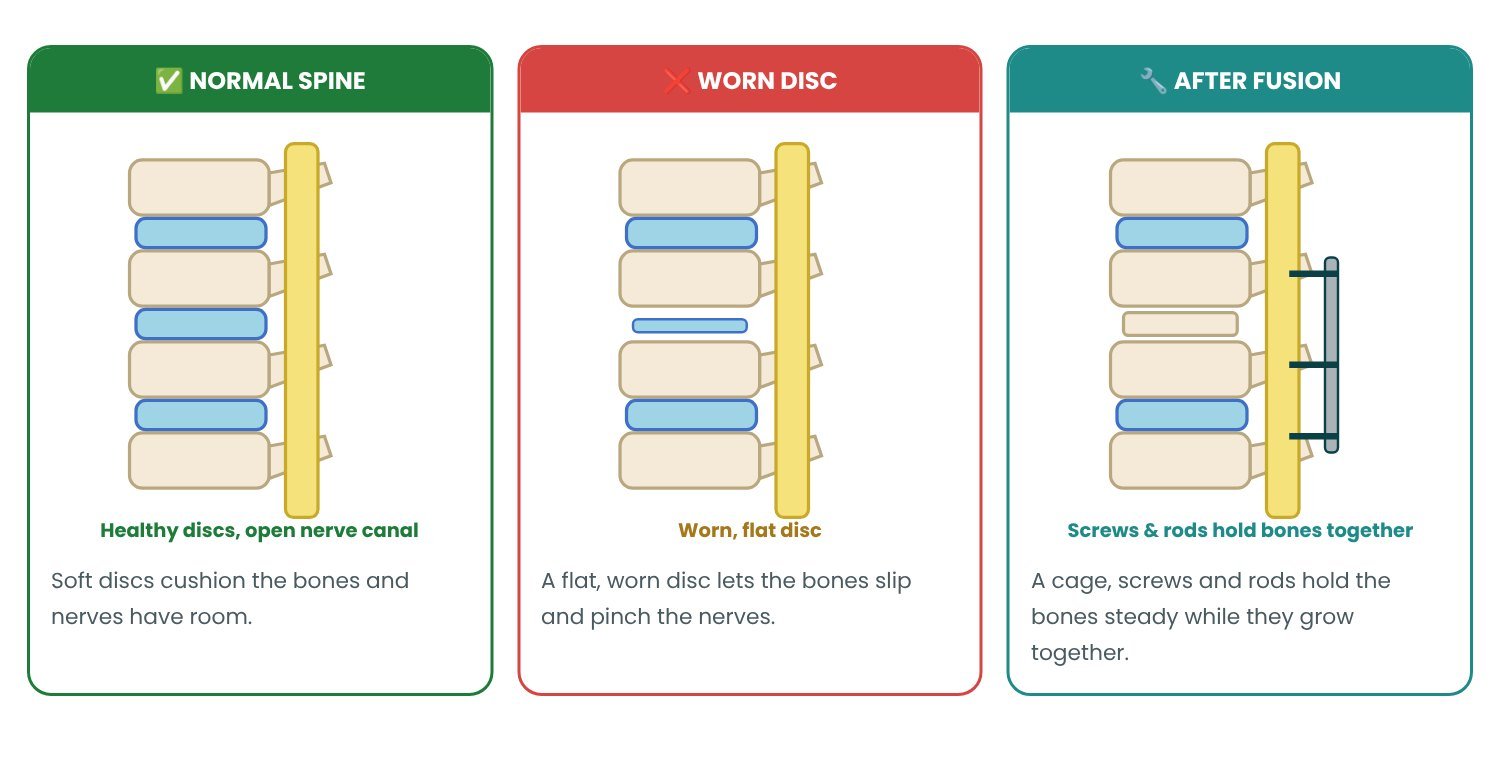
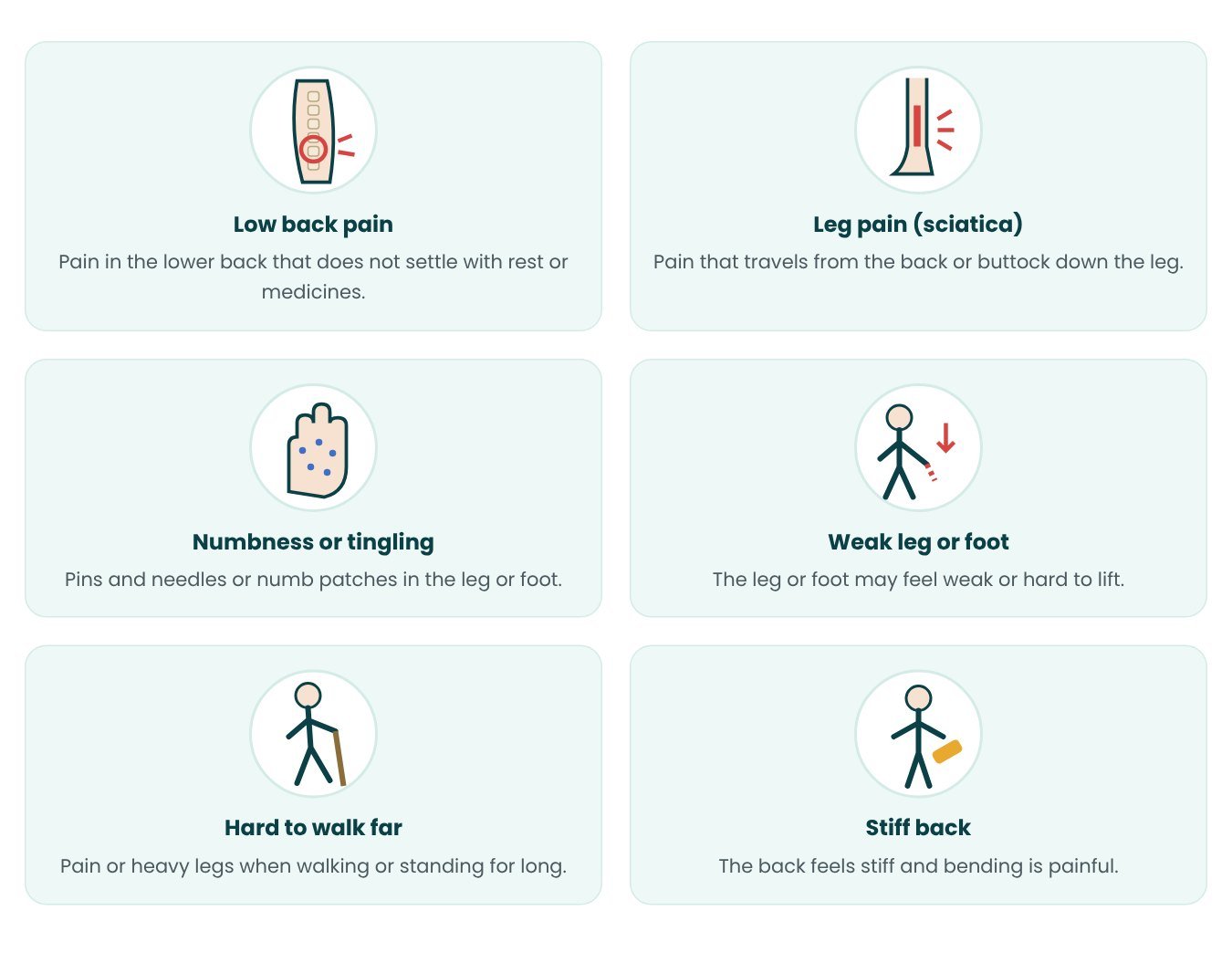
The lower back (lumbar spine) is made of five bones called vertebrae, with soft discs between them acting as cushions. Nerves to the legs pass through the spinal canal. When a vertebra slips forward (spondylolisthesis), a disc wears out badly, or the spine becomes unstable, the nerves can be squeezed. This causes back pain and leg pain, numbness or weakness (sciatica), and difficulty walking or standing for long.
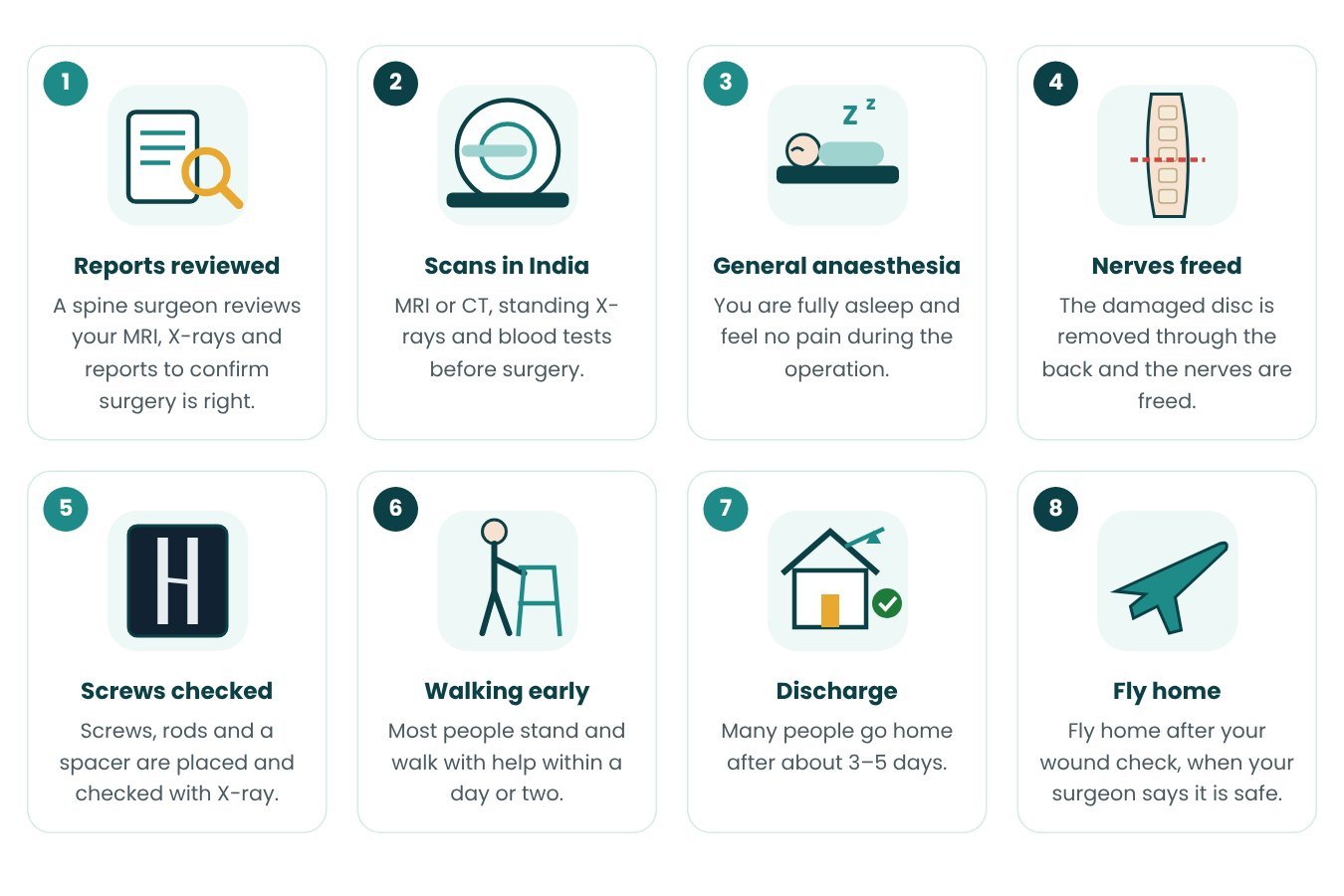
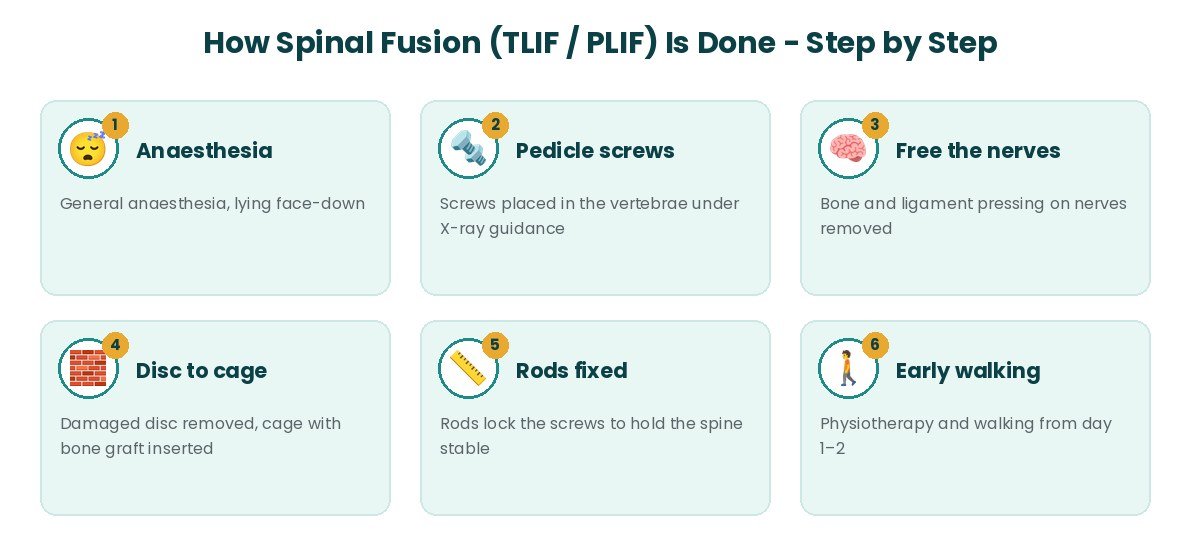
Spinal fusion permanently joins two vertebrae so the painful, unstable segment stops moving. In TLIF (transforaminal lumbar interbody fusion) and PLIF (posterior lumbar interbody fusion), the surgeon works from the back: the squeezed nerves are freed, the damaged disc is removed and replaced with a cage filled with bone graft, and the vertebrae are held firmly with screws and rods. Over the next 6–12 months the bones grow together into one solid unit. TLIF approaches the disc from one side, with less handling of the nerves; PLIF approaches from both sides.
🖼️ Understand It in Pictures
Normal vs worn spine disc
👀 Symptoms in Pictures
🩻 Scans & Tests — What Doctors See


🎬 The Treatment Journey in Pictures

📅 Recovery at a Glance
Drawings: Satyug Healthcare (simplified, not to scale). Photos: Wikimedia Commons; author and licence under each photo.
🩺 Conditions Treated
⚠️ Symptoms That May Need Spinal Fusion
- ➤Long-standing lower back pain
- ➤Pain, numbness or tingling going down one or both legs
- ➤Leg pain or heaviness on walking that improves when sitting or bending forward
- ➤Weakness in the legs or foot drop
- ➤Back pain worse on standing or bending
- ➤Pain not better after 3–6 months of physiotherapy and medicines
- ➤Spine slipping or moving abnormally on X-ray
- ➤Bladder or bowel problems (urgent – needs immediate care)
🔬 Tests Before Treatment
| Test | Why it is done |
|---|---|
| MRI of the lumbar spine | Shows the discs, nerves and spinal canal narrowing |
| Standing and flexion-extension X-rays | Show slippage and abnormal movement (instability) |
| CT scan of the spine | Gives bone detail for screw planning |
| Nerve conduction / EMG (if needed) | Checks nerve damage when the cause of leg symptoms is unclear |
| Bone density (DEXA) in older patients | Checks bone strength for holding screws |
| Blood tests, ECG and chest X-ray | Check fitness for anaesthesia and surgery |
🏥 The Procedure — Step by Step
⚖️ Types of Lumbar Fusion
| Technique | What is done | Best for |
|---|---|---|
| Open TLIF | Disc reached from one side through a midline incision; screws and cage | Most single- and two-level cases |
| PLIF | Disc reached from both sides behind the spinal canal | Central stenosis needing wide decompression |
| MIS TLIF | Same fusion through small tubes and cuts with X-ray / navigation | Selected single-level cases; less muscle injury |
| Two-level TLIF / PLIF | Fusion of two adjacent segments | Disease at two levels |
| ALIF / OLIF / XLIF | Disc reached from the front or side of the abdomen | Selected cases needing large cages or alignment correction |
📅 Your Day-by-Day Plan in India
| Day | What happens |
|---|---|
| Day 1 | Arrival in India, airport pick-up and hotel check-in |
| Day 2–3 | Spine surgeon consultation, MRI / X-ray review and pre-operative tests |
| Day 4 | Admission and TLIF / PLIF surgery |
| Day 5–6 | Pain control, drain removal; walking with physiotherapist |
| Day 7–10 | Physiotherapy in hospital; discharge after 5–7 days |
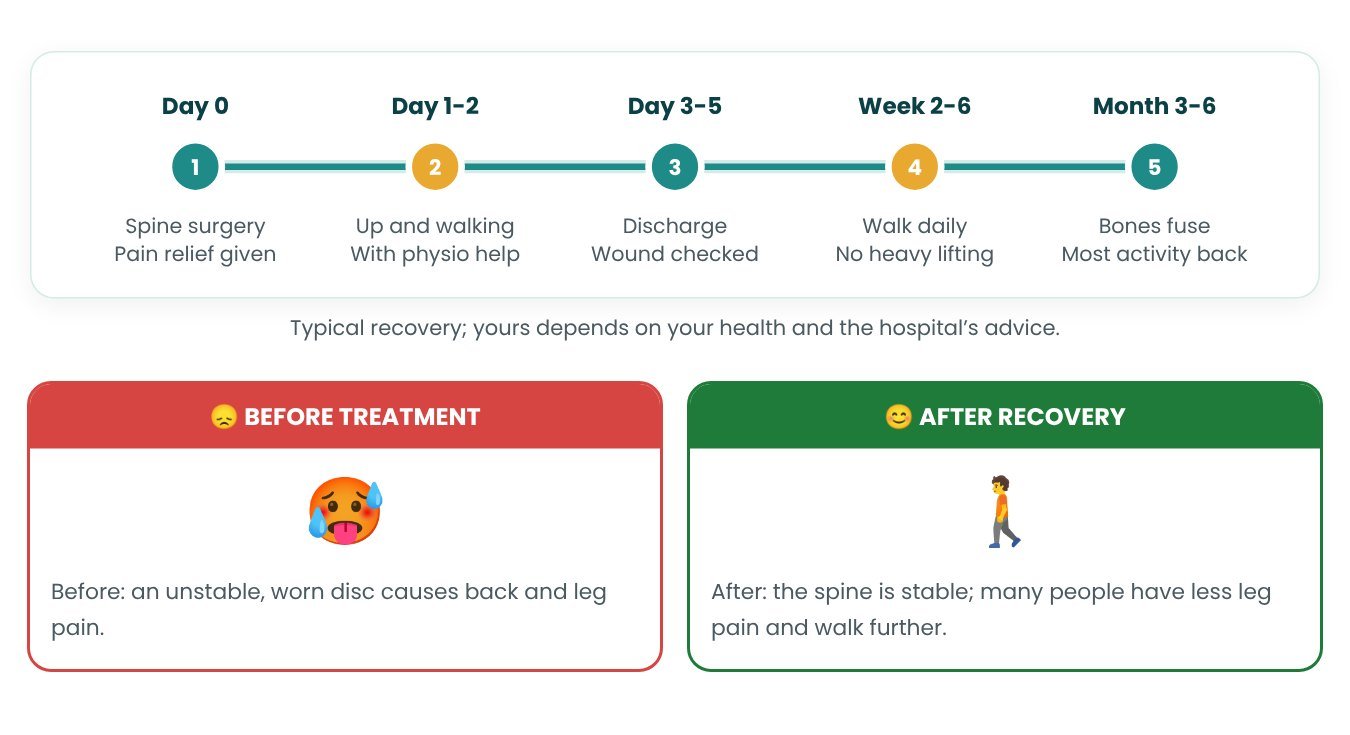
| Week 2–3 | Rest in hotel; outpatient physiotherapy; stitch removal at 12–14 days |
| Week 3–4 | Follow-up X-ray and final review; fly home ✈️ |
🌱 Recovery After Treatment
🏆 Success Rate
| Outcome | Result |
|---|---|
| Fusion (bones joining) rate | About 85–95% |
| Good or excellent leg-pain relief | About 80–90% |
| Patient satisfaction after TLIF | About 80–85% |
| Re-operation within 4 years with fusion (SLIP trial) | About 14% |
| Adjacent-level problems needing surgery | About 1–3% per year over the long term |
Results depend on the cause of the problem, number of levels fused, bone quality, smoking (which slows fusion), body weight, diabetes and following the physiotherapy plan.
🩹 Risks & Possible Complications
Spinal fusion is a major operation. Possible risks include:
- •Ongoing back pain in some patients despite good fusion
- •Tear of the nerve covering (dural tear), about 2–8%, usually repaired at surgery
- •Wound infection (about 1–4%)
- •Failure of fusion or screw loosening (about 5–15%), higher in smokers
- •Nerve injury causing new leg weakness or numbness (about 1–2%)
- •Blood clots in the legs or lungs (rare)
- •Adjacent-segment degeneration in later years
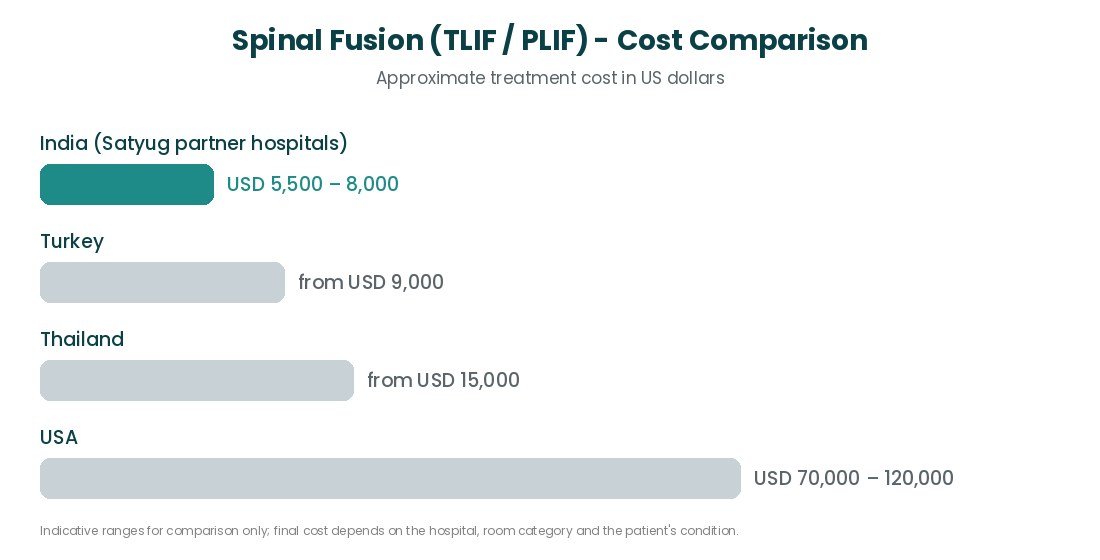
💰 Cost of Spinal Fusion (TLIF / PLIF) in India
The cost of spinal fusion (TLIF / PLIF) in India starts from about USD 5,500 for a single-level open TLIF / PLIF, with 5–7 days in hospital in a private or twin-sharing room. This includes the surgeon and anaesthesia fees, standard screws, rods and cage, physiotherapy in hospital and meals for one attendant. Minimally invasive and two-level fusions cost more.
| Option / Hospital tier | Approx. cost (USD) | Hospital stay | Notes |
|---|---|---|---|
| Single-level open TLIF / PLIF (this package) | 5,500 | 5–6 days, twin sharing | Standard screws, rods and 1 cage |
| Single-level minimally invasive (MIS) TLIF | 6,500 | 4–5 days, twin sharing | Smaller cuts, faster mobilisation |
| Two-level TLIF / PLIF | 8,000 | 6–7 days, private room | Extra screws and cage |
| Navigation / robotic-assisted fusion | 8,500 – 11,000 | 5–7 days | Premium hospitals and implants |
📋 What the Package Includes
- ✔Surgeon, assistant and anaesthetist fees
- ✔Operation theatre charges
- ✔Standard screws, rods and cage
- ✔Hospital stay in chosen room
- ✔Routine medicines and nursing care
- ✔Post-op X-ray and blood tests
- ✔In-hospital physiotherapy and brace
- ✔Meals for patient and one attendant
- ✖Flights, visa fees and travel insurance
- ✖Hotel stay and attendant food outside hospital
- ✖Pre-operative MRI / CT if not done
- ✖Extra implants or navigation
- ✖Bone graft substitutes (if used)
- ✖Extra hospital or ICU days
- ✖Blood products and special drugs
- ✖Outpatient physiotherapy after discharge
✈️ Your Medical Travel Process with Satyug Healthcare

| Step | Details |
|---|---|
| 1. Send reports | Recent MRI of the lumbar spine (images and report), standing and flexion-extension X-rays, any CT scan, details of symptoms and previous spine treatment or surgery |
| 2. Free opinion & quotes | Within 48-72 hours you receive opinions and cost estimates from 3-5 leading hospitals to compare. |
| 3. Choose hospital & doctor | We help you compare doctors, success rates, room options and total budget. |
| 4. Medical visa | The hospital issues a Visa Invitation Letter (VIL) to the Indian Embassy. The patient and up to 2 attendants apply for an e-Medical / Medical Attendant visa. |
| 5. Travel planning | Flight guidance, wheelchair assistance, airport pick-up, hotel or guest house near the hospital. |
| 6. Treatment in India | Your coordinator and interpreter stay with you for admission, treatment, discharge and billing. |
| 7. Return & follow-up | Fit-to-fly letter, medicines, and online follow-up with your doctor after you return home. |
🎒 Travel Checklist
- 📌Valid passport (6+ months) for the patient and attendants, plus 10 passport-size photos each
- 📌Medical visa / e-visa and the hospital’s Visa Invitation Letter
- 📌All spine reports, MRI / X-ray / CT scans on CD / link and prescriptions
- 📌Yellow fever vaccination certificate (mandatory for travellers from African countries)
- 📌Polio vaccination certificate where applicable
- 📌Declare cash above USD 5,000 at the airport; hospitals accept wire transfer and cards
- 📌Foreigners staying longer than permitted must register with the FRRO — our team assists
⭐ Why Choose Satyug Healthcare?
❓ Frequently Asked Questions
➤ How much does spinal fusion (TLIF / PLIF) cost in India?
➤ How long does the surgery take?
➤ How long will I stay in hospital and in India?
➤ Is it painful?
➤ When can I walk?
➤ What is the difference between TLIF and PLIF?
➤ Is minimally invasive (MIS) TLIF better?
➤ What is the success rate?
➤ When can I go back to work?
➤ Can I fly home after surgery?
➤ Will the screws need to be removed?
Medical disclaimer: This page is for general information and does not replace a consultation with a qualified specialist. Treatment plans and costs are confirmed only after the patient is examined. Sources: Ghogawala et al., SLIP trial, NEJM 2016; NASS Clinical Guideline for Degenerative Lumbar Spondylolisthesis (2014); NCBI StatPearls: Transforaminal Lumbar Interbody Fusion and Posterior Lumbar Interbody Fusion; AAOS OrthoInfo: Spinal Fusion; NHS: Lumbar decompression and fusion. Infographics: Satyug Healthcare.
Frequently Asked Questions
The cost of spinal fusion surgery in India starts from USD 5500. Single-Level Open TLIF / PLIF: USD 5500; Single-Level Minimally Invasive (MIS) TLIF: USD 6500; Two-Level TLIF / PLIF: USD 8000. The final cost depends on the hospital, room category and medical condition.
Spinal fusion (TLIF / PLIF) in India from USD 5,500 – lumbar fusion for spondylolisthesis and instability, implants included, 5–7 day stay. Free opinion.


TOP HOSPITALS
Special High-quality Hospitals


HAPPY PATIENTS
What Our Patients Are Saying




























Our Gallery



Get a Free Quote
Tell us what you need and share your medical reports. Our medical team prepares your treatment plan and cost estimate.
- Free medical opinion on your reports
- Your quote within 24–48 hours
- Help with visa invitation letter, travel and airport pickup
- Coordinators available on WhatsApp
Prefer to talk? Call +91-8860606766 or WhatsApp us.
Thank you! Your request is received.
Reference . Our medical team will send your free quote within 24–48 hours by e-mail or WhatsApp.
Chat on WhatsApp now