Search from 500+ procedures across top NABH & JCI accredited hospitals of India
Assistance
Consultation
Services
Opinion
Care Coordination
What will your treatment cost?

| Surgery Name | Cost | Room | Hospitalization |
|---|---|---|---|
| Gamma Knife Radio Surgery cost in India | $6200 | OPD Basis | OPD Basis |
✓ Inclusion
- Room Rent,
- Cost of Surgery,
- Consultation by Primary Team in Package days,
- Basic Investigations.
- Routine Pharmacy and Consumables,
- Patient Food.
- Surgeon’s Fees.
- Anesthetist Fee.
- Operation Theatre Charges.
- Pharmacy Services Charges including Drugs &Medical Consumables
✗ Exclusion
- Additional treatment over over radiation treatment
Know More About Procedure & Surgery
🇮🇳 Medical Package — India
Gamma Knife Radiotherapy cost in India
World-class treatment • NABH & JCI Accredited Hospitals • Save up to 80% vs USA/UK
What is Gamma Knife?
Gamma Knife radio surgery is a type of radiation therapy used to treat tumors, vascular malformations and other abnormalities in the brain. Gamma Knife radio surgery, like other forms of stereotactic radio surgery (SRS), is not surgery in the traditional sense because there is no incision. Instead, Gamma Knife radio surgery uses specialized equipment to focus about 200 tiny beams of radiation on a tumor or other target with sub millimeter accuracy. Although each beam has very little effect on the brain tissue it passes through, a strong dose of radiation is delivered to the place where all the beams meet. The precision of brain stereotactic radio surgery results in minimal radiation delivery to healthy tissues surrounding the target. Gamma Knife radio surgery is usually a one-time therapy completed in a single day.
Why it is done?
This type of radiation treatment is usually performed when:
- ✓A tumor or other abnormality in the brain is too hard to reach with standard neurosurgery
- ✓A person isn't healthy enough to undergo standard surgery
- ✓A person prefers a less invasive treatment
Gamma Knife radio surgery is most commonly used to treat the following conditions:
- ✓Brain tumor. Radiosurgery is useful in the management of small noncancerous (benign) and cancerous (malignant) brain tumors. Radiosurgery damages the genetic material (DNA) in the tumor cells. The cells lose their ability to reproduce and may die, and the tumor may gradually shrink.
- ✓Arteriovenous malformation (AVM). AVMs are abnormal tangles of arteries and veins in your brain. In an AVM, blood flows from your arteries to veins, bypassing smaller blood vessels (capillaries). AVMs, if left untreated, may "steal" the normal flow of blood from the brain, causing a stroke, or lead to bleeding in the brain. Radiosurgery destroys the AVM and causes the blood vessels to close off over time.
- ✓Trigeminal neuralgia. Trigeminal neuralgia is a disorder of one or both of the trigeminal nerves, which relay sensory information between your brain and areas of your forehead, cheek and lower jaw. This nerve disorder causes disabling facial pain that feels like an electric shock. After treatment, many people will experience pain relief within a few days to a few months.
- ✓Acoustic neuroma. An acoustic neuroma (vestibular schwannoma) is a noncancerous (benign) tumor that develops along the nerve of balance and hearing leading from your inner ear to your brain. When the tumor puts pressure on the nerve, you can experience hearing loss, dizziness, loss of balance and ringing in the ear (tinnitus). Radiosurgery may stop the growth of an acoustic neuroma.
- ✓Pituitary tumors. Tumors of the bean-sized gland at the base of the brain (pituitary gland) can cause a variety of problems. The pituitary gland regulates hormones in your body that control various functions, such as your stress response, metabolism and sexual function. Radiosurgery can be used to shrink the tumor and lessen the disruption of pituitary hormone regulation.
Preparation
- ✓Wear comfortable, loose fitting clothing.
Tell your doctor if you:
- ✓Are taking pills or injections to control diabetes
- ✓Are allergic to shellfish or iodine — both are chemically related to special dyes that may be used during the procedure
- ✓Have implanted medical devices in your body, such as a pacemaker, artificial heart valve, aneurysm clips, neurostimulators or stents
- ✓Experience claustrophobia
Before the procedure begins, you'll have a lightweight frame attached to your head with four pins. This frame will stabilize your head during the radiation treatment and serve as a point of reference for focusing the beams of radiation. During this process:
- ✓Your hair will not be shaved, but your hair may be washed with a special shampoo
- ✓You'll receive numbing shots in the four places on your scalp where the pins will be inserted — two points on your forehead and two at the back of your head
After the head frame is attached, you'll undergo imaging scans of your brain that show the location of the tumor or other abnormality in relation to the head frame. The type of scan used depends on the condition being treated:
- ✓Tumors. Imaging for tumors may include computerized tomography (CT) or magnetic resonance imaging (MRI). In a CT scan, a series of X-rays creates a detailed image of your brain. In an MRI scan, a magnetic field and radio waves create detailed images of your brain. A small needle may be placed in the back of your hand or in your arm to inject a dye into a blood vessel to view the blood vessels in your brain and highlight blood circulation. In some cases, you may have both MRI and CT scans.
- ✓Arteriovenous malformations (AVMs). Imaging for brain AVMs may include CT scans, MRI scans, cerebral angiograms or some combination of these tests. In a cerebral angiogram, a doctor inserts a small tube in a blood vessel in your groin and threads it to the brain using X-ray imaging. Dye is injected through the blood vessels to make them visible on X-rays. Your doctor may inject a dye into a blood vessel during CT or MRI scans to view the blood vessels and highlight blood circulation.
- ✓Trigeminal neuralgia. An MRI or a CT scan is used to create images of nerve fibers to select a target area for treating trigeminal neuralgia. The results of the brain scans are fed into a computerized planning system that allows the radio surgery team to determine the appropriate areas to treat, doses of radiation and how to focus the radiation beams to treat the areas. Children are often anesthetized for the imaging tests and during the radio surgery. Adults are usually awake, but may be given a mild sedative to help them relax.
During Surgery
You'll lie on a bed that slides into the Gamma Knife machine, and your head frame will be attached securely to a helmet inside the machine. You'll have an intravenous (IV) tube that delivers fluids to your bloodstream to keep you hydrated during the day. A needle at the end of the IV is placed in a vein, most likely in your arm. The time needed to complete the procedure may range from less than an hour to about four hours, depending on the size and shape of the target. During the procedure:
- ✓You won't feel the radiation
- ✓You won't hear any noise from the machine
- ✓You'll be able to talk with the doctors via a microphone
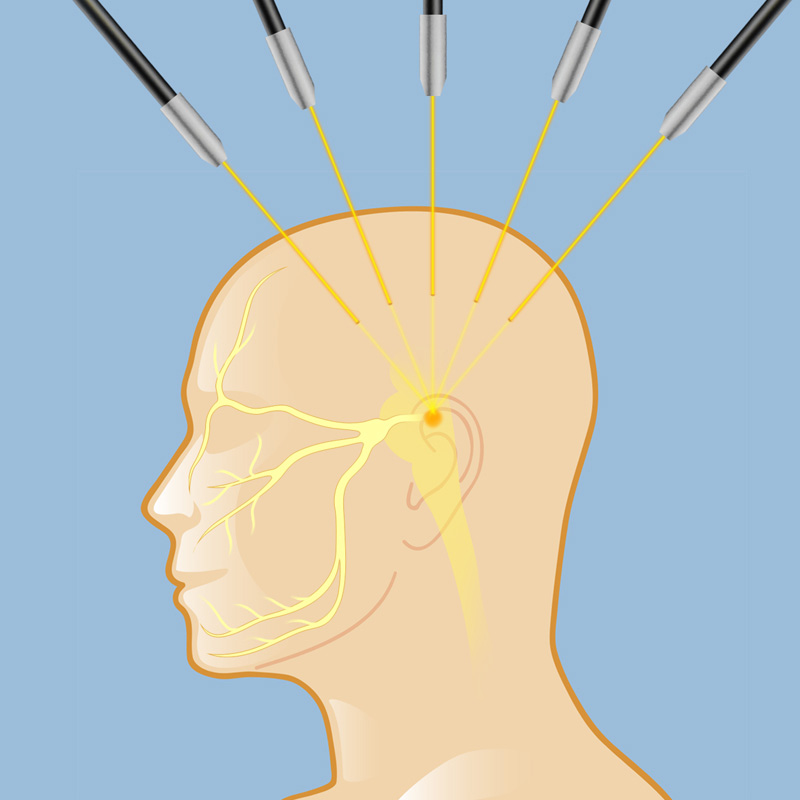
Gamma Knife radio surgery is usually an outpatient procedure, but the entire process will take most of a day. You may be advised to have a family member or friend who can be with you during the day and who can take you home. In some cases, an overnight stay in the hospital may be necessary.
Risks
Gamma Knife radio surgery doesn't involve surgical incisions, so it's generally less risky than traditional neurosurgery.
Early complications or side effects are usually temporary. Some people experience mild headaches, a tingling sensation on the scalp, nausea or vomiting. Other side effects may include:
- ✓Fatigue. Tiredness and fatigue may occur for the first few weeks after Gamma Knife radio surgery.
- ✓Swelling. Swelling in the brain at or near the treatment site can cause a variety of symptoms depending on what areas of the brain are involved. If post-treatment swelling and symptoms do occur from the Gamma Knife treatment, these symptoms usually show up approximately six months after treatment rather than immediately after the procedure like with conventional surgery. Your doctor may prescribe anti-inflammatory medications (corticosteroid medications) to prevent such problems or to treat symptoms if they appear.
- ✓Scalp and hair problems. Your scalp may be red, irritated or sensitive at the four sites where the head frame was attached to your head during the treatment. But the head frame does not leave any permanent marks on the scalp. Rarely, some people temporarily lose a small amount of hair if the area being treated is right under the scalp.
After the procedure
After the procedure, you can expect the following:
- ✓The head frame will be removed.
- ✓You may have minor bleeding or tenderness at the pin sites.
- ✓If you experience headache, nausea or vomiting after the procedure, you'll receive appropriate medications.
- ✓You'll be able to eat and drink after the procedure.
If you have any related query, you can send us your report on below mention email address or you can call us or whatsApp for any second opinion.
Video/tele consultation also available
E-mail address- query@satyughealthcare.com
Phone number- +91888-242-4372, +91991-065-5125
Free Medical Opinion
Expert review in 48 hours
Best Surgeon
Top specialists in India
Hospital Booking
NABH / JCI accredited
Visa Assistance
Invitation letter provided
Airport Transfer
Safe pickup & drop
Tele-Consultation
Video consult before travel
Hotel Booking
Near hospital, affordable
Multilingual Support
Arabic, French, English
📞 Get Started Today — It Is Free
Ready to Plan Your Treatment in India?
Send your medical reports and get a free expert opinion within 48 hours. Our coordinators speak Arabic, French and English.
Frequently Asked Questions
Gamma Knife radio surgery is nearly 90 percent successful in killing or shrinking brain tumors or stopping their growth.
Top doctors for Gamma Knife treatment| Cost for Gamma Knife procedure|Book online appointment| Best Gamma Knife procedure in India. Search Results Web results for cost of Hernia treatment|





TOP HOSPITALS
Special High-quality Hospitals




HAPPY PATIENTS
What Our Patients Are Saying






























Our Gallery