
Spinal Cord Stimulator Implant Package
Assistance
Consultation
Services
Opinion
Care Coordination
What will your treatment cost?

See the cost breakdown by option, hospital and city →
| Surgery Name | Cost | Room | Hospitalization |
|---|---|---|---|
| Spinal Cord Stimulator Implant Package | 13500 USD | Private / Twin Sharing Room | Trial 1 day + permanent implant 2-3 days in hospital; total stay in India 2-3 weeks |
| Trial + Non-Rechargeable SCS System | 13500 USD | Twin Sharing | 3-4 days hospital (trial and implant) |
| Trial + Rechargeable SCS System | 16000 USD | Private Room | 3-4 days hospital (trial and implant) |
| Trial + High-Frequency / MRI-Compatible SCS System | 19000 USD | Private Room | 3-4 days hospital (trial and implant) |
✓ Inclusion
- ✔Consultation with an interventional pain specialist and spine surgeon
- ✔Routine pre-procedure blood tests, ECG and anaesthesia assessment
- ✔SCS trial with temporary percutaneous leads under X-ray guidance (1 day in hospital)
- ✔Trial programming and review
- ✔Permanent percutaneous lead implant with anchoring
- ✔Non-rechargeable implantable pulse generator (battery) and patient remote
- ✔Surgeon and anaesthetist fees, operation theatre and routine consumables
- ✔Implant hospital stay of 2–3 days in a twin sharing room with nursing care
- ✔Standard medicines and antibiotics during the stay
- ✔Device programming and patient training before discharge
- ✔Free: airport pick-up & drop, visa invitation letter, interpreter & coordinator (Satyug Healthcare)
✗ Exclusion
- ✖MRI, CT or other scans if required
- ✖Rechargeable, high-frequency or MRI-compatible devices (separate packages)
- ✖Additional leads, paddle leads or laminotomy for lead placement
- ✖Room upgrade and extra hospital days
- ✖Psychological assessment if charged separately
- ✖Treatment of complications such as infection or lead migration
- ✖Future battery replacement or revision surgery
- ✖Medicines after discharge
- ✖Flights, visa fees, hotel, food and local travel
Know More About Procedure & Surgery
Spinal Cord Stimulator (SCS) Implant in India
A small implanted device that calms chronic nerve pain – most often leg and back pain after spine surgery – when medicines, physiotherapy and injections have failed, implanted after a successful trial by experienced pain and spine specialists in India.
📖 What is a Spinal Cord Stimulator?
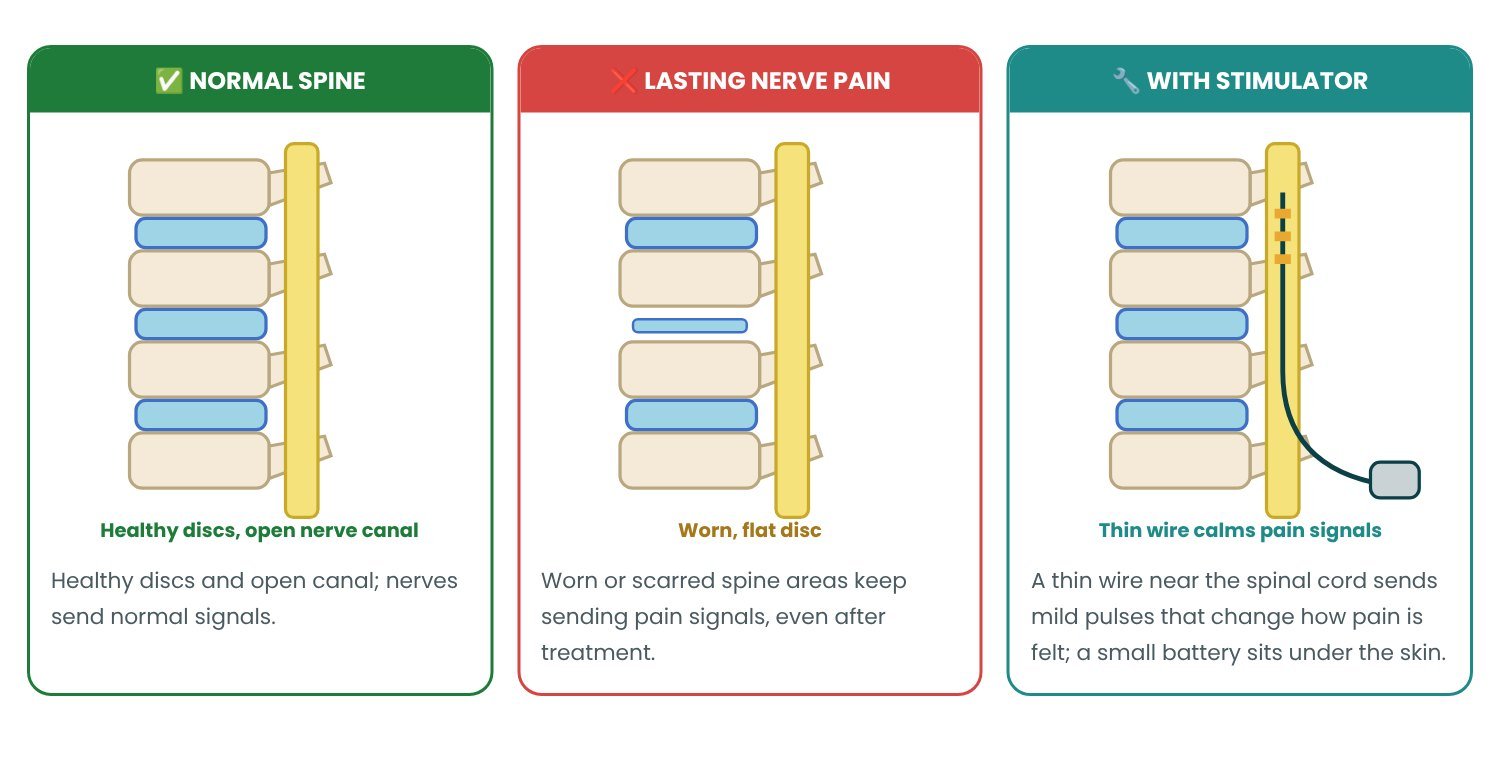
Some pain continues long after an injury or surgery has healed because the nerves themselves keep sending pain signals. This is called chronic neuropathic (nerve) pain. Common examples are persistent leg and back pain after spine surgery (failed back surgery syndrome), complex regional pain syndrome (CRPS) and painful diabetic neuropathy. Strong medicines often help only a little and cause side effects.
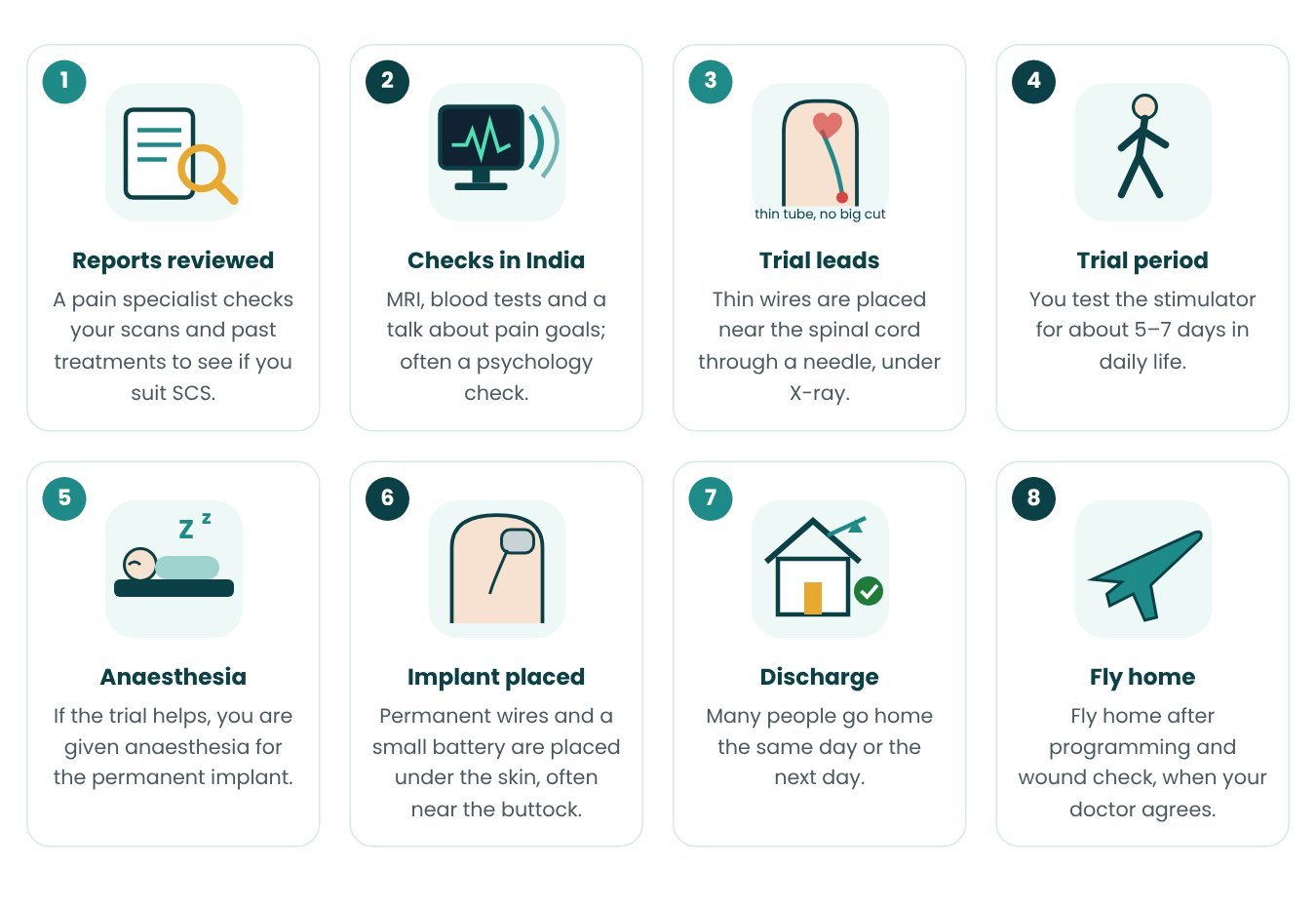
A spinal cord stimulator (SCS) is a small device, like a heart pacemaker, with thin wires (leads) placed in the space over the spinal cord (epidural space) and a battery (pulse generator) placed under the skin of the buttock or tummy. It sends mild electrical pulses that block or change pain signals before they reach the brain. Every patient first has a trial of about 5–7 days with temporary leads; only if pain falls by at least 50% is the permanent system implanted. This package uses a non-rechargeable battery.
🖼️ Understand It in Pictures
Why long-term back and leg pain happens
👀 Symptoms in Pictures
🩻 Scans & Tests — What Doctors See

🎬 The Treatment Journey in Pictures
📅 Recovery at a Glance
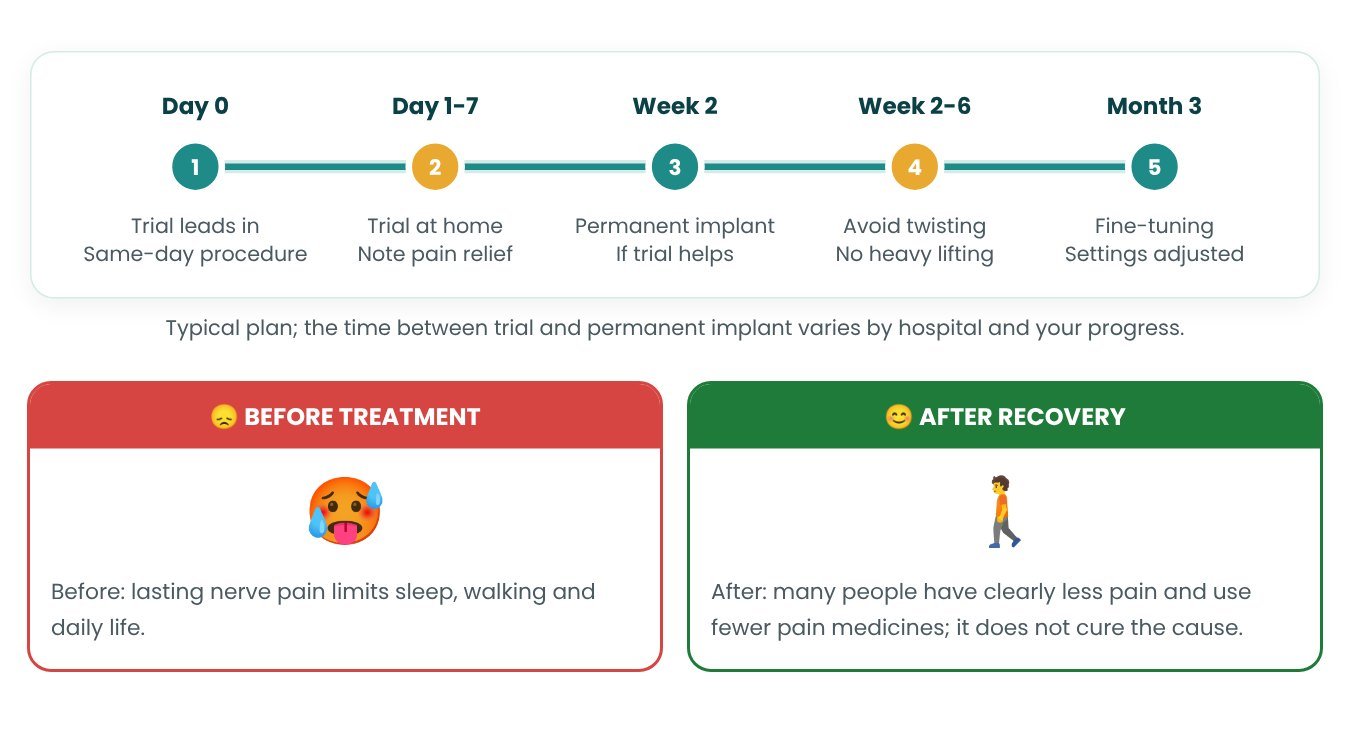
Drawings: Satyug Healthcare (simplified, not to scale). Photos: Wikimedia Commons; author and licence under each photo.
🩺 Conditions Treated
⚠️ Who May Benefit From SCS?
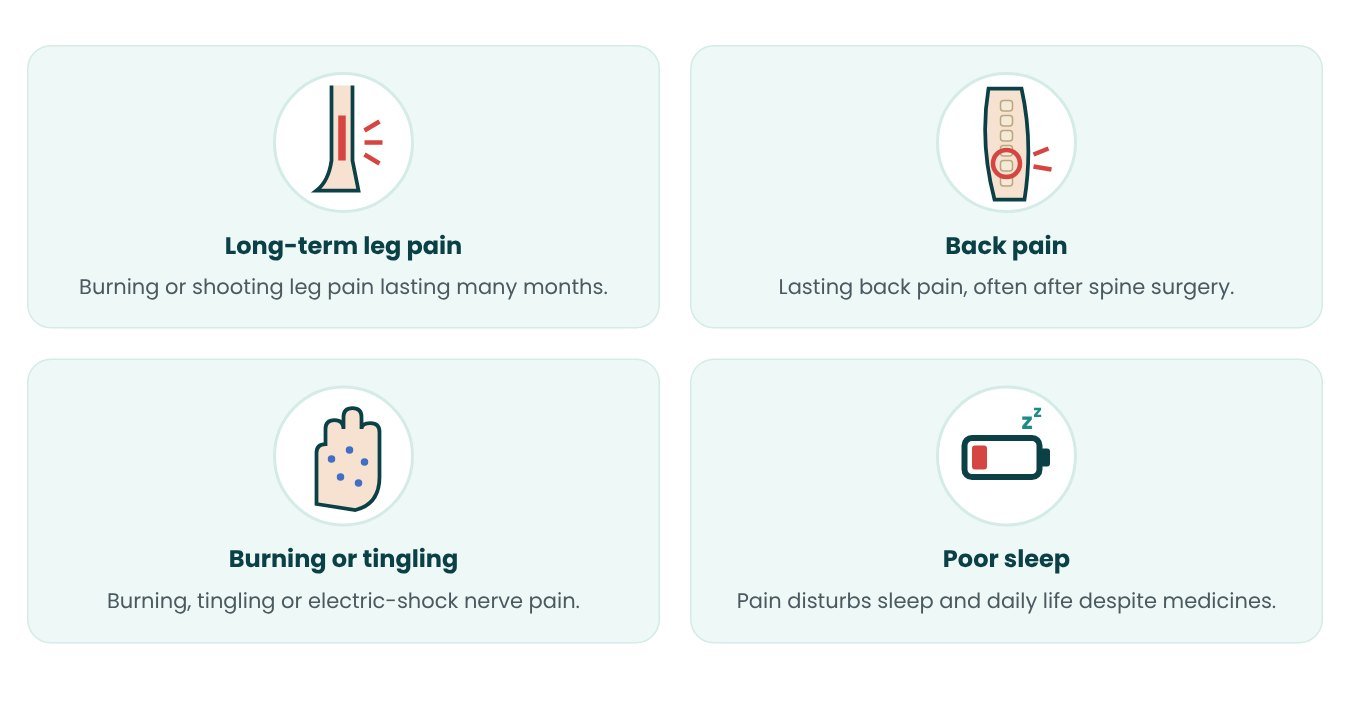
- ➤Leg or back pain for more than 6 months
- ➤Pain continuing after spine surgery
- ➤Burning, shooting or electric-shock pain
- ➤Numbness or pins and needles with pain
- ➤Pain not controlled by medicines and injections
- ➤Side effects from strong painkillers
- ➤Not a candidate for more spine surgery
- ➤Poor sleep and daily function due to pain
🔬 Tests Before Treatment
| Test | Why it is done |
|---|---|
| MRI of the spine | Checks the spinal canal and rules out a problem that needs surgery instead. |
| X-rays of the spine | Shows previous implants and the space for leads. |
| Pain specialist assessment | Confirms the type of pain and that other treatments have been tried. |
| Psychological assessment | Recommended by guidelines to check mood and expectations, which affect results. |
| Blood tests, clotting and sugar | Ensures safe needle placement and good healing. |
| ECG and anaesthesia check | Confirms fitness for sedation and surgery. |
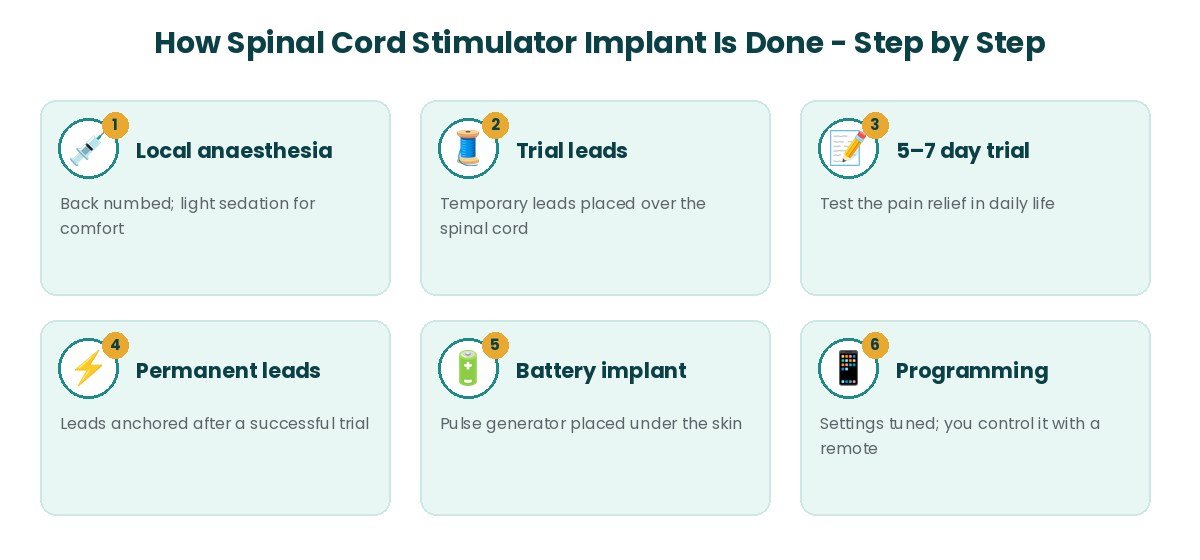
🏥 The Procedure — Step by Step
⚖️ Types of SCS Systems
| System | What is done | Best for |
|---|---|---|
| Non-rechargeable SCS (this package) | Battery lasts several years, then replaced; no daily charging | Low-energy settings, patients who prefer no charging |
| Rechargeable SCS | Battery charged through the skin, lasts about 9–10+ years | Higher energy needs, younger patients |
| High-frequency (10 kHz) SCS | Paraesthesia-free stimulation, strong for back pain | Back-predominant pain, diabetic neuropathy |
| Burst / closed-loop systems | Newer waveforms or automatic adjustment | Patients not helped by conventional settings |
| DRG stimulation | Leads placed on specific nerve-root ganglia | Focal pain such as CRPS of the foot or groin |
📅 Your Day-by-Day Plan in India
| Day | What happens |
|---|---|
| Day 1 | Arrival in India ✈️, airport pick-up and hotel check-in |
| Day 2 | Pain specialist and spine surgeon consultation, tests and psychological assessment |
| Day 3 | Trial lead placement ⚡ (1 day in hospital) and programming |
| Day 4–9 | Trial period at hotel: normal activities, pain diary, programming adjustments |
| Day 10 | Trial review; trial leads removed if a permanent implant is planned |
| Day 11 | Permanent SCS implant surgery |
| Day 12–13 | Hospital stay (2–3 days), wound care, programming and remote training; discharge |
| Day 14–19 | Rest at hotel, wound check, fine-tuning of settings |
| Day 20 | Final review, device card and fitness-to-fly letter |
| Day 21 | Fly home ✈️ |
🌱 Recovery After Treatment
🏆 Success Rate
| Outcome | Result |
|---|---|
| Patients with ≥50% pain relief (good candidates) | About 50–80% |
| Patients who pass the trial | About 60–80% |
| Reduction in pain medicines | Common – many reduce or stop opioids |
| Need for revision surgery over years | About 10–30% |
| Hospital stay in this package | Trial 1 day + implant 2–3 days |
Results are best in carefully selected patients with nerve-type leg pain, a clearly successful trial, good emotional health and realistic goals. Results from conventional settings may fade over years and can often be improved by reprogramming.
🩹 Risks & Possible Complications
SCS is a reversible, low-risk treatment; most problems relate to the hardware.
- •Lead movement (migration) reducing pain coverage – about 5–15%, may need repositioning
- •Pain at the battery site – about 5–10%
- •Infection – about 2–5%, may require device removal
- •Hardware problems such as lead fracture – about 5–10% over years
- •Spinal fluid leak with headache – about 1%
- •Loss of benefit over time – some patients
- •Bleeding or spinal cord injury – rare, under 1%
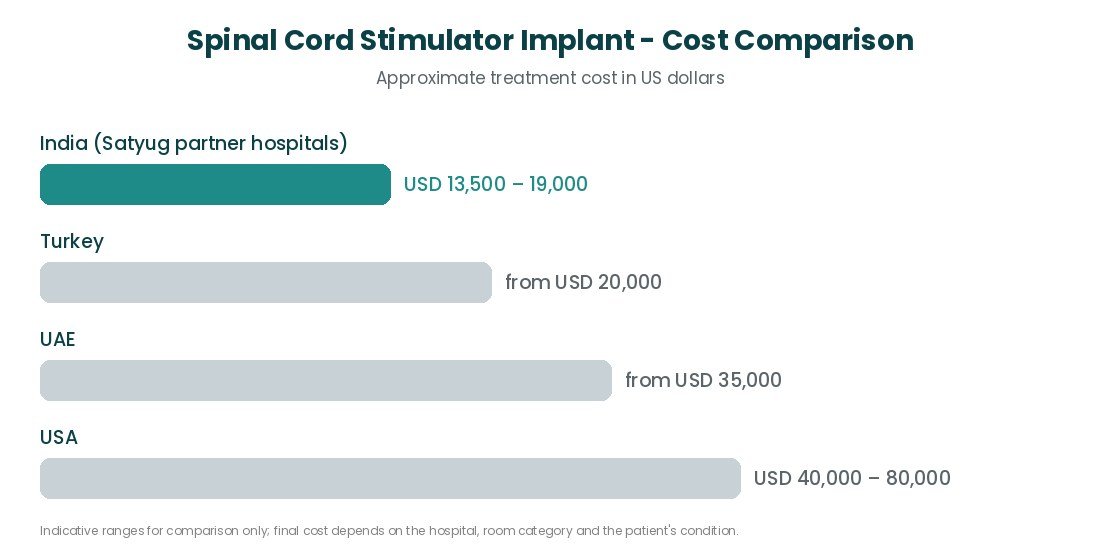
💰 Cost of Spinal Cord Stimulator Implant in India
The cost of a spinal cord stimulator implant in India starts from about USD 13,500 for the trial plus a non-rechargeable SCS system. Most of the cost is the imported device. The package covers the trial, permanent leads and battery, surgeon and anaesthetist fees, operation theatre, programming and 3–4 days in hospital in a twin sharing room. Rechargeable and high-frequency/MRI-compatible systems cost more.
| Option / Hospital tier | Approx. cost (USD) | Hospital stay | Notes |
|---|---|---|---|
| Trial + Non-Rechargeable SCS System (this package) | 13,500 | 3–4 days (trial and implant), twin sharing | Battery lasts several years, no charging |
| Trial + Rechargeable SCS System | 16,000 | 3–4 days, private room | Longer battery life (about 9–10+ years) |
| Trial + High-Frequency / MRI-Compatible SCS System | 19,000 | 3–4 days, private room | 10 kHz therapy, full-body MRI conditional |
| Trial only (if not proceeding) | 2,500 – 4,000 | 1 day | Temporary leads and programming |
📋 What the Package Includes
- ✔SCS trial with temporary leads
- ✔Permanent leads and non-rechargeable battery
- ✔Pain specialist / surgeon fees
- ✔Anaesthesia and operation theatre
- ✔3–4 days in hospital (twin sharing)
- ✔Device programming and remote training
- ✔Routine medicines and antibiotics
- ✔Free airport pick-up, visa letter & interpreter
- ✖MRI or CT scans
- ✖Rechargeable or high-frequency device
- ✖Extra leads or paddle-lead surgery
- ✖Room upgrade
- ✖Extra hospital days
- ✖Battery replacement in future
- ✖Treatment of complications
- ✖Flights, hotel and food
✈️ Your Medical Travel Process with Satyug Healthcare

| Step | Details |
|---|---|
| 1. Send reports | Recent MRI of the spine (images on CD or link), reports of previous spine surgeries, a list of pain treatments tried (medicines with doses, injections, physiotherapy), a description of where the pain is and how it feels, any nerve studies, and your medical history including blood thinners, diabetes and mood. |
| 2. Free opinion & quotes | Within 48-72 hours you receive opinions and cost estimates from 3-5 leading hospitals to compare. |
| 3. Choose hospital & doctor | We help you compare doctors, success rates, room options and total budget. |
| 4. Medical visa | The hospital issues a Visa Invitation Letter (VIL) to the Indian Embassy. The patient and up to 2 attendants apply for an e-Medical / Medical Attendant visa. |
| 5. Travel planning | Flight guidance, wheelchair assistance, airport pick-up, hotel or guest house near the hospital. |
| 6. Treatment in India | Your coordinator and interpreter stay with you for admission, treatment, discharge and billing. |
| 7. Return & follow-up | Fit-to-fly letter, medicines, and online follow-up with your doctor after you return home. |
🎒 Travel Checklist
- 📌Valid passport (6+ months) for the patient and attendants, plus 10 passport-size photos each
- 📌Medical visa / e-visa and the hospital’s Visa Invitation Letter
- 📌All spine MRI and X-ray scans (images on CD / link), surgery and injection reports, nerve studies and current prescriptions
- 📌Yellow fever vaccination certificate (mandatory for travellers from African countries)
- 📌Polio vaccination certificate where applicable
- 📌Declare cash above USD 5,000 at the airport; hospitals accept wire transfer and cards
- 📌Foreigners staying longer than permitted must register with the FRRO — our team assists
⭐ Why Choose Satyug Healthcare?
❓ Frequently Asked Questions
➤ How much does a spinal cord stimulator cost in India?
➤ Why is a trial needed?
➤ What happens if the trial does not work?
➤ How long do I need to stay in India?
➤ How successful is SCS?
➤ Does it hurt?
➤ What does stimulation feel like?
➤ How long does the battery last?
➤ Can I have an MRI with an SCS?
Medical disclaimer: This page is for general information and does not replace a consultation with a qualified specialist. Treatment plans and costs are confirmed only after the patient is examined. Sources: NCBI StatPearls: Spinal Cord Stimulator; Kumar et al., PROCESS trial, Pain 2007; Kapural et al., SENZA-RCT, Anesthesiology 2015; NICE Technology Appraisal TA159 (Spinal cord stimulation for chronic pain of neuropathic or ischaemic origin); British Pain Society SCS guidance; Mayo Clinic; Cleveland Clinic: Spinal Cord Stimulation. Infographics: Satyug Healthcare.
Frequently Asked Questions
The cost of spinal cord stimulator implantation in India starts from USD 13500. Trial + Non-Rechargeable SCS System: USD 13500; Trial + Rechargeable SCS System: USD 16000; Trial + High-Frequency / MRI-Compatible SCS System: USD 19000. The final cost depends on the hospital, room category and medical condition.
Spinal cord stimulator implant in India from USD 13,500 incl. trial. Relief for chronic nerve and back pain, expert pain specialists, free opinion & visa help.









TOP HOSPITALS
Special High-quality Hospitals


HAPPY PATIENTS
What Our Patients Are Saying



























Our Gallery



Get a Free Quote
Tell us what you need and share your medical reports. Our medical team prepares your treatment plan and cost estimate.
- Free medical opinion on your reports
- Your quote within 24–48 hours
- Help with visa invitation letter, travel and airport pickup
- Coordinators available on WhatsApp
Prefer to talk? Call +91-8860606766 or WhatsApp us.
Thank you! Your request is received.
Reference . Our medical team will send your free quote within 24–48 hours by e-mail or WhatsApp.
Chat on WhatsApp now